


In venture capital, speed and insight are everything. Yet, many firms still rely on fragmented spreadsheets, manual contact lists, and messy email threads. This old way of working creates information silos, slows down deals, and hides valuable connections that could lead to the next big investment. Relying on outdated methods means missed opportunities, inefficient due diligence, and painful, manual reporting to limited partners (LPs).
This guide focuses on the modern venture capital software stack—tools built specifically for the unique workflows of VCs. From finding new companies to managing your portfolio, the right software transforms how a firm operates. The goal is to move beyond manual processes by automating the analyst and reducing manual overhead in deal flow. This is about building a more efficient, data-driven, and competitive firm.
This list is your map to the best tools available. We’ve selected the top platforms, from market intelligence giants like PitchBook to specialized CRMs like Affinity and portfolio management solutions like Carta. For each tool, you'll find:
- A clear summary explaining what it does.
- Key features and what makes it stand out.
- "Best for" recommendations to match the software to your firm's specific needs.
- Practical examples of how to use it.
- Screenshots and links to see the platforms in action.
Our goal is to help you find the best venture capital software to build a streamlined, integrated tech stack. Let's dive into the essential tools top VCs are using to win the best deals.
1. Proven SaaS
Proven SaaS isn't a traditional CRM or portfolio manager. It's a deal sourcing and market intelligence tool that gives VCs a unique advantage. It helps analysts and investors spot promising early-stage SaaS companies by analyzing their advertising data. By tracking which companies are successfully spending on ads, it uncovers businesses with proven product-market fit—often before they appear on anyone else's radar.
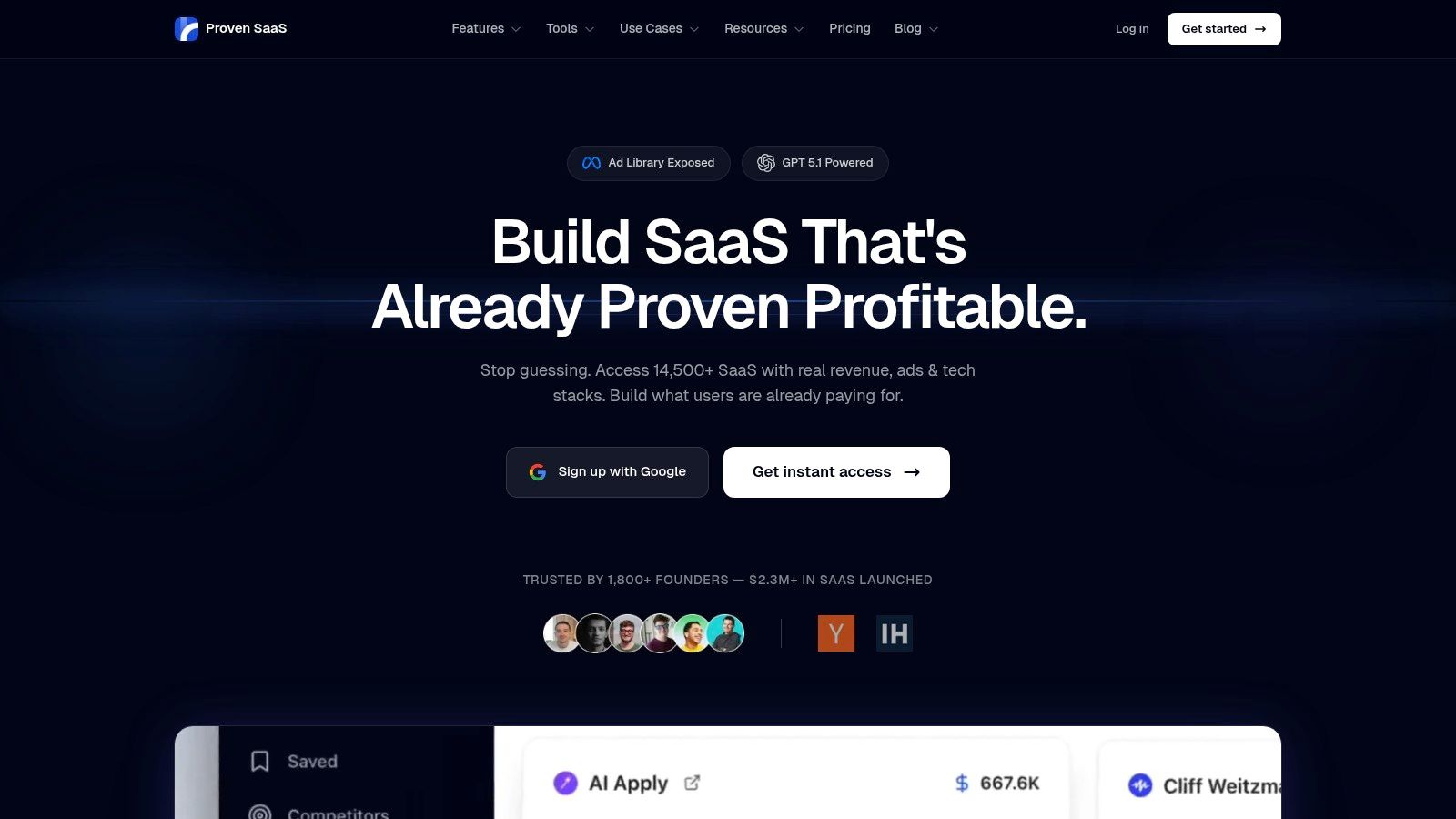
The platform's strength is its ability to connect sustained Meta ad spend to real business growth, mapping out revenue trends and competitive landscapes. For a VC, this provides an objective signal to validate an investment idea. For instance, instead of relying only on a founder's projections, an analyst can use Proven SaaS to see if a niche is truly viable and if a company has real traction.
Clear Examples for Venture Capital
- Find Hidden Gems: Imagine you're looking for B2B SaaS companies that are growing but still under the radar. You can use Proven SaaS to filter for companies spending over $10K per month on ads. This is a strong signal of a healthy, revenue-generating business ready to scale.
- Validate a Niche Fast: Let's say your fund is exploring the "AI for sales teams" space. Before spending weeks on research, you can use the Niche Validator to see how many companies are competing, what their average ad spend is, and the estimated revenue potential. You get a data-backed answer in minutes.
- Smarter Due Diligence: You're considering an investment and want to understand their go-to-market strategy. Proven SaaS lets you see their ad creatives, audience targeting, and marketing funnels. This helps you judge how sophisticated their growth engine is compared to competitors.
Limitations and Considerations
While powerful, Proven SaaS has two main limitations. First, its revenue figures are estimates based on public ad data, not private financials. They provide a reliable direction but aren't a substitute for financial diligence. Second, it focuses on companies advertising on Meta platforms, so it might miss businesses that grow through SEO, sales teams, or other channels.
| Feature Highlights | Practical Application for VCs |
|---|---|
| Revenue Intelligence | Quickly screen for companies in a specific MRR range ($10K–$500K) to fit your fund's investment criteria. |
| Ad Spend Estimator | Gauge a company's capital efficiency and get a sense of its customer acquisition cost (CAC). |
| Niche Validator | Evaluate the market size and competition in a vertical before you start sourcing deals. |
| API Access | Integrate Proven SaaS data directly into your firm’s custom deal flow management or venture capital software. |
Website: https://proven-saas.com
2. PitchBook
PitchBook is a foundational data platform for the private markets, often considered the gold standard for sourcing, diligence, and market intelligence. While many tools manage internal workflows, PitchBook excels at providing a vast, external dataset on private companies, deal histories, investor profiles, and fund performance.
For any VC, this platform is essential for validating opportunities. Before making contact, an analyst can use PitchBook to find companies hitting specific growth milestones, analyze a target's complete funding history, and identify key investors. Its data on valuations and past deals is critical for structuring term sheets. For example, an analyst can build a specific search like, "Show me all Series A fintech companies in Europe that raised over $5M in the last 18 months."
Key Features & Use Cases
- Company & Deal Screeners: Filter thousands of companies by stage, sector, location, and funding.
- Valuation & Comps Data: Access capitalization tables and comparable company analyses to inform your valuations.
- Portfolio & Fund Benchmarking: See how your portfolio performs against customized market benchmarks.
- Dedicated Support: Get help from experts to master the platform's advanced features.
Example in Action: A partner at a VC firm is focused on B2B SaaS. She sets up a saved search in PitchBook to get an alert every time a company in that category announces a seed round. This automates her deal sourcing, delivering fresh opportunities directly to her inbox each morning.
Pricing & Access
PitchBook uses a custom, enterprise-level pricing model. It's a significant investment, typically suited for established funds rather than new managers. To get access, you'll need a consultation with their sales team to create a package based on your firm's needs.
- Pros: Unmatched depth of private market data, powerful diligence tools, and excellent for sourcing.
- Cons: High cost makes it inaccessible for smaller teams, and there's a learning curve for advanced features.
Website: https://pitchbook.com/solutions/venture-capital
3. Crunchbase Pro
Crunchbase Pro is a popular, easy-to-use platform for discovering startups, tracking fundraising rounds, and monitoring market news. Unlike enterprise tools, Crunchbase is known for its accessibility, making it a favorite for outbound sourcing and initial company screening, especially for analysts and smaller VC teams. It provides a quick, comprehensive snapshot of a company’s funding history, investors, and key people.
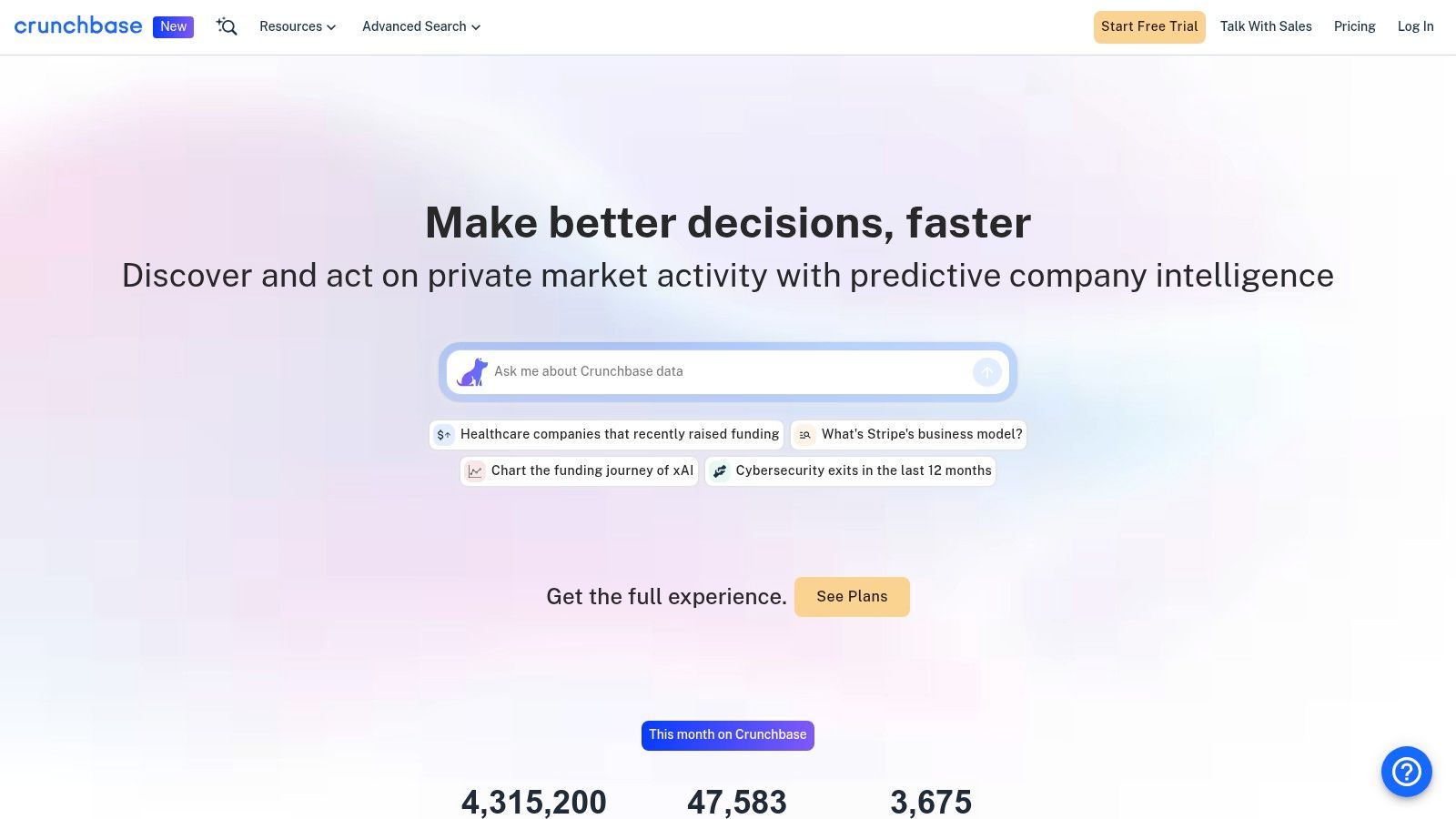
For VCs, Crunchbase Pro is a great tool for the top of the funnel. Its search and alert features let you build lists of target companies based on recent funding, industry, or location. For instance, an associate could quickly generate a list of all seed-stage AI companies in a specific city, export it as a CSV, and upload it directly into their CRM for outreach. This simple workflow makes it an efficient tool for mapping ecosystems and finding new companies without a huge budget.
Key Features & Use Cases
- AI-Assisted Search & Alerts: Build dynamic lists and get alerts when companies meet your investment criteria.
- Company Profiles & Signals: Access funding rounds, investor details, team info, and other growth indicators.
- CSV Export: Easily export company lists to use in your main CRM or other venture capital software.
- Kanban-Style 'Stages': Use a simple visual pipeline to track interesting companies.
Example in Action: An analyst uses the "Recommended Companies" feature on her dashboard. Crunchbase’s algorithm learns from her searches and saved lists, suggesting relevant companies she might have missed. By regularly reviewing these suggestions, she trains the AI on her specific investment interests.
Pricing & Access
Crunchbase Pro has a transparent, subscription-based model with plans for individuals and teams, making it very accessible. You can sign up for a free trial on their website to test it out. This approach is perfect for emerging managers and firms needing a flexible, budget-friendly data solution.
- Pros: Easy to use, great for top-of-funnel sourcing, and has a large database of user-contributed information.
- Cons: Data can be less complete than premium tools, and it's not as robust for deep due diligence.
Website: https://www.crunchbase.com
4. CB Insights
CB Insights is a market intelligence platform that helps VCs see future trends and emerging opportunities. While other platforms document what has already happened, CB Insights focuses on predicting what will happen next. It uses proprietary algorithms to generate forward-looking signals, making it a powerful tool for VCs focused on strategy and finding new, untapped markets.
This platform helps firms build a data-driven investment thesis from the ground up. Instead of just screening for past funding rounds, an analyst can use CB Insights to identify entire sectors poised for growth. For example, they can use its "Market Maps" to visualize competitive landscapes and discover new companies before they become well-known. Its proprietary Mosaic score, which measures a private company's health and growth potential, is a unique feature for quickly evaluating potential investments.
Key Features & Use Cases
- Proprietary Predictive Metrics: Use Mosaic scores to gauge a company's health and future exit potential.
- AI-Powered Search & Research: Ask natural language questions about markets, trends, and competitors with ChatCBI.
- Market Maps & Trend Analysis: Visualize competitive landscapes and identify emerging tech trends early.
- Enterprise Data Integrations: Feed CB Insights data directly into your CRM or data warehouse for deeper analysis.
Example in Action: A VC team is developing a thesis on "AI in Drug Discovery." They use the "Collections" feature to build and share a list of the top 10 startups in this space. This helps them collaborate, track the market segment over time, and leverage venture capital AI for a competitive edge.
Pricing & Access
CB Insights is an enterprise-grade platform with custom pricing. It's typically sold as an annual subscription and requires a consultation with their sales team. It is best suited for institutional VCs and corporate venture teams rather than smaller funds.
- Pros: Strong predictive analytics, excellent for market analysis and thesis building, and offers enterprise-grade integrations.
- Cons: High cost, and data depth can vary depending on the industry.
Website: https://www.cbinsights.com/what-we-offer/pricing
5. Affinity
Affinity is a relationship-intelligence CRM designed for the deal-driven world of venture capital. Its main advantage is eliminating the manual data entry that plagues traditional CRMs. It automatically captures interactions from your email and calendar, building a dynamic relationship map that shows who knows whom, the strength of those connections, and the best path to a warm introduction.
For VCs, Affinity turns the firm's collective network into a strategic asset. Instead of relying on memory, teams get a single, real-time view of their entire network. The platform automatically enriches contact and company data, providing a complete picture for sourcing and diligence. This makes it a powerful piece of venture capital software for firms that believe their network is their main competitive advantage.
Key Features & Use Cases
- Automated Activity Capture: Syncs emails and calendar events to track every interaction automatically.
- Relationship Scoring & Mapping: Shows you the strength of connections and visualizes paths to key contacts.
- Purpose-Built Pipelines: Manage deal flow, fundraising, and talent sourcing with customizable VC workflows.
- AI-Powered Insights: Offers AI features for summarizing meetings, generating research, and drafting emails.
Example in Action: An analyst is researching a new company. She uses the Affinity Chrome extension, which instantly shows that a partner at her firm has a strong connection to one of the founders. What would have been a cold email is now a warm introduction, all in a matter of seconds.
Pricing & Access
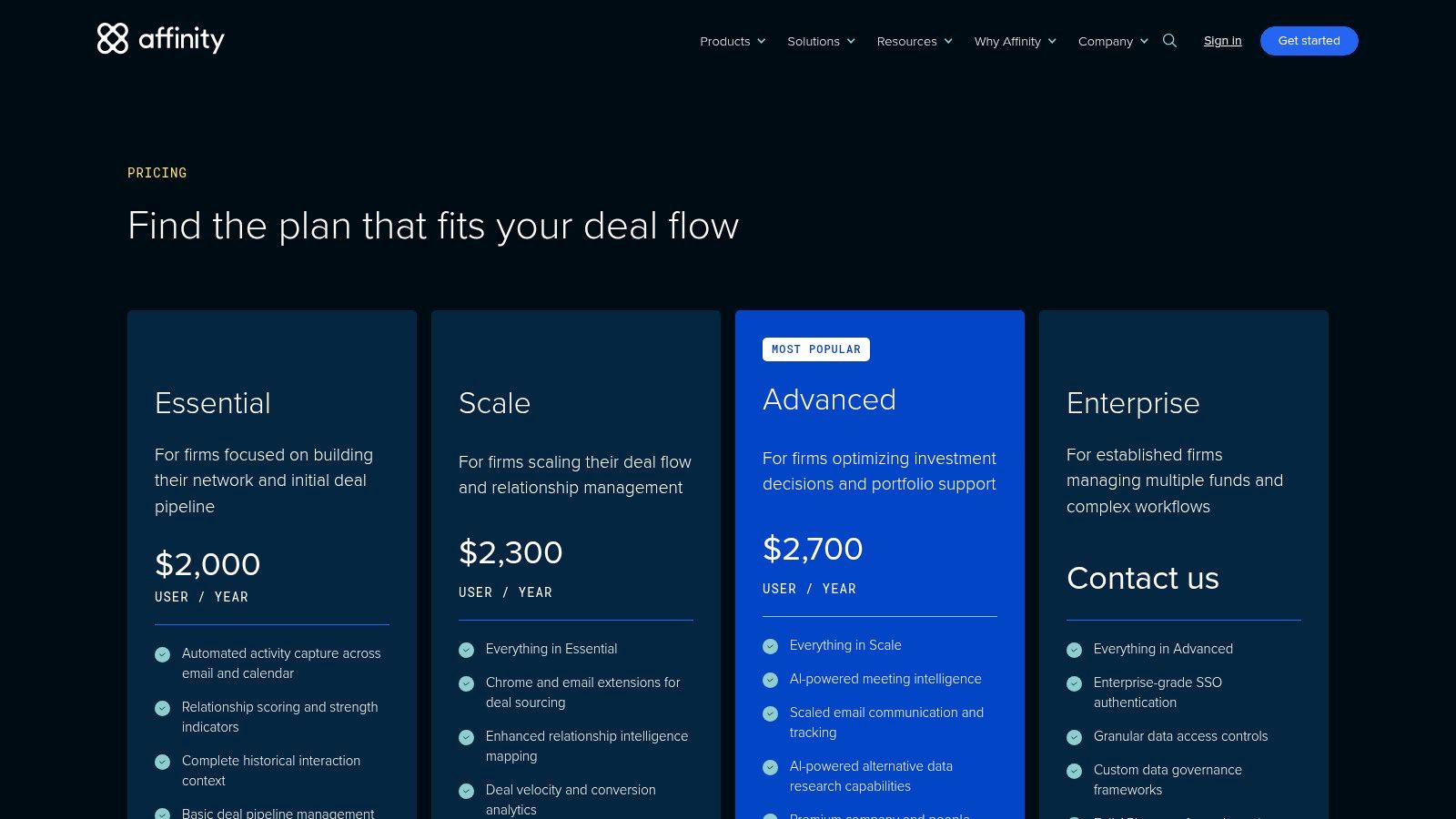
Affinity uses a per-user, per-year subscription model with several tiers. Pricing is not public and requires a consultation to get a custom quote. The advanced AI features are typically reserved for the higher-priced tiers.
- Pros: Drastically reduces manual data entry, excellent for network-driven sourcing, and is built specifically for VC workflows.
- Cons: Can become expensive for larger teams, and some of the best features are in the premium tiers.
Website: https://www.affinity.co/product/affinity-pricing
6. 4Degrees
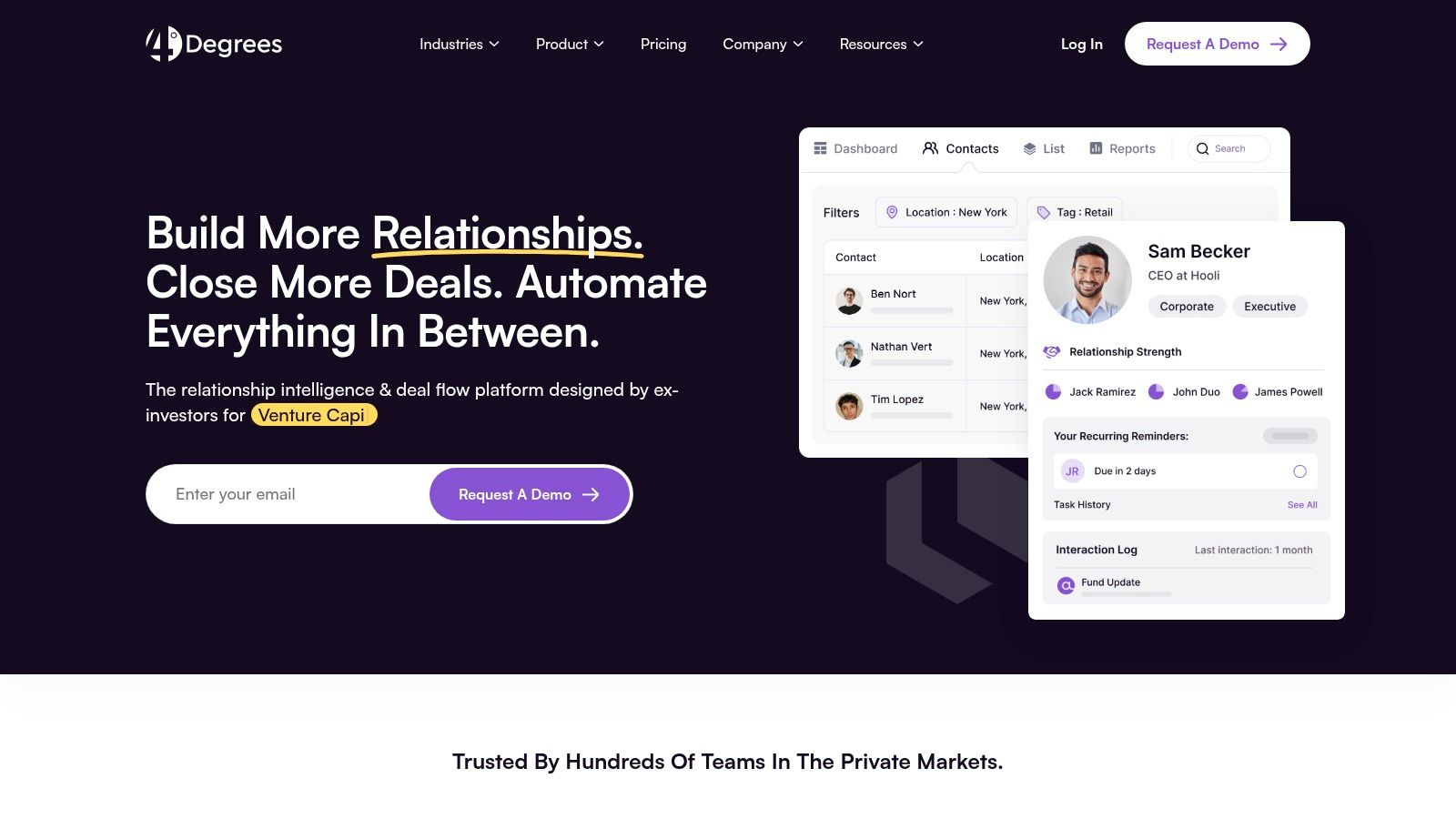
4Degrees is a relationship-intelligence CRM built by former investors for the private markets. It was created to replace generic CRMs and spreadsheets with a platform that understands the network-driven nature of venture capital. Its strength is using AI to automatically surface relevant connections, track relationships, and identify deal opportunities within a firm’s existing network, minimizing manual work.
Unlike CRMs that require constant updates, 4Degrees is designed for quick results. For VCs, this means less time logging interactions and more time acting on insights. The platform automatically enriches contacts and flags relevant news, turning a static contact list into a dynamic, opportunity-generating engine. This is ideal for firms that prioritize network-driven sourcing and want to ensure no warm introduction slips through the cracks.
Key Features & Use Cases
- AI-Driven Relationship Insights: Automatically analyzes communications to map your firm's network and find the strongest path to any person.
- Deal Pipeline & Diligence Workflows: Manage deals from start to finish with customizable pipelines and diligence checklists.
- Automated Data Enrichment: Reduces manual updates by automatically syncing contact info, company details, and news.
- Portfolio & Team Activity Dashboards: Provides a clear overview of team interactions, pipeline health, and portfolio engagement.
Example in Action: A new associate joins a firm. On day one, she integrates her email and calendar with 4Degrees. The platform's AI immediately starts mapping her network and relationship strengths, delivering actionable sourcing ideas within days, not months.
Pricing & Access
4Degrees uses a custom pricing model based on team size and needs. You'll need to schedule a demo with their sales team to get a quote. It's typically a good fit for small-to-midsize firms looking for a purpose-built CRM without enterprise-level complexity.
- Pros: Built for private market workflows, provides quick value, and reduces manual data entry through automation.
- Cons: Pricing is not public, and it may need integrations for more advanced analytics.
Website: https://www.4degrees.ai
7. Zapflow
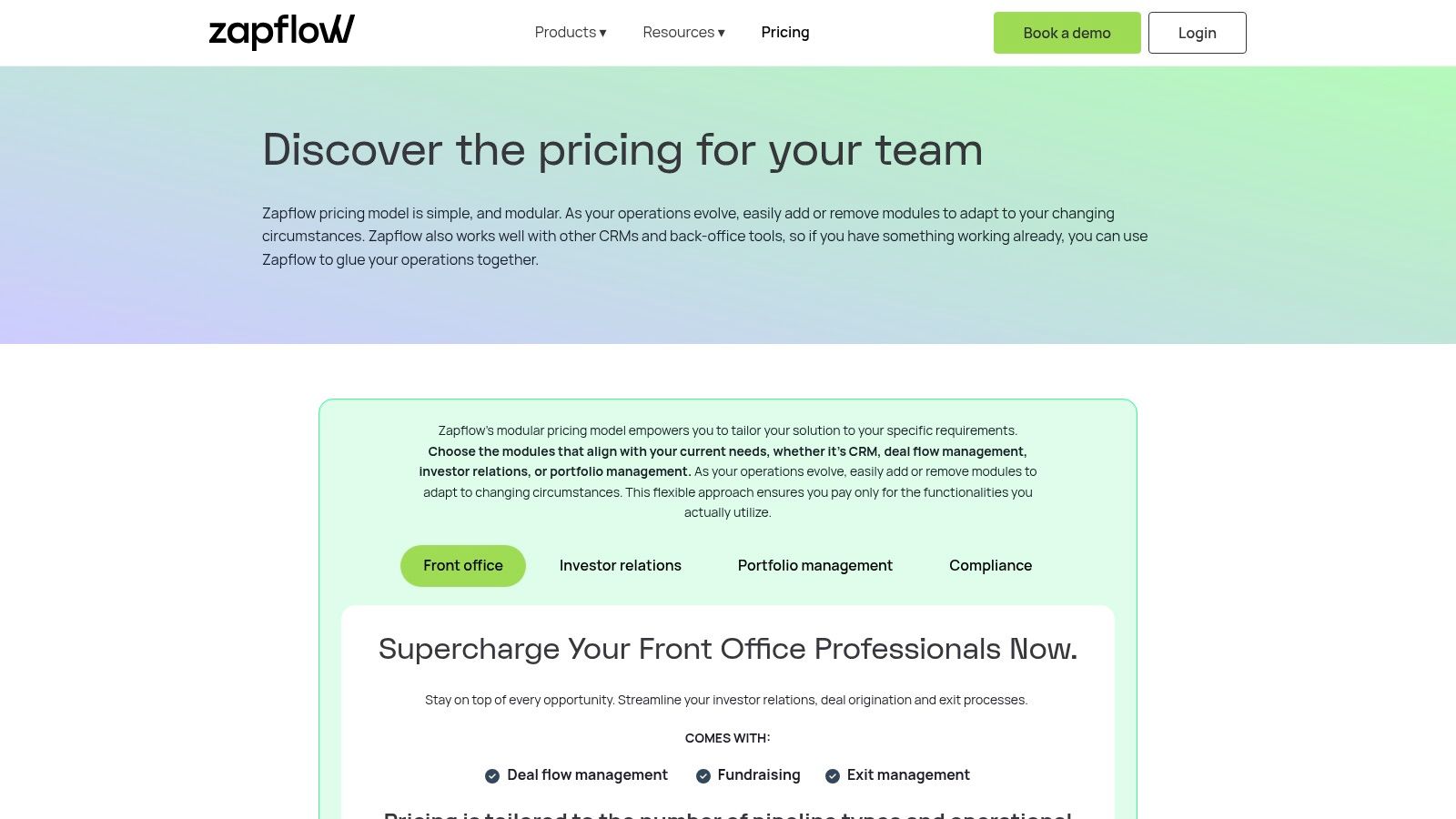
Zapflow is a highly modular platform designed to serve the end-to-end needs of VC and private equity firms, from deal sourcing to LP reporting. Its key differentiator is its "all-in-one" approach, allowing funds to unify front-office tasks like dealflow management with back-office needs like compliance and investor relations. This helps firms reduce the number of tools they use and avoid integration headaches.
For VCs, Zapflow consolidates critical functions that often require separate subscriptions. A team can manage their deal pipeline, track fundraising conversations with LPs, and automate quarterly portfolio reports all within a single system. The platform is especially useful for funds that need to incorporate compliance checks, such as KYC/AML and ESG reporting, directly into their workflows without buying a separate tool.
Key Features & Use Cases
- Modular Platform: Pay for only the modules you need, including Dealflow, Fundraising, Portfolio Monitoring, and an LP Portal.
- Integrated Compliance: Built-in tools for KYC/AML checks streamline due diligence and regulatory needs.
- Automated Reporting: Generate quarterly and ESG reports for LPs, pulling data directly from portfolio monitoring.
- Flexible Deployment: Choose between a shared cloud, a private cloud, or an on-premise installation for data control.
Example in Action: A fund manager uses Zapflow’s LP Portal to create a secure, central hub for all investor communications. Instead of emailing quarterly reports and capital call notices, she provides LPs with a branded login where they can access all documents and updates on their own schedule.
Pricing & Access
Zapflow offers transparent, module-based pricing, often with unlimited users for core modules, which is great for growing teams. However, there are setup fees, and contracts are billed annually with a 12-month minimum. Pricing for each module is available on their website.
- Pros: Broad functionality in one platform, transparent pricing, and strong compliance features.
- Cons: Setup fees and a minimum 12-month contract can be a barrier for some.
Website: https://www.zapflow.com/pricing
8. AngelList Venture (Funds)
AngelList Venture has evolved into a powerful engine for launching and managing venture funds. It's not a traditional CRM; instead, it offers end-to-end fund administration services, handling the complex back-office operations that can slow down fund managers. It’s an integrated solution for legal formation, closings, capital calls, and LP reporting, all within a standardized, tech-enabled framework.
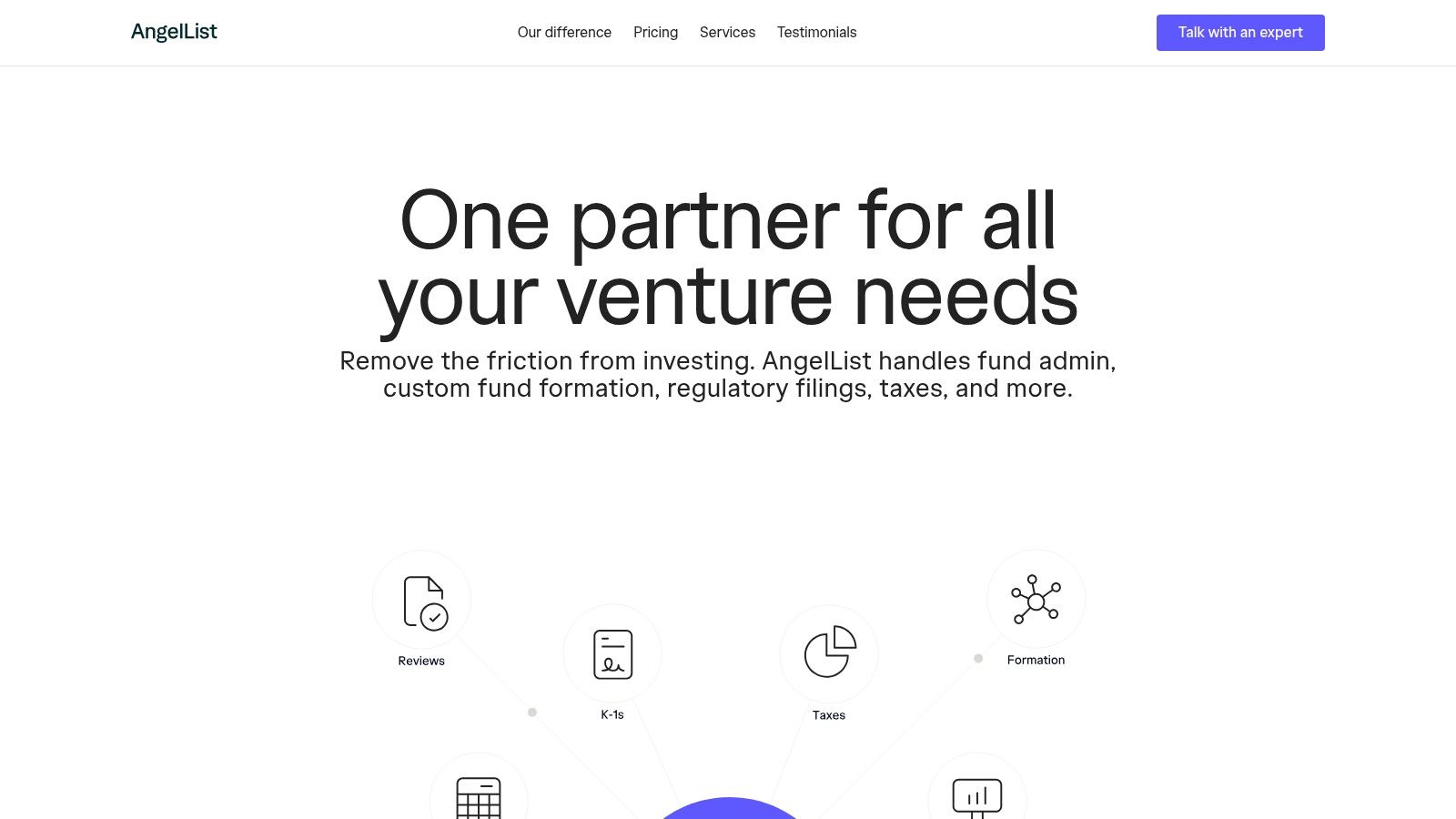
This platform is a "fund-in-a-box" solution, perfect for emerging managers, solo GPs, and firms launching Special Purpose Vehicles (SPVs). AngelList makes it easier to create a fund by streamlining the legal and administrative hurdles. Instead of hiring separate lawyers and accountants, managers can use AngelList to manage the entire fund lifecycle. For investors, this means a clean, transparent portal for signing documents and tracking investments.
Key Features & Use Cases
- Fund & SPV Administration: Full-service packages for legal, tax, and compliance for US-based funds and SPVs.
- LP Portal & Communications: A central hub for limited partners to access documents, see performance, and get updates.
- Capital Calls & Distributions: Automated workflows for managing capital calls and distributing returns.
- Tax & Reporting: Handles the generation and delivery of K-1 tax forms and other financial reports.
Example in Action: A VC firm finds a great investment that falls outside its main fund's thesis. They use AngelList to quickly create an SPV for this single deal. This allows their LPs to participate in the opportunistic investment through a clean, compliant vehicle without distracting the main fund. To learn more about this stage, explore a clear guide to Series A investments.
Pricing & Access
AngelList provides transparent pricing for its SPV services and offers custom quotes for its fund administration packages. The model is designed to be accessible and predictable, often costing less than traditional legal and accounting services.
- Pros: Streamlined platform for launching and managing funds/SPVs, transparent pricing, and great for emerging managers.
- Cons: May not suit complex institutional funds that need custom reporting.
Website: https://funds.angellist.com
9. Carta (Fund Administration)
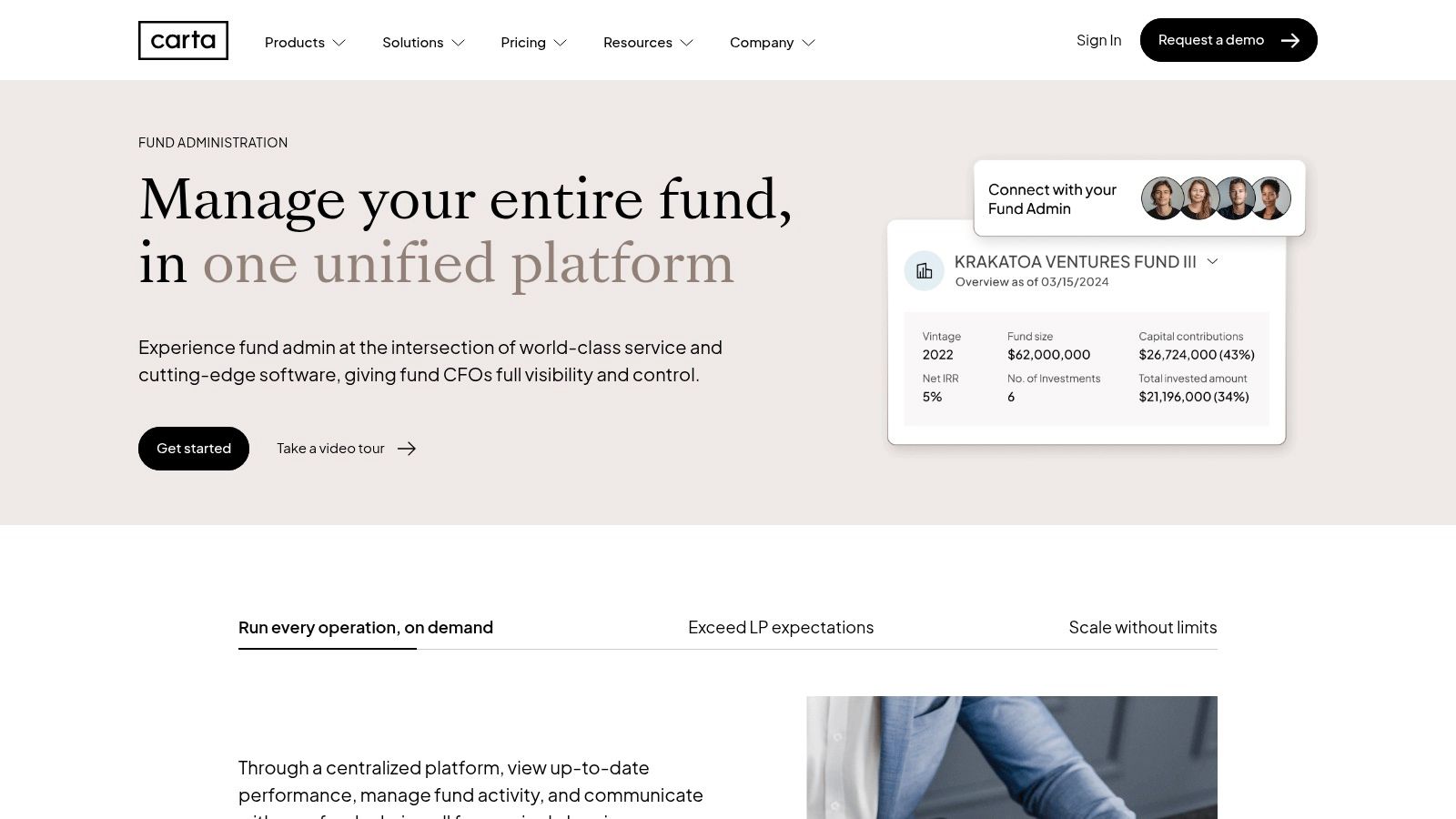
Carta has grown from a cap table management tool into a comprehensive fund administration platform. Its core strength is integrating fund administration directly with the cap table data of its vast network of startups. This eliminates manual data entry, providing VCs with a single source of truth for fund performance, portfolio valuations, and investor reporting.
For VCs, Carta simplifies complex back-office operations. Instead of juggling spreadsheets for capital calls, distributions, and LP reporting, firms can manage these critical workflows in one system. The platform automates the calculation of key fund metrics like IRR and TVPI, giving GPs real-time visibility into performance without waiting for quarterly reports from a third party.
Key Features & Use Cases
- Unified Fund & Portfolio Data: See real-time IRR, TVPI, and DPI dashboards that pull data from portfolio company cap tables.
- Automated Financial Operations: Manage capital calls and distributions through a centralized portal.
- LP Portal: Provide limited partners with a professional, secure portal to access account statements and tax documents.
- Integrated Compliance & Tax: Add on services for fund tax prep, KYC/AML checks, and valuations.
Example in Action: A fund manager uses Carta's LP portal to improve investor relations. Instead of just uploading quarterly reports, she shares portfolio company milestones and updates through the portal. This creates a more transparent and engaging experience for her LPs, reinforcing their confidence.
Pricing & Access
Carta’s fund administration services have a custom pricing model based on fund size, complexity, and number of LPs. The bundled services can be a higher-cost option, but the integration benefits often justify the investment. You'll need a consultation to get a package tailored to your firm's needs.
- Pros: Deeply integrated stack that connects fund admin with portfolio data, strong investor experience, and robust add-on services.
- Cons: Custom pricing can be costly, and migrating from other tools requires a significant effort.
Website: https://carta.com/fund-management/fund-administration/
10. Edda
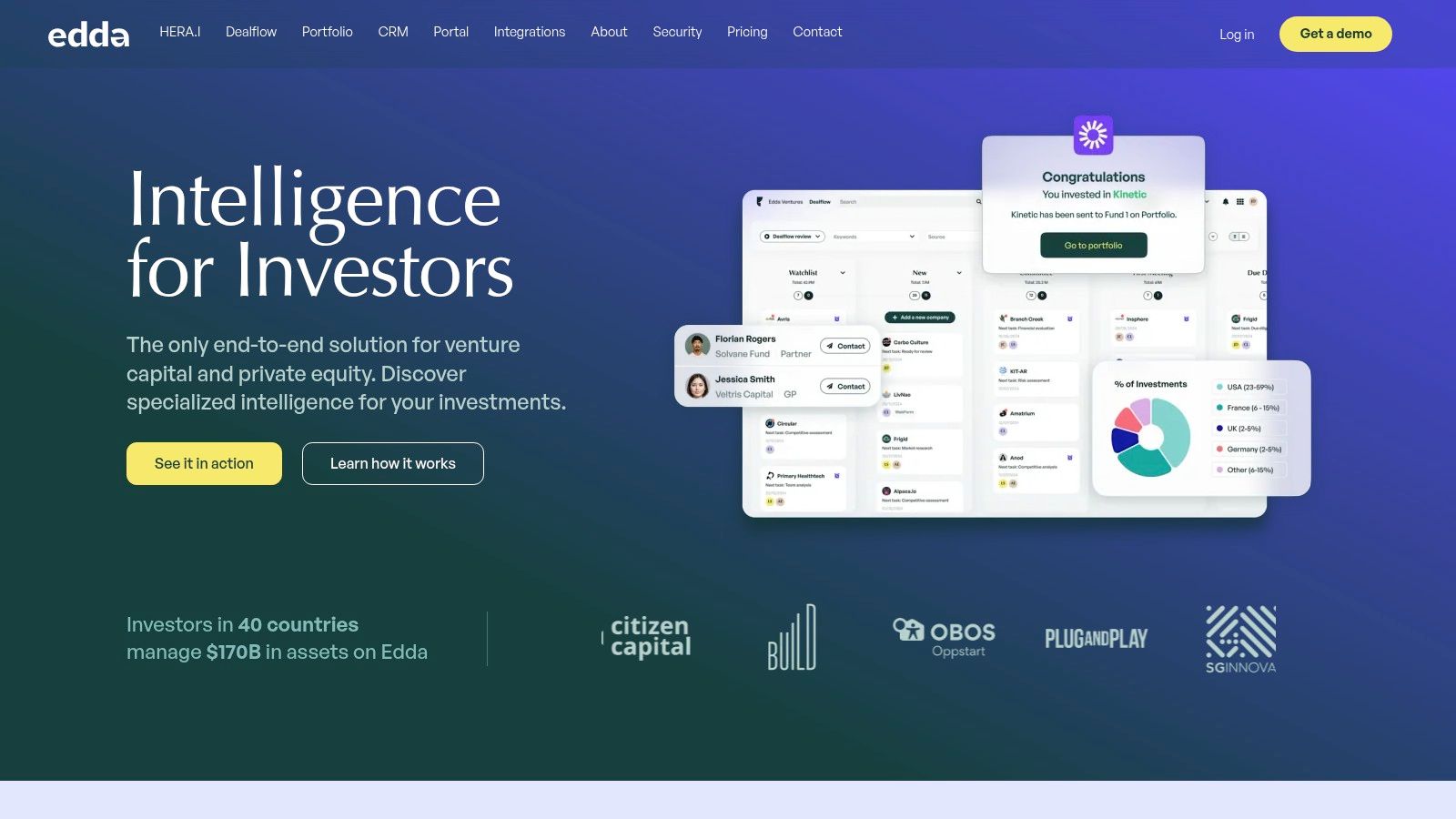
Edda is an integrated, end-to-end platform designed to consolidate the core activities of a venture capital firm. It combines deal flow management, CRM, portfolio monitoring, and an LP portal into a single system, aiming to reduce the number of tools a fund needs. Its key differentiator is the seamless transition from a potential deal to an active portfolio company, all within one environment.
For VCs, Edda acts as a central hub for operations. The platform uses AI to streamline tedious tasks like parsing pitch decks for key metrics, importing complex cap tables, and enriching company data. This automation allows investment teams to spend less time on manual data entry and more time on strategic analysis and building relationships.
Key Features & Use Cases
- Integrated Dealflow & Portfolio Management: Manage deals from sourcing to exit in one place.
- AI-Powered Assistants: Use tools for automated pitch deck analysis, cap table imports, and due diligence.
- LP Portal & Reporting: Generate detailed fund performance reports (IRR, TVPI) and share them with LPs via a secure portal.
- Enterprise-Grade Security: Meets compliance standards like SOC 2 and GDPR for reliability.
Example in Action: During late-stage due diligence, an analyst uses Edda’s AI cap table importer to quickly model different financing scenarios. This saves hours of manual spreadsheet work and helps visualize how ownership will change before finalizing a term sheet.
Pricing & Access
Edda’s pricing is not public and requires a consultation to receive a custom quote. This model suggests it is tailored to professional investment firms, from emerging managers to established funds, who need a scalable and secure solution.
- Pros: All-in-one system reduces the need for multiple tools, practical AI features speed up common VC tasks, and strong focus on data security.
- Cons: Pricing is not transparent, and teams may need to adapt their processes to use the newer AI features.
Website: https://edda.co
11. Navatar
Navatar is a specialized CRM for private markets built on top of the Salesforce platform. It tailors the world’s most powerful CRM to the specific workflows of venture capital, with modules for deal origination, fundraising, investor relations, and portfolio management. By using the Salesforce ecosystem, it provides a familiar foundation that many firms already use but with the VC-specific features they need out of the box.
This platform excels at unifying deal flow and investor relations in one system. VCs can track deal pipelines and manage diligence while also running fundraising campaigns and managing LP communications through a built-in portal. Its strength lies in combining operational CRM with strategic investor relations, making it a powerful tool for funds that prioritize both deal execution and capital management.
Key Features & Use Cases
- Thematic Sourcing & Engagement Intelligence: Track firm-wide relationships and engagement to identify warm introductions.
- Deal Pipeline & Diligence Collaboration: Manage deals from sourcing to close with structured approval workflows.
- Investor Relations & Fundraising Modules: Streamline LP communications and manage capital calls through an LP portal.
- Salesforce Native Integrations: Connects seamlessly with Outlook, LinkedIn, Slack, and other apps in the Salesforce ecosystem.
Example in Action: A partner uses Navatar’s fundraising module to build targeted LP lists based on past engagement and investment preferences. This turns her CRM data into a strategic asset for raising the next fund more efficiently.
Pricing & Access
Navatar’s pricing is custom and depends on the specific modules and user count. Since it’s built on Salesforce, firms will also need Salesforce licenses. It is best suited for established funds that are committed to the Salesforce platform and need an all-in-one solution.
- Pros: Deep private-markets features on a familiar Salesforce stack, strong IR and fundraising tools, and highly customizable.
- Cons: Requires a Salesforce license and can be a significant investment to set up and maintain.
Website: https://www.navatargroup.com/salesforce-for-venture-capital-crm-software/
12. Altvia
Altvia is a comprehensive platform built on Salesforce, designed specifically for the private capital markets. It centralizes deal flow, investor relations, and portfolio management into a single system. For venture capital firms, Altvia’s key advantage is its ability to manage the entire fund lifecycle—from fundraising and sourcing to portfolio monitoring and LP reporting—all within the familiar Salesforce environment.
Its integrated approach means that contact information, deal progress, and investor communications are interconnected, preventing data silos. The platform is particularly strong in investor relations, offering sophisticated tools for capital raising and a secure portal for limited partners.
Key Features & Use Cases
- Fundraising & CRM: Manage capital raising campaigns, track LP commitments, and centralize communications.
- ShareSecure Investor Portal: Provide LPs with a secure, branded portal to access documents like K-1s and quarterly reports.
- Portfolio Monitoring: Collect and analyze key performance indicators (KPIs) from portfolio companies.
- Deal Flow Management: Customize deal flow pipelines and automate workflows.
Example in Action: An analyst uses Altvia's ShareSecure portal to create a Virtual Data Room (VDR) for an active deal. She can track which potential co-investors have accessed specific documents, giving her valuable intelligence on engagement during due diligence.
Pricing & Access
Altvia operates on a custom pricing model that depends on the modules required and the number of users. As a Salesforce-based solution, it's better suited for established firms with the resources to invest in a tailored setup.
- Pros: Purpose-built for the full fund lifecycle, strong investor relations tools, and highly extensible via Salesforce.
- Cons: Requires Salesforce implementation, and relationship intelligence is less automated than newer CRMs.
Website: https://altvia.com/venture-capital/
Top 12 Venture Capital Software Comparison
| Product | Core features | 👥 Target audience | Data & freshness | 💰 Pricing | ✨ Notable differentiator / ★ |
|---|---|---|---|---|---|
| 🏆 Proven SaaS | Meta Ad Library scraping, MRR estimates, profit ratings, niche validator, API | Founders, indie hackers, growth teams | 14.5k+ SaaS profiles; hourly/daily updates; ad-driven signals | 💰 Tiered (not public) + free tools | ✨ Revenue-backed ad intelligence for fast niche validation. ★★★★☆ |
| PitchBook | Private-company & deal data, cap tables, advanced screeners | VCs, institutional investors | Deep curated private-market coverage; frequent updates | 💰 Enterprise / premium (expensive) | ✨ Granular deal & investor intelligence for diligence. ★★★★★ |
| Crunchbase Pro | AI search, list building, alerts, CSV export | Scouts, lean VC teams, SDRs | Large crowd-sourced database; frequent updates | 💰 Self-serve; budget-friendly | ✨ Easy self-serve sourcing & exports. ★★★★ |
| CB Insights | Market maps, Mosaic & predictive metrics, AI search | Strategy teams, corporate dev, large funds | Millions of companies; proprietary predictive scoring | 💰 Enterprise / custom | ✨ Predictive models (Mosaic, exit prob.) for whitespace analysis. ★★★★★ |
| Affinity | Automated activity capture, relationship graphs, scoring | VC firms, deal teams | Auto-captured emails/meetings + enrichment | 💰 Per-user (yearly) — scales with team | ✨ Relationship-intelligence CRM with network graphs. ★★★★ |
| 4Degrees | AI relationship insights, deal pipeline, signals | Small/mid VC firms | Signals-driven sourcing; rapid enrichment | 💰 Demo / custom | ✨ Investor-native CRM built by ex-investors; fast time-to-value. ★★★★ |
| Zapflow | Dealflow, LP portal, portfolio & ESG reporting, compliance | Fund ops, mid-size VC/PE firms | Operational & portfolio monitoring; quarterly reports | 💰 Module pricing; 12‑month min + setup | ✨ Modular front-office + compliance stack. ★★★★ |
| AngelList Venture (Funds) | Fund & SPV admin, LP portal, K-1s, closings | US fund managers, SPV creators | Admin & investor reporting data; standardized workflows | 💰 Published SPV costs; transparent | ✨ Turnkey fund/SPV administration with transparent pricing. ★★★★ |
| Carta (Fund Admin) | Fund accounting, LP portal, tax add‑ons, capital calls | VC/PE managers, fund admins | Real-time fund metrics & transaction history | 💰 Custom / bundled services | ✨ Integrated fund admin + tax & investor experience. ★★★★ |
| Edda | Dealflow → portfolio, AI utilities, LP portal, KPIs | Small/mid VC firms wanting consolidation | Auto-enrichment; portfolio KPIs & reporting | 💰 Demo / custom | ✨ All-in-one VC platform with AI-assisted workflows. ★★★★ |
| Navatar | Salesforce-based CRM, thematic sourcing, IR & VDR | Private-capital teams on Salesforce | Thematic sourcing + engagement analytics | 💰 Custom; Salesforce implementation | ✨ Deep private-markets features on Salesforce. ★★★★ |
| Altvia | Salesforce CRM, ShareSecure LP portal, portfolio dashboards | US mid-market VC/PE firms | Centralized investor & fundraising data | 💰 Custom; Salesforce overhead | ✨ Secure investor portal (ShareSecure) & fundraising CRM. ★★★★ |
Building Your Firm’s Ideal Tech Stack
Choosing the right venture capital software can seem daunting, but the goal isn't to find one perfect tool that does everything. Instead, you want to build a tech stack that multiplies your firm's effectiveness. Good software automates administrative tasks, freeing up your team to focus on what matters most: finding and funding great companies.
The software you choose should solve your firm's specific bottlenecks. A seed-stage fund focused on high-volume sourcing has different needs than a later-stage firm managing complex portfolio reporting. The key is to map your processes first and then find tools that fit—not the other way around.
Key Takeaways for Building Your VC Stack
Your software should support every step of your investment process. Here are the core principles to remember:
- Sourcing is Your Starting Point: Your deal flow is your lifeblood. Proactive, data-driven sourcing is a must. Tools like Proven SaaS, PitchBook, and Crunchbase provide the raw intelligence to help you spot high-potential startups before everyone else does.
- Relationships are Your Currency: A generic CRM isn’t enough. Platforms like Affinity and 4Degrees are designed for the network-driven nature of VC, automatically capturing interactions and turning your collective network into a powerful, searchable asset.
- Integration is Key: The best venture capital software stacks are integrated. Your market intelligence tool should feed into your CRM, which should sync with your portfolio management system. This creates a single source of truth and eliminates data silos.
- Specialization Drives Efficiency: Don't expect one tool to be the best at everything. Use Carta or AngelList Venture for their best-in-class fund administration, and let a purpose-built CRM handle your relationships. Forcing one platform to do a job it wasn't designed for leads to frustration.
Your Action Plan: A Step-by-Step Guide
Ready to build or upgrade your tech stack? Here’s a practical approach:
- Audit Your Current Process: Map out your existing workflow. Where are the delays? What tasks take the most manual effort? Is it tracking founder conversations, preparing LP reports, or finding qualified leads?
- Prioritize Your Biggest Pain Point: Solve your most significant problem first. If sourcing is your challenge, start with market intelligence tools. If LP reporting is a nightmare, focus on platforms like Edda or Altvia.
- Run Pilot Programs: Never commit to a firm-wide rollout without testing. Have a small group on your team pilot a new tool for a month. Get their honest feedback on its usability and impact.
- Consider Total Cost of Ownership: Look beyond the subscription fee. Factor in the time and resources needed for implementation, training, and data migration. A cheaper tool that requires significant manual work is often more expensive in the long run.
Ultimately, the right technology empowers your team to make smarter, faster decisions. It transforms data into insights and automates the mundane so you can focus on building relationships and exercising judgment. As you evaluate your options, in-depth comparisons can provide clarity; for a broader look, this guide to The Top 12 Venture Capital Software Tools for 2025 offers another valuable perspective.
By thoughtfully selecting and integrating the right platforms, you can build a durable, data-driven engine that gives your firm a sustained competitive advantage.
Ready to supercharge your deal sourcing with validated, data-driven insights? Proven SaaS tracks thousands of emerging SaaS companies, giving you a direct view into who is gaining traction and spending on growth. Stop guessing and start identifying your next big investment with real-time market intelligence. Discover your next portfolio company with Proven SaaS.
Build SaaS That's
Already Proven.
14,500+ SaaS with real revenue, ads & tech stacks.
Skip the guesswork. Build what works.
Trusted by 1,800+ founders


