

Stop guessing what makes a Facebook ad successful. In a crowded market, the fastest way to grow is by modeling what's already working. Pouring your budget into ads that don't convert is a mistake SaaS founders and growth teams can't afford. The key isn't just to see what others are doing; it's to understand why their campaigns get results.
This article is a practical guide. We'll break down 10 winning Facebook ad examples from top SaaS companies, revealing the exact formats, copy, and strategies behind their success. We're moving past simple descriptions to analyze the mechanics of each campaign.
For each example, you will get:
- A clear breakdown of the ad's creative, headline, and copy.
- A strategic analysis of why it works, from audience targeting to design.
- Actionable tips and copy ideas you can adapt for your own product today.
This isn't just a gallery of ads. It's a playbook to give you a competitive edge. By studying these successful campaigns, you’ll learn how to build a repeatable process for creating ads that generate leads and customers. Let's decode what works.
1. Video Carousel Ad (Lead Generation)
A Video Carousel ad shows multiple product features in one ad. Instead of a single image, it uses a sequence of short video clips (3-6 seconds each) that users can swipe through. Each video card highlights a distinct feature or benefit, giving you multiple chances to capture attention.
This approach lets you tell a more complete product story without overwhelming the viewer. For example, a project management tool could use the first card to show task creation and the second to demonstrate team collaboration. This format is great for educating potential customers and driving actions like webinar sign-ups, making it one of the most effective winning Facebook ad examples for complex software.
Why It Works
- Breaks Down Complexity: SaaS products often have many features. This format breaks them down into simple, bite-sized video clips.
- Holds Attention Longer: The swipeable nature of carousels encourages users to engage more deeply than they would with a static ad.
- Highlights Multiple Benefits: You can appeal to different user needs in a single ad. One person might care about collaboration, while another wants analytics.
Actionable Takeaways & Strategy
For this to work, each video card should be clear and have its own headline.
- Focus Each Card: Dedicate each card to a single feature. Example: Card 1: "Create a Task in Seconds." Card 2: "Assign to Your Team Instantly."
- Add Captions: Most people watch Facebook videos with the sound off. Use clear text on the screen to ensure your message is understood.
- Test Your Sequence: The order of your cards matters. Test different sequences to see which one generates the lowest cost-per-lead (CPL). A good flow often starts with the problem and ends with the benefit.
2. Single Image Ad with Testimonial (Conversion)
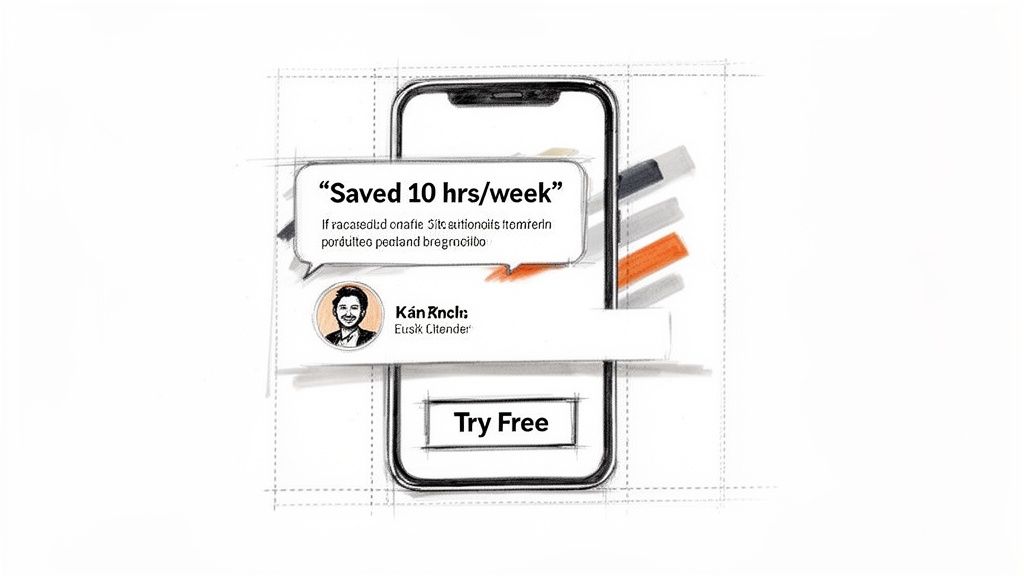
This is a classic, high-converting ad format. It combines a clean image (like a product screenshot) with a powerful customer quote. This simple ad builds trust and drives conversions, sending qualified traffic to a sign-up or demo page.
This approach works because people trust other people more than brands. By putting a real customer testimonial front and center, you immediately handle a user's skepticism and show a real-world benefit. It's one of the most reliable winning Facebook ad examples for validating an offer.
Why It Works
- Builds Instant Credibility: A direct quote from a happy customer is a powerful endorsement. It's more believable than a company's own marketing copy.
- Simple and Scannable: In a busy feed, a simple image and bold text are easy to digest quickly. The main benefit is communicated in seconds.
- Highly Efficient: This format is fast and cheap to produce. You don't need a large video budget, so you can test multiple testimonials and visuals easily.
Actionable Takeaways & Strategy
To make this ad work, your testimonial choice is critical. The goal is to make the social proof feel authentic.
- Use Quantifiable Testimonials: Choose quotes with specific numbers. "Saved us 10 hours per week" is much stronger than "Saved us time."
- Rotate Creative Frequently: Testimonial ads can get old. Rotate new quotes and background images weekly to keep them fresh.
- Analyze Competitor Ads: When you see a competitor run this type of ad for over 60 days, it’s a strong sign it's profitable. You can find these long-running campaigns using competitive intelligence research.
3. Interactive Instant Experience (Lead Generation)
An Instant Experience is a full-screen, mobile-optimized ad that loads instantly inside the Facebook app. It’s like a mini-landing page in your ad, guiding users through product features, showing videos, or capturing lead information with a form.
This format excels at reducing friction. Instead of waiting for an external website to load, a potential customer can immediately engage with your product's story. For example, a tool like Airtable could use it to showcase various templates. This direct engagement makes it one of the most compelling winning Facebook ad examples for driving high-quality leads.
Why It Works
- Removes Friction: By keeping users within Facebook, you eliminate slow load times and the drop-off from sending traffic to an external site.
- Creates an Immersive Experience: The full-screen format captures the user's full attention, allowing you to tell a more detailed product story.
- Qualifies Leads Effectively: Users who take the time to go through your Instant Experience and fill out a form show a much higher level of interest.
Actionable Takeaways & Strategy
To get the most out of Instant Experiences, focus on a simple, mobile-first design that guides the user to a single call-to-action.
- Keep It Concise: Limit your experience to 3-5 screens. Too many steps can cause people to leave. The goal is a quick, impactful tour.
- Simplify Your Lead Form: If you're collecting leads, ask for minimal information. A name and email are often enough.
- Guide the User Journey: Use a mix of video, carousels, and images to create a logical flow that feels intuitive. Knowing your audience is key; check out this guide to audience analysis on proven-saas.com to better tailor the journey.
4. Story Ad with Swipe-Up (Traffic & Conversions)
A Story Ad is a full-screen, vertical video made for Facebook and Instagram Stories. It uses a direct "Swipe Up" call-to-action that sends users straight to a landing page, making it a powerful tool for driving traffic and free trial signups. It captures attention in a format where users are already consuming content.
This format is great for growth-stage SaaS companies looking to scale. By showing a quick product demo or a user testimonial in a short clip, brands can grab a user's attention. Because it looks like organic Story content, it feels less like an ad, making it one of the most effective winning Facebook ad examples for mobile audiences.
Why It Works
- Mobile-Native Experience: Story ads fill the entire screen, creating an immersive experience that commands a user’s full attention.
- Low-Friction CTA: The "Swipe Up" action is an intuitive gesture for mobile users, making it easy to go from seeing an ad to visiting a landing page.
- High Engagement Format: The fast-paced, vertical video format aligns with modern content habits, encouraging quick action.
Actionable Takeaways & Strategy
Success with Story ads depends on capturing attention immediately and delivering your message clearly, even without sound.
- Hook in 2 Seconds: Start with your most compelling visual or value prop. The first two seconds are critical to stop the user from tapping away.
- Use Captions and Text Overlays: Assume users are watching with the sound off. Use bold text to communicate your core message.
- Test and Iterate Rapidly: Constantly test different hooks, visuals, and CTAs. Monitor your swipe-up rate (over 2% is good) and pause underperforming ads quickly. Many successful creative strategists test 5-7 new ads weekly.
5. Retargeting Ad with Urgency (Conversions)
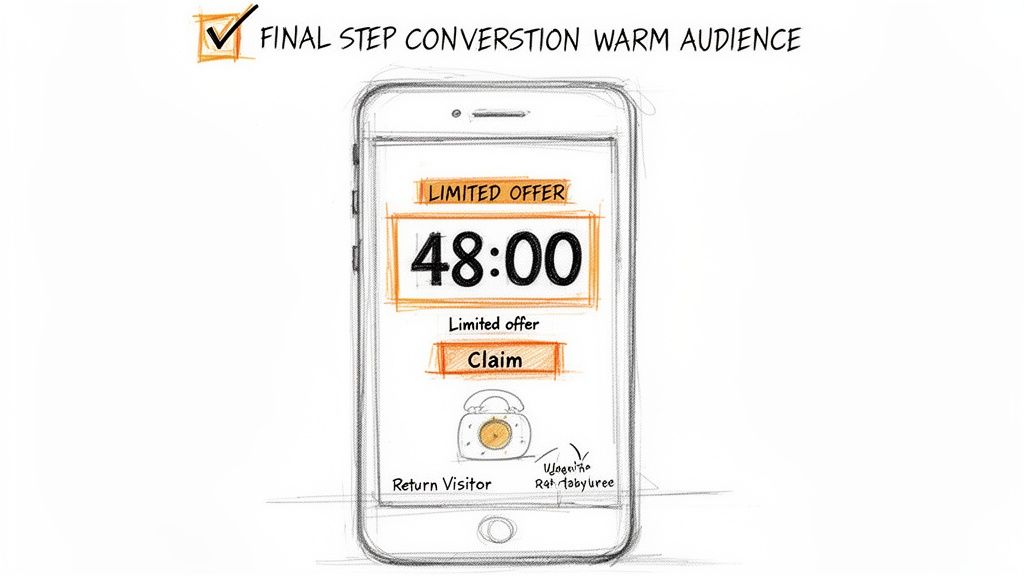
A Retargeting Ad targets a "warm" audience: users who have already visited your website but haven't converted. This ad uses a short video (15-30 seconds) with a time-sensitive offer to create urgency and push hesitant prospects to act.
This strategy is highly effective because you're spending money on users who are already familiar with your brand. By adding a deadline, like a limited-time discount, you give them a powerful reason to act now. This turns indecision into conversion, making it one of the most profitable winning Facebook ad examples for maximizing trial-to-paid rates.
Why It Works
- Targets High-Intent Users: You are advertising to people who already know you. This warm audience is much more likely to convert.
- Overcomes Procrastination: Urgency is a powerful psychological trigger. Limited-time offers combat the tendency to delay decisions.
- Improves ROAS: By focusing on a small, qualified audience, this strategy often yields a much higher Return On Ad Spend (ROAS) than broad campaigns.
Actionable Takeaways & Strategy
Your goal is to re-engage and convert. The ad and offer must be direct and compelling.
- Segment Your Audience: Target users who visited your pricing page in the last 7-14 days. This is often the sweet spot before they lose interest.
- Craft a Strong Offer: Test different urgency angles. Common tactics include a percentage discount ("Get 25% off") or a deadline ("Offer expires in 48 hours").
- Keep Creative Simple: Use a short video that quickly reminds the user of your value and presents the urgent offer. On-screen text with a countdown timer is highly effective.
6. Lead Magnet Giveaway Ad (Lead Generation)
A Lead Magnet ad offers a valuable, free resource in exchange for a user's email address. Instead of promoting a product trial, this ad provides a template, checklist, or report.
This approach works because it solves an immediate problem for the user, building trust before asking for a sale. For instance, a marketing tool might offer a free "KPI Dashboard Template," capturing leads who want to improve their reporting. This method generates a high volume of leads and is a key part of many winning Facebook ad examples for SaaS.
Why It Works
- Low-Friction Conversion: Asking for an email for a free resource is a much smaller commitment than signing up for a product trial.
- Audience Qualification: The type of lead magnet someone downloads shows their specific needs, allowing for targeted follow-up.
- Builds Authority and Trust: By providing real value upfront, you position your brand as a helpful expert, making people more open to future sales messages.
Actionable Takeaways & Strategy
Success depends on the value of your lead magnet. The goal is to maximize sign-ups while collecting qualified leads.
- Offer High-Value Resources: Create something genuinely useful, like a customizable template or an exclusive checklist.
- Optimize Your Landing Page: Keep your lead form simple, with a maximum of 3-4 fields (e.g., name, work email). A clean landing page will boost conversions.
- Nurture Leads: Don't let new leads go cold. Enter them into an automated email sequence that guides them toward a product trial or demo.
7. Comparison Ad (Problem-Solution)
The Comparison ad format uses a "before and after" or "us vs. them" approach to show how your product is better than an old, inefficient process. A split-screen visual can directly contrast the pain of the old way with the streamlined solution you provide.
This format is effective because it frames your product as the clear solution to a business problem. For example, an ad could show the chaos of spreadsheets on one side and the clean workflow of a tool like Asana on the other. By highlighting the frustration of the problem, you create a powerful desire for the solution, making this one of the most persuasive winning Facebook ad examples for established SaaS products.
Why It Works
- Creates Instant Clarity: The side-by-side comparison makes your value proposition easy to understand instantly.
- Taps into Pain Points: It shows the target audience you understand their daily struggles, which builds trust.
- Justifies a Higher Price Point: By visually demonstrating time savings or improved efficiency, you build a strong case for your product's ROI.
Actionable Takeaways & Strategy
Success here depends on making the "before" state feel painful and the "after" state feel like a huge relief.
- Focus on a Single, High-Impact Problem: Pick one major pain point per ad, such as "chaotic team communication" vs. "centralized project updates."
- Quantify the Benefit: Add a specific metric to your copy or visual. For example, "Stop wasting 10 hours a week on manual reports."
- Use Simple Visuals: The power is in the contrast. Use simple icons and minimal text to make the comparison instantly clear.
8. Short Tutorial Video (How-To)
A Short Tutorial is a 30 to 90-second "how-to" video that provides immediate value by teaching the audience how to solve a specific problem. The ad demonstrates a quick win using your software, positioning the product as an essential solution.
This approach builds trust by focusing on education first. For example, a tool like Zapier could show how to automate a weekly report in under 60 seconds. The main goal is to get high-quality engagement, shares, and comments. This organic boost amplifies reach, making it one of the most effective winning Facebook ad examples for community-driven growth.
Why It Works
- Builds Authority & Trust: Providing value upfront establishes your brand as an expert. Users are more likely to buy from a company that has already helped them.
- High Engagement Signals: Tutorials that solve real problems get saved and shared. This engagement lowers ad costs and increases organic reach.
- Qualifies Leads Naturally: Viewers who watch a tutorial to the end are highly interested in your solution and are more likely to become customers.
Actionable Takeaways & Strategy
To succeed, focus on a single, compelling problem and a quick, satisfying solution. The video should feel helpful, not like a polished corporate ad.
- Focus on One Quick Win: Choose a common user pain point and show how to solve it in a few simple steps.
- Use a Pattern Interrupt: Start the video with a hook in the first three seconds, like a question ("Tired of manual updates?").
- Drive Action in Comments: End with a clear call-to-action that encourages engagement. For example, "Comment 'TEMPLATE' below, and I'll send you the link."
9. Webinar Promotion Ad (Lead Generation)
A Webinar Promotion ad uses an image or short video to promote an upcoming live training event. The goal is to capture high-intent leads who are willing to invest 30-60 minutes to solve a problem, making them highly qualified for sales follow-up.
This strategy is effective for educating prospects on complex topics where your software is the solution. For example, a fintech company could host a webinar on "Automating Q4 Financial Reporting." By offering tangible value upfront, you build trust and turn cold traffic into warm leads. This educational approach makes it one of the most reliable winning Facebook ad examples for a B2B audience.
Why It Works
- Generates High-Quality Leads: Users who register for a webinar are actively seeking a solution and are more qualified than those who download a simple checklist.
- Builds Authority and Trust: Hosting an educational event positions your brand as an industry expert.
- Creates a Sales Pipeline: The registration list provides a warm audience for targeted follow-up, nurturing leads toward a demo or trial.
Actionable Takeaways & Strategy
Success depends on balancing urgency with planning. Promoting an event too early can lead to low attendance.
- Time Your Promotion: Start promoting your webinar 7-10 days before the event. This creates urgency without giving people too much time to forget.
- Highlight the Speaker: Test ad creative that emphasizes the speaker's authority. Use their headshot and credentials to build credibility.
- Focus on the "Why": Your ad copy should clearly state what attendees will learn and how it will solve a specific pain point.
10. User-Generated Content Ad (Social Proof)
A User-Generated Content (UGC) ad leverages authentic customer testimonials, reviews, or user-submitted videos to build trust. Instead of polished brand messaging, this format puts real customers front and center, letting their genuine experiences serve as powerful social proof.
By showcasing unscripted praise from actual users, you disarm skepticism and connect with prospects on a human level. This is one of the most credible winning Facebook ad examples because it shifts the focus from "what the company says" to "what its users achieve," making the benefits feel more tangible.
Why It Works
- Builds Unmatched Trust: Authentic reviews from real people are far more persuasive than brand promises.
- High Authenticity and Relatability: User-generated content feels genuine. Prospects see people like them succeeding with your product.
- Cost-Effective Creative: Sourcing content from your user base reduces the time and money spent on professional ad creative.
Actionable Takeaways & Strategy
To launch a successful UGC campaign, you need a system for collecting customer stories. Be proactive in asking for feedback.
- Solicit Specific Stories: Ask targeted questions like, "How did our tool save you time this week?" This prompts more detailed responses.
- Feature Diverse Customers: Showcase a variety of users from different industries and roles to broaden your ad's appeal.
- Incentivize Submissions: Offer a small incentive like a gift card or a free month of service in exchange for a video testimonial.
Top 10 Winning Facebook Ad Examples — Format, Goal & Use Case
| Ad Format | 🔄 Implementation Complexity | ⚡ Resource Requirements / Cost | ⭐📊 Expected Outcomes / Impact | 💡 Ideal Use Cases | Key Advantages |
|---|---|---|---|---|---|
| Video Carousel Ad (Lead Generation) | High — multi-clip production & sequencing, frequent optimization | High production + media ($15K–50K+/mo) | Strong engagement & lead gen; predictable CPL; good demo clarity ⭐⭐⭐ | Proven SaaS product demos, webinar signups | Shows multiple value props, demo workflows, scales with Meta AI |
| Single Image Ad with Testimonial Overlay (Conversion) | Low — simple static design, fast iterations | Low production; moderate media ($10K–30K+/mo) ⚡ | High CTR on targeted audiences; reliable conversions 📊⭐⭐⭐ | B2B conversion-focused campaigns, niche validation | Low cost, quick A/B tests, strong social proof |
| Interactive Instant Experience (Lead Generation) | Medium–High — design + in-platform development 🔄 | Moderate–High implementation + media ($12K–40K+/mo) | High lead intent, lower bounce, richer engagement ⭐⭐⭐ | Micro-SaaS lead capture, warm-audience engagement | Frictionless full-screen experience, better lead quality |
| Story Ad with Swipe-Up (Traffic/Conversions) | Medium — vertical creative, instant hook required | Medium production; higher spend ($20K–60K+/mo) | High mobile engagement & traffic; short attention window 📊⭐ | Growth-stage, mobile-first SaaS for trial signups | Native mobile behavior, lower CPM, measurable swipe rates |
| Retargeting Video Ad with Urgency (Conversions) | Low–Medium — short edits, audience segmentation | Low–Medium media focused ($5K–25K+/mo) ⚡ | Highest conversion rates on warm audiences; quick ROI ⭐⭐⭐⭐ | SaaS with free trials, recent visitors within 7–14 days | Cost-efficient, fast test cycles, strong ROAS with urgency |
| Lead Magnet Giveaway Ad (Lead Generation) | Low — asset + form setup, nurture required | Moderate spend & content creation ($10K–50K+/mo) | Highest lead volume at low CPL; lower average lead quality 📊⭐ | Top-of-funnel for research-heavy buyers, list building | Predictable volume, easy segmentation and A/B testing |
| Comparison / Problem–Solution Ad (Awareness→Conversion) | Medium–High — messaging, creative, legal review 🔄 | High production & media ($25K–100K+/mo) | Effective across funnel; appeals to decision-makers; shareable ⭐⭐⭐ | Enterprise SaaS, competitive positioning, mid-funnel outreach | Clear competitive differentiation, rational persuasion |
| Short-Form Tutorial / How‑To Video (Engagement→Conversions) | Low — quick recordings or screencasts | Minimal production; organic-first (low/no spend) ⚡ | Strong organic reach & engagement; lower direct attribution 📊⭐ | Creator & niche SaaS, community growth, education-led inbound | Low cost, authentic, repeatable content that builds trust |
| Webinar Promotion Ad (Lead Generation) | Medium–High — event production + registration funnel | High resources for production + promotion ($15K–50K+/mo) | High-intent registrants; strong pipeline but higher CPL ⭐⭐⭐ | B2B SaaS & Fintech for lead qualification & thought leadership | High-intent leads, content repurposing, measurable attendance |
| User‑Generated Content / Review Ad (Social Proof) | Low–Medium — sourcing, releases, curation | Moderate (incentives + media) ($10K–40K+/mo) | Very high trust & ROAS; authentic conversion lift ⭐⭐⭐⭐ | Community-driven SaaS, skeptical audiences, retention-focused | High authenticity, scalable asset production, strong shareability |
From Examples to Execution: Your Next Steps
We’ve analyzed ten powerful, winning Facebook ad examples, looking at the strategy that drives their success. A clear pattern emerges: the best ads are not born from guesswork. They are designed to connect a specific solution to a precise customer pain point.
The core lesson is that a "winning" ad is a combination of the right format, a compelling message, and relevant targeting. You saw how a simple testimonial can turn a static image into a conversion machine and how a lead magnet can fill your pipeline. These are repeatable frameworks for growth.
Synthesizing the Winning Formulas
Use these examples as your strategic playbook. Focus on adapting the underlying principles.
- Social Proof is Your Loudest Megaphone: As seen in the testimonial and UGC ads, using your customers' voices builds instant credibility. This is critical for SaaS, where trust drives purchases.
- Value-First, Sell-Second: The lead magnet and webinar ads prove that offering real value upfront is the best way to earn a prospect's attention. Give them a tool or knowledge before you ask for a sale.
- Clarity Over cleverness: Every successful ad communicated its value with absolute clarity. Your audience is scrolling fast; they don't have time to figure out a confusing message. Be direct.
Your Action Plan for Implementation
Theory is valuable, but execution drives results. Here is a simple, three-step plan to get started today.
- Identify Your #1 Goal: What is the single most important action you need from your ads right now? Is it booking demos? Driving free trials? Growing your email list? Choose one goal. This will determine which ad format to test first.
- Adapt, Don't Duplicate: Select the one example from this list that best aligns with your goal. Review the "Actionable Takeaways" section for that ad. Adapt the strategic framework to your unique product and audience. What is your customer's biggest pain point?
- Validate Before You Scale: The most critical lesson from analyzing these winning Facebook ad examples is that sustained ad spend is the ultimate signal of success. Seeing a competitor run the same ad for months is a powerful indicator that it's profitable. Your goal is to find these proven models and build upon them. This data-driven approach removes the guesswork.
Ready to stop guessing and start building on proven success? Proven SaaS gives you a curated database of the best-performing ads in SaaS, allowing you to see exactly which strategies your competitors are using to win. Use our platform to find validated ad concepts and build your next campaign with confidence. Get started at Proven SaaS today.
Build SaaS That's
Already Proven.
14,500+ SaaS with real revenue, ads & tech stacks.
Skip the guesswork. Build what works.
Trusted by 1,800+ founders


