


What Is an Audience Analysis for SaaS Growth?
Audience analysis is the process of getting to know your potential customers on a deeper level. It’s about understanding their goals, challenges, and daily routines before you write a single line of code.
Think of it like a chef learning their guests' favorite flavors before designing the menu. For a SaaS founder, this process is the secret to building a product people will actually pay for. It’s the difference between guessing what people want and knowing what they need.
Why Audience Analysis Is Your SaaS Superpower
Imagine you pour months into building a slick SaaS tool for project managers. You launch, and… crickets. It turns out your perfect user is actually a marketing coordinator who’s wrestling with a completely different set of problems. This is the exact kind of expensive misstep an audience analysis helps you sidestep.
This process isn't about collecting random facts. It's about building a sharp, actionable picture of your Ideal Customer Profile (ICP). When you truly get who they are and what they need, you can shape everything—from your product features to your marketing copy—with precision.
What an Analysis Reveals
A solid audience analysis gives you the kind of intel that informs your entire business strategy. The whole point is to answer the big, foundational questions that will set your product’s direction and guide how you bring it to market.
Here's a quick look at the core components of audience analysis. The table below breaks down what each part tells you and the key questions you should be asking.
Audience Analysis At a Glance
| Component | What It Tells You | Example Question |
|---|---|---|
| Demographics | The basic "who" of your audience—their job title, company size, and industry. | What are their professional characteristics? |
| Psychographics | The "why" behind their behavior—their motivations, values, and career goals. | What drives their professional decisions? |
| Pain Points | The specific, frustrating challenges they run into in their daily work. | What problems are they desperate to solve? |
| Behaviors | The "how" of their workflow—the tools they already use and where they go for info. | How do they work and find solutions today? |
By digging into these areas, you move from building in the dark to creating solutions for real, proven needs. It’s the most critical step you can take toward finding that elusive product-market fit.
This kind of research is a fundamental piece of a much larger puzzle. To understand how these customer insights fuel the entire process, you can learn more about how to approach market validation for your SaaS idea.
At the end of the day, a thorough audience analysis ensures you’re not just building another piece of software. You’re building an indispensable tool for a specific group of people you truly understand.
So, Why Does Audience Analysis Actually Drive SaaS Success?
You get the what, but the why is where you find your competitive edge. Audience analysis is the crucial step that prevents you from building a product in a vacuum, burning through your marketing budget, and watching competitors who did their homework zoom past you.
Think of it like this: building a SaaS without audience analysis is like trying to hit a target in a pitch-black room. You're just flinging arrows and hoping one sticks. With it, you've got a laser sight. Every decision, from feature development to your ad copy, is aimed squarely at a target you know you can hit.
From Wasted Effort to a Winning Strategy
Truly understanding your audience has a direct, measurable impact on your revenue. This isn't some fluffy, theoretical exercise; it's a practical business tool that delivers real results and helps you sidestep expensive blunders.
When you take the time to do a proper analysis, you can:
Write marketing messages that actually connect. Knowing your audience's exact pain points—and the words they* use to talk about them—turns generic copy into a compelling conversation.
- Build features people will gladly pay for. Stop guessing what to build next. Instead, you can pour your development resources into solving the problems that keep your ideal customers up at night.
- Discover profitable, untapped niches. Sometimes your best market isn't the one you first aimed for. A deep analysis can shine a light on underserved groups with urgent, unmet needs.
> For instance, imagine a founder builds a complex project management tool for large enterprise teams. After launching to crickets, an audience analysis reveals that their perfect users aren't giant corporations. They're actually small marketing agencies drowning in client approval workflows. By tweaking their messaging and simplifying one key feature, they find product-market fit almost overnight.
The Growing Demand for Audience Insight
This laser-focus on the customer isn't just a fleeting trend—it's a core part of how modern businesses win. The global audience analytics market was valued at around USD 4.62 billion and is expected to skyrocket to USD 13.75 billion by 2033. Why? Because businesses are drowning in user data and desperately need to make sense of it all. You can explore more insights on the audience analytics market's growth to see the full picture.
In the end, audience analysis is your roadmap. It tells you where to go, what to build, and how to talk about it once you're there. It ensures your SaaS is built on a solid foundation of real-world demand. Without it, you’re not building a business—you’re just building a product for yourself.
The Three Pillars of Audience Understanding
So, what exactly goes into a solid audience analysis? The best way to think about it is like building a three-legged stool. If one leg is weak, the whole thing topples over. You need all three working together to get a stable, complete picture of your customer.
These three legs are Demographics (the 'who'), Psychographics (the 'why'), and Behaviors (the 'how'). Let's break down what each one means and why it's so important for a SaaS founder.
Pillar 1: Demographics — The "Who"
First up, demographics. These are the straightforward, factual details about your audience. They give you the basic blueprint of who your customers are in a measurable way. For a SaaS business, this is about their professional lives.
This objective data lets you carve out a specific slice of the market. Key demographic points for SaaS usually include:
- Job Title: Are you talking to a VP of Sales, a junior-level engineer, or a freelance graphic designer? Each one has very different needs.
- Company Size: Is your ideal customer a one-person shop, a fast-growing startup with 50 employees, or a massive enterprise?
- Industry: Do they work in fintech, healthcare, retail, or a totally different sector?
- Location: Where are they based? This can affect everything from language to compliance with data laws like GDPR in Europe.
For example, a founder building inventory management software gets way more mileage from a profile like "Warehouse Manager at a 100-500 person e-commerce company" than from "male, age 45." One is an actionable target, the other is just a statistic.
Pillar 2: Psychographics — The "Why"
While demographics tell you who they are, psychographics uncover why they do things. This is where you get inside their heads to understand their motivations, values, frustrations, and goals. It's the human story behind the data points.
> Psychographics are your secret weapon for writing copy that resonates. When you get what keeps your audience up at night, you can stop selling features and start selling solutions to their real-world problems.
This is all about understanding their mindset. You're trying to answer questions like:
- What are their biggest career goals? Are they chasing a promotion? Desperate to save time on mind-numbing tasks? Or just trying to look good in front of their boss?
- What are their biggest pain points? Are they drowning in messy spreadsheets, struggling with poor team communication, or stuck using clunky, outdated software?
- What do they value most? Do they get excited about brand-new features, or do they prefer something that's rock-solid and reliable?
Knowing their psychographics helps you understand that a customer isn't just buying project management software; they're buying a sense of calm and control over their chaotic workday.
Pillar 3: Behaviors — The "How"
Finally, the behavioral pillar looks at what your audience actually does. This isn't about what they say they do, but what their actions reveal. You’re looking at how they work, the tools they use, and where they go for information. The goal is to see how your SaaS can slide into—and improve—their existing routines.
Behavioral data gives you a real-world look at their habits, including:
- Tool Usage: What software is already open on their desktop all day? Are they Excel power users, loyal to a competitor, or patching together a workflow with a bunch of free apps?
- Information Sources: Where do they learn about new products? Do they follow industry blogs, trust recommendations on LinkedIn, or listen to specific podcasts?
- Purchase Habits: Are they the type to sign up with a credit card without talking to anyone, or do they need a full sales demo before they'll even consider it?
When you analyze all three pillars together, you move from a flat, one-dimensional sketch to a full-color, 3D model of your ideal customer. This deep understanding is the foundation every great SaaS product is built on.
Alright, we've covered the what and the why. Now for the fun part: getting your hands dirty and actually figuring out who your future customers are. This is where you roll up your sleeves and gather the raw intel that will shape your entire SaaS strategy.
Let's break down four powerful ways you can start digging for that gold today.
At the end of the day, all audience analysis comes back to those three pillars we talked about: demographics, psychographics, and behaviors. It’s about building a complete picture.
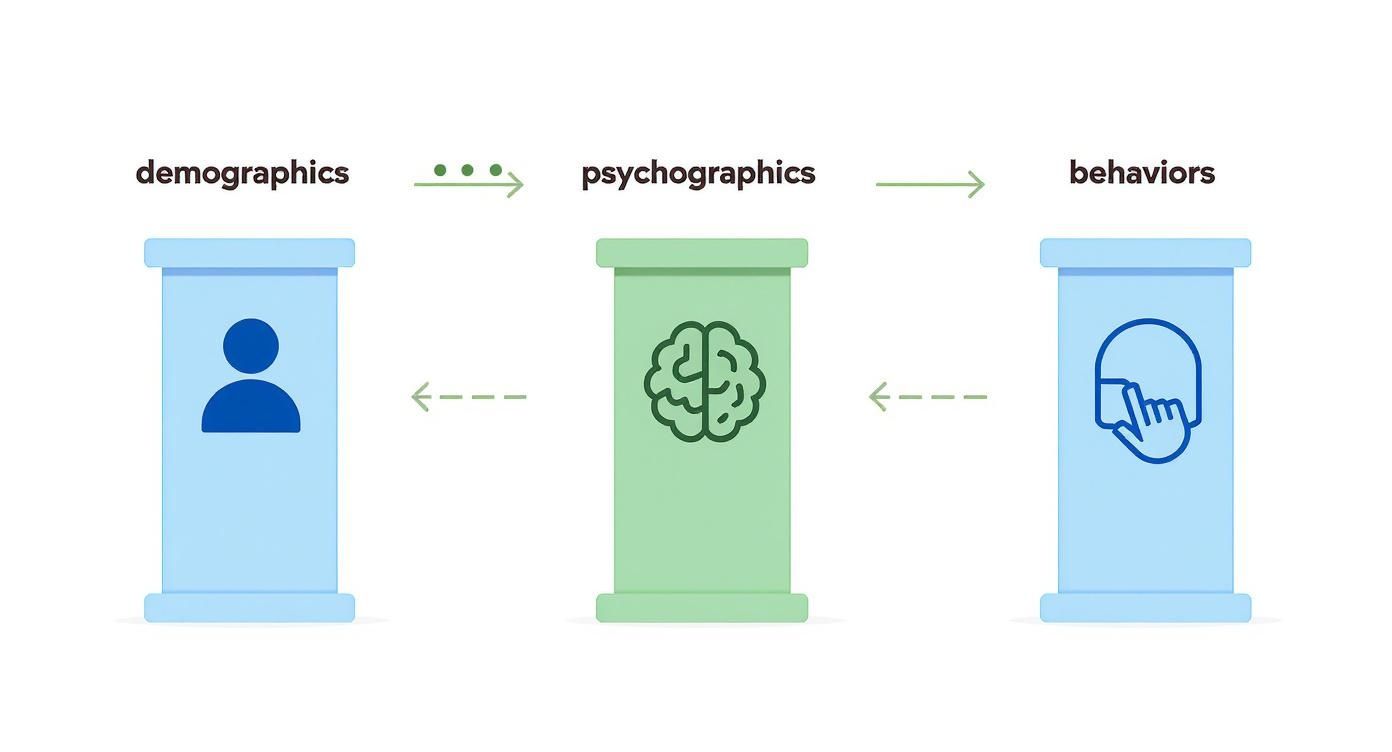
This simple visual is a great reminder that you need to know who your users are, why they do what they do, and how they act. One piece without the others leaves you with a blind spot.
Method 1: Actually Talk to People (Customer Interviews)
Want the real story? Just ask for it. Customer interviews are the single most direct way to get inside your audience's head. Think of them as casual conversations, not formal interrogations. The goal is to uncover the deep-seated frustrations and desires that a multiple-choice survey could never capture.
Find 5-10 people who seem like a perfect fit for your idea. Get on a call. And listen. Your main job here isn't to pitch your product—it's to understand their world.
Example questions for an interview:
- "Walk me through the last time you dealt with [problem]." This uncovers real-world context and emotion.
- "What's the most frustrating part of that process?" This helps you pinpoint the most painful part of the problem.
- "What have you tried to solve this before?" This reveals their current solutions and what they're willing to pay for.
Method 2: Validate Your Hunches (User Surveys)
Interviews give you rich, qualitative insights. Surveys give you quantitative scale. They’re the perfect way to see if the patterns you spotted in those one-on-one chats hold true across a much larger group.
Tools like Typeform or Google Forms make this super easy to set up. Just remember to keep it short and sweet. A high completion rate on a 5-question survey is way more valuable than a handful of responses on a 20-question beast.
> The secret to a good survey is asking unbiased questions. It's easy to accidentally fish for the answers you want. Instead of asking, "Wouldn't a faster reporting tool be amazing?" try something like, "How do you handle reporting right now, and what are the biggest bottlenecks you face?"
Method 3: Eavesdrop Ethically (Social Media Listening)
Guess what? Your potential customers are already online, talking openly about their problems. You just have to know where to look.
Social media listening is all about tuning into platforms like LinkedIn, Twitter, Reddit, or niche industry forums. You're looking for the digital breadcrumbs they leave behind.
Keep an eye out for phrases like "does anyone know a tool for..." or "I really wish [competitor's product] could do..." Those posts are pure gold—unfiltered, candid insights into what the market is desperate for.
Method 4: Let Your Competitors Do the Work (Competitor Analysis)
Why start from scratch? Your competitors have already spent a ton of time and money figuring out who to target. By analyzing their marketing, their messaging, and their customer reviews, you can learn a lot about the audience they're serving.
Here’s a pro tip: go to review sites like G2 or Capterra and read all the 3-star reviews for competing products. These are often the most valuable. The 1-star reviews are usually just angry rants, and the 5-star ones are full of praise. But the 3-star reviews? That's where you find what users like but also what's missing or driving them crazy. It’s a ready-made roadmap for you.
Choosing Your Audience Analysis Method
So, which approach is right for you? It often comes down to your budget, timeline, and what you're trying to learn. Here's a quick cheat sheet to help you decide.
| Method | Best For | Time Investment | Cost |
|---|---|---|---|
| Customer Interviews | Getting deep, contextual "why" insights. | High | Low |
| User Surveys | Validating ideas and spotting trends at scale. | Medium | Low |
| Social Media Listening | Finding unfiltered, real-time customer needs. | Medium | Low-High |
| Competitor Analysis | Understanding the existing market and finding gaps. | Low | Free-Low |
The best strategy is usually a mix of these. Start with interviews to form a hypothesis, then use surveys to validate it with a larger crowd. All while keeping an eye on what people are saying online and what your competitors are up to.
Modern tools have really supercharged this process, using AI to map customer journeys across websites and social media for incredibly detailed insights.
Once you’ve gathered all this fantastic data, the next step is making sense of it. If you’re ready to dive into that, check out our guide on the best SaaS business intelligence tools to help turn your findings into action.
Turning Audience Insights Into Action
Collecting all that data is a great start, but it's only half the job. The real magic happens when you take those raw insights and turn them into concrete decisions that actually shape your product and your marketing. This is where the research starts turning into revenue.
The first step is to distill everything you've learned into a clear Ideal Customer Profile (ICP) or user persona. This isn't just a boring summary document. Think of it as creating a living, breathing character who represents your perfect customer—give them a name, a face, and a story. This profile should pull together their demographics, their motivations, and their behaviors into one relatable person your whole team can get behind.
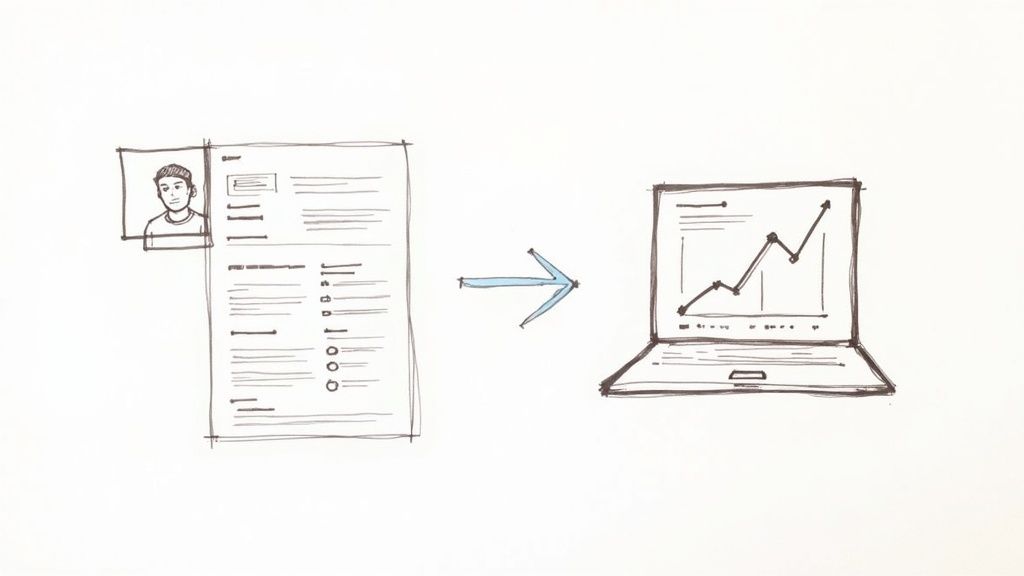
From Persona to Profit
Once you have a crystal-clear ICP, every decision you make becomes easier and more focused on the customer. You're no longer guessing. Instead, you can apply what you know to the most critical parts of your business.
Website Copy: You can use the exact* words and pain points you heard in your interviews to write headlines that make your ideal customer think, "Wow, they get me."
- UI/UX Design: You can design an interface that matches your user's tech skills and daily habits, making your product feel natural and intuitive right from the start.
- Content Strategy: You can create blog posts, guides, and social media updates that directly answer the questions your audience is already typing into Google.
This laser-focused approach is what fuels real growth. Truthfully, a deep understanding of your customer is the foundation for figuring out how to find product-market fit for your SaaS.
A Before and After Example
Let's make this real. Imagine a new SaaS tool for team scheduling. Their initial marketing is pretty generic.
> Before Analysis: "Our powerful scheduling software streamlines team collaboration and boosts productivity."
It's okay, but it's bland. It could be for anyone, which means it's really for no one.
Now, let's say they do their homework. They discover their ideal customer is a manager at a small, remote-first marketing agency. This manager is constantly struggling with time zone confusion, which leads to missed client deadlines.
With that insight, they can change their messaging completely.
> After Analysis: "Stop wasting time on time zone math. Get your remote marketing team on the same page and never miss a client deadline again."
See the difference? It's night and day. The second message speaks directly to a real person with a real, painful problem. This is how you grab someone's attention and turn a casual website visitor into a genuinely interested lead. You're not just selling a tool; you're offering a specific solution to their world.
The shift toward this kind of deep audience understanding is happening globally, especially in North America and the Asia Pacific region. North America currently leads the market, largely because hyper-competitive industries like retail and advertising need these real-time insights to survive. Meanwhile, Asia Pacific is poised for the fastest growth, thanks to a massive, digitally-savvy population that provides a rich environment for this analysis. You can discover more global insights about audience analytics on GWI.com.
A Few Common Questions About Audience Analysis
Even with a clear plan, taking the plunge into audience analysis can feel a bit daunting. SaaS founders often ask about the timing, common traps, and how much it’s all going to cost. Let's tackle some of the most frequent questions to help you get started with confidence.
How Often Should I Do an Audience Analysis?
Think of audience analysis as an ongoing conversation, not a one-and-done task. It's a constant cycle of learning, building, and tweaking.
You'll want to do a really deep dive when you're first validating a new idea or eyeing a new market. That initial research is your foundation. But after you launch, the job isn't over. A good rule of thumb is to check in and refresh your understanding every quarter or at least twice a year.
Why? Because markets change. Customer problems evolve. New competitors pop up. Regular check-ins make sure your product and your marketing speak to who your customers are today, not who they were last year.
What Are the Biggest Mistakes to Avoid?
Most mistakes here don't come from a bad place—they usually stem from good intentions mixed with the wrong approach. Sidestepping these common blunders will make your research so much more powerful.
Here are the big ones to watch out for:
- Running on assumptions, not data. Your gut instinct is a fantastic starting point, but it's not a business plan. You have to back it up with real evidence from real people.
Focusing only on demographics. Knowing your audience is 35-45 years old is one thing. Understanding why* they do what they do is where the magic happens.
- Asking leading questions. A survey designed to prove you’re right is a waste of everyone's time. Instead of asking, "Don't you think this feature is great?" try asking, "Tell me about the biggest challenge you face when you're trying to [accomplish a task]."
- Treating everyone the same. Your audience isn't a single entity. They're a collection of different people with slightly different needs. Segmenting them into smaller groups is the key to connecting with them effectively.
Go into your research with an open mind. Be prepared to be wrong.
> The point of an analysis isn't to confirm what you already believe. It's to uncover the truth about your market. The most valuable insights are often the ones that completely shatter your assumptions.
Can I Do This on a Small Budget?
Yes, absolutely. You don't need a huge research budget or fancy enterprise software to get meaningful insights. In the early days, being scrappy is your biggest asset.
You can learn a ton for little to no money. Start by just talking to people. Interview a few folks in your professional network who seem like your ideal customer. Use free tools like Google Forms to send out a simple survey and see if your interview findings hold up with a larger group.
You can also dig through competitor reviews on sites like G2 or Capterra. Or, hang out in relevant Reddit and LinkedIn communities. These places are goldmines of honest, unfiltered feedback.
How Do I Know if My Analysis Is Working?
The proof is in the pudding. A good audience analysis directly impacts your business in positive ways. If you're not seeing results, the research isn't doing its job.
When you start applying what you've learned, you should see real, tangible improvements.
Are more visitors to your website signing up? Are people using your product more actively? Are customers telling you that your messaging "just gets them"? These are the signs that you're on the right track. The numbers don't lie.
---
Ready to find your next profitable SaaS idea without the guesswork? Proven SaaS uses AI to analyze millions of ads, uncovering validated markets where competitors are already succeeding. Stop building in the dark and start with a data-backed advantage. Discover your next proven idea today at Proven SaaS.
Build SaaS That's
Already Proven.
14,500+ SaaS with real revenue, ads & tech stacks.
Skip the guesswork. Build what works.
Trusted by 1,800+ founders


