

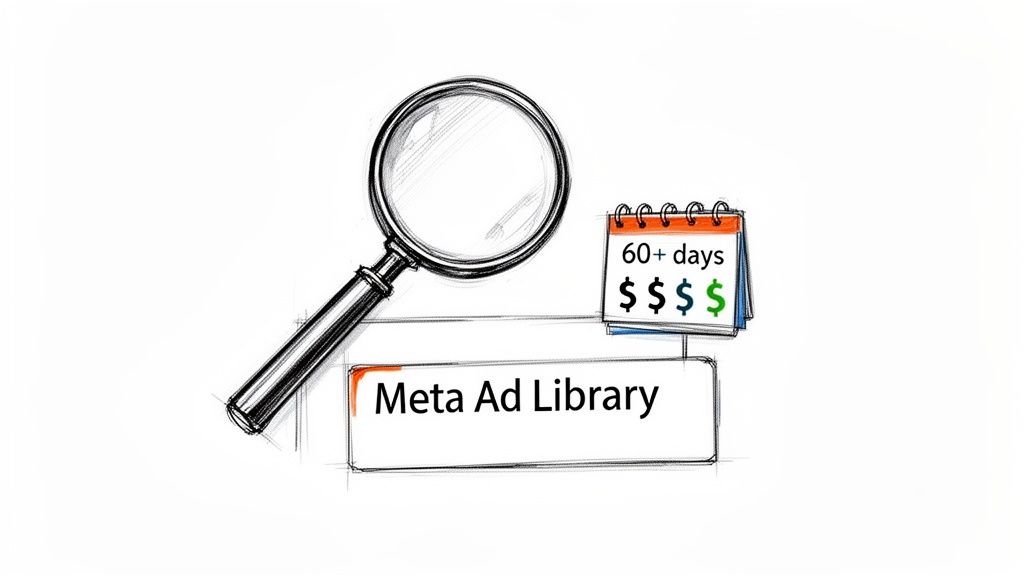
The best way to start tracking competitor ads is to go directly to the free Meta Ad Library. You're not just browsing; you're looking for one specific clue: ads that have been running for more than 60 days. When you find one, you’ve hit the jackpot. It's a clear signal that the ad is making money and the company has found a solid way to get customers.
This simple, data-driven check cuts through all the usual guesswork.
Your Unfair Advantage: What Competitor Ads Are Really Telling You
Let's be honest. Building a SaaS product based on a gut feeling is a quick way to fail. Why guess what customers want when your competitors are already showing you what works? Learning how to track their ads isn’t just a nice skill to have; it's a must-do strategy for any founder who wants to win.
Instead of hoping people will like your idea, you can analyze what they’re already paying for. This gives you a clear roadmap, showing you which niches are profitable and where the money is.
The Power of Ad Longevity
The main idea is simple but powerful: if an ad runs for a long time, it's making money.
If a competitor is spending thousands of dollars on the same ad for over two months, they aren’t just testing. They’ve found a message, an audience, and an offer that works.
Think about the Meta Ad Library. It’s a huge database created because of EU transparency laws, holding over 3.54 billion active ads. With 86% of marketers using Facebook for advertising, it’s a tough place where only the best ads survive.
In fact, research shows a harsh reality: a massive 88.7% of Meta ads fail within the first two months. The rare ones that survive, that small 11.3% that make it past the 60-day mark, are the proven winners you should be studying.
By focusing on ads that have been running for 90 days or more, you're not just looking at ads; you're looking at proven business models. This simple filter cuts through the noise and points directly to profitable opportunities.
From Data to Decisions
This data-first approach helps you de-risk your business idea before you write a single line of code. By seeing what's already working, you can answer the big questions without wasting time and money on failed experiments.
For a closer look at this process, check out our guide to SaaS competitive analysis that actually works.
Understanding these ad dynamics helps you:
- Validate Niches with Confidence: See where others are successfully finding customers.
- Uncover Winning Angles: Analyze your competitors' messaging to find problems you can solve even better.
- Reverse-Engineer Entire Funnels: See their customer journey, from the ad to the landing page.
- Shorten Your Path to Revenue: Enter a market where you already know people are spending money.
This isn’t just about spying; it’s about smart strategy. By the end of this guide, you’ll have a clear process to track competitor ads and turn those insights into a solid product plan.
How to Read the Signals from Competitor Ads
When you find a company running ads consistently, the number of ads they have live tells you a lot about their budget and confidence. You can quickly figure out if a niche is a small experiment or a full-blown, profitable business.
Let’s look at what the volume of ads can tell you.
What Ad Volume Tells You About Their Budget and Maturity
The number of active ads in the Meta Ad Library is one of the clearest signs of a company's investment. You don't need to see their bank statements to get a good idea of where they stand.
Here’s a simple breakdown based on experience:
1-5 Active Ads (The Testers): This is a small, experimental budget, likely around $1,000 to $5,000 per month. For example, a new no-code website builder might run a few ads to see if there's interest. This shows early validation, not a proven success.
6-15 Active Ads (The Growers): This many ads means they've found something that works. Their budget is probably between $5,000 and $20,000 a month. Imagine a CRM for dentists that has found its audience and is now focused on steady growth.
16-30 Active Ads (The Scalers): Now we're talking serious money. This suggests a monthly spend of $20,000 to $50,000. These companies have a successful system for getting customers and are trying to dominate their market.
31+ Active Ads (The Leaders): Anyone running this many ads is a market leader with a budget often over $50,000 a month. Think of big players like Mailchimp or HubSpot. They have a sophisticated, data-driven marketing machine.
These numbers are based on an analysis of over 47,000 ads. When you search for 'email marketing tool' and see a competitor with 50+ active ads, you’re looking at a multi-million dollar business. For more on ad spend, check out the research from Mida.so on the Meta Ads Library.
Here's the bottom line: a high ad count means high confidence. Companies don't spend big unless they know it’s working.
Why Creative Diversity Is a Signal of Sophistication
Beyond just the number of ads, the variety in their ads tells an even more interesting story. A smart marketing team tests many different ideas to find what connects with their audience.
As you look at a competitor's ads, watch for this kind of variety:
Multiple Copy Angles: Are they testing different headlines? For example, one ad might say, "Save 10 hours a week," while another focuses on a pain point like, "Stop losing track of projects." This is a classic sign of a team that’s carefully optimizing its message.
A Mix of Ad Formats: If you see a mix of static images, carousels, and videos, you're looking at a well-funded company. They're testing which format gets the most attention and the cheapest clicks.
Different Creative Styles (UGC vs. Polished): Are they using authentic-looking videos from their customers (user-generated content or UGC)? Or are their ads polished, professional videos? Testing both shows they understand what works on social media, as UGC often performs very well.
This level of creative variety is a clear sign of a data-driven marketing team with a serious budget. It shows they have the resources to run complex tests and are always improving their strategy.
Your Practical Workflow for Ad Strategy Analysis
Alright, let's get practical. To get real value from tracking competitor ads, you need a repeatable process that filters out the noise and gives you actionable information. This isn't about just scrolling through ads; it's about methodically breaking down your competitor's entire customer acquisition plan.
The goal is to understand the why behind their ads. What problems are they solving? What promises are they making? By breaking down their approach, you can map their entire sales funnel and find gaps where your product can win.
Finding the Right Competitors to Watch
First, you need to focus. Don't just type a known competitor's name into the Meta Ad Library. Instead, think like your ideal customer. What would they search for to solve their problem?
For example, try searching for solution-focused phrases like:
- 'AI email tool' to see who is advertising for email automation.
- 'SaaS project management' to find the key players in the productivity space.
- 'No-code website builder' to discover who is targeting non-technical founders.
This simple shift immediately shows you who is spending real money to attract the same customers you want. You'll find not just the big names, but also the smaller competitors fighting for a piece of the market.
Taking Apart Their Messaging and Creatives
Once you have a list of competitors, it's time to study their messaging. What story are they telling? A company running 50+ ads isn't guessing; they are systematically testing different ideas to see what works.
Look for common themes in their ad copy. Are they focused on saving time, cutting costs, or increasing revenue? The answer tells you which pain points are most important to their customers.
Next, look at their visuals. Are they using lots of customer testimonials, or do they prefer polished, professional videos? For example, a heavy use of user-generated content (UGC) is a strong sign they're building their brand on trust and authenticity—a powerful strategy.
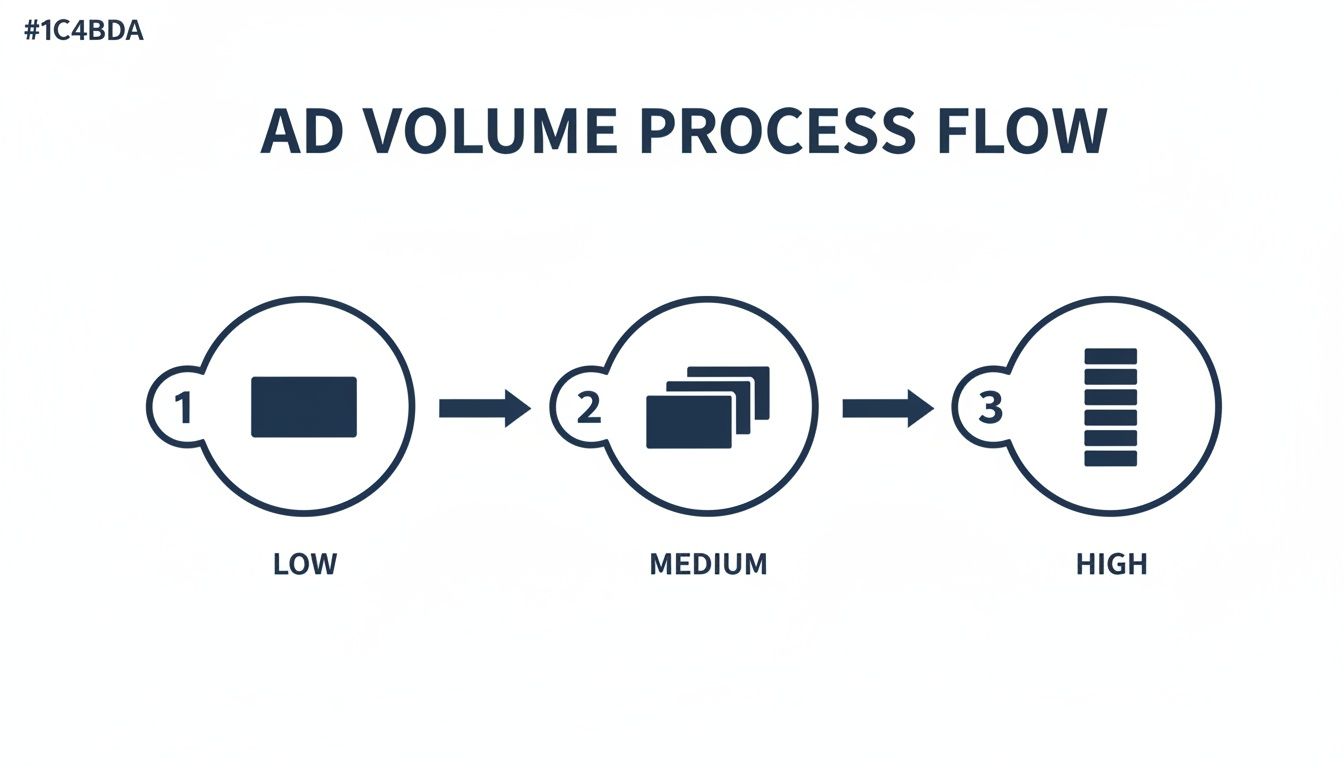
As this simple visual shows, a higher ad volume usually means a more mature and well-funded marketing strategy.
Analyzing Their Offers and Funnels
An ad is just the first step. The real conversion happens on the landing page. Click on their best-performing ads—the ones you see running for weeks—to see where they send people. This is how you map out their entire customer acquisition funnel.
Pay attention to the offer. Is it a free trial, a product demo, or a free plan? For example, you might notice a competitor offering the "first month free," a common tactic to lower the barrier for new users to sign up.
A high-performing campaign must have a seamless connection between the ad's promise and the landing page's message. If an ad promises to "simplify your bookkeeping," the landing page better deliver on that promise with a clear headline, customer testimonials, and an obvious call-to-action button.
By studying this connection, you can reverse-engineer their entire strategy. To automate some of this work, check out our guide on the 12 best Facebook ad spy tools for SaaS founders. This workflow gives you a powerful blueprint, revealing not just what your competitors are doing, but how they’re turning clicks into customers.
Reading Between the Lines to Figure Out What's Profitable
The Meta Ad Library gives you a front-row seat to your competitor's marketing, but it won't show you their return on investment (ROI).
Fortunately, you don’t need to see their dashboard to figure out if an ad is making them money. The single most important clue is ad longevity.
Think about it: when a new ad pops up and disappears a few weeks later, it probably wasn't working. But when an ad runs for months? That’s not an accident. That ad is profitable.
This simple insight is your secret weapon. You get to learn what works without spending a dime of your own money on testing.
Why Ad Longevity Is Your Best Proxy for Profit
No sane company keeps spending money on an ad that's losing money. It's that simple. If an ad has been running for over 90 days, it’s almost certainly profitable. This is especially true when you realize just how many ads fail.
A 2025 study of over 47,000 ads found that a massive 88.7% of them fail within the first 60 days. That means only a tiny fraction—just 11.3%—make it past the two-month mark. These are the ads you need to study. You can find more details in this complete guide to the Meta Ad Library.
By focusing your analysis only on these long-running campaigns, you filter out all the failed experiments and focus on the proven winners. This simple rule lets you reverse-engineer a successful marketing strategy.
Following this approach gives you a huge advantage. Instead of guessing which messages might work, you can analyze the ones that have already been proven effective by your competitor's budget.
Reverse-Engineering Winning Creatives and Copy
Once you've identified these "survivor" ads, it's time to figure out why they're working so well. This is how you learn the specific creative formats and copy styles that are winning in your niche.
As you analyze these ads, look for consistent patterns:
- Dominant Creative Formats: Do you see a lot of user-generated content (UGC)? Data often shows UGC performs much better than branded content, sometimes having a 50% higher survival rate. Or maybe carousel ads are their go-to, lasting 35% longer than single-image ads in some SaaS markets.
- Recurring Copy Hooks: Pay close attention to the headlines. Are they short and to the point? The ideal length for ad copy is often between 20-40 words, which has been shown to double the chances of an ad surviving past 60 days.
- Clear Calls-to-Action: What are they asking people to do? Is the main offer a "Free Trial," "Book a Demo," or "Download Now"? The CTA they've settled on is the one that has proven to drive the most valuable actions.
From Observation to Actionable Insights
By tracking which ads stick around, you're not just spying—you're gathering valuable market intelligence. You’re learning which pain points are most urgent, which solutions are most appealing, and which creative styles grab the most attention.
This process gives you a powerful framework for building your own campaigns.
| Signal | What It Tells You | Your Next Step |
|---|---|---|
| Ad runs 90+ days | This ad is profitable and has a message that resonates. | Analyze its core message, pain point, and value proposition. |
| UGC video is common | Authenticity and social proof work for this audience. | Plan to use customer testimonials in your own ad strategy. |
| Short, direct headlines | The audience likes clear, benefit-focused copy. | Test simple, punchy headlines in your own ads. |
This methodical approach turns the Meta Ad Library from a simple directory into a strategic playbook. You get to see the results of thousands of dollars in A/B testing, learn from your competitors' wins, and enter the market with a validated strategy from day one.
Common Mistakes to Avoid When Analyzing Ads
When you start digging into competitor ads, it's easy to get lost or jump to the wrong conclusions. Having access to this much data is a game-changer, but only if you know how to read it correctly. Avoiding a few common traps can make the difference between finding real insights and wasting your time.
Many founders get distracted by flashy ads. But an ad might look amazing and still fail. The real gold is in ad longevity. The ads that stick around for months are the ones actually making money.
Misinterpreting Small Tests as a Full Strategy
One of the biggest mistakes is seeing a few new ads from a competitor and assuming they've made a big strategic change. Most of the time, you're just seeing a small-scale test. A company might run three to five ad variations to see if a new message or audience works.
This is just an experiment, not a validated strategy... yet.
Treating these small tests as a major campaign is a big mistake. It can trick you into wasting your own money chasing a temporary experiment. Instead, wait and see. If they launch more ads with the same message or increase the budget, that’s when you know they've found something that works.
The real signal isn't the test itself, but how the company reacts to the results. If a competitor scales a small experiment into a 15+ ad campaign, that’s your sign they've struck gold.
Ignoring Creative Diversity as a Budget Signal
Looking at ad volume alone is another common mistake. The total number of ads is a good starting point, but the diversity of those ads tells a much richer story. For example, a competitor running 20 ads that are all slight variations of the same image is very different from one running 20 ads with completely different formats.
When you see a company testing a wide mix of creative types, it usually means they have a more sophisticated and well-funded marketing team.
- User-Generated Content (UGC) Videos: This shows they understand the power of authenticity.
- Polished Studio Creatives: This indicates a serious production budget.
- Simple Static Images or Carousels: This suggests they're testing basic offers and messages.
A competitor testing all of these formats is a powerful signal. It tells you they likely have a large budget and are working hard to optimize their campaigns. They aren’t just trying to find one winning ad; they’re building a powerful system to acquire customers.
The Dangers of Blindly Copying Ads
This is the most tempting mistake: just copying a competitor's successful ad. You see an ad that's been running for 90+ days, so you create a similar version and hope for the best. This approach almost never works.
Why? Because you're missing the context behind that ad's success. You don't know their specific audience targeting, their bidding strategy, or the value of the customers that ad brings in. Their "winning" ad might only be profitable because it's aimed at a very specific customer segment that you can't reach.
So instead of copying, deconstruct. Analyze the core pain point they're addressing, the value they're promising, and the offer they're making. Use those insights to inform your own unique creative strategy. Real success comes from understanding the "why" behind their ad, not just the "what."
Turning Your Insights Into a Confident MVP
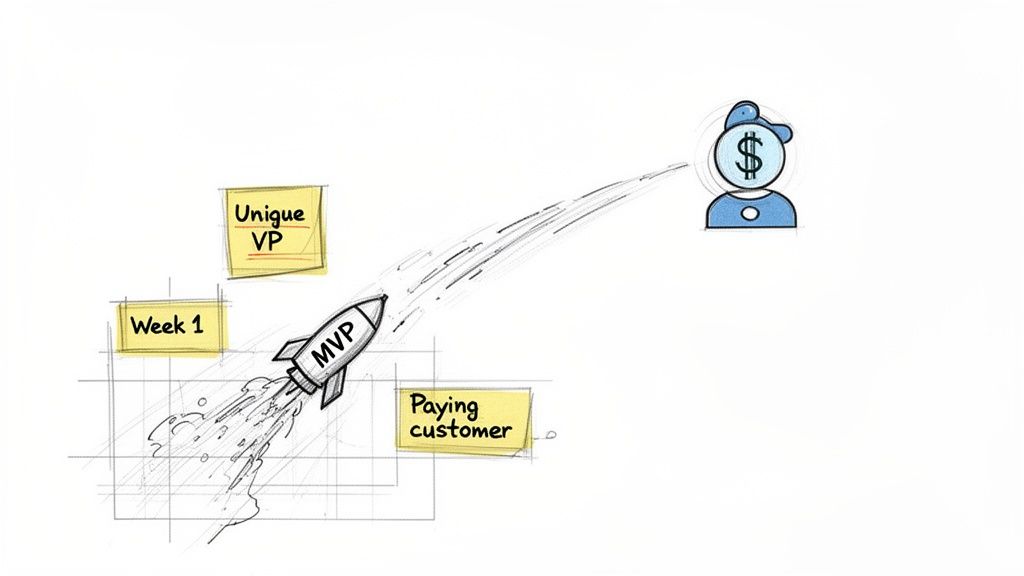
This is where your research pays off. The information you've gathered from competitor ads is a roadmap for building a SaaS product you know people are already buying. You're translating their successful campaigns into a plan for your own Minimum Viable Product (MVP).
This process removes much of the guesswork. Instead of building on a hunch, you’re launching into a market where customers are already spending money. Think of this data as your shortcut from a raw idea to your first paying customer.
Defining Your Unique Angle
Your MVP doesn’t need to do everything your competitors do. It just needs to solve one problem exceptionally well or serve a specific group of customers. Your ad analysis is the perfect tool for finding these opportunities.
Start by asking these questions:
- What problems do their best ads mention over and over? This tells you what's most urgent for their audience.
- What is the core promise in their most successful ads? This is the value proposition that is clearly working.
- Is there a type of customer their ads seem to be missing? For example, maybe their messaging is for big companies, leaving an opening for a tool built for freelancers.
Let's say you see competitors spending a lot on ads for "enterprise project management" with complex features. Your MVP could be a simple, fast tool designed just for small creative agencies. You've just used their ad budget to find your niche.
We cover this validation process in more detail in our guide on how to validate a business idea before you waste time and money.
The goal isn't to copy your competitors. It's to find your own unique space in the market. Use their proven messaging as a starting point to create a unique value proposition that solves a problem better or serves a niche more effectively.
This approach flips the traditional building process. You can validate your core idea on day one, define a focused MVP in week one, and launch with the confidence that paying customers are already out there.
Got Questions? We've Got Answers
Once you start digging into competitor ads, questions always come up. Here are answers to some of the most common ones.
How Accurate Are Those Ad Spend Guesses, Really?
They are not an exact science, but estimating a competitor's spend based on their ad volume is a solid industry practice.
The ranges—like $1,000-$5,000 a month for a few ads or $20,000-$50,000 for 16-30 ads—come from analyzing thousands of advertiser accounts. They give you a good directional sense of how much money and confidence a company is putting behind their ads.
For example, a company running 30+ ad variations isn't just experimenting. That's a clear sign they're scaling a customer acquisition system that works.
Can I See Their ROI or How Many Conversions They Get?
No. The Meta Ad Library won't show you private data like conversion rates or return on ad spend (ROAS).
But you can get a powerful clue by watching one simple thing: how long an ad has been running.
An ad that’s been live for 90+ days is almost guaranteed to be making them money. With data showing that 88.7% of ads fail within two months, longevity is the best free proxy you have for positive ROI.
This simple filter helps you cut through the noise and focus only on what's proven to work.
How Often Should I Be Checking Their Ads?
A quick 30-minute check-in once a week is a great habit. It’s frequent enough to catch important changes but not so often that it becomes a burden.
This weekly check-in helps you:
- Spot new campaigns as soon as they launch.
- Catch new messaging angles or offers they're testing.
- Notice which older ads get turned off, a sign they weren't performing.
A simple routine like this keeps you ahead of the curve. Of course, automated tools can also help by alerting you when a competitor makes a big move.
Ready to stop guessing and start building with confidence? Proven SaaS uses AI to analyze millions of ads, surfacing profitable and validated SaaS ideas daily. Find your next great idea today.
Start discovering profitable SaaS ideas on Proven SaaS
Build SaaS That's
Already Proven.
14,500+ SaaS with real revenue, ads & tech stacks.
Skip the guesswork. Build what works.
Trusted by 1,800+ founders


