

How to Validate a Business idea Before You Waste Time and Money
You’ve got a business idea. It feels big, game-changing even. But alongside the excitement, there's a nagging question: "What if I build this and no one comes?" You're right to be cautious. The path from a great concept to a profitable business is littered with good intentions.
Why Most Startups Fail (And How to Make Sure Yours Doesn’t)
The numbers can be scary. Data shows that up to 90% of startups fail, with many not making it past their first year. You can see the full breakdown of startup failure rates at Failory.com.
But the most important stat isn't that they fail, but why. The top reason, accounting for about 42% of startup deaths, is "no market need." Founders fall in love with their solution, spend months or years building it, and launch to the sound of crickets. It's a preventable tragedy.
The Power of Idea Validation
The good news? You can avoid this. The secret is validation—a simple process of testing your idea against reality before you go all-in. Think of it less like a pass/fail exam and more like being a detective, looking for clues that you're on the right track.
This guide provides a clear, step-by-step framework to do just that. It's designed to save you time, money, and the heartbreak of building something nobody wants. It’s about moving from "I think people want this" to "I know people will pay for this."
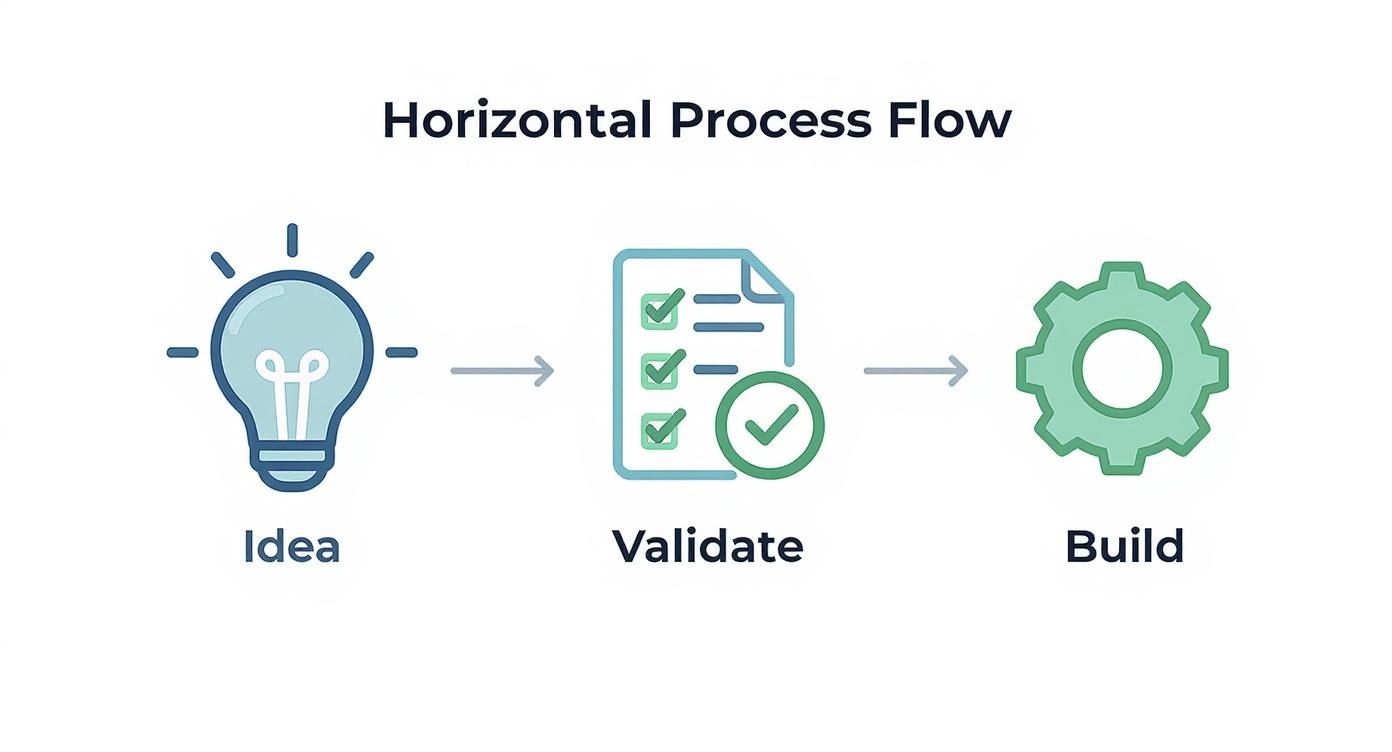
This simple visual explains the entire philosophy:
That 'Validate' step is the game-changer. Jumping straight from 'Idea' to 'Build' is the classic, costly mistake. By validating first, you prove people want what you're selling before you invest heavily in creating it.
> The goal of idea validation isn't to prove you're right. It's to find out what is right. This is a process of discovery, not just confirmation.
Over the course of this guide, we’re going to walk through the entire validation playbook.
Here's a simple, powerful process we will unpack throughout this guide.
Our Validation Framework at a Glance
| Validation Stage | Objective | Key Activity |
|---|---|---|
| Stage 1: Framing | Define what you think is true. | Write down your Problem, Solution, and Customer. |
| Stage 2: Research | Find the first signs of life. | Run a small, targeted ad campaign to a landing page. |
| Stage 3: Experiment | See if people will commit. | Ask for an email address in exchange for early access. |
| Stage 4: Interviews | Understand the "why." | Talk to the people who signed up to hear their stories. |
| Stage 5: Analysis | Check if people will pay. | Run a pre-sale experiment or ask for a letter of intent. |
| Stage 6: Decision | Make a data-backed choice. | Use a go/no-go scorecard to decide your next move. |
This process gives you a repeatable system for testing any idea.
We'll cover how to:
- Frame your idea as simple, testable assumptions.
- Find demand signals using small, inexpensive ad campaigns.
- Run quick experiments with simple landing pages and pre-sale offers.
- Conduct customer interviews that get you honest, valuable feedback.
- Make a confident go/no-go decision based on real evidence.
Following these steps ensures you're building a business on a foundation of proven customer need, giving your brilliant idea the best possible shot at success.
Nailing Down Your Idea and Core Assumptions
Before you test anything, you need to get crystal clear about what you're actually testing. A vague idea like "a better tool for designers" is impossible to validate. The first step is to break your big idea down into small, specific statements.
This isn’t just homework; it’s about turning your gut feeling into a set of hypotheses. It forces you to pinpoint the specific beliefs that must be true for your business to work. If you skip this, your test results will be a messy, confusing pile of data.
Frame Your Idea with the Problem-Solution-Customer Model
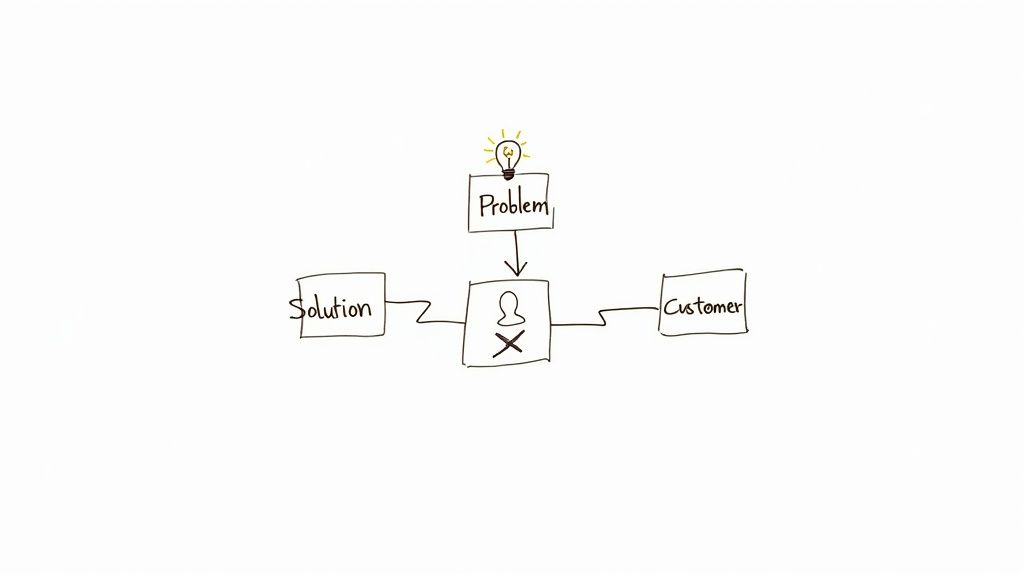
A great way to gain clarity is the Problem-Solution-Customer (PSC) framework. It’s simple: you just write one clear sentence for each of those three areas. This helps you focus on what really matters.
Let's use a real-world example. Imagine your idea is a SaaS tool that helps freelance writers manage their client deadlines and invoices.
Here’s how you could break that down using the PSC model:
- The Problem: Freelance writers struggle to keep track of multiple client deadlines and chase overdue invoices, which creates stress and hurts their cash flow.
- The Solution: A simple, all-in-one dashboard that shows upcoming deadlines, sends automated invoice reminders, and tracks payments.
- The Customer: The target user is a full-time freelance writer who has been in business for 1-3 years and juggles 5-10 clients at a time. They are likely using a messy combination of calendars, spreadsheets, and sticky notes right now.
Writing this down is surprisingly powerful. It forces you to ask hard questions. Is this a real, "hair-on-fire" problem, or just a minor annoyance? Is your solution truly better than a simple spreadsheet? And have you identified a specific group of customers who feel this pain acutely? Getting this customer segment right is crucial. For more on this, check out our guide on how to find profitable niches.
> A great idea is just a collection of unproven assumptions. Your job is not to defend the idea, but to ruthlessly test the assumptions.
Turn Your Assumptions into Questions You Can Actually Answer
Once you have your PSC statements, rephrase them as questions. This is where validation begins. You're building a bridge from an idea in your head to facts you can gather from the real world.
Let's stick with our freelance writer tool. The hypotheses we just wrote now become a clear research plan:
Do freelance writers really* struggle with this, or have most of them already found a good system?
Would they actually pay* for a new tool, or is their current "good enough" solution free and easy?
- Is "full-time freelance writer" the right target, or is this actually a bigger problem for part-time writers?
These aren't just things to think about. Each question points to a specific experiment you need to run or a conversation you need to have. This disciplined approach keeps you focused on getting real insights, not just feel-good feedback. The answers will tell you whether you've got a business on your hands or just a clever invention.
Alright, you’ve framed your idea and listed your core assumptions. Now for the exciting part: seeing if anyone out there actually cares. This is where we move from theory to real-world evidence.
The best part? You can get a strong signal of demand without writing a single line of code or spending a fortune.
The entire goal here is to run a simple, low-cost experiment. We want to see if your target audience will take one small action—like giving you their email address—in exchange for learning more about your solution. It’s the first real test of your value proposition.
Put Up a Digital Storefront
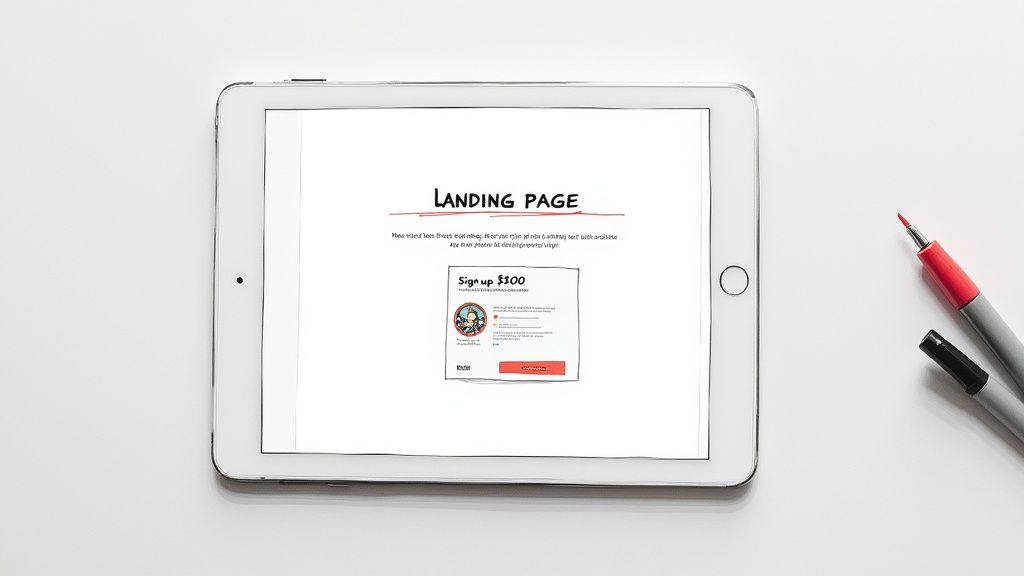
Your first move is to create a simple one-page website, often called a landing page. Think of it as a movie poster for your product. Its only job is to clearly state the problem you solve and convince visitors to sign up to hear more.
You don't need a developer. Tools like Carrd, Webflow, or Leadpages let you build a professional-looking page in a few hours.
Your page only needs three things:
- A Killer Headline: This must grab your target customer's attention by speaking directly to their pain. For our freelance writer tool, a headline could be: "Stop Chasing Invoices. Get Paid on Time, Every Time."
- A Clear Value Prop: In a few short sentences, explain what your product does and who it's for. Focus on the benefit, not the features. Instead of "Our tool has automated reminders," try "Automated reminders ensure you never have to send an awkward 'just checking in' email again."
- One Single Call-to-Action (CTA): This is critical. Don't add links to your social media or blog. The only goal is to get an email address. A simple button that says "Get Early Access" or "Join the Waitlist" is perfect.
- Platform: Facebook
- Audience: People with "Freelance Writer" as their job title, who also like pages such as "Copyblogger" or "Freelancers Union."
- Click-Through Rate (CTR): This tells you what percentage of people who saw your ad actually clicked on it. A good CTR means your ad's message is resonating with the audience.
- Cost Per Sign-Up (or Cost Per Acquisition): This is the most important metric. Calculate it by dividing your total ad spend by the number of email sign-ups you received. This tells you exactly how much it costs to acquire one interested person.
- Emotion: Do they sound genuinely frustrated or annoyed when talking about their current process? Real pain has an emotional signature.
- Workarounds: Are they using three different apps and a paper notebook to do one job? These are huge clues that a better solution is needed.
- Budget: Are they already spending money trying to fix this (e.g., paying for multiple subscriptions, hiring a virtual assistant)? This is the ultimate validation—it proves the problem is valuable enough to have a budget.
- Pre-Order Now & Get a 50% Lifetime Discount
- Become a Founding Member for $49
- Lock In Early Bird Pricing
- What's the deal? A lifetime discount, early access, a say in the product roadmap—make the offer irresistible.
- When will they get it? Provide a realistic, honest timeline for when you plan to launch the first version.
- What's the risk? A no-questions-asked, 100% money-back guarantee builds immense trust.
- Is the problem a "hair-on-fire" issue? Did your interviews confirm this is a top priority for your customers, or just a minor annoyance?
- Is there real demand? What was your landing page conversion rate and your cost per sign-up? Can you build a sustainable business on those numbers?
- Will people actually pay? How many pre-orders did you get? If none, what did interviews tell you about what they currently spend to solve this problem?
- Go: The signals are strong. The problem is painful, you got sign-ups at a reasonable cost, and people paid you money. You have a green light to start building your Minimum Viable Product (MVP).
- No-Go: The evidence just isn't there. Conversions were low, no one would pay, and interviews revealed the problem isn't a priority. It's time to shelve the idea and move on. You're not starting from scratch; you're starting from experience.
- Pivot: This is the most common outcome. You have mixed signals. Maybe people love the problem but hate your proposed solution. Or maybe you discovered you were talking to the wrong audience. A pivot isn't a failure; it's a course correction. You take what you learned, adjust your idea, and run a new, smarter experiment.
- The price is too high for the value they perceive.
- Your proposed solution is missing a key feature they consider essential.
- They are interested, but their company has a strict process for buying new software.
This setup is intentionally simple. You aren't building a website; you're building a demand-testing machine. Every element should be focused on answering one question: is this idea compelling enough to make someone act?
Run a Small, Targeted Ad Experiment
With your landing page live, you need to get the right people to see it. A small, tightly controlled ad campaign is the perfect way to do this. You don’t need a big budget; many founders get the data they need with just $100 to $200.
The magic is in the targeting. For B2B ideas, a platform like LinkedIn is perfect because you can target people by job title, industry, and company size. For our freelance writer example, Facebook or Instagram might be better, targeting users who follow popular writing blogs or are members of freelancer groups.
A targeted ad campaign for our freelance tool could look like this:
This level of detail ensures your ad is only shown to people who fit your ideal customer profile. It’s far more effective than just shouting into the void. The insights you get from a well-targeted campaign are pure gold. For a deeper dive, our guide on conducting effective startup market research has even more strategies.
Track the Only Metrics That Matter
Once your ads are running, it's tempting to watch vanity metrics like "likes" or "impressions." Ignore them. They don't prove business viability.
You only need to focus on two numbers that tell the real story.
> The point of this experiment isn't to get a thousand sign-ups. It's to collect cold, hard data on whether your message resonates with your target audience enough for them to act.
These are the two metrics to watch like a hawk:
These numbers give you a hard, quantitative baseline for your idea's potential. This whole process typically takes 2 to 4 weeks and can cost between $150 and $500. It's vital to decide on your success criteria before you start. For example, you might aim for a cost per sign-up under $10. This prevents you from endlessly throwing money at an idea that isn't gaining traction.
This process isn't about hitting a home run on your first try. It's about creating a fast feedback loop. If your cost per sign-up is too high, it's not a failure; it's a signal to tweak your messaging, adjust your targeting, or rethink your value proposition. Every experiment, successful or not, gets you closer to an idea with proven, measurable demand.
Running Customer Interviews That Get Real Answers
Your landing page and ads have given you the what—the numbers, the click-through rates, the email sign-ups. But data alone is silent. Now it's time to discover the why.
This is where you talk to the actual people who signed up. These conversations are where you find the deep insights a spreadsheet can never provide.
Let’s be clear: this is not a sales pitch. The golden rule of a good customer interview is: Listen more than you talk. Your goal isn't to convince them your idea is brilliant. It's to understand their world so deeply that you can see if your idea even fits into it.
The Art of Asking Questions That Don't Suck
The quality of your insights depends entirely on the quality of your questions. You have to stop asking questions that fish for compliments ("Don't you think this is a cool idea?") and start asking for facts.
This is the core idea behind Rob Fitzpatrick’s fantastic book, The Mom Test. The premise is that your mom will lie to you about your business idea because she loves you. To get the truth, you have to ask questions that even your mom can't fudge.
This means no more hypothetical questions about the future. Forget asking "Would you use a tool that did X?" People are terrible at predicting their future behavior. Instead, anchor your questions in their past actions.
Here's a simple comparison:
| Don't Ask This (Fluff) | Ask This Instead (Facts) | Why It Works |
|---|---|---|
| "Do you think this is a good idea?" | "Tell me about the last time you had to track a client invoice." | It focuses on a real, past event, not a vague opinion. |
| "Would you pay for a solution like this?" | "What tools are you using for this now? Are you paying for them?" | It anchors the conversation in actual behavior and budget. |
| "Is managing clients a big problem for you?" | "Walk me through your process for onboarding a new client." | It uncovers their real-world process, tools, and frustrations. |
Good questions are open-ended. They encourage people to tell stories. You want to hear about their workflows, their frustrations, and the clever (or clumsy) workarounds they've created. That's where you'll find the pain points your product can solve.
How to Get People on the Phone
Now it's time to email the people on your waitlist. Keep your email short, personal, and focused on learning from them. You're not asking for a sale; you're asking for their expertise.
Here’s a simple template that works wonders:
> Subject: Quick question about [the problem you solve]
>
> Hi [Name],
>
> Thanks for signing up for the waitlist for [Your Project Name].
>
> I'm the founder, and I'm trying to learn more about how freelance writers like you handle client admin. Would you be open to a quick 15-minute chat next week?
>
> I promise this isn't a sales call—I'd just love to hear about your experience.
>
> Thanks,
> [Your Name]
Once you're on a call, your job is to be a journalist, not a salesperson. Start with broad questions. When they mention something interesting, drill down. Your main goal is to get them to tell you a story about a specific time they faced the problem you're trying to solve.
Listening for Problems Worth Solving
As you conduct more interviews, you'll start to notice patterns. You’re listening for signals that you’ve found a problem that is truly painful, not just a minor annoyance.
It's one thing for someone to say something is a "headache." It's another for them to spend 10 minutes passionately describing the convoluted spreadsheet monstrosity they built to manage their clients.
Listen for these green flags:
When you hear multiple people describe the same ridiculous workaround or express the same exact frustration, you're onto something real. You’re no longer just guessing. You’re gathering concrete evidence that the problem is painful, frequent, and that people are actively looking for a better way.
Validating Price and a Real Willingness to Pay
So far, so good. You have email sign-ups and powerful stories from customer interviews. These are great signs that you've found a real problem.
But let's be blunt: interest is cheap. Commitment is what matters. The ultimate test for any business idea is whether someone will pull out their credit card.
It’s time to validate the most important assumption of all: willingness to pay. This is the moment of truth. An email is free, but a pre-order—even a small one—is a powerful commitment that proves you're building something valuable.

This step separates the curious onlookers from your future customers. It’s not just about the money; it’s about getting definitive proof that you've found a problem so painful people will pay to make it go away.
The Ultimate Validation: The Pre-Sale Experiment
The most direct way to test this is with a pre-sale experiment. It's simple: you add a payment button to your landing page. You’re being completely transparent and making an honest offer to your most interested prospects.
Your call-to-action changes from a soft "Join the Waitlist" to a clear transaction:
You can connect this button to a simple payment processor like Stripe or Gumroad. The setup is fast and doesn't require any custom code. The goal is to create a frictionless way for someone to make a financial commitment.
This isn’t about tricking people. It's about getting the strongest possible signal that you're building something people will actually buy.
> A pre-sale isn't meant to fund your entire company. It’s about collecting undeniable evidence. Even a handful of pre-orders is an incredible leading indicator of product-market fit.
Crafting an Honest and Compelling Offer
Transparency is everything here. You must be crystal clear that this is a pre-order for a product that isn't built yet. People are often happy to support an early-stage idea if they trust the founder and believe in the vision.
Make sure your landing page copy clearly answers these questions:
When you frame the offer this way, the pre-order feels less like a risky purchase and more like a partnership. You're not just selling a product; you're inviting them to be part of the journey. This is how you build a loyal base of early adopters who are invested in your success.
Interpreting the Results: What Success Looks Like
Don't fixate on getting hundreds of sales. At this stage, you're looking for proof, not profit.
Honestly, even 5-10 pre-orders from strangers is an incredibly strong signal. It proves your value proposition is so compelling that people are willing to pay for a solution that doesn't even exist yet. That’s powerful.
If you get zero pre-orders, that's also valuable data. It’s a clear sign that you need to go back and rethink your pricing, your messaging, or maybe even the core problem you're solving. It’s far better to learn this now for the cost of a small ad campaign than after sinking six months and thousands of dollars into development.
For larger B2B products, you might not use a payment button but instead ask for a signed commitment. If that’s your world, these letter of intent templates for business can show you how to structure that ask.
Ultimately, this pre-sale data, good or bad, is the most important piece of evidence you’ll collect in your entire validation journey.
Making the Final Go or No-Go Call
You’ve done the work. You have data from your landing page, notes from your customer interviews, and real numbers on whether people will pay. Now it's time to step back, look at all the evidence, and make a decision.
This isn’t about a single magic number. It’s about combining your quantitative data (the what, like conversion rates and pre-sales) with your qualitative findings (the why, like the frustrations you heard in interviews). You need both to see the full picture.
A Simple Scorecard to Keep You Honest
It's easy to let your own excitement cloud your judgment. The best way to stay objective is to use a simple scorecard. It forces you to compare the evidence you've collected against the assumptions you started with.
Your scorecard should answer a few critical questions with hard data:
Laying it all out like this makes it impossible to ignore the facts. A 10% sign-up rate with zero pre-orders tells a very different story than a 1% sign-up rate from a few people who were so excited they paid you on the spot.
> A "no" at this stage is a huge win. Seriously. The entire point of this process is to kill bad ideas quickly. You just saved yourself months, maybe years, of building something nobody was ever going to buy.
The Three Paths Forward
Once you’ve reviewed your scorecard, you'll land in one of three places. None of them are a dead end; they're all progress.
Got Questions? Let's Talk Specifics
Even with a solid plan, you're bound to have questions. Here are answers to some of the most common ones that come up during the validation process.
What’s a Reasonable Budget for Test Ads?
You don't need a huge budget. A range of $100 to $200 is usually enough to get a reliable first signal on demand.
The goal isn't to get hundreds of users. You're just trying to collect enough data to calculate your cost per sign-up. For example, spending $150 to get 15 email sign-ups from a targeted audience gives you a $10 cost per acquisition. That's a real number you can use to project future marketing costs, not just a guess.
People Are Signing Up, But No One's Buying. What Gives?
First, don't panic. This is common and provides incredibly valuable feedback. It's a classic sign that you’ve correctly identified the problem but missed the mark on the solution or the price.
This is your cue to talk to people again. Reach out to everyone who signed up but didn't buy. A simple, personal email asking for 15 minutes of their time can uncover the truth. You'll likely learn things like:
> Key takeaway: A sign-up means you've made them nod their head about the problem. A pre-order means they believe you can actually solve it for them. Your job is to close that gap.
How Many People Do I Really Need to Interview?
Forget about statistical significance. You're looking for patterns, not polling a nation.
A good rule of thumb: after 5 to 10 high-quality interviews with people in your target audience, you'll start hearing the same problems, frustrations, and desires over and over. You’ll be able to finish their sentences.
When you can accurately predict what the next person is going to say about their biggest challenges, you’ve probably learned enough to move forward. It’s about the depth of the conversations, not the quantity.
---
Ready to stop guessing and start building with confidence? Proven SaaS is the unfair advantage for founders who want to find business ideas that are already working. We analyze millions of ads to show you which SaaS companies are spending big to acquire customers, giving you a clear signal of market demand before you even write a line of code. Find your next profitable SaaS idea today at https://proven-saas.com.
Build SaaS That's
Already Proven.
14,500+ SaaS with real revenue, ads & tech stacks.
Skip the guesswork. Build what works.
Trusted by 1,800+ founders


