

Series D Financing: A Clear Guide to Late-Stage Funding
Your company has successfully navigated the early funding stages—Series A, B, and C. You've established product-market fit, scaled your operations, and claimed significant market share. So, what’s the next move? For a select group of high-growth, mature startups, the answer is Series D financing.
This isn't just another funding round. It's the final, strategic push before a major milestone like an Initial Public Offering (IPO) or a major acquisition. Think of it less as building the company and more as preparing it for the world stage.
What Is Series D Financing?
Let's use a simple analogy. If your startup is a rocket, the early funding rounds (Seed, Series A) built the rocket and tested the engines. Series B and C were the powerful boosters that launched you into orbit, proving your business model could fly.
A Series D financing round is the final engine burn that sets your course for a distant destination, like the New York Stock Exchange. It’s for companies that are already on a stable, high-growth path and just need one last major push to reach their ultimate goal.
At this point, you're not experimenting. You have a proven business model, a strong revenue stream, and a clear path to profitability. Investors in a Series D round aren't betting on a dream; they're investing in a well-oiled machine poised for market domination.
The Evolution of Startup Funding
Companies raising a Series D are typically valued in the hundreds of millions, sometimes even billions, of dollars. The capital raised is significant, often $100 million or more, and it's used for specific, high-stakes goals.
The focus shifts from pure growth to strategic positioning. Common objectives include:
- The Final Pre-IPO Push: Strengthening the balance sheet to look attractive for a public offering.
- Making Strategic Acquisitions: Buying smaller companies to gain new technology, talent, or market share.
- Aggressive Market Expansion: Launching massive campaigns or entering new international markets to become the undisputed leader.
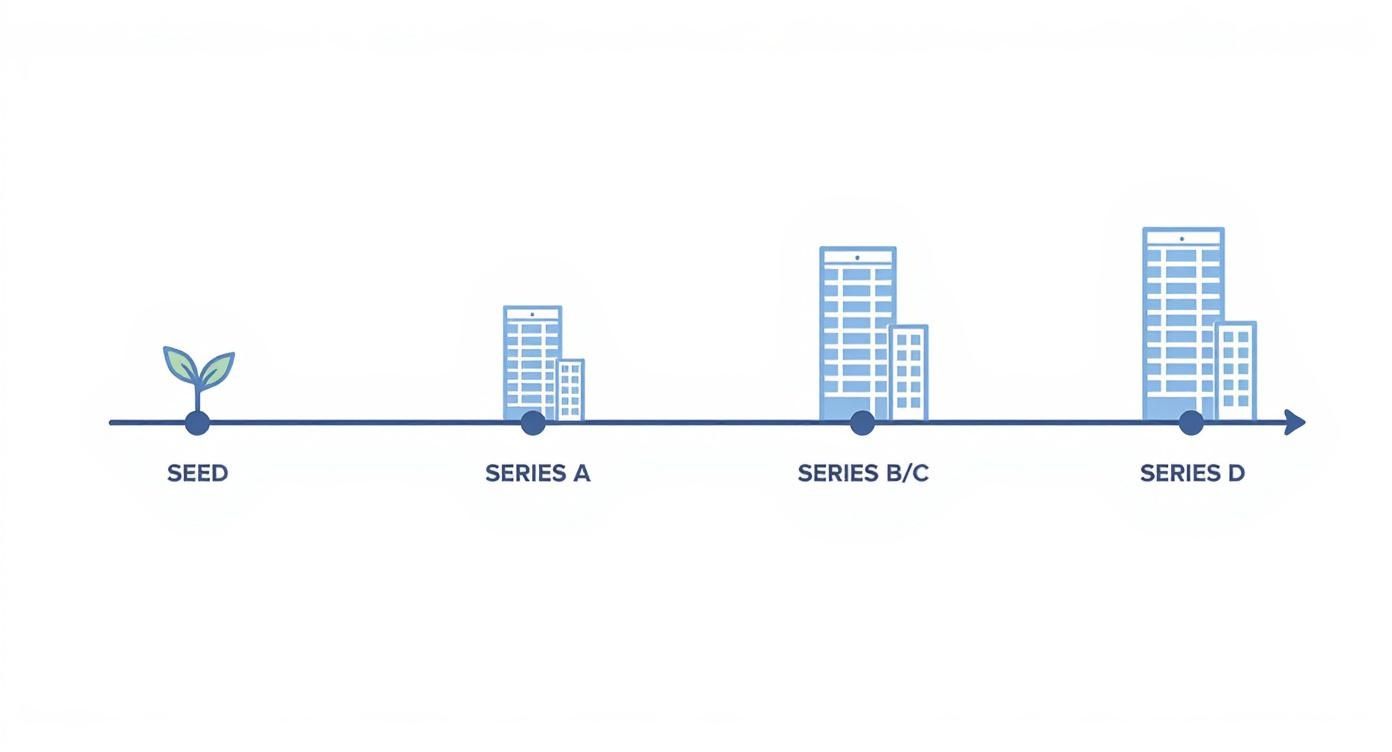
This infographic shows where Series D fits into the startup funding journey, illustrating how each stage builds on the last.
As you can see, by the time a company reaches Series D, it's operating in a completely different league with higher stakes and even higher expectations.
How Series D Differs From Earlier Rounds
The biggest difference from earlier rounds is risk and expectation. Early-stage investors write checks based on a great idea and a strong team. By Series D, investors demand hard data and predictable growth models. They’ve moved past the "what if" and are focused on "what's next."
To put it all in perspective, here’s a simple breakdown of how the funding stages compare.
Startup Funding Stages at a Glance
This table provides a clear side-by-side comparison, showing how a company's needs, goals, and investors change with each round.
| Funding Stage | Company Maturity | Primary Goal | Typical Investors |
|---|---|---|---|
| Series A | Early Stage | Develop product & find product-market fit | Angel Investors, Seed Funds, Early-Stage VCs |
| Series B | Growth Stage | Scale the business & expand user base | Traditional Venture Capital (VC) Firms |
| Series C | Late Stage | Capture market share & achieve rapid growth | Late-Stage VCs, Growth Equity Firms |
| Series D | Pre-IPO/Mature | Prepare for an exit (IPO) or make strategic acquisitions | Private Equity, Hedge Funds, Corporate VCs |
As the company evolves, so do its investors. The scrappy VCs of Series A give way to institutional giants like private equity firms and hedge funds in Series D.
> A Series D financing round signals that a company has graduated from the startup world's frantic growth phase. It’s now stepping into a new chapter focused on sustainable leadership, market dominance, and delivering major financial returns.
The Strategic Goals of a Series D Round
By the time a company reaches Series D, the goal is no longer just to survive. This is a high-stakes play to transition from a successful startup into an undeniable market leader. The money raised is a tool for achieving a critical endgame.
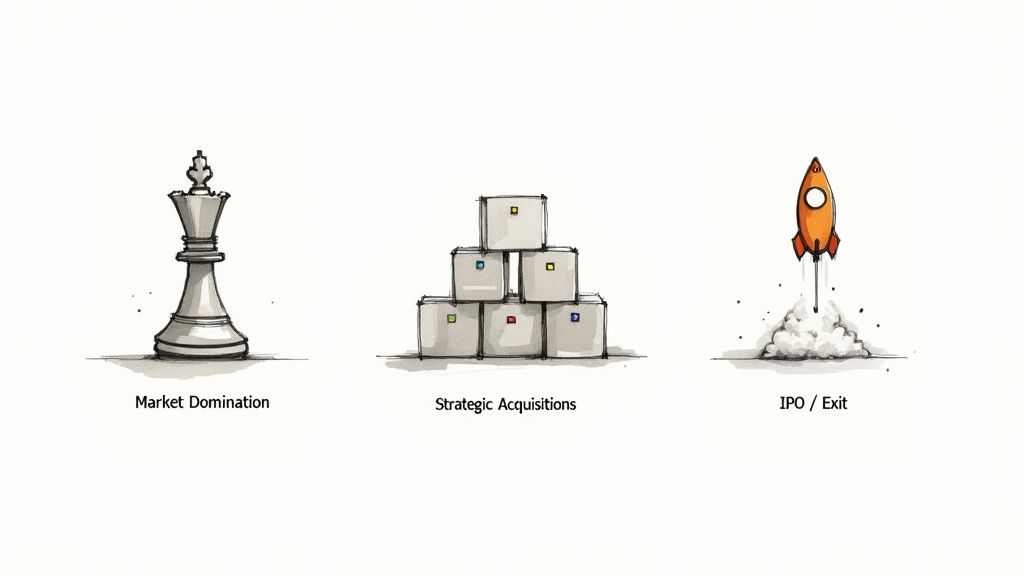
This stage is about dominance. A Series D provides the cash for bold, aggressive moves that smaller competitors can't afford. It’s the final, decisive move in a long game of strategy.
Achieving Market Domination
A primary goal of Series D is to cement the company's place at the top. The mindset shifts from capturing market share to completely owning it. This often means launching an all-out effort to build a competitive moat so wide that no one else can cross it.
The capital funds big-ticket items that were previously out of reach:
- Massive Customer Acquisition: Rolling out huge marketing campaigns to saturate every channel.
- Serious International Expansion: Establishing a real operational presence in key global markets.
- Deepening Product Integration: Building an entire ecosystem around the core product, making it difficult for customers to switch.
This final push is expensive because the goal is to create such a massive lead that competitors are effectively boxed out of the market.
Fueling Strategic Acquisitions
Another powerful use for Series D capital is buying other companies. Why spend years building a new feature when you can acquire it? This strategy accelerates growth and can neutralize a potential competitor in a single move.
These aren't random purchases; they are highly strategic acquisitions targeting companies that offer:
- Complementary Technology: Acquiring innovative tech that would take years to build internally.
- New Customer Segments: Buying a smaller player with a loyal user base in a different vertical.
- Key Talent: Acquiring a team of specialized engineers or seasoned executives.
For example, a fintech company might buy a startup with a unique AI-driven fraud detection tool, instantly upgrading its own product and leapfrogging the competition. To spot these opportunities, companies often start with comprehensive SaaS market research.
The Final Push Before an Exit
Sometimes, a Series D round is the last private fundraising a company will do before a major exit, like an Initial Public Offering (IPO) or a large acquisition. In these cases, the funding is often called “pre-IPO” financing.
> Key Question for Founders: Is this round about strengthening our financials for Wall Street, or making our company the most attractive acquisition target in our industry?
The money is used to polish the company from top to bottom, preparing it for the intense scrutiny of public markets or a corporate buyer. This includes shoring up the balance sheet, fine-tuning for profitability, and ensuring all governance is in perfect order. It's all about commanding the highest possible valuation at the exit.
Who Invests in Series D and What They Look For
By the time a company reaches Series D, the investor profile has changed dramatically. The early-stage VCs who backed your vision are now joined by a new group of investors who are more risk-averse, intensely data-driven, and ready to write much larger checks.
https://www.youtube.com/embed/Da7xADfJkJE
Think of it this way: early investors are talent scouts looking for raw potential. Series D investors are like general managers of a championship team. They aren't looking for potential anymore; they're recruiting proven superstars who can deliver a win. They are backing a predictable growth machine.
The New Players at the Table
The investors for Series D financing are institutional heavyweights with deep pockets and a laser focus on financial performance.
Here’s who you’ll typically find leading these rounds:
- Late-Stage Venture Capital Funds: Specialized VCs that focus only on mature, high-growth companies.
- Private Equity (PE) Firms: Traditionally buyers of established companies, PE firms are increasingly entering late-stage venture rounds.
- Hedge Funds and Mutual Funds: Public market investors who get in early on promising companies before they IPO.
- Corporate Venture Capital (CVCs): Investment arms of large corporations looking for strategic partnerships or future acquisitions.
This trend is growing. There has been a notable increase in late-stage funding as more capital flows toward mature, scaling companies.
What Investors Scrutinize in a Series D Candidate
When these heavy-hitters evaluate a company, their due diligence is relentless. They are looking for cold, hard evidence that your business is scalable, defensible, and on a clear path to a massive exit. The conversation shifts from potential to performance.
> An ideal Series D candidate has graduated from the "growth at all costs" mindset. Investors need a clear, data-backed story showing exactly how the company will achieve profitability and long-term market leadership.
Investors will dig deep into your metrics to see if the story holds up. Your numbers must be solid and predictable.
The Key Metrics on Their Checklist
Here are the non-negotiable metrics and qualities that Series D investors will focus on:
- Predictable and Scalable Revenue: They want to see a consistent history of revenue growth, usually measured by Annual Recurring Revenue (ARR). More importantly, they need proof of a scalable customer acquisition model where the lifetime value (LTV) of a customer is significantly higher than the cost to acquire them (CAC). A healthy LTV/CAC ratio (typically 3:1 or higher) is a must.
- A Clear Path to Profitability: While you may not be profitable yet, you must have a believable financial model that shows exactly when and how you’ll get there.
- Low Customer Churn: A low churn rate proves you have a sticky product that customers value. For SaaS companies, an acceptable annual churn rate is generally below 10%. High churn is a massive red flag.
- A Strong, Defensible Market Position: Investors need to see your "moat"—whether it's proprietary technology, strong brand recognition, or exclusive partnerships that competitors can't easily replicate.
- An Experienced Leadership Team: The founding team must prove it can run a large, complex organization. Investors look for executives who have successfully scaled a company before.
Securing Series D financing means proving you're no longer just a startup. You are a full-fledged enterprise ready to dominate your industry and deliver a massive return on investment.
Navigating Series D Valuations and Deal Terms
By the time you reach a Series D round, calculating your company's valuation is far more complex than in earlier stages. It becomes a sophisticated mix of financial modeling and strategic negotiation.

While a high valuation is attractive, it's only half the story. A sky-high number often comes with investor-friendly deal terms designed to protect their large investment. These terms can significantly impact your control and the final payout for your team.
Understanding Late-Stage Valuation Methods
Series D investors move beyond simple growth metrics. They need to see a clear, defensible path to a multi-billion-dollar outcome.
Here are the methods they typically use:
- Discounted Cash Flow (DCF): This method forecasts your future cash flow and calculates its present-day value. It focuses on your ability to generate actual cash—the ultimate sign of a healthy business.
- Comparable Company Analysis (CCA): Investors look at publicly traded companies similar to yours (your "comps") and apply their valuation multiples to your financials. This grounds your valuation in what the public market considers reasonable.
- Precedent Transactions: This method analyzes recent M&A deals in your industry to benchmark what your company might be worth in a potential acquisition.
Valuation is a specialized field. For software founders, it's helpful to learn more about how to value SaaS companies.
Key Deal Terms You Must Understand
The valuation is just the starting point. The real negotiations happen in the term sheet, which contains clauses that determine who gets paid what in an exit. Ignoring the fine print is a costly mistake.
> A high valuation might feel like a victory, but harsh deal terms can turn that win into a loss for founders and early employees. The details of the term sheet are just as important as the pre-money valuation.
Pay close attention to these two areas:
Liquidation Preferences and Participation Rights
Liquidation preferences determine who gets paid first when the company is sold or liquidated. A standard "1x non-participating" preference is common: investors get their money back before anyone else.
However, be cautious of terms like "participating preferred stock," which allows an investor to get their initial investment back and then take their ownership percentage of the remaining proceeds. This "double-dipping" can dramatically reduce the payout for founders and employees.
Anti-Dilution Provisions
These terms protect investors if you raise a future round at a lower valuation—a "down round."
- Full Ratchet: This is the most punishing version. It reprices an investor’s original shares to the new, lower price, causing massive dilution for everyone else.
- Weighted-Average: This is a more founder-friendly approach. It uses a formula to adjust the investor's price, resulting in less severe dilution.
Understanding these mechanics is non-negotiable. Negotiating fair terms ensures that everyone who helped build the company is rewarded fairly at the finish line.
Real-World Examples of Successful Series D Rounds
Theory is helpful, but real-world examples make these concepts click. Let's look at a few companies that have raised a Series D to see what this funding can achieve. These examples show smart, strategic moves designed to win a market.
Example 1: Airtable's Push for Enterprise Dominance
Airtable, the popular low-code platform, raised a $185 million Series D in 2020. This wasn't about survival; it was a strategic move to push deeper into the enterprise market. The funding, led by Thrive Capital, was aimed at building out features that large corporations need, like advanced security and administrative controls.
- The Goal: Transition from a tool loved by small teams to an indispensable platform for Fortune 500 companies.
- The Outcome: Airtable used the capital to scale its sales and engineering teams, solidifying its position as a leader in the collaborative work management space.
Example 2: Databricks' Bet on the Data Lakehouse
Databricks, a data and AI company, raised a $1 billion Series G in 2021 (a round that functions similarly to a late-stage Series D). This massive round, which valued the company at $28 billion, was about owning a new category: the "lakehouse" architecture.
- The Goal: Fuel global expansion and invest heavily in R&D to make their Lakehouse platform the industry standard for data engineering, data science, and machine learning.
- The Outcome: The funding enabled Databricks to accelerate its growth and prepare for a highly anticipated IPO, demonstrating how late-stage capital can be used to define and dominate a new market segment.
This chart gives you a sense of the funding environment where companies were able to raise such significant rounds.
You can see the massive capital flowing into sectors like Information Technology and Health Care, which shows investor confidence in mature tech companies. Being located in a tech hub often provides an advantage, as seen in lists of venture-backed companies in San Francisco.
What We Can Learn From These Rounds
A few common threads tie these successful Series D stories together:
- A Proven Track Record: Both companies had already demonstrated exceptional growth and a solid customer base.
- A Clear Strategic Purpose: The money was for a well-defined plan to achieve market domination, not just for operational costs.
- Top-Tier Investors: Securing backing from late-stage specialists is a powerful signal to the market that you are a leader.
The data supports this. Series D is a critical step for companies ready to cement their leadership or prepare for an IPO. You can discover more insights about Series D startup trends to get a better feel for the market.
Navigating the Minefield: Common Series D Pitfalls
The path to Series D funding is filled with potential pitfalls. A single misstep can impact your valuation, team morale, and your stake in the business you've built. Knowing the common traps is the first step to avoiding them.
The Dreaded Down Round
One of the biggest fears is a down round—raising money at a lower valuation than your previous round. It signals to the market that something is wrong and can crush employee morale by devaluing their stock options.
Giving Away Too Much of the Company
Dilution is part of every funding round, but a poorly structured Series D can be particularly harsh. Founders and early team members can see their ownership shrink significantly, reducing their potential payout in an exit.
Overlooking the Fine Print in Deal Terms
Valuation gets the headlines, but the real power is in the term sheet. Late-stage investors are experts at writing terms that protect their investment. Clauses like aggressive liquidation preferences or full-ratchet anti-dilution provisions can strip founders of control and future earnings.
This is where you need experienced legal and financial advisors to model different exit scenarios and explain what each term means for you and your team.
> A sky-high valuation means nothing if the deal terms give new investors all the control and a disproportionate share of the rewards. The real win is a deal that’s fair for everyone.
Failing to Manage Expectations After the Deal Closes
Securing the funding is just the beginning. After a Series D, the pressure intensifies. You now have major institutional investors who expect a clear path to an IPO or a massive acquisition.
To get ahead of this, you need a solid plan:
- Build a Clear Roadmap: Show investors exactly how you’ll use every dollar to hit specific milestones.
- Set Realistic Timelines: Be honest about how long it will take to reach key goals.
- Communicate, Communicate, Communicate: Keep investors updated on progress, challenges, and any necessary pivots.
Understanding broader market trends is also crucial. The global venture capital landscape is always shifting, with capital flowing to different regions and industries. Knowing these trends provides context for your own fundraising efforts. You can explore more venture capital investment trends to see how the landscape is changing.
Got Questions About Series D? We’ve Got Answers.
Even after doing your homework, specific questions about Series D rounds often come up. Let's tackle some of the most common ones.
How Long Does a Series D Round Take?
Brace yourself—a Series D is a marathon. Plan for a 6 to 9-month journey from your first investor conversation to when the cash is in the bank. The extensive due diligence at this stage—covering detailed financials, legal audits, and complex term sheet negotiations—takes time.
Is a Series D Always a Good Thing?
Not necessarily. While it usually signals impressive growth, a Series D can sometimes be a "bridge round"—a last-ditch effort to raise cash because the company isn't ready for an IPO but can't survive without more capital. That narrative can be a red flag for investors.
> A Series D should feel like a strategic choice, not a last resort. Your pitch needs to be about playing offense—taking over a market—not just playing defense.
What Happens if We Can’t Raise a Series D?
Failing to close a Series D forces hard conversations. If funding doesn't come through, you'll need to pivot your strategy toward one of these options:
- Gun for Profitability: Cut costs and focus on becoming self-sustaining through your own revenue.
- Look for an Exit: Seek an acquisition by a larger company, which can still provide a solid return.
- Explore Other Funding: Consider alternatives like venture debt, which offers capital without significant equity dilution.
If none of these paths work, you might face a painful "down round" or have to shut down parts of the business. This is why hitting your growth targets after Series C is so critical.
Can We Just Skip It and Go Straight to an IPO?
Absolutely. Some companies with strong, predictable revenue and a massive market opportunity do skip a Series D and head right for a public offering.
However, many iconic companies use a Series D to strengthen their balance sheet and solidify their leadership position. This gives them a war chest to make a bigger splash when they finally go public. The right move depends on your company's financial strength and the current state of the public markets.
---
Don't just guess what's profitable. Proven SaaS gives you a data-backed unfair advantage by showing you the SaaS ideas that are already working. We analyze millions of ads to surface businesses with significant ad spend—a strong signal of real revenue—so you can build your next venture with confidence. Find your next profitable SaaS idea today at https://proven-saas.com.
Build SaaS That's
Already Proven.
14,500+ SaaS with real revenue, ads & tech stacks.
Skip the guesswork. Build what works.
Trusted by 1,800+ founders


