

Forget waiting for a lightning bolt of inspiration. The smartest way to find a business idea is to see what’s already working. It’s about finding where people are already spending money, then figuring out how you can serve that market even better. This isn't about guessing; it's about following the clues.
Stop Guessing and Start Investigating Proven Ideas

The whole "eureka!" moment is mostly a myth. Great businesses usually aren't born from a sudden flash of genius. They come from carefully observing what people are already paying for. The trick is to look for proof that a market exists before you build anything.
One of the best clues you can find is advertising.
Think about it: when a company spends thousands of dollars on ads every single month, they're not just guessing. They are showing you hard proof of a profitable business. They've found a real problem, built a solution people want, and figured out how to reach them.
This data-first approach flips the old brainstorming method on its head. You stop trying to invent ideas in a vacuum and start acting like a detective, hunting for clues that point to real opportunities.
Following the Money Trail
Why is ad spend such a reliable signal? It's simple. No company can afford to waste money on ads that don't bring in customers. A steady, high-budget ad campaign is a clear sign that a business is profitable.
Basically, they're making more money from each customer than it costs to find them. And in the world of online business, this money trail is easier to follow than ever.
The core mindset shift is moving from "What can I build?" to "What problems are people already paying to solve?" By focusing on existing demand, you dramatically reduce the risk of building something nobody wants.
Tools that let you peek into public ad libraries, like the Meta Ad Library, show you exactly who is spending big and staying consistent. For a new founder, this is a goldmine.
Example: Imagine you discover a competitor is spending over $10,000 per month on a single ad campaign. That’s not just a budget—it's a bright, flashing sign that they've found a validated niche with real customers. This method helps you avoid the number one startup killer: building a product nobody needs. For a deeper dive, check out how other key SaaS market metrics reveal growth opportunities.
Comparing Ideation Methods
Choosing how to find your next big idea is a critical first step. The table below breaks down the difference between the old way of doing things and the signal-based approach we're talking about.
| Attribute | Traditional Brainstorming | Data-Driven Signal Analysis |
|---|---|---|
| Starting Point | "What if..." ideas in a vacuum | "What's already working?" |
| Risk Level | High (untested assumptions) | Low (based on proven demand) |
| Effort Focus | Generating brand-new concepts | Identifying existing patterns |
| Key Question | "Can I build this?" | "Can I do this better?" |
| Validation | Post-build (surveys, interviews) | Pre-build (market signals, ad spend) |
| Outcome | Potential for zero market fit | Higher chance of product-market fit |
While brainstorming can be useful, analyzing market signals is a far more reliable way to de-risk your startup from day one. It grounds your entire venture in reality, not just wishful thinking.
Finding Your Signal Where Proven Demand Hides
Forget locking yourself in a room to brainstorm. The best business ideas aren't dreamed up; they're discovered. Think of yourself as an investigator following a trail of clues that lead straight to what people are already paying for.
This simple shift in perspective is everything. Instead of guessing what might work, you're going to find clear, undeniable signals of market demand that are hiding in plain sight. It’s the single best way to de-risk your venture before you even write a line of code.
The Ad Spend Goldmine
Your first stop should be where companies are already spending serious cash to find customers. Public ad platforms, especially the Meta Ad Library, are treasure troves of validated business concepts.
Why? Because a company consistently spending thousands on ads is screaming one thing: this business makes money.
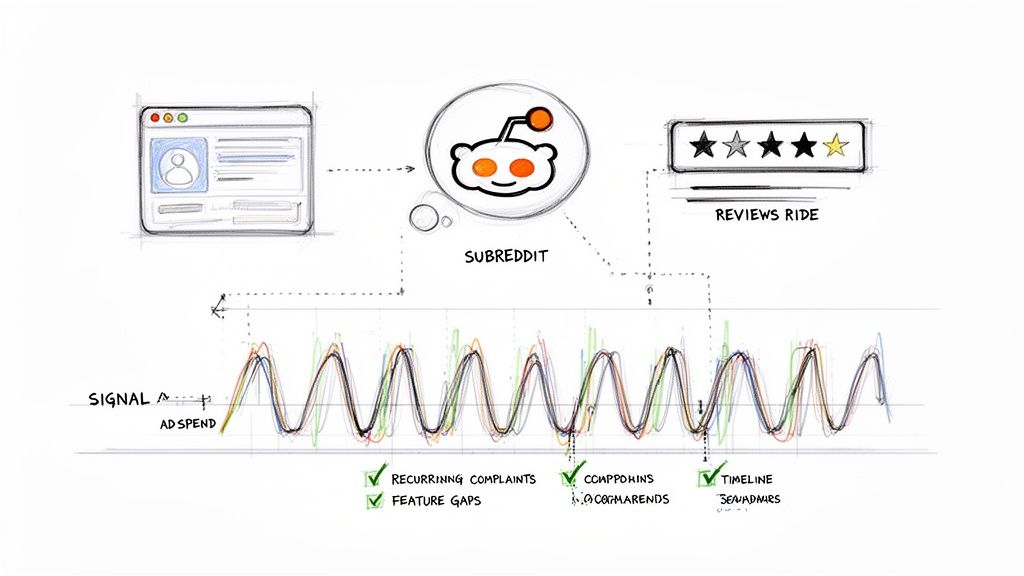
This library shows you the exact messaging, visuals, and offers that are converting customers right now. When you start seeing patterns, you're looking at pain points that are real enough for businesses to throw significant marketing budgets at.
Manually digging through ads is a solid start, but the real magic happens when you track sustained ad spend over time. Modern tools can automate this, flagging companies that have been running the same campaigns for months. That’s the ultimate validation—proof they've cracked a profitable marketing channel and, by extension, a profitable business. It’s the strongest demand signal you can possibly find.
Digging into Niche Communities
Beyond ads, your future customers are already online talking about their problems. All you have to do is listen.
Niche online communities are goldmines for unfiltered feedback and raw business ideas.
- Specific Subreddits: Dive into places like
r/ecommerce,r/saas, orr/sysadmin. Look for posts where people complain about their current tools, ask for software recommendations, or share clunky workarounds. - Indie Hackers Forums: This is where founders build in public. The discussions are packed with insights on feature gaps, underserved markets, and problems that smart people are actively trying to solve.
- Facebook Groups: Search for groups dedicated to specific job roles or software, like "Shopify Experts" or "HubSpot Power Users." The questions and complaints you'll find there are direct signals of unmet needs.
The trick is to look for repetition. One person complaining is just an anecdote. But ten people complaining about the same missing feature in a popular app? That's a business idea.
If you want a more structured way to tackle this, we have a whole guide on how to find profitable niches that actually work.
Decoding B2B Review Sites
Finally, B2B software review sites like G2 and Capterra give you a structured look at what customers love—and hate—about existing products.
But here's a pro tip: ignore the five-star reviews. The real insights are buried in the two- and three-star feedback.
When you're sifting through these reviews, keep an eye out for these signals:
- Recurring Complaints: Are users constantly mentioning a clunky UI, bad customer support, or a feature that’s always broken?
- Feature Gaps: Look for phrases like "I just wish it could do X" or "It's great, but it doesn't integrate with Y." These are literally feature requests.
- Underserved Segments: Pay close attention when a reviewer says something like, "This is great for a big enterprise, but it's way too complex for my small team." That's your cue to build a simpler, more focused solution for that exact customer.
This whole process turns ideation from a wild guess into a data-driven exercise. By focusing your search on signals from companies already spending $10K+ monthly on ads, you're tapping into proven revenue machines, not just another trend.
How to Turn Market Signals into SaaS Concepts
You've done the detective work. You’ve sifted through ads, forum complaints, and software reviews. Now you have a pile of raw information. But raw signals are just noise until you know how to turn them into an actual business idea.
This is the fun part. It’s where you switch from investigator to architect. Here are three proven methods for turning market chatter into a specific, actionable business idea. These aren’t just theories; they're repeatable systems for finding your unique angle.
The Unbundler Approach
The Unbundler strategy is simple and elegant. You find a big, complicated, all-in-one software and carve out one specific feature. Then you build a simple, focused product around that single function, targeting a niche audience that is overwhelmed by the original platform.
Think about software giants like HubSpot or Salesforce. They do a million things, but many customers pay for the whole expensive package just to use one or two key features. That's your opportunity.
Example: Imagine you're reading G2 reviews and notice HubSpot users consistently complain about how clunky the landing page builder is.
- The Signal: People keep complaining that a core feature inside a big software suite is too complicated or frustrating to use.
- The Idea: You could build a super-simple landing page builder that integrates perfectly with HubSpot’s CRM. It would offer just the essential tools small businesses need, without the extra bloat.
The beauty of this approach is that you're not trying to create a new market. You're simply serving an existing, paying market better by solving a specific frustration.
The Pickaxe Play
Remember the gold rush? The people who consistently got rich weren't the ones digging for gold. It was the people selling pickaxes, shovels, and sturdy jeans. The Pickaxe Play applies this exact logic to the tech world. You find a booming new industry and build the essential tools that everyone in that space needs to succeed.
Today’s gold rushes are platforms like Shopify, the AI creator economy, or the newsletter boom on platforms like Beehiiv. Instead of competing head-on, you build something that makes life easier for people already on that platform.
This strategy is all about building for a growing ecosystem. You’re tying your success to the platform's growth, which gives you a powerful tailwind right from the start.
Example: You notice a huge surge in creators using new AI video tools. A common headache for them is managing all the video files they're producing.
- The Signal: A new platform or technology is exploding in popularity, creating a new class of businesses and creators.
- The Idea: You could develop a specialized digital file manager built specifically for AI video creators. It could have features to automatically tag assets, manage different project versions, and connect directly to popular AI video tools.
The Verticalizer Strategy
The Verticalizer technique is about taking a general-purpose tool and tailoring it for one specific industry (a "vertical"). A generic tool can never perfectly serve the unique workflows, language, and needs of a specialized profession.
A classic example is a generic CRM. It works okay for many businesses, but it’s not a perfect fit for any of them.
Example: Imagine you're in a subreddit for dental practice owners. You see post after post about how they struggle to adapt their generic CRM to track patient appointments and insurance claims.
- The Signal: A specific professional niche is trying to force a generic tool to fit their industry-specific workflow.
- The Idea: You build a CRM designed exclusively for dental practices. It would come with pre-built fields for patient records, insurance codes, and appointment follow-ups—all using the language dentists and their staff actually understand.
These techniques give you a clear framework for turning data into a solid product concept.
SaaS Idea Extraction Techniques
A summary of proven methods for converting market signals into specific, actionable SaaS business concepts with examples.
| Technique | Core Concept | Example Signal | Resulting SaaS Idea |
|---|---|---|---|
| The Unbundler | Carve out one high-value feature from a large, complex platform and sell it as a standalone product. | Users of a major marketing suite complain that the email builder is too clunky and slow. | A fast, simple, and affordable email builder that integrates with the original platform's contact list. |
| The Pickaxe Play | Build essential tools and services that support a rapidly growing platform or ecosystem. | Thousands of new stores are launching on Shopify, and they all struggle with managing inventory returns. | A "returns management" app specifically for the Shopify App Store that automates the entire process. |
| The Verticalizer | Adapt a successful horizontal software for the unique needs of a specific industry or niche. | Construction firms use generic project management tools but need better ways to track daily site reports and safety compliance. | A project management platform built just for construction, with pre-built templates for daily logs, safety checklists, and equipment tracking. |
Each framework gives you a powerful, repeatable way to process market intelligence. Instead of waiting for a random stroke of genius, you can systematically uncover opportunities that are hiding in plain sight.
Validate Your Idea Before You Build a Single Thing
An idea is just a guess until you prove someone will actually pay for it. Many founders make the same painful mistake: they spend months building a product in secret, only to launch to the sound of crickets.
The smarter path is to run a few quick, cheap experiments to see if your idea has a pulse before you write a single line of code. This isn't about building a perfect product; it's about getting real-world data fast. The only question that matters right now is: "Will people open their wallets for this?"
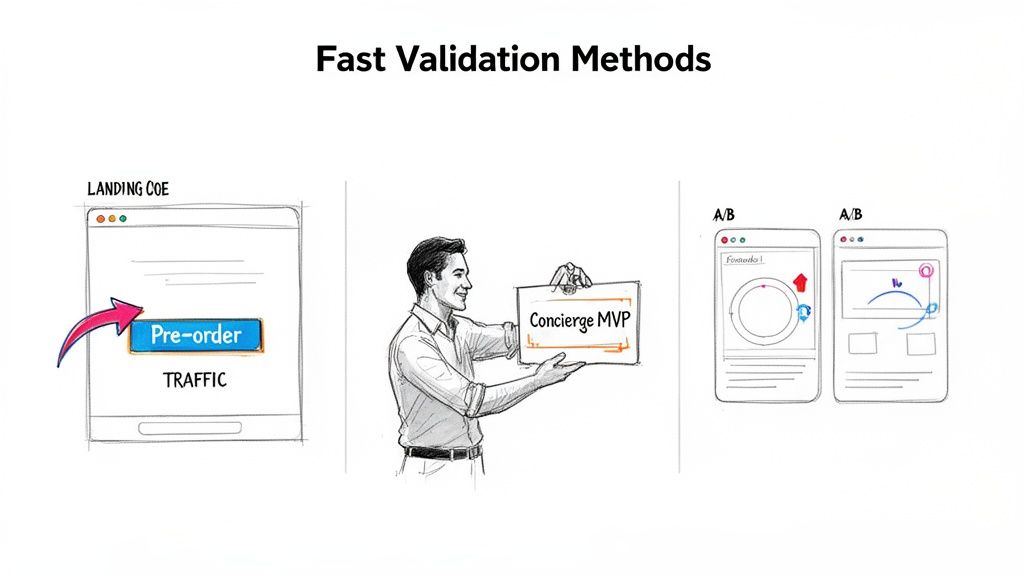
The Landing Page "Smoke Test"
A smoke test is a simple way to measure interest without an actual product. You build a one-page website that describes your product as if it's already real. Then, you see if anyone tries to buy it.
Your page needs to clearly explain the problem you're solving and how your solution is the answer. Focus on the benefits for the customer, not just a list of features. Most importantly, include a strong call-to-action button, like "Get Early Access" or "Pre-Order Now & Save 50%."
When someone clicks that button, you can collect their email or even send them to a checkout page to accept pre-orders. The goal isn't to get rich. It's to find the strongest signal of validation: someone willing to pull out their credit card.
You don't need to be a developer to do this. A tool like Carrd lets you build a professional-looking landing page in under an hour.
Once it's live, spend $100 to $200 on targeted ads to drive some traffic. If you get a handful of email sign-ups or even one or two pre-orders, you might be onto something.
The "Concierge MVP" Method
While a landing page tests intent, a Concierge MVP tests the solution. The idea is to deliver the core service of your business idea manually to your first few customers. This forces you to get your hands dirty and truly understand their problems.
Example: Let's say your idea is a tool that generates social media content for real estate agents. Here’s how you'd do it:
- Find a few customers: Reach out to agents you know or find them in online communities.
- Deliver the service by hand: For a small fee, offer to create their social media posts for a week. You do everything manually—writing copy, designing graphics in Canva, and scheduling posts.
- Listen and learn: As you do the work, you'll see their exact workflow, discover their real frustrations, and learn which features they actually need.
A Concierge MVP has no "product" at all. It's 100% a human-powered service, which lets you learn incredibly fast with zero development cost.
This approach gives you rich, qualitative feedback. You're not just looking at metrics; you're building relationships with the people who could become your first champions and co-creating the solution with them. For a deeper dive, check out this guide on how to validate a business idea before you waste time and money.
Find Your Winning Message with an Ad Test
Sometimes an idea is good, but the way you talk about it doesn't connect with people. A simple ad test can help you find the most compelling marketing message before you build it into your website.
The setup is easy. Create two or three different ad variations for your non-existent product, with each one focused on a different benefit.
For our real estate example, you might test:
- Ad A (The Time-Saving Angle): "Stop Wasting Hours on Social Media. Our AI Tool Creates a Week of Real Estate Posts in 5 Minutes."
- Ad B (The Lead-Gen Angle): "Turn Your Social Media into a Lead Machine. Our AI Tool Writes Posts That Attract Motivated Buyers."
- Ad C (The Professional Angle): "Elevate Your Brand Instantly. Get Stunning, Professional Social Media Designs for Your Listings."
Run these ads to the same audience with a small budget. After a few days, the ad with the highest click-through rate (CTR) shows you which message resonates most with your target customers. This simple experiment helps you nail your positioning from day one.
How to Choose the Winning Idea to Build
You've done the work. You've found some real market signals and tested a few promising concepts. Now you're at a crossroads, looking at a handful of good ideas and wondering, "Which one do I actually build?"
This is the moment to think like an investor, not just a founder. We need to get objective. Let's use a simple scoring system to compare your ideas. This way, you can move forward with confidence, knowing you’ve picked the path with the highest chance of success.
Gauging the Revenue Potential
First, let's talk about money. Can this idea actually be profitable? You don't need a complex financial model yet. A quick "back-of-the-napkin" estimate is all it takes.
Look at the competitors you found. What are they charging? A business that can charge $299/month has a much higher potential than one that charges $19/month.
Then, go back to their ad spend. If a company is consistently spending $20,000+ per month on ads, that’s a huge signal. It tells you the market is willing to pay and can be reached profitably.
Analyzing Market Growth Trends
Building a great product in a shrinking market is like swimming upstream. You want the wind at your back. The key question is: Is the demand for this kind of solution growing, flat, or dying?
Use a free tool like Google Trends and look up the core problems your idea solves. For instance, is search interest for "AI video editing" rising while "manual video transcription" is flatlining?
This gives you a big-picture view of the market's direction. You're looking for tailwinds—growing industries and rising search volumes that will naturally lift your business as it grows.
Choosing a market with momentum is a massive strategic advantage. It means new customers are constantly flowing into the space, which makes your marketing far more effective.
Assessing Your Founder-Market Fit
This is the most personal, and arguably most important, piece of the puzzle. A brilliant idea is worthless if you're the wrong person to build it. Founder-market fit is about being brutally honest about how you match up with the opportunity.
Ask yourself these three questions:
- Passion: Am I genuinely interested in this space? You're going to live and breathe this for years. A real interest is non-negotiable.
- Skills: Do I have what it takes (or can I learn it fast enough) to build the first version and find the first ten customers myself?
- Network: Do I know anyone in this industry? Even a few contacts can give you priceless feedback, introductions, or even become your first paying users.
Don't sugarcoat your answers. A big "no" across all three is a serious red flag.
Pinpointing Your Unfair Advantage
Finally, what’s your secret weapon? What makes your approach different and hard to copy? An "unfair advantage" is something your competitors can't easily replicate.
This doesn't have to be a revolutionary technology. It can be much simpler:
- A Distribution Channel: Maybe you have a large social media following or a popular blog where your ideal customers hang out.
- A Unique Brand Angle: You could serve the same market but with a brand that’s funnier, more professional, or more human than the boring competition.
- A Niche Focus: By focusing on a tiny sub-segment (like a CRM built only for landscape architects), you can build features they love that the big players would never bother with.
- Technical Innovation: Maybe you genuinely have a smarter, faster, or cheaper way to solve the core technical problem.
Your unfair advantage is your answer to the question, "Why will we win?" Without a good answer, you’re just another "me too" product in a crowded market.
Taking Your Idea From a Spark to a Real Thing
Execution is everything. It's what separates a successful founder from a daydreamer. You've done the hard work of finding an idea, and now it's time to get your hands dirty and actually build something. This is your roadmap for turning that concept into a reality.
The secret is that the best ideas are the ones the market has already proven it wants. You just had to find the signals. Now, let's act on them.
This flowchart gives you a final sanity check before you dive in.
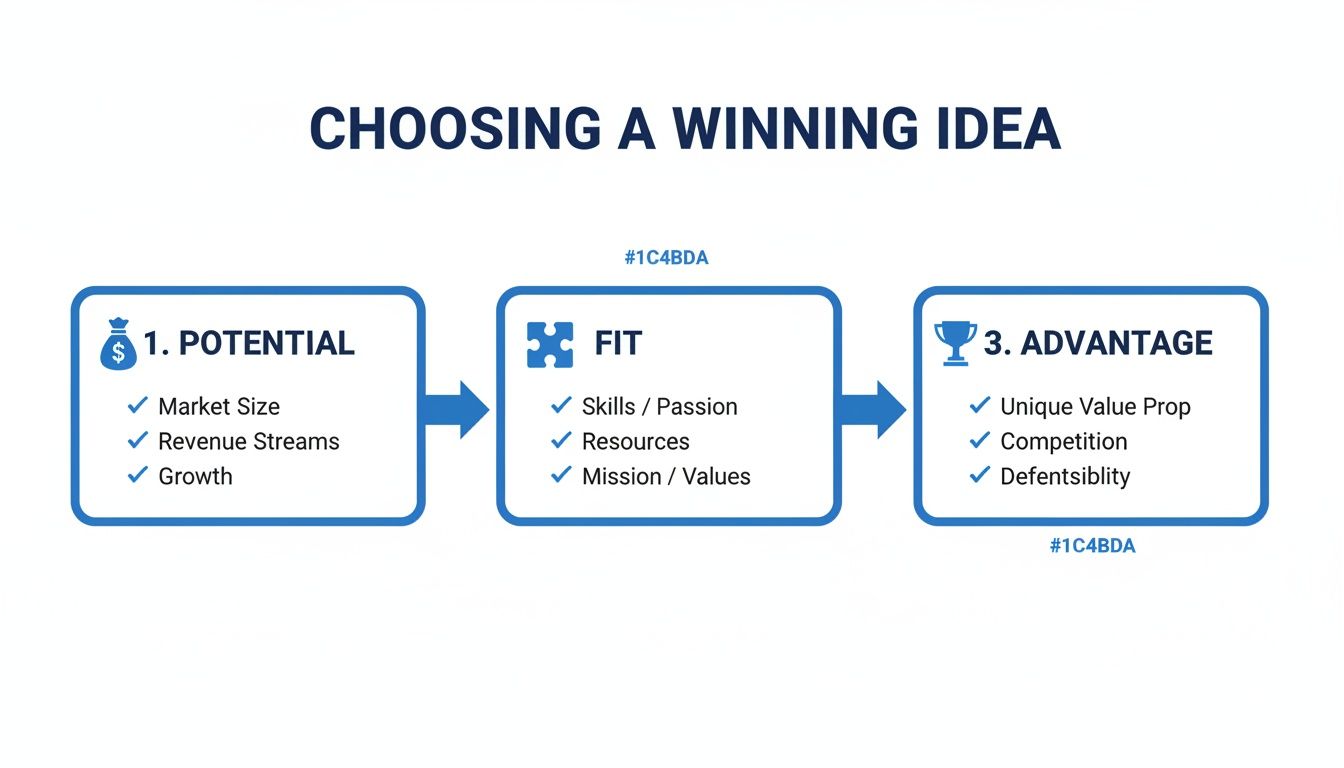
It really boils down to three key things: the idea's financial potential, how well it fits you, and what unique advantage you can bring to the table.
Your Action Plan for This Week
Once you've settled on your winning idea, the key is to build momentum—fast. Here’s a simple, actionable checklist to get you from concept to a live test in just a few days.
Days 1-2: The One-Pager. Open a document and write it out. What’s the problem? Who is it for? And what’s your unique solution? Keep it short, under 300 words.
Days 3-4: Build Your Test Page. Use a tool like Carrd to create a simple landing page. Your only mission is to write one powerful headline that grabs your target customer and explains the core benefit.
Day 5: Run the Test. Put $100 into targeted ads (like Google or Facebook) and point them at your new landing page. Your goal is to measure interest. Do people sign up for your email list? Do they click "pre-order"?
This sprint isn't about being perfect. It’s about speed and learning. Taking a small, messy action is infinitely better than having a perfect plan that never sees the light of day.
This quick validation is your first real step toward building a product people will actually pay for. To see what comes next, check out our founder's guide to MVP development for startups and learn how to launch fast and learn even faster.
Frequently Asked Questions
When you're hunting for the perfect business idea, a lot of the same questions tend to pop up. Let's tackle some of the most common ones.
How Do I Know if a Market Is Too Saturated?
It's easy to see a crowded market and think, "no room for me." But I've learned to see saturation differently. It's actually a massive green light—it proves people are already opening their wallets for this kind of solution.
The trick isn't to avoid these markets but to find your unique angle. Don't try to out-feature the giants. Instead, find a niche they're ignoring. If the big players are building "project management for everyone," you can win by building "project management just for architects." The fact that others are profitable is your proof that a focused, fresh approach can absolutely work.
What if I Can't Estimate a Company's Revenue?
Forget about getting exact revenue numbers; it's nearly impossible and you don't need them. What you need are strong signals, and the best one out there is consistent ad spend.
Think about it: no sane company is going to burn $10,000+ every month on ads for a product that isn't making money. That sustained spending is your evidence of a healthy, profitable business. You can make a rough guess at revenue by checking their pricing page, but the ad spend itself is the real validation you're looking for.
How Much Should I Spend on a Validation Ad Test?
You can get meaningful data without breaking the bank. A small budget of $100 to $300 is plenty to see if you're onto something.
The goal here isn't to get sales; it's to get answers. You're testing your message. Are people clicking? Are they signing up for your email list on the landing page? High engagement and a reasonable cost per sign-up are incredibly powerful early signals.
Can I Trust AI to Generate Business Ideas for Me?
Think of AI as a creative partner, not the CEO. It's fantastic for brainstorming and expanding on the real-world signals you've already found. For example, you can give an AI tool a list of customer complaints and ask it to dream up features that would solve those problems.
But AI has no skin in the game. It can't feel market pain or spot true demand. Always base your final decisions on hard data—ad spend signals, real search trends, and conversations with actual potential customers.
Ready to stop guessing and start building on what's already proven to work? Proven SaaS shows you exactly which SaaS businesses are successfully spending on ads right now. Find your next validated business idea today.
Build SaaS That's
Already Proven.
14,500+ SaaS with real revenue, ads & tech stacks.
Skip the guesswork. Build what works.
Trusted by 1,800+ founders


