

The best way to find a great business idea isn't to lock yourself in a room and brainstorm. The real secret is to find out what people are already paying for. Successful founders don’t gamble on a hunch; they find proven demand and then build a better, smarter solution.
Stop Guessing and Start Investigating
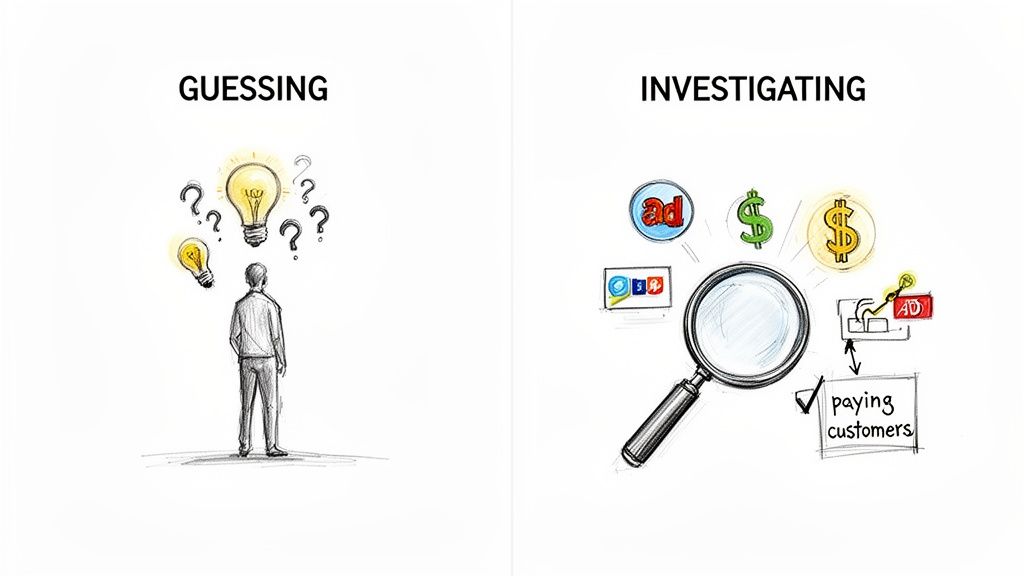
Forget the myth of the "eureka" moment. Truly successful business ideas aren't found in a flash of genius. They're uncovered through deliberate investigation, not random creative sparks.
The old way—chasing a gut feeling—is slow, risky, and often ends with building a product nobody actually wants.
A modern, data-driven founder flips this script. Instead of asking, "What cool problem can I solve?" they start with a much better question: "What problems are people already spending serious money to solve?" The answer is hiding in plain sight—in public advertising data.
Follow the Money in Ad Spend
Think about it: consistent, heavy ad spend is one of the most reliable signals of market demand. Companies don't keep burning cash on ads that aren't bringing in a positive return.
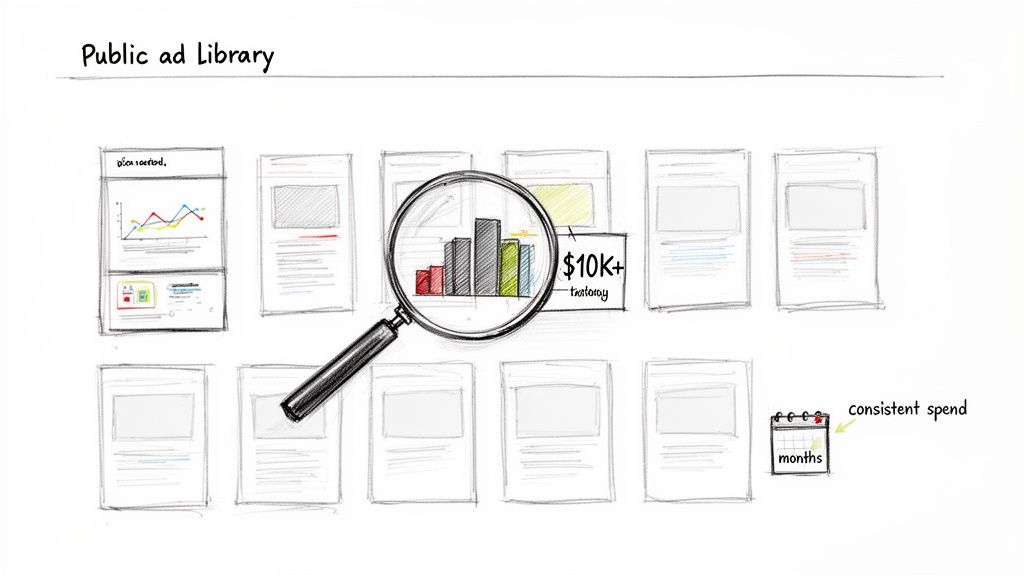
If you see a business spending $10,000+ every month on ads, and they've been doing it for months, that’s a massive clue. It tells you they have a working business model and have found a strong product-market fit.
This is where your investigation starts. By digging into these ad signals, you can reverse-engineer their success.
- Find Proven Niches: Look for markets where multiple competitors are all spending heavily. This points to a large, healthy customer base that is willing to pay for solutions.
- Validate Demand Instantly: High ad spend is your proof that demand exists. You get to skip the painful, early validation phase and jump straight to analyzing a proven opportunity.
- Discover Winning Angles: Study the ad copy, visuals, and landing pages of these high-spending competitors. It’s a masterclass in what messaging actually connects with customers in that niche.
To see this in action, let's look at two different paths you can take to find an idea.
Two Paths to a Business Idea
| Method | Traditional Ideation (The Guesswork Path) | Data-Driven Investigation (The Proven Path) |
|---|---|---|
| Starting Point | Brainstorming, personal passion projects, or a "cool" idea. | Analyzing real-world ad spend and market data. |
| Validation | Slow and painful. Often involves building a product first, then searching for customers. | Instant. High ad spend proves people are already buying. |
| Risk Level | Extremely high. You might build something nobody wants. | Significantly lower. You're entering a market with proven demand. |
| Focus | "What can I build?" | "What are people already paying for?" |
Choosing the data-driven path gives you an immediate and powerful advantage.
History shows that the smartest founders build on what's already working. Take the SaaS world, for example. With worldwide revenue hitting $317.55B in 2024 and projected to reach $1,228.87B by 2032, the opportunity is enormous.
Tools like Proven SaaS are built for this. They use AI to sift through Meta's ad library, flagging companies with significant ad spend—a strong indicator of high revenue and a validated market. You can instantly filter opportunities by traction, estimated revenue, and growth signals, taking the guesswork out of the equation.
To succeed, you need to master the generation of ideas that are grounded in reality. This means shifting your mindset from speculation to strategic investigation. That simple change is your first step toward building a business with a built-in advantage.
Follow the Money: How to Decode Market Signals in Ad Libraries
If you want to find a business idea with built-in demand, start where the money is already flowing. Public ad libraries, like the one from Meta, are a goldmine for this kind of intelligence. Think of it as a real-time map showing you exactly what customers are willing to pay for.
The logic here is simple but powerful: businesses don't burn cash on ads that don't make them money. When you see a company consistently spending thousands of dollars every month on advertising, it's a massive, flashing sign that they've struck gold in a profitable niche.
Why Consistent Ad Spend Is the Ultimate Proof
When you spot a SaaS company spending $10,000 or more per month on ads, you're not just looking at a clever marketing campaign. You're seeing hard evidence of a viable business model.
That level of investment screams that their customer acquisition cost (CAC) is comfortably lower than their customer lifetime value (LTV). In simple terms, they're making a profit on every new customer they bring in.
This sustained spending tells you three critical things:
- The Problem is Real: People are feeling this pain point so acutely that they’re actively searching for—and paying for—a solution.
- The Market is Healthy: There's enough demand to justify an aggressive, paid acquisition strategy.
- The Solution Works: The product is delivering on its promise. If it wasn't, customers would leave, and the ad budget would quickly dry up.
This entire approach is about following the money. It’s the kind of detective work that platforms like Proven SaaS automate, but understanding the "why" gives you a serious edge. You can see more on this in our deep dive into using an ad library to find profitable niches.
How to Spot Winning Ideas
Jumping into an ad library without a game plan is like trying to find a needle in a haystack. You need to approach it like a detective, hunting for specific clues and patterns that signal a healthy market.
Example: Let's say you search for "dental software" and find three different companies all running ads for practice management tools. Your first thought might be, "This market is too crowded." But look closer. What it really tells you is that dentists are a high-value customer segment, and they're more than willing to pay for software that solves their specific problems.
A market crowded with high-spending advertisers isn't a red flag; it's a giant green light. It confirms you've found a large, validated, and profitable customer base. Your job isn't to find an empty field, but to find your unique way into a proven arena.
Turning Ad Data into a Business Concept
Once you've zeroed in on a promising advertiser, the real investigation begins. Don't just glance at a single ad—dig into their entire campaign history. Have they been running the same ad for six months? Ads with that kind of longevity are almost always the ones that convert the best.
Here's a practical breakdown of what to look for:
- Analyze the Messaging: What specific pain points do they hit in their ad copy? Is the focus on saving time, boosting revenue, or eliminating errors? This language tells you exactly what the target audience values most.
- Study the Creative: Are they using video testimonials, simple animations, or screenshots of the software in action? The format they stick with is the one that's working.
- Deconstruct the Offer: What's the call to action? Is it a "free trial," a "demo request," or a "downloadable guide"? This reveals the most effective hook for getting customers in that niche.
Example: Imagine you discover a company spending $20,000 a month on ads for a project management tool aimed at construction firms. You notice their best-performing ads all feature testimonials from site managers talking about how the tool helps them reduce project delays.
Boom. You've just uncovered a validated business concept: a SaaS tool that solves project delays for construction site managers. You already know the audience, their core pain point, and the kind of messaging that gets them to click. You’ve just skipped months of guesswork and started with a foundation that’s already proven to work.
Reverse-Engineering Your Competitor's Success
So, you've spotted a profitable niche by following the ad-spend trail. Now, the real work begins: breaking down why the top companies in that space are winning. This isn't about copying their product; it's about strategic detective work to find your unique angle and build something better.
Think of yourself as an investigator. Your job is to dissect a competitor’s entire playbook—from their landing page and pricing to their features and what their customers are saying. This process uncovers their main selling points and, crucially, where they’re falling short.
Dissecting the Value Proposition
Start with their homepage. This is their best sales pitch, engineered to turn visitors into customers. Zero in on the headline, the main call-to-action, and the specific problems they promise to solve. This tells you what message clicks with their audience.
Next, dig into their pricing page. What features are locked behind more expensive plans? This is a huge clue, showing you what they believe is their most valuable functionality. Understanding this helps you map out your own features and figure out how you could deliver more value for the price.
Finding Gold in Customer Complaints
One of the best ways to get business ideas is to listen to people complain about existing products. Public review sites like G2, Capterra, and even forums on Reddit are goldmines for this.
Filter the reviews to show only the 1, 2, and 3-star ratings. Look for patterns. Are people constantly complaining about a clunky interface, a missing integration, or slow customer support?
These complaints aren't just noise. They're a validated feature list served up on a silver platter. Each one is a real pain point the current market leader is failing to address, leaving a perfect opening for you.
If you want to go deeper on this, check out our clear guide to SaaS competitive analysis that actually works. It breaks down the whole process step-by-step.
Learning from Their Ad Strategy
Head back to the ad libraries like the Meta Ad Library and see what messages your competitors are spending the most money on. An ad that's been running for months isn't a fluke; it's a proven winner. The copy highlights the most persuasive benefits and speaks directly to the customer's core needs.
This gives you a front-row seat to the exact images, copy, and offers they're using. It's a masterclass in what grabs your target audience's attention.
The old saying "build what people are already buying" has never been more true. Global SaaS revenue is expected to grow 19.38% every year, hitting $793.10B by 2029. The US market alone has over 17,000 SaaS companies, and the AI SaaS niche is projected to skyrocket to $1,547.57B by 2030. You can learn more about the explosive growth of the SaaS market from the data itself.
This incredible growth proves that the best opportunities often come from improving a validated idea, not from trying to invent a new category from scratch.
When you put all these pieces together, you’re not just copying someone. You’re gathering the intel needed to enter a proven market with a smarter, more focused solution that directly attacks the weaknesses of the current players.
Got an Idea? Here’s How to Validate It in Just One Week
All the analysis in the world means nothing without action. After you've reverse-engineered what makes your competitors tick, it’s tempting to dive into development. But hold on. The savviest founders always take one final, critical step to slash their risk before pouring time and money into building a product.
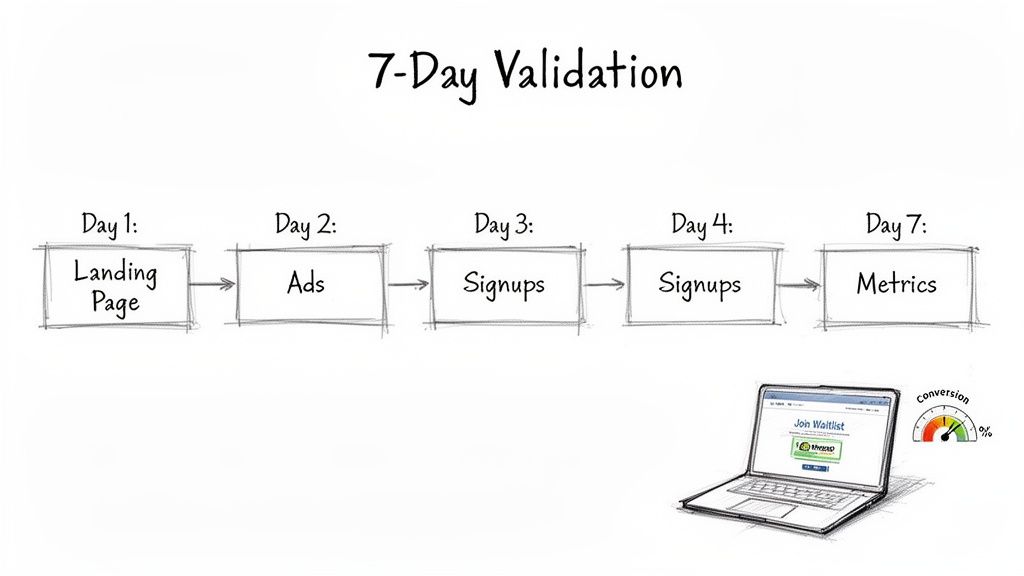
This is the one-week validation sprint. It’s a lean blueprint for testing whether your idea has actual demand in the real world, using minimal time and cash. The goal isn't to build a thing; it's to see if people will sign up for the promise of a thing.
Step 1: Set Up Your Digital Storefront
First, you need a simple, one-page website. This isn’t a full-blown site with a blog and an about page. Think of it as a focused digital storefront—a landing page with a single job: to capture the email of someone who wants your solution.
You can whip this up in an afternoon using a simple builder like Carrd, Webflow, or Framer. Don't get bogged down in perfection. Your page just needs these key ingredients:
- A Killer Headline: Nail the problem you solve and for whom. Use the insights from your competitor research. Example: "The Easiest Way for Construction Firms to Prevent Project Delays."
- A Clear Value Prop: A few bullet points explaining the top 2-3 benefits. Focus on the outcome, not the features. Example: "Reduce rework by 30%," or "Keep every project on schedule."
- A Simple Waitlist Form: This is the most important part. Just one field: email. The call-to-action should feel urgent and exclusive, like "Join the Waitlist" or "Get Early Access."
The key is to make your idea feel real, even though the product is still a concept. This quick approach is exactly how to validate your business idea before you waste time and money.
Step 2: Drive a Little Targeted Traffic
Your landing page is live. Now you need to get the right eyeballs on it. A small, targeted ad campaign works wonders. You don't need a massive budget; $100 to $300 is usually plenty to get the initial data you need.
Remember where your successful competitors are advertising? Start there. If they're all over Facebook ads, that's your testing ground. Spin up a simple campaign targeting their exact audience.
For our construction software example, you could target people with job titles like "Project Manager" or "Site Superintendent" in the construction industry. Your ad copy can be a shorter version of your landing page headline, driving them straight to your waitlist.
This isn't about guessing; it's about following a proven playbook for how to validate your startup idea and letting the market tell you if you're onto something.
Step 3: Read the Signals (and Measure What Matters)
Once traffic starts flowing, watch a couple of key numbers like a hawk. These metrics will tell you if you've struck gold or if it's time to head back to the drawing board.
This isn't about getting thousands of sign-ups. It's about seeing if a compelling percentage of highly-targeted visitors are interested enough to give you their email. That's the signal you're looking for.
Here’s what you need to track:
- Sign-Up Conversion Rate: This is your north star. Of all the people who hit your page, what percentage signs up? A rate between 5% and 10% is a great signal. If you hit anything above 15%, you've likely found a serious pain point.
- Cost Per Lead (CPL): How much did each email cost you? Divide your total ad spend by the number of sign-ups. A low CPL means your message is hitting the mark.
Let's run a quick scenario. Say you spend $200 on ads, which brings 400 people to your landing page. Out of those, 40 people join your waitlist.
Here’s your validation scorecard:
| Metric | Calculation | Result | Interpretation |
|---|---|---|---|
| Conversion Rate | (40 sign-ups / 400 visitors) * 100 | 10% | Strong signal. This is solid proof of genuine interest. |
| Cost Per Lead | $200 ad spend / 40 sign-ups | $5.00 | Positive. An excellent cost to acquire a warm lead. |
With numbers like these, you can move forward with confidence. You're not building on a hunch anymore; you're building on real-world data from people who have already raised their hands.
Spotting Untapped Niches and Future Trends
Analyzing existing markets gives you a solid foundation, but the real magic happens when you see where things are headed. Spotting a good business idea isn't just about what's making money today; it's about predicting what will make money tomorrow. This is where you find your true competitive edge.
The key is to look for early signals of explosive growth. One of the best indicators is a new advertiser who goes from spending zero to dropping thousands on ads in just a few weeks. That rapid spending usually means they’ve hit a raw nerve—a painful problem—and are scaling fast before the competition notices.
The Power of Vertical SaaS
One of the most reliable ways to find these hidden gems is by focusing on vertical SaaS. This means software built for one, very specific industry. Think about how many successful "horizontal" tools exist—like generic CRMs or project management platforms. They try to serve everyone, which means they don't serve any single industry perfectly.
That gap is your opportunity. You can find incredible business ideas by taking a proven, horizontal concept and tailoring it for an underserved niche.
- Instead of another generic CRM, you build a CRM for landscape architects.
- Instead of a general project management tool, you create project management software for dental labs.
- Instead of a broad social media scheduler, you design one specifically for independent bookstore owners.
Each of these niches has its own unique language, workflows, and problems that a one-size-fits-all tool can’t solve. By building for a specific vertical, you can often charge more because your solution is a "must-have" that perfectly fits their world.
The beauty of vertical SaaS is that you're not reinventing the wheel. You're just putting better tires on it for a very specific type of road. The core concept is already validated; you’re just perfecting its application.
Riding the Wave of High-Growth Trends
Beyond niching down, you can spot future winners by watching which categories are attracting new, high-spending advertisers. Right now, a few areas are on fire.
For instance, the AI copilot space is exploding. Companies are building AI assistants for everything from writing code to handling customer support. Another huge trend is the rise of API-first tools, which let businesses plug specialized functions (like payment processing) directly into their own software.
The smartest business ideas often come from spotting these patterns early. The B2B SaaS market is projected to rocket from USD 0.49 trillion in 2026 to USD 1.58 trillion by 2031, growing at a blistering 26.24% compound annual rate. Much of that growth is coming from niches like API-led tools and vertical SaaS. You can dig into more data on the accelerating B2B SaaS market to get a feel for where the money is flowing.
Using Intelligence Tools to Find Your Niche
Trying to track all these signals manually is a nightmare. This is where a platform like Proven SaaS can be a game-changer. It's built to do the heavy lifting by automatically flagging growth signals and sorting companies into specific verticals and trends.
Instead of guessing what might work, you can see hard data on what’s already working.
Here’s how it gives you an edge:
| Feature | How It Helps You Find Ideas |
|---|---|
| Growth Signal Tracking | Instantly flags new companies that are rapidly increasing their ad spend, pointing you to hot trends before they get crowded. |
| AI-Powered Categorization | Automatically groups companies into niches like "AI Copilots" or "Vertical SaaS for Healthcare," so you can explore specific markets. |
| Revenue & Spend Estimates | Helps you prioritize by showing which niches have competitors with high estimated revenue, proving there’s a profitable market to enter. |
Using tools like this shifts you from being a passive observer to an active investigator. You can systematically uncover underserved markets, validate their potential with real spending data, and gain the confidence to build a solution for a hungry audience.
Your Action Plan from Idea to First Customer
So, how do you put all this theory into practice? Great business ideas are the result of a deliberate, data-driven process. The goal is to stop guessing and start building on a foundation that's already proven to work.
You’re not an inventor hoping for a lucky break. You’re an investigator following the money. This approach stacks the odds in your favor by taking the guesswork out of the equation.
This flow chart breaks down the core process for spotting a high-potential niche.
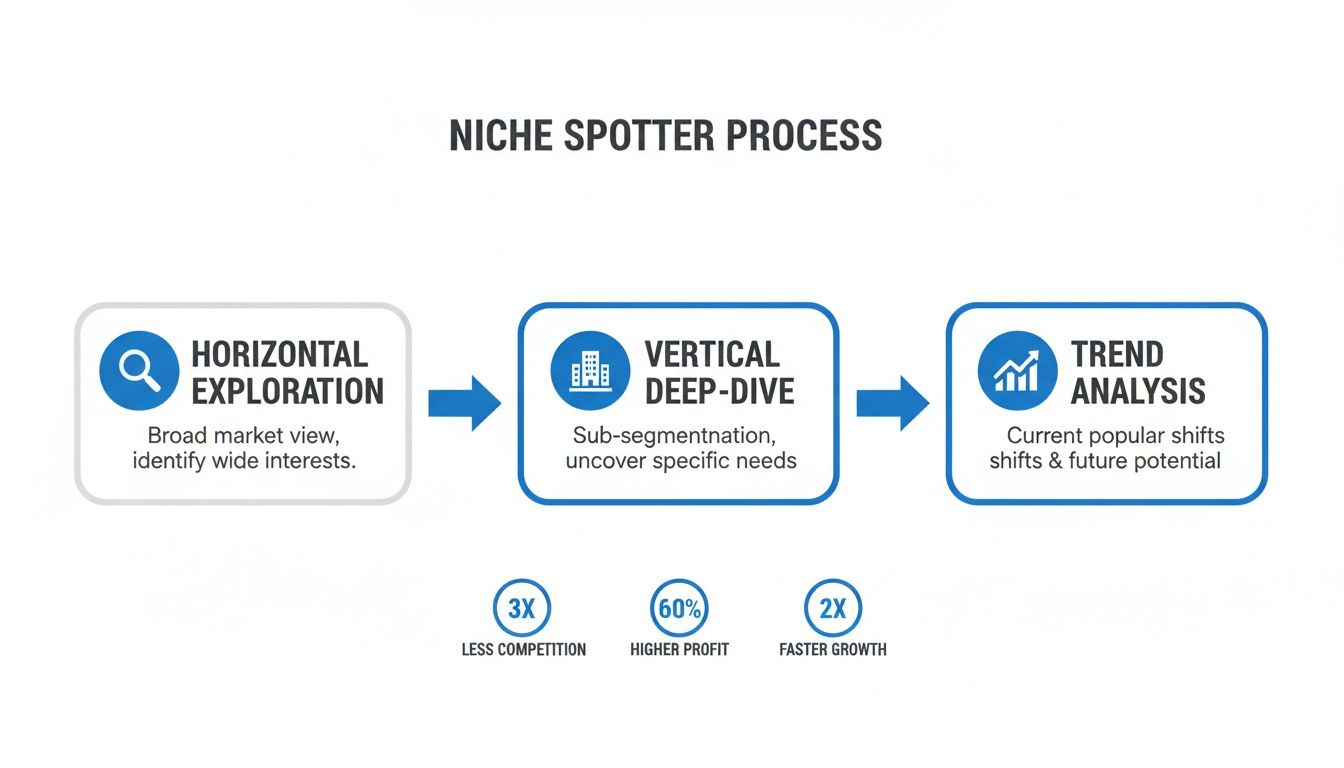
As you can see, it moves from broad exploration to a deep-dive analysis, and finally to trend-spotting. This ensures your idea isn't just viable today but has potential for the future.
Your Five-Step Action Plan
Here’s a simple roadmap that takes you from spotting a hot market to getting feedback from your first customer.
Hunt for High-Spend Signals
Start by digging through ad libraries. Look for companies consistently spending $10,000+ per month on advertising. That level of ad spend is the clearest signal that a validated market exists with customers willing to pay.Deep-Dive into 3-5 Competitors
Once you’ve found a promising niche, pick a handful of the top players. It's time to reverse-engineer their success. Tear apart their landing pages, analyze their pricing, and read every single customer review. This is where you'll uncover their strengths and, more importantly, their weaknesses.Pinpoint Your Unique Angle
Your job isn't to build a carbon copy. Based on your deep-dive, find a unique way in. Maybe it's serving an overlooked audience (like a CRM specifically for plumbers). Or maybe it's building a feature that directly solves a complaint you saw over and over in their 1-star reviews.
Finding your angle isn't about being completely original. It's about being strategically different where it matters most to a specific group of customers.
Run a One-Week Validation Test
Before writing a line of code, build a simple landing page that sells the promise of your unique solution. Drive a small amount of targeted traffic to it—a $100-$300 ad budget is enough to start. The only thing you need to measure is your email sign-up rate. This is the ultimate proof that people actually want what you're planning to build.Use Real Feedback to Guide Your Build
A successful validation test does more than just give you confidence. It gives you a waitlist of potential day-one customers. Talk to them. Ask them questions. Use their direct feedback to shape your product, ensuring you build something people will happily pay for from the moment you launch.
A Few Common Questions
Is a Crowded Market a Red Flag?
No, it’s the opposite. If you see a bunch of competitors all throwing money at ads, that’s a fantastic signal. It's hard proof that there's real customer demand and a market big enough for people to make a living in. Your goal isn't to discover an empty playground; those are usually empty for a good reason. The real opportunity is finding a busy market where you can carve out your own space.
What's a Realistic Budget for a Validation Test?
You don't need to break the bank. For most tests, a budget of around $100 to $300 is plenty. That's usually enough to get a decent amount of targeted traffic to a simple landing page and see if your idea clicks with people.
What Happens if My Idea Bombs the Test?
That’s actually a great outcome! Seriously. The point of these quick, cheap tests is to find out if an idea is a dud before you sink months of your life and thousands of dollars into building it. Failing fast saves you a ton of time and cash. If an idea doesn't pan out, you just move on to the next proven niche you found and run another low-cost test. It's all about iteration.
Stop guessing and start investigating. Proven SaaS uses AI to analyze ad libraries, giving you a list of validated niches with real revenue signals. Find your next profitable idea on Proven SaaS.
Build SaaS That's
Already Proven.
14,500+ SaaS with real revenue, ads & tech stacks.
Skip the guesswork. Build what works.
Trusted by 1,800+ founders


