


It's a classic startup nightmare: spending months building a product you're sure will be a hit, only to launch to the sound of crickets. The reason is almost always the same—you built a solution for a problem you thought people had, not one they were actively complaining about.
A focused Facebook group search flips that script. It turns mindless scrolling into a powerful market research tool, letting you find your next great idea by listening, not guessing.
Why Facebook Groups Are a Goldmine for SaaS Ideas
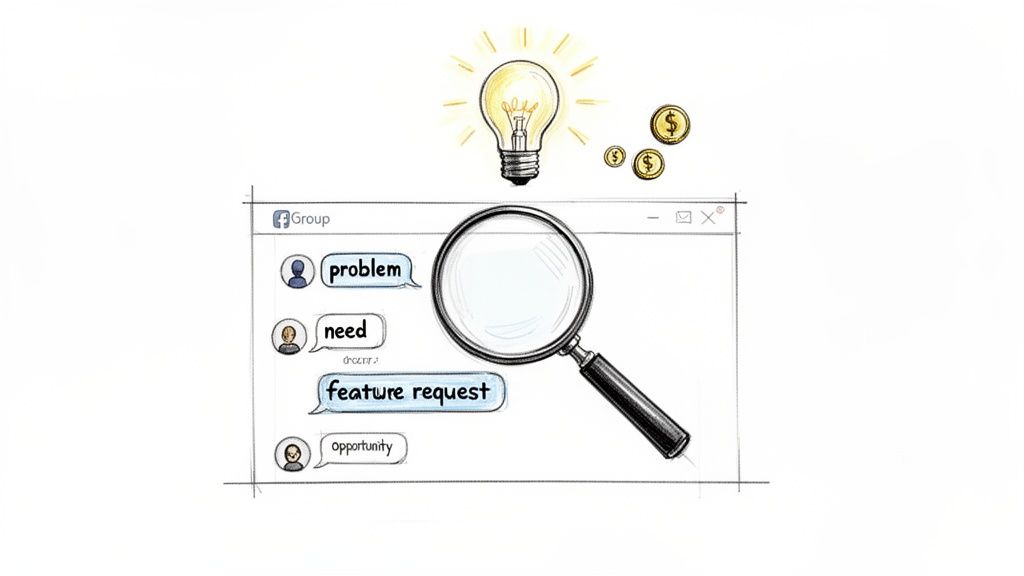
Imagine if you could tap into thousands of conversations where your ideal customers are openly discussing their biggest frustrations. That's what Facebook Groups offer. These communities are massive, self-organizing focus groups where people share real problems, completely unprompted.
Uncovering Raw Customer Pain Points
Company pages are for marketing, and personal profiles are for vacation photos. But in a private group? That's where the real talk happens. People aren't trying to sound polished; they're looking for help.
You'll find posts that read like a product manager's dream backlog:
- "Does anyone know a tool that connects X and Y without a million steps?"
- "I'm so tired of the workflow for [common task]. I wish there was a simpler way."
- "We're looking for an alternative to [popular software] because it's just too expensive."
These aren't just complaints. They are explicit market gaps and direct feature requests. Listening to these conversations is the very heart of SaaS market research that actually works.
The Power of Niche Communities
The real value isn't in giant, generic groups. It's in the hyper-focused communities dedicated to specific professions, software, or industries. For example, a group for "Notion Power Users" will have entirely different frustrations than one for "Shopify Store Owners."
By joining these specialized groups, you immerse yourself in the exact language, workflows, and challenges of a well-defined audience.
Groups are a massive part of the Facebook experience, with 1.8 billion monthly active users. More importantly for founders, links shared in groups see an average 3.2% click-through rate (CTR)—the highest of any content type on the platform.
Where SaaS Founders Find the Best Insights
A quick comparison shows why Groups are the superior channel for organic research compared to other Facebook content types.
| Content Source | Average Click-Through Rate (CTR) | Best For |
|---|---|---|
| Groups | 3.2% | Unfiltered pain points, feature requests |
| Pages | 2.2% | Competitor analysis, marketing messages |
| News Feed | 1.5% | Broad trends, ad inspiration |
This high engagement means you’re tapping into an active, motivated user base. It’s no wonder some entrepreneurs even learn how to transform your Facebook Group into a profitable membership business. The takeaway is simple: before writing code, you can validate demand by finding real people asking for the very thing you want to build.
Mastering Facebook's Native Search Filters
Jumping into a Facebook group search without a plan is frustrating. You'll get thousands of results, but most of it is just noise. The secret is knowing how to use Facebook’s own filters to cut through the clutter.
Start with a broad keyword, but don't look at the results yet. On the left-hand side of the page, the first thing you should do is click "Groups." This simple move instantly gets rid of random posts, pages, and people, focusing your search on communities.
Refining Your Initial Discovery
Now that you're only seeing groups, it's time to get more specific. When exploring a new niche, the "Public Groups" filter is your best friend. It lets you peek inside without committing to joining, so you can see group names, read their descriptions, and check member counts.
This is your first pass at gauging the market. For example, a search for "real estate marketing" filtered by "Public Groups" might show you dozens of communities with thousands of members—a fantastic signal that you've found a real audience.
You can see exactly where these critical filters are located in the screenshot below.
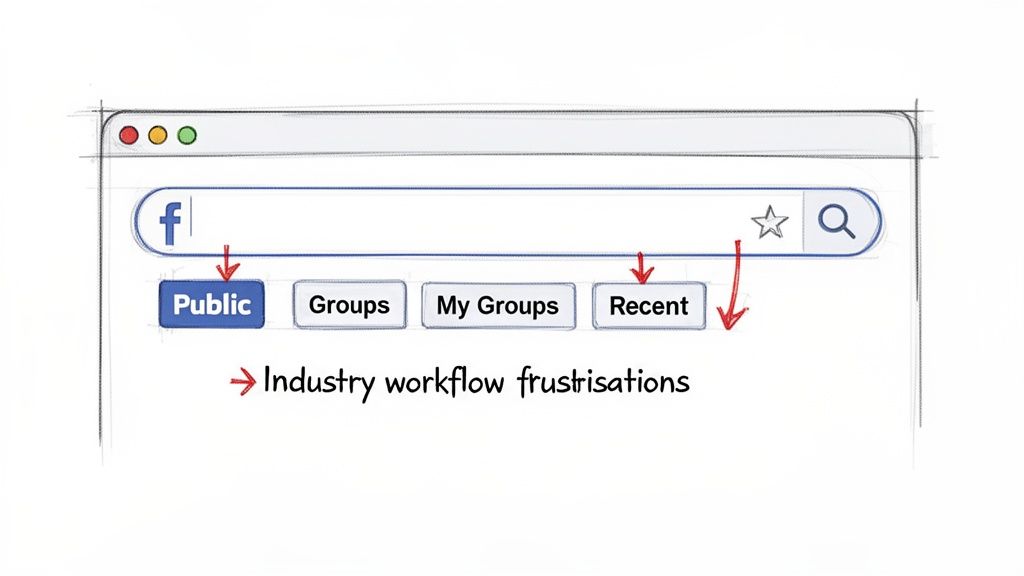
This little menu is your command center. It's how you'll pivot from broad discovery to deep-dive analysis with just a click.
Searching Inside Groups You Have Joined
The real detective work begins once you’ve joined a few promising groups. This is where you can tap into years of conversations, unearthing the real-world pain points and recurring problems that people are desperate to solve.
Forget the main Facebook search bar. Go directly to the group's page and use its dedicated internal search function. This is where you can get hyper-specific with your queries. I’ve found great insights with searches like:
- "workflow frustrations"
- "software recommendations for invoicing"
- "I wish there was an app that..."
These aren't just keywords; they're direct lines into the minds of your potential customers. You're not guessing their problems anymore—you're reading their exact words.
Pro Tip: After searching inside a group, always filter the results by "Most Recent Posts." This shows you what people are struggling with right now, giving you a real-time pulse on the market’s most urgent needs.
By working this two-step process—using filters to find communities, then digging deep into the ones you join—you can turn the chaos of Facebook into an organized database of customer intelligence.
Searching Outside the Facebook Bubble
Facebook's built-in search is a decent start, but its algorithm often prioritizes recent or popular posts, meaning you can easily miss older, relevant discussions. To dig deeper, you need to step outside of Facebook. Think of it as performing a surgical Facebook group search from the outside in.
Using Google to Your Advantage
The simplest and most powerful way to do this is by using Google search operators. With a simple command, you can tell Google to only search within public Facebook Groups, sidestepping Facebook’s biased discovery feed.
The command is site:. It tells Google to limit its search to one specific website. Here’s the formula you'll use:
site:facebook.com/groups/ "your keyword phrase"
Let’s run through a quick example. Say you're exploring an idea for a project management tool for creative agencies. You could search Google for:
site:facebook.com/groups/ "frustrated with asana"
Just like that, Google will show you only results from public Facebook Groups where people have used that exact phrase. It's a direct way to find specific complaints about a huge competitor.
Get creative with this! Try searching for buying signals or common problems:
site:facebook.com/groups/ "looking for a tool that"site:facebook.com/groups/ "alternative to mailchimp"site:facebook.com/groups/ "how do you manage client onboarding"
This method is fantastic for finding conversations buried deep in a group's history—the kind of posts that Facebook’s internal search would never show you.
Can Third-Party Tools Help?
Beyond doing this by hand, there are tools designed to monitor these conversations automatically. They're typically called social listening or community intelligence platforms. While we won't dive into a full review here, it's good to know they exist. These tools automate the process of finding mentions of your keywords across social media, including public Facebook Groups.
The real power of these platforms is aggregation. Instead of you searching ten different ways for "frustrated with asana," a tool can watch thousands of groups for that phrase and instantly report on the volume of conversation.
As a founder, this gives you a bird's-eye view of the market. You can quickly spot which competitors get negative feedback or see what features people are constantly requesting. If you’re also thinking about paid ads, this kind of insight is just as valuable as what you'd get from the best Facebook ad spy tools for SaaS.
A Quick Word on Doing This Right
Whether you’re using Google tricks or a paid tool, you must be ethical. Your mission is to be a respectful observer, not a creepy data harvester.
Keep these ground rules in mind:
- Respect Privacy: These techniques are for public conversations only.
- Don't Scrape: Pulling user data from Facebook is against their rules and can get your account banned.
- Listen, Don't Pitch: The goal is to learn from organic conversations, not to jump in with a sales pitch.
Stick to these guidelines, and you can gather amazing market intelligence without crossing any lines.
Turning Group Conversations Into Validated SaaS Ideas
So, you've sifted through countless group discussions. Now what? The real magic is turning that raw chatter into a solid business concept. This is where you connect an online complaint to a concrete plan for a product—before writing a single line of code.
It all starts with spotting genuine pain points. Your Facebook group search should be laser-focused on phrases that practically scream "opportunity."
Find and Quantify the Pain
I always start by looking for direct expressions of frustration. Instead of searching for a competitor's name, search for the problem they claim to solve.
Try queries that get right to the heart of the matter:
- "I wish there was an app for..."
- "How does everyone handle X?"
- "So frustrated with [common task]"
- "Is there a simpler way to manage..."
When you find a post that hits on a potential pain point, the next question is: is this a widespread issue? Look at the engagement. A post with five likes is a whisper, but one with 500 comments is a flashing neon sign pointing to a real market need.
This simple workflow breaks down how to move from identifying a problem to validating a potential solution.
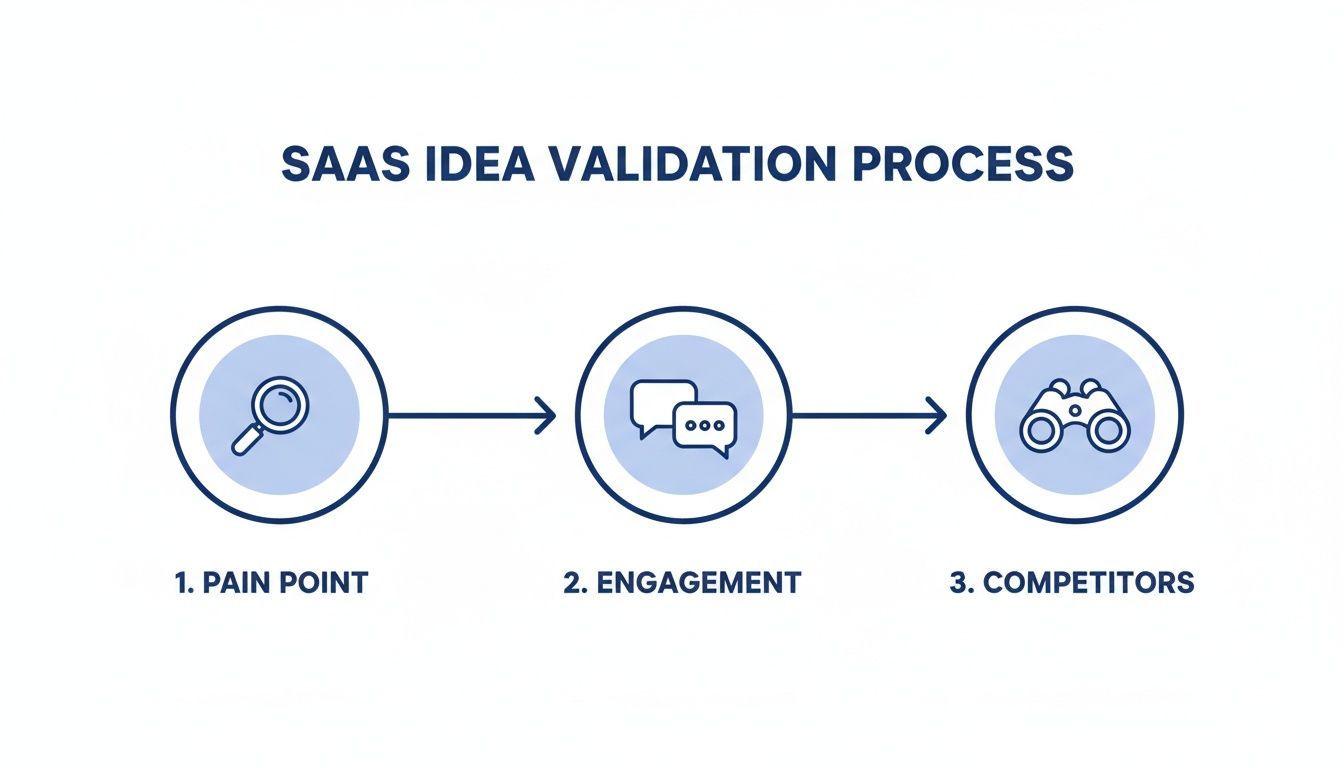
It’s a clear path: pinpoint the pain, measure how much the community cares, and then see what the competitive landscape looks like.
Use Comments as Free Market Intelligence
The comments section of a popular complaint post is an absolute goldmine of free market intelligence. As people chime in, they'll inevitably mention existing tools and competitors they've tried. Pay close attention. Are they recommending software, or are they mentioning it as a flawed, expensive, or overly complicated option? Every comment helps you piece together the competitive puzzle.
Once you've identified these pain points, you'll need a solid process to validate your SaaS idea.
Here's a real-world example: I was monitoring a "Digital Nomads" group and kept seeing posts about the nightmare of tracking visa days and tax residency. One post asking, "How do you all track your Schengen days?" exploded with over 300 comments. The replies were a mess of manual spreadsheet methods and complaints about existing apps being too simple or buggy.
That massive engagement, combined with the clear lack of a go-to solution, was a powerful signal. It confirmed a real need for a travel-tech tool designed to solve that exact problem.
Cross-Reference with Quantitative Data
The final piece of the puzzle is to blend what you've learned from conversations with some hard data. When you see competitors mentioned in group discussions, check the Facebook Ad Library to see if those companies are running ads targeting that same audience. If a SaaS company is consistently spending money on Facebook Ads to reach "Digital Nomads," it's a strong indicator that the niche is profitable.
This cross-referencing is what separates a hunch from a data-backed opportunity. Facebook Group searches can reveal incredible engagement. This is especially true in passionate industries like travel, where group-shared content can hit a 6.62% CTR. For founders building an MVP, searching groups can uncover growth signals—like real estate's 3.69% CTR—that prove competitors are already profitable.
Common Mistakes and How to Avoid Them
Digging through Facebook groups for SaaS ideas is a goldmine, but it's surprisingly easy to get wrong. The classic rookie mistake? Joining 20 groups on day one. It feels productive, but it just creates a firehose of noise that drowns out the real insights.
Start small. Pick just three to five highly relevant and active groups. This lets you learn the vibe of the community, understand who the key players are, and absorb the culture. Quality over quantity is the name of the game here.
Another trap is confusing one person's passionate rant with genuine market demand. You'll spot a super detailed post from someone trashing their current software, and your eyes will light up. But one loud voice doesn't equal a paying customer base.
Look for patterns, not just solo performances. When you see different people bringing up the same frustration, phrased in different ways, over weeks or months—that's when a personal headache starts to look like a real market gap.
The Cardinal Sins of Group Research
The fastest way to get your research efforts shut down is to break the unwritten rules of the community. Getting banned makes the whole exercise pointless.
Whatever you do, steer clear of these blunders:
- Shameless Self-Promotion: This is the big one. Never be the person who jumps into a conversation just to drop a link to your landing page. It’s the quickest way to get labeled a spammer and lose all credibility.
- Asking for an Invite: Begging for an invitation to a private group is bad form. The real way in is to become a valuable member of public groups first. Share what you know, help people out, and you’ll find that invitations start coming to you.
Turning Chaos Into a Coherent System
Just scrolling through feeds without a plan isn't research; it's procrastination. The final big mistake is not having a system to capture what you find. Without one, you're left with a jumble of random screenshots and half-remembered comments.
You need a simple process. A basic spreadsheet is your best friend here.
| Group Name | Link to Post | Identified Pain Point | Potential Competitors Mentioned |
|---|---|---|---|
| SaaS Founders | [Link] | "Managing recurring billing for international clients is a nightmare." | Stripe, Chargebee |
| Digital Nomads | [Link] | "Tracking visa days and tax residency rules is too complex." | Manual spreadsheets, generic apps |
This simple act of organizing transforms your lurking into a repeatable workflow. You’ll be able to spot recurring problems, keep tabs on the competition, and build a library of ideas that are backed by actual evidence. This is what separates aimless browsing from strategic discovery.
Common Questions & Quick Answers
Got a few lingering questions? Let's clear them up. Here are some of the most common things founders ask when they start digging into Facebook Groups for market research.
Is Scraping Data from Facebook Groups Okay?
Let me be crystal clear: absolutely not. Scraping data is a direct violation of Facebook's Terms of Service, and it's a surefire way to get your account permanently shut down. Every method I’ve shared in this guide is about manual, ethical research.
Think of it this way: you're here to be a fly on the wall, listening to genuine conversations to understand a market. You're not here to harvest personal data. Stick to manual analysis—it respects user privacy and keeps you in line with the platform's rules.
How Do I Find the Good Private Groups?
Discovering the best private groups is less about searching and more about networking. You won't find them with a simple keyword search. Instead, start by following the key influencers and known experts in your niche. Pay attention to the communities they're active in or mention.
You’ll often find these hidden gems mentioned on industry blogs or in podcast interviews. The best way in is to become a known, helpful voice in the public communities first. Once you start adding real value, invitations to more exclusive groups tend to follow.
Pro Tip: The path into private groups is paved with genuine engagement. Focus on contributing value to public spaces, and doors to exclusive communities will start to open as you build a solid reputation.
What's the Best Way to Search Inside a Massive Group?
Once you've joined a large group, ignore the main Facebook search bar. Your best friend is the dedicated search bar located within the group itself. It’s a surprisingly powerful tool for digging through years of conversations.
Use it to hunt for keywords related to customer pain points ('annoyed,' 'stuck,' 'wish I had'), tools ('software,' 'app,' 'template'), or competitor names. From there, you can filter the results by "Most Recent" to catch the latest buzz or by "Top Posts" to see the most engaged discussions on a topic.
At Proven SaaS, we’ve built a system that takes this kind of deep market research to the next level. Our platform analyzes advertising data to pinpoint SaaS ideas where competitors are already spending big—proving a market is hungry for a solution. Find your next profitable venture at https://proven-saas.com.
Build SaaS That's
Already Proven.
14,500+ SaaS with real revenue, ads & tech stacks.
Skip the guesswork. Build what works.
Trusted by 1,800+ founders


