

Before you write a single line of code, you need to answer the most important question: will anyone actually pay for this? One of the fastest ways to find out is by analyzing your competitors' Facebook ad creatives. This isn't just about spying; it's about finding hard evidence that a market for your idea already exists.
Why Facebook Ads Are a Goldmine for Market Validation
When a SaaS company consistently spends thousands of dollars on Facebook ads, you're seeing more than a marketing campaign. You're seeing proof of a system that acquires customers profitably. If it weren't working, they'd stop. It’s that simple.
This gives you a massive shortcut, letting you skip the guesswork.
The goal isn't to copy their colors or fonts. It's to reverse-engineer their strategy by answering three core questions:
- What problem are they solving? Look at the specific pain points mentioned in their ad copy.
- How are they positioning their solution? How do they present their product as the best answer to that problem?
- What result are they promising? What is the specific, tangible outcome they're selling to customers?
For example, an ad for a project management tool might say: "Tired of messy spreadsheets? Get a clear view of your team's progress."
- Problem: Messy spreadsheets.
- Solution: A clear visual dashboard.
- Promise: Better visibility of team progress.
Answering these questions reveals the messaging, features, and benefits that are already convincing people to buy.
Your Secret Weapon: The Meta Ad Library
The Meta Ad Library is a free, searchable database of every ad running on Facebook and Instagram. It was built for transparency, but for a founder, it's a treasure trove of market research.
Here’s the simple search interface. You can type in any advertiser and see exactly what they're running.
This search instantly shows you every active ad a company is running, giving you a real-time, behind-the-scenes look at their strategy. Tools like Proven SaaS build on this data, adding extra analysis to help you spot powerful signals faster.
Why Creative is Your Biggest Clue
The ad creative—the image, video, and text—is everything. The data is clear: ad creative is the single biggest driver of a campaign's success, responsible for a whopping 56% of its total sales impact.
When you see a competitor spending over $10K a month on ads, their creative strategy is doing most of the work. You can find more data on this in Coupler.io research on tracking ad creatives.
An ad creative is a direct reflection of a validated customer problem. If a company is scaling its ad spend, it's because the message in that creative is hitting a nerve and driving growth. Your job is to figure out what that message is.
A Simple Framework for Ad Creative Analysis
Jumping into the Meta Ad Library without a plan is a mistake. It's like wandering into a library without knowing what you're looking for. You need a structured way to turn a sea of ads into clear, actionable ideas for your SaaS.
First, clarify your goal. Are you a founder trying to validate a new idea? Or a marketer trying to understand a competitor's messaging? Your objective shapes what you look for.
The entire process is a funnel for turning raw ads into validated SaaS ideas.
You start by observing competitors, finding those who are consistently spending money (a huge signal), and distilling that intelligence into a solid business idea.
How to Deconstruct Ad Creatives
With your objective set, it's time to dissect individual ads. Don't just look at an ad and think, "that's nice." Break it down into its core components to understand why it works.
Here’s a simple table outlining what to look for and the insights you can pull from each element.
Core Elements of a SaaS Ad Creative Analysis
| Creative Element | What to Look For | Example Insight |
|---|---|---|
| The Hook (First 3 seconds) | How do they stop the scroll? A question? A bold statement? A surprising visual? | A project management tool always opens with a video of a messy spreadsheet. This visual hook grabs users experiencing that exact pain point. |
| The Headline | What is the main promise? The headline is prime real estate and often reveals the core value proposition. | A competitor uses headlines like, "The Last CRM You'll Ever Need." This suggests their audience is tired of switching tools and values a long-term solution. |
| Primary Text | What pain point or benefit do they lead with? This is their first chance to qualify the audience. | A scheduling tool's ad copy begins with, "Tired of endless back-and-forth emails?" They are immediately calling out a universal frustration for their target users. |
| The Visual | Is it a product demo, a user-generated video, a founder talking to the camera, or an animated explainer? | An analytics SaaS uses simple, animated graphics instead of complex dashboards. This tells you they’re targeting less technical users who get easily overwhelmed. |
| Call-to-Action (CTA) | What's the ask? "Sign Up," "Learn More," or "Get a Demo" target people at different stages of their buying journey. | A high-ticket enterprise software uses "Book a Demo" almost exclusively. This signals they have a sales-led process and don't expect immediate sign-ups. |
By breaking down ads this way, you move past surface-level observations and start seeing the strategy behind them.
The real magic happens when you spot patterns. If a competitor runs 10 different ads and 8 of them use headlines focused on "saving 3 hours per week," you've just found a core selling point that is almost certainly converting for them.
Reading Quantitative and Qualitative Signals
A good analysis looks at two types of signals: the hard data (quantitative) and the psychological cues (qualitative).
Quantitative signals are the number-driven clues that tell you an ad is making money. The most important signal is sustained ad spend. No one keeps paying for an ad that isn't delivering a positive return. It's the ultimate vote of confidence. Specialized tools can help you spot this; you can learn more in our guide on the best Facebook ad spy tools for SaaS.
Qualitative insights are about the messaging, emotion, and psychology behind the ad. What feeling are they trying to create? Are they using fear of missing out (FOMO)? Highlighting the dream of efficiency? Or leaning on social proof with customer testimonials? Understanding the why behind an ad's performance is crucial for crafting your own unique angle.
How to Spot Winning SaaS Ads
When you're digging through a competitor's ads, you're a detective looking for clues. The real skill is learning to tell the difference between a random experiment and a finely-tuned, money-making machine.
You need to read between the lines and spot the patterns that scream, "This is working!" These signals point you straight to what’s resonating with your audience.
Here are three clear signs of a winning ad strategy.
1. They Test Creatives Constantly
The most obvious sign of a smart marketing team is a high creative testing velocity—how fast they launch new ads.
Serious companies don't just create one ad and hope for the best. They are constantly testing new hooks, headlines, visuals, and messaging angles to beat their current top performer.
What to look for:
- A steady stream of new ads: Most high-growth companies launch between 8 and 20 new creatives every single month.
- Lots of variations: You’ll notice them testing the same video with five different headlines, or the same message with three different visuals.
This level of activity shows they have a system for creative production and analysis. They’re investing heavily because it pays off.
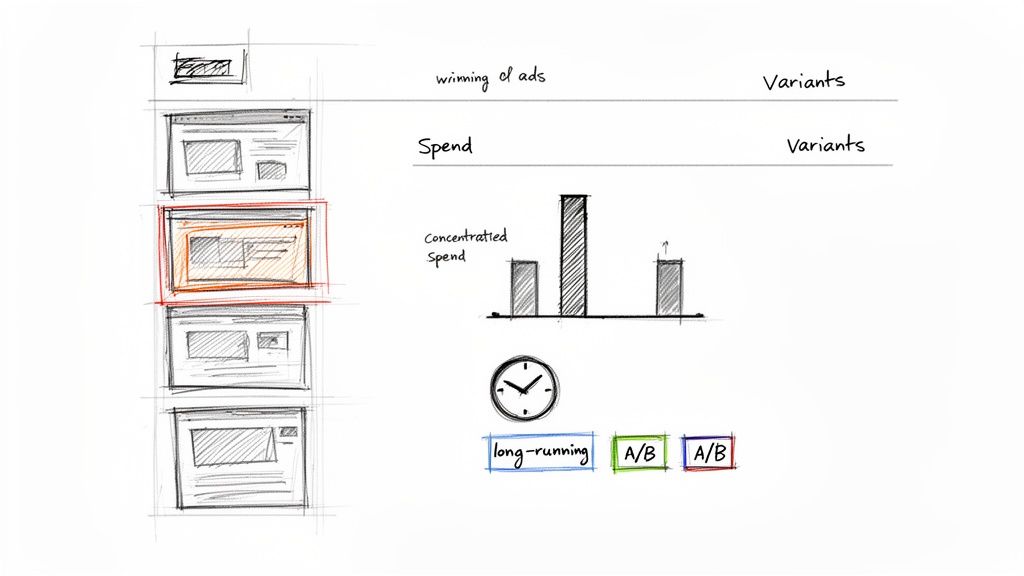
2. They Funnel Spend into a Few Top Performers
Here's a big one. While a competitor may be testing dozens of creatives, Meta's algorithm is efficient. It quickly learns what works. A huge signal is when you see a massive chunk of their ad budget being pumped into just a handful of ads.
This isn't a manual choice; it's the algorithm automatically shifting spend to the creatives that drive results. In most successful ad accounts, it's common to see 55-80% of the entire budget going to just one or two winning ads.
When you find an ad like this, you’ve struck gold. This isn't just another test. This is the creative that won their internal A/B tests and is now being scaled heavily. This ad is a free masterclass in what your target audience wants.
3. They Have "Evergreen" Ads That Run for Months
The final signal to hunt for is the evergreen creative. This is an ad that has been running for months, sometimes even years, with minimal changes.
In the fast-moving world of social media ads, longevity is the ultimate proof of an ad's power. If an ad has been running for over 90 days, it means it has tapped into a core message that consistently converts. It’s not just riding a trend; it’s speaking to a fundamental market need.
This clue is especially helpful for identifying companies that are spending big—think $10K+ a month—and have sophisticated testing programs.
Spotting these patterns is much easier with tools that surface these signals for you. For instance, the Proven SaaS Ad Library feature is built to help you cut through the noise and focus on competitors who are getting a real return on their ad spend.
Turn Ad Insights into a Minimum Viable Product (MVP)
A deep dive into Facebook ad creatives isn't just a marketing task—it's one of the best ways to roadmap your product. You're getting direct signals from the market about what people will actually buy, telling you exactly which problems are painful enough for them to solve with a credit card.
This process removes a massive amount of risk from your development cycle. Instead of building based on a gut feeling, you’re building based on proven demand. This is how you sharpen a vague concept into a focused MVP with a real chance of success.
From Ad Copy to Core Features
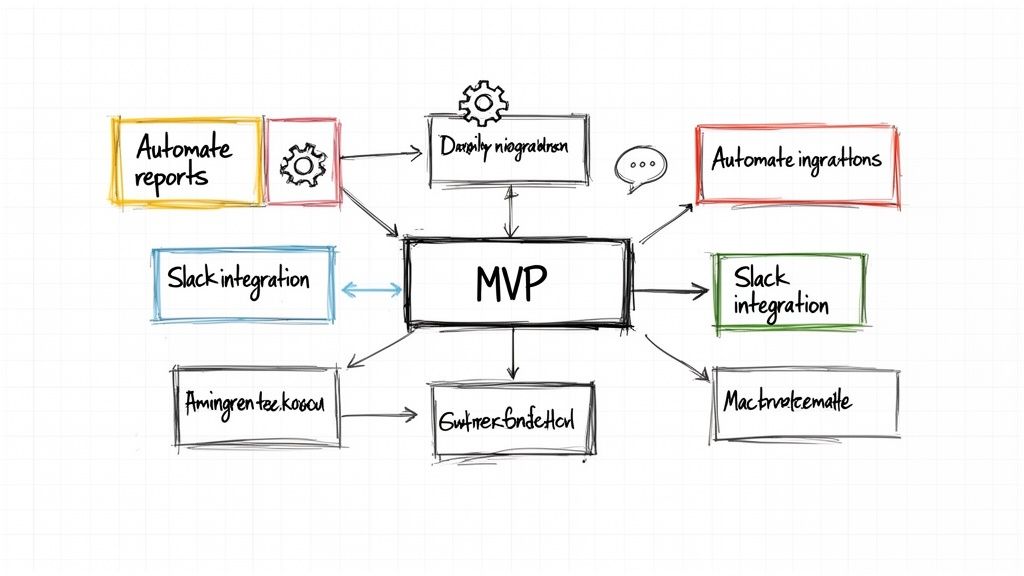
Start by turning the patterns you found into a feature list. The most common benefits and solutions in winning ads should become your priority tickets.
Let's walk through a clear example. Imagine you're analyzing ads for project management software and you notice these recurring themes:
- Pain Point: Ads constantly mention, "Tired of juggling tasks in messy spreadsheets?"
- Solution: A common promise is, "Automate your weekly status reports."
- Visuals: You see demo after demo of a clean, drag-and-drop Kanban board.
From these three signals, you've identified the core of your MVP. Your product absolutely needs a simple task board and some form of automated reporting. These aren't just wishlist features; the market is telling you they're essential.
Crafting Your Unique Selling Proposition
Once you have a list of must-have features, your next job is to figure out how you can deliver them differently. The goal is never to build a carbon copy of another tool. It’s to find a gap in their positioning that you can fill.
Look at what your competitors' ads aren't saying. Are they all targeting huge enterprise clients? That could leave a wide-open gap for a simpler tool designed for freelancers. Do their ads brag about dozens of complex features? That creates an opportunity for a product that does one thing perfectly.
For example, if every competitor's ad promises an "all-in-one" solution, your unique selling proposition (USP) could be "The simplest project management tool for creative agencies." You're solving the same core problem, but you’re aiming at a specific, underserved niche. This is a huge part of understanding your audience, which we cover in our clear guide to audience analysis for SaaS growth.
When you combine validated features with a distinct market position, you create an MVP that not only solves a real problem but also stands out in a crowded space.
Advanced Ad Analysis Tactics
You’ve got the basics down. Now, let's explore tactics that help you see beyond individual ads and map out a competitor's entire growth playbook. This is where you connect the dots.
Find the Ads They’re Really Betting On
The Meta Ad Library shows you everything, which can be overwhelming. The trick is to ignore the one-off tests and find the campaigns they're pouring serious money into.
This is where a tool like Proven SaaS helps. It lets you cut through the noise by filtering for competitors with high, sustained ad spend.
If you spot a campaign that’s been live for 60+ days, you’re not looking at an experiment. That’s a proven winner. It’s an ad that is clearly making them money; otherwise, it would have been shut off weeks ago.
Watch How Their Ads Evolve
Looking at what a competitor is running right now is just a snapshot. The real insights come from tracking how their creative has changed over time.
For example, watching their messaging evolve shows how they've refined their understanding of their customers.
- Did their headlines start by talking about features, but now they all focus on benefits?
- Did they switch from generic stock photos to user-generated videos or product demos?
- Has their call-to-action changed from a passive "Learn More" to a confident "Sign Up"?
This evolution tells a story, revealing what they learned after spending thousands on ads. You get to see which angles failed and which became the core of their messaging.
A competitor's ad history is a roadmap of their A/B tests. Seeing them abandon a certain value proposition is just as insightful as seeing which one they’ve scaled for the last six months.
Decode Their Live A/B Tests
The Ad Library lets you peek over a competitor's shoulder as they run A/B tests. If you see them running several nearly identical ads, you've found a live experiment.
For example, you might find the exact same video ad running with five different headlines. That's a goldmine. It tells you they’re confident in the visual but are still trying to find the perfect hook to grab attention.
Look for these common A/B testing patterns:
- Headline Tests: The visual is the same, but the headlines are different.
- Visual Tests: The headline and copy are identical, but the images or videos change.
- Audience Angle Tests: The creative is the same, but the copy is tweaked for different personas (e.g., "for small teams" vs. "for enterprise").
Benchmark Against the Industry
Finally, you need context. Knowing industry benchmarks helps you understand if a competitor's strategy is just okay or truly exceptional. For example, the average click-through rate for Facebook lead gen ads is around 2.53%.
But here's the key: the gap between top-performing and bottom-performing ads can be as high as 4x.
If you see a competitor consistently crushing that average, it’s a huge sign that their creative strategy is dialed in. Those are the ads you need to study closely. You can find more details on these Facebook ad benchmarks on Wordstream.com.
Frequently Asked Questions About Ad Creative Analysis
When you start digging into Facebook ad creative analysis, a few questions always pop up. Let's clear those up so you can turn this process into a powerful research habit.
How do I know if a competitor’s ad spend is significant?
The best clue is how long their ads run. While the Ad Library won't show you a competitor's exact budget, seeing a company run multiple ad variations for more than 30 days is a strong sign they've found a winning formula. If they're keeping the ads live, it means they're profitable.
Tools like Proven SaaS offer a shortcut by letting you filter for companies spending over $10K a month. This is a great benchmark, indicating that paid ads are a core part of their growth strategy.
What’s the most important element to analyze in a SaaS ad?
While slick videos are eye-catching, the real gold is in the core message. Focus on the headline and the first few lines of ad copy. That's where the strategy lives.
What specific pain point are they focusing on? What tangible outcome are they promising? The visual's job is to stop the scroll, but the messaging is what convinces the right person to click. It reveals their entire market positioning.
Can I just copy a successful competitor's ad?
No, and you shouldn't want to. Directly copying an ad is not only unethical but it rarely works. Your brand has a different voice, a unique value proposition, and a different story.
The point of analysis is not to copy-paste. It's to deconstruct the strategy behind the ad. Ask why it's working. Why does that headline connect so well? What emotion does their visual trigger? Use those insights as inspiration to build your own creative that speaks to the same customer needs but in a way that's authentic to your brand.
How often should I check the Ad Library for new ads?
If you're serious about keeping a finger on the pulse of your market, checking in once a week is a great habit. The ad world moves fast, and the best advertisers are always testing.
A weekly check-in allows you to:
- Spot new campaigns as soon as they launch.
- Notice which ads get turned off—a clear sign they weren't working.
- See which creatives are being scaled up, which tells you they've found a winner.
Think of it as getting a real-time feed of your competitors' marketing playbook and what your audience is responding to right now.
Stop guessing and start building with confidence. Proven SaaS uses AI to analyze thousands of ads, surfacing profitable and validated SaaS ideas daily. Find your next venture here: https://proven-saas.com
Build SaaS That's
Already Proven.
14,500+ SaaS with real revenue, ads & tech stacks.
Skip the guesswork. Build what works.
Trusted by 1,800+ founders


