

The world of digital marketing startups is packed, but for founders who use data, the opportunities are crystal clear. To succeed, you need an edge—a way to find real market needs before you even start building. This guide skips the theory and shows you the practical tools and platforms to help you discover, build, and grow a profitable software company.
We'll look at how to use ad intelligence to see what's already working, get essential tools without overspending, and master the key advertising channels where your future customers are. Forget guesswork. This list is your clear, step-by-step process for validating ideas in the real world.
Here, you'll find a data-backed list of platforms that reveal real SaaS opportunities. For each one, you'll get a simple snapshot of the business, how it works, and signs that it's growing. We include direct links and screenshots to make everything easy to follow.
Think of this as your playbook for turning market signals into a real business. You will learn:
- How to find proven niches by looking at what companies are spending on ads.
- Simple steps for building a first version of your product based on what works.
- Specific channels to use to get your first customers.
- Big mistakes to avoid when entering a competitive market.
Each platform on this list is a building block for a smarter, faster startup journey, starting with the most important step: validation. Let's dive into the platforms that can help you find and launch successful digital marketing startups.
1. Proven SaaS: The Ad Intelligence Platform for Validated Ideas
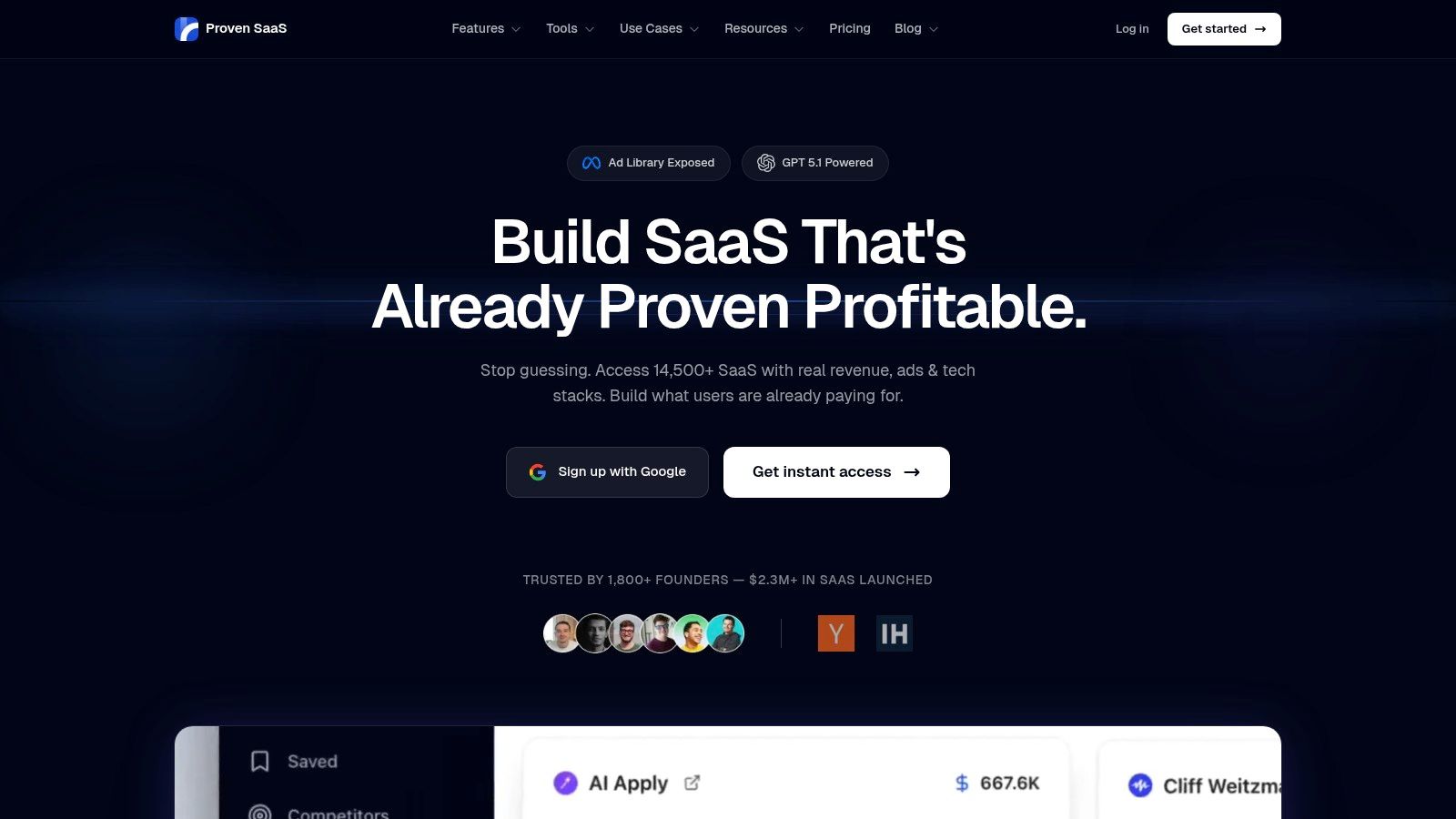
Proven SaaS is a competitive intelligence tool designed to take the risk out of building a software company. It scans Meta's public Ad Library, connects millions of ads to specific companies, and estimates key numbers like revenue and ad spend. This turns raw advertising data into a library of proven business ideas. It helps founders focus on building what people are already buying, instead of guessing what they might want.
The platform is especially useful for digital marketing startups because it shows which software products are already successfully finding customers on social media. This is key for understanding if a market is viable from day one.
Why It Stands Out: A Clear View of Market Demand
What makes Proven SaaS special is how it connects different data points into one simple workflow. Instead of manually digging through ad libraries and guessing at revenue, the platform automates the whole process. It finds companies spending over $10,000 a month on ads, which is a strong signal that they have a product people want and a way to reach them.
For example, you might discover a small but fast-growing company that makes a tool to automate social media comments for real estate agents. By looking at their ads, you can see the exact pain points they solve, like "never miss a lead" or "respond to comments in seconds." This is a validated idea you can build upon.
Key Features & Capabilities
Proven SaaS combines several research tools into one, making it a complete solution for market validation.
- SaaS Intelligence Database: A list of over 14,500 company profiles. Each one links active ads to company websites, the technology they use, and estimated revenue. This gives you a quick overview of a company's entire digital operation.
- Revenue & Ad Spend Modeling: The platform gives you estimated monthly revenue ranges ($10K–$500K+), ad spend levels, and a "Profit Rating." This helps you quickly find opportunities that are not just growing, but likely profitable.
- Ad Creative Analyzer: Go beyond just seeing ads. This tool lets you break down the top-performing ads in any niche. You can study the messaging, calls-to-action, and visuals to shape your own marketing strategy before you even have a product.
- Integrated Niche Validator: A built-in guide helps you go from a broad idea to a specific, validated niche. It uses market size, competition, and growth trends to give you a clear "go" or "no-go" signal, saving you months of wasted time.
Practical Tips for Founders
To get the most from Proven SaaS, be strategic. Start by filtering the database for niches you know something about. For instance, if you have a background in e-commerce, you could filter for "Shopify Apps" with monthly revenue between $20k and $100k to find small, underserved markets.
Use the ad library to see the main problems competitors are solving in their ad copy. If several successful companies are all running ads that mention "reducing cart abandonment," that's a powerful signal of a valuable problem to solve. Aspiring founders can find detailed guides on how to apply these techniques in the platform's resources for SaaS founders looking to build validated ventures.
Pros & Cons
| Strengths | Weaknesses |
|---|---|
| Fast Validation: Quickly find ad-proven SaaS ideas and sort them by estimated revenue, growth, and profit. | Estimates, Not Guarantees: Revenue and profit numbers are models and need to be confirmed with real customers. |
| All-in-One Intelligence: Connects ads, company data, and revenue, replacing multiple research tools. | Bias Toward Paid Ads: Might miss startups that grow organically or through channels other than social media ads. |
| High-Quality Signals: Focuses on companies with high ad spend ($10K+/mo) and provides hourly data updates. | Niche Focus: Mainly focused on B2B and B2C SaaS, so it may be less useful for other business models. |
| Actionable Tooling: Built-in tools help you move from idea to a basic product and test marketing channels fast. |
Website: https://proven-saas.com
2. AppSumo
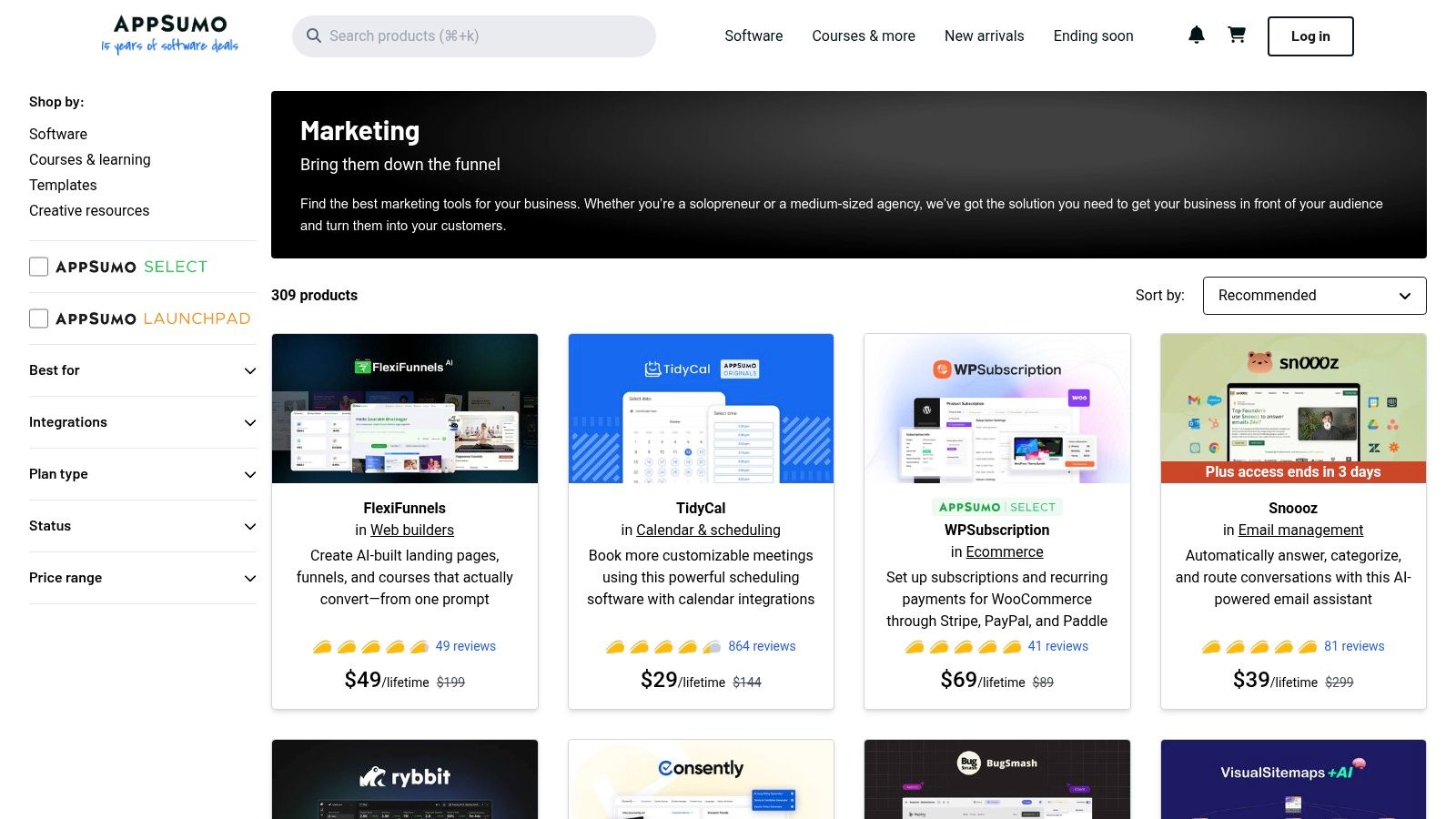
AppSumo isn't a single tool; it's a marketplace offering lifetime deals (LTDs) on new software products. This makes it a vital resource for digital marketing startups on a budget. It lets founders and small teams get powerful software for a one-time fee, avoiding recurring monthly subscriptions. This is perfect for trying out different tools for SEO, social media, or content creation without a big financial risk.
For example, instead of paying $99/month for a social media scheduling tool, you might find a similar one on AppSumo for a one-time payment of $59. This frees up cash to spend on other critical areas like advertising or product development.
Why It's a Go-To Platform
What makes AppSumo special is its "get it before it's big" model. Many tools on the platform come from early-stage companies trying to build their first user base. For buyers, it’s a chance to get a great product at a low price. For founders, launching on AppSumo can be a great way to validate their market and get new customers.
The platform creates a win-win: startups get a quick injection of cash and early feedback, while marketers get access to new tools at an amazing price.
Key Features and Offerings
- Lifetime Deals (LTDs): The main attraction. Pay once and own the software forever, often including future updates.
- Diverse Tool Categories: Find solutions for everything from email marketing and SEO to AI content writers and video editors.
- User Reviews and Questions: Each product page has a detailed Q&A section and honest reviews from other users, helping you check the tool's quality before you buy.
- 60-Day Money-Back Guarantee: AppSumo has a great refund policy, so you can test a tool and get your money back if it's not a good fit.
How to Use AppSumo Effectively
To get the most value from AppSumo, be strategic. Don't just buy a tool because it's a good deal; make sure it solves a real problem for your business right now.
- Read the Reviews: Pay close attention to user feedback, especially about the founding team's support and the product's future plans.
- Check the Tiers: Most deals have different tiers (e.g., Code 1, Code 2) that unlock more features or higher limits. Figure out what you need to pick the right one.
- Validate the Company: Do a quick search for the company outside of AppSumo. Look at their main website and social media to see if they seem built to last.
Website: https://appsumo.com/collections/category/marketing/
3. G2
G2 is a massive peer-to-peer review site where businesses can find, compare, and manage software. For digital marketing startups, it’s a goldmine for checking out the competition and choosing the right tools. The platform has millions of verified user reviews, letting you evaluate everything from email marketing tools to analytics software based on real experiences, not just marketing hype.
For example, if you're choosing a social media tool, you can filter reviews by company size to see what other startups like. This helps you avoid buying an expensive, complicated tool designed for large corporations when a simpler, more affordable option would work better.
Why It's a Go-To Platform
G2's strength is its Grid® Reports, which are simple charts that rank software based on customer satisfaction (from user reviews) and market presence. This gives you a quick, visual snapshot of who the leaders, contenders, and niche players are in any marketing category.
For a startup, this means you can quickly find tools that users love but that don't have the huge marketing budgets of big companies. This is how you find hidden gems that offer great value and new features, giving you a competitive edge without breaking the bank.
Key Features and Offerings
- Verified User Reviews: G2 checks reviewers to make sure they're real, giving you trustworthy feedback on a product's pros, cons, and best uses.
- Grid® Reports and Category Rankings: Data-driven reports that help you quickly compare top players in categories like Marketing Automation, SEO, and Social Media Management.
- In-Depth Feature and Pricing Comparisons: See exactly how different tools stack up on key features and price.
- Annual "Best Software" Lists: Lists that highlight top-rated products based on user happiness, giving you a great place to start your research.
How to Use G2 Effectively
To get the most out of G2, look beyond the overall star rating and dive into the details.
- Filter by Company Size: A tool that's great for a huge company might be too complex and expensive for a startup. Use filters to see reviews from companies your size.
- Analyze the "Dislikes" Section: The "What do you dislike?" part of a review is often the most useful. It points out common bugs, bad customer support, or missing features that could be deal-breakers.
- Cross-Reference with Grid® Placement: A tool might have great reviews but be a "Niche" player. This could mean it's excellent for a very specific task but might not have all the features you need. Use the Grid® to see the bigger picture.
Website: https://www.g2.com/categories/marketing?utm_source=openai
4. Google Ads
Google Ads is the essential advertising platform that lets digital marketing startups reach customers who are actively searching for solutions on Google Search, YouTube, and other websites. It's a fundamental channel for finding customers and validating your market because it connects you directly with users who have a problem they want to solve now.
For example, a startup offering an AI-powered tool for writing blog posts can run ads that appear when someone searches "best AI writing assistant" or "how to write blog posts faster." This high-intent traffic is perfect for testing if people are willing to pay for your solution.
Why It's a Go-To Platform
What makes Google Ads so powerful is its direct access to active problem-solvers. Unlike social media ads, which interrupt users, Search ads capture people at the exact moment they are looking for something. This makes it one of the most efficient ways for a new business to get its first leads and sales.
For founders, it's a rapid testing ground. You can try out different landing pages, ad copy, and audiences with a small budget and get immediate data to guide your marketing strategy. Our practical guide to digital marketing for startups offers more context on channel validation.
Key Features and Offerings
- Precise Keyword Targeting: Bid on the specific search terms your ideal customers use, so your ads are shown to a relevant, interested audience.
- Flexible Budget Control: Set daily budgets and cost-per-click (CPC) limits to manage your ad spending. You can start with as little as $10 a day.
- Performance Planner & Forecasting Tools: Use built-in tools to estimate potential clicks, conversions, and costs for your campaigns before you launch.
- Comprehensive Ad Network: Reach users not only on Google Search but also through video ads on YouTube and banner ads across the web.
How to Use Google Ads Effectively
To avoid wasting money, you need a structured approach. Focus on a small, highly relevant set of keywords first.
- Start with "Bottom-of-Funnel" Keywords: Target phrases that show someone is ready to buy, like "[your competitor] alternative" or "software for [specific problem]."
- Implement Conversion Tracking: This is essential. Set up tracking for sign-ups or purchases to measure your return on investment (ROI) and help Google's algorithm optimize your ads.
- Use Negative Keywords: Add keywords to prevent your ads from showing for irrelevant searches. For example, if you sell software, add "free" and "jobs" as negative keywords.
- Create Tightly Themed Ad Groups: Group a few similar keywords together and write very specific ads for them. This improves your Quality Score and lowers your costs.
Website: https://ads.google.com/
5. Meta Ads (Facebook & Instagram)
Meta Ads is the advertising platform for Facebook and Instagram, making it a crucial tool for digital marketing startups looking to reach very specific audiences. It’s great for testing creative ads, retargeting visitors who have left your site, and finding niche audiences for both B2C and B2B products.
For a new company, Meta's platform is a direct way to see if your product has a market. For instance, a startup with a project management tool for creative freelancers can target users who list "freelance graphic designer" as their job title and also follow popular design software pages on Instagram. You can test your message and visuals with a small budget to see who responds.
Why It's a Go-To Platform
What sets Meta Ads apart is its incredibly detailed audience targeting. You can go beyond basic demographics to target users based on their interests, online behaviors, life events, and past interactions with your business. This level of detail is a huge advantage for startups.
The platform's machine learning algorithm is also very powerful. Once it has enough data, it automatically finds the users most likely to become customers. This makes it a highly scalable way to get new customers, even for a small team.
Key Features and Offerings
- Advanced Audience Targeting: Use detailed demographic, interest, and behavioral data to build precise custom audiences and "lookalike" audiences (people similar to your existing customers).
- Flexible Budgeting: Set daily or lifetime budgets to keep full control over your ad spending.
- Diverse Ad Formats: Experiment with different ad types, including single images, carousels, videos, and stories.
- Comprehensive Analytics: The Ads Manager provides detailed reports to track your return on investment and understand how users engage with your ads.
How to Use Meta Ads Effectively
Success on Meta requires a smart approach. Don't make quick changes to your campaigns while they are in the "learning phase."
- Define Your Objective: Choose the right campaign goal (e.g., Traffic, Leads, Sales). This tells Meta's algorithm what you want to achieve.
- Spy on Competitors: Before you start, see what kind of ads your competitors are running. This gives you ideas for messaging and visuals that work in your niche. You can learn more about using an ad library for competitive research to get a head start.
- Test Broadly, Then Narrow: Start with broader audiences to get initial data. Then, use those results to create more targeted lookalike and retargeting campaigns.
Website: https://www.facebook.com/business/ads/pricing
6. LinkedIn Ads
LinkedIn Ads is the top B2B advertising platform, allowing digital marketing startups to connect directly with decision-makers using professional data. You can target users by job title, company size, industry, and specific skills. This makes it the best channel for software companies and service providers selling to other businesses.
Unlike consumer platforms, LinkedIn is where people are in a business mindset. This makes them more open to B2B offers. For example, a startup selling HR software can run ads that target "HR Managers" at companies with 100-500 employees. This is a direct line to the exact people who make purchasing decisions.
Why It's a Go-To Platform
LinkedIn’s biggest strength is its professional data. While other platforms guess at user interests, LinkedIn knows a user's job title, their company, and their professional connections. This allows for hyper-specific targeting that no other platform can match.
This level of targeting means the leads you get are much higher quality. Although the cost-per-click (CPC) is often higher than on platforms like Facebook, the leads are usually far more relevant. For B2B startups with high-value customers, paying more for a quality lead is a smart investment.
Key Features and Offerings
- Precise Targeting: Filter your audience by job title, seniority, industry, company name, company size, and professional skills.
- Multiple Ad Formats: Choose from Sponsored Content (in-feed ads), Sponsored Messaging (direct messages), and Lead Gen Forms.
- Objective-Based Campaigns: Structure your campaigns around specific goals like brand awareness, website visits, or lead generation.
- Insight Tag: A tracking pixel that helps you measure conversions and understand the professional demographics of your website visitors.
How to Use LinkedIn Ads Effectively
Success on LinkedIn requires a focused approach because of its higher costs. It's not the place for broad, speculative campaigns.
- Start with a Niche Audience: Instead of targeting a wide industry, focus on a specific job title within that industry to control costs and test your message.
- Use Lead Gen Forms: This ad format lets users submit their information without leaving LinkedIn, which dramatically increases conversion rates for things like whitepapers or webinars.
- Align Ad Copy with Professional Goals: Speak to your audience's career challenges. An ad for a CTO should talk about scalability, while one for a marketing manager should focus on ROI.
Website: https://business.linkedin.com/advertise.html
7. HubSpot Marketing Hub
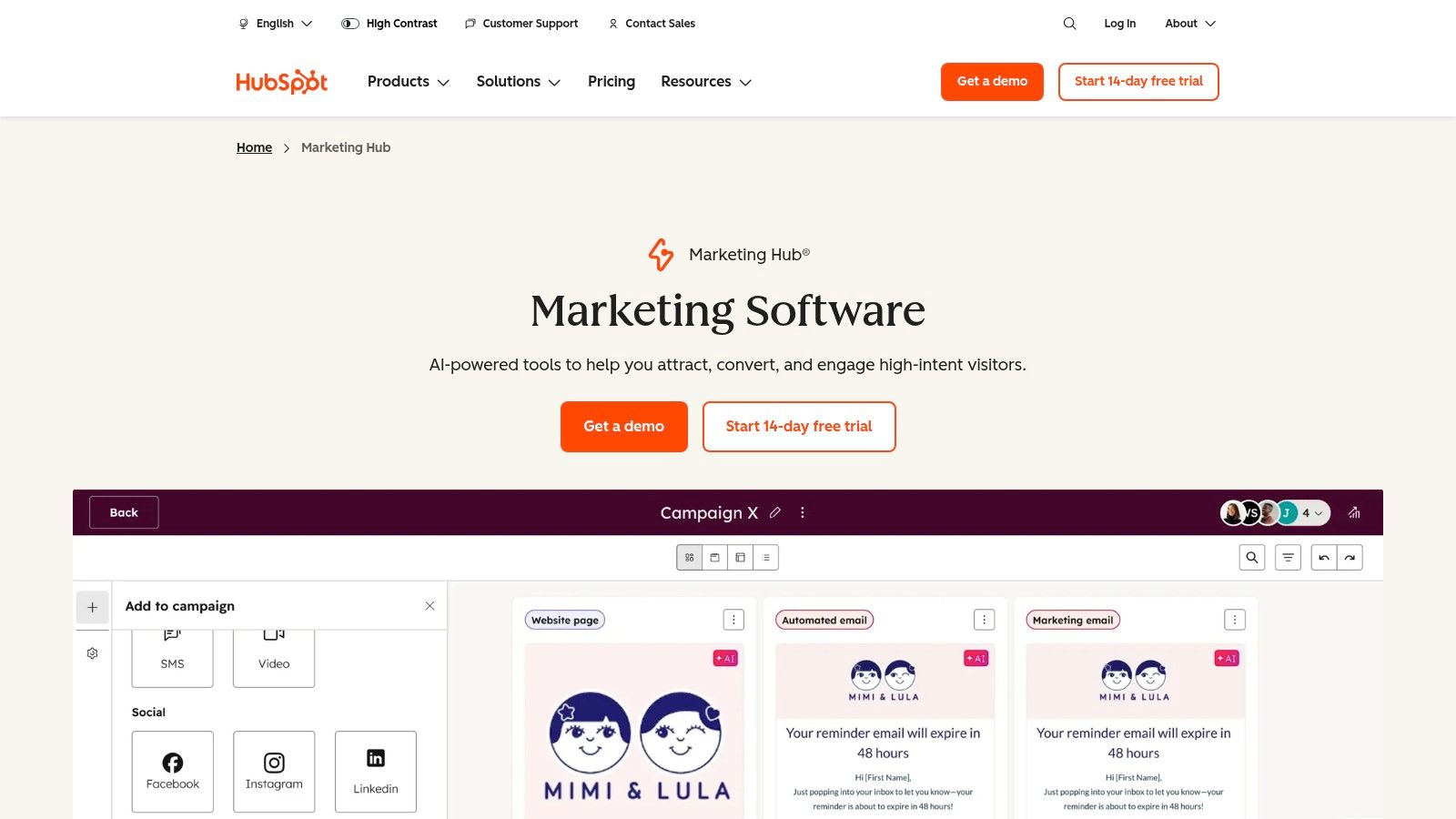
HubSpot Marketing Hub is an all-in-one marketing platform that helps companies attract and convert customers. For digital marketing startups, it offers a single system for managing email campaigns, landing pages, forms, and analytics. This means you don't have to piece together multiple tools, giving you one clear view of all your marketing activities.
The platform is built around inbound marketing, helping startups create a repeatable growth engine by attracting and nurturing leads. It starts with a strong set of free tools, allowing even startups on a tight budget to build a solid marketing foundation before paying for more advanced features.
Why It's a Go-To Platform
What makes HubSpot special is its scalability. A startup can begin with the free CRM and marketing tools, and as it grows, upgrade to paid plans that unlock powerful automation and reporting. This "grow-with-you" model prevents the pain of switching systems later.
For example, you can start by capturing leads with free forms on your website. As you grow, you can upgrade to automate your email follow-ups to nurture those leads, saving you valuable time. The "HubSpot for Startups" program also offers big discounts, making its premium features accessible to early-stage companies.
Key Features and Offerings
- Integrated CRM: Every marketing action is tied to a contact record, giving you a complete history of each lead's journey.
- Comprehensive Toolset: Includes email marketing, landing pages, live chat, ad management, and social media scheduling all in one place.
- Marketing Automation: Paid plans unlock powerful workflows to nurture leads automatically based on their behavior.
- Extensive App Marketplace: Integrates with hundreds of other tools like Stripe and Zapier, letting you build a custom tech stack.
How to Use HubSpot Marketing Hub Effectively
To get the most value, use the platform's integrated features from day one. Don't treat its tools as separate; build campaigns that connect them.
- Start with the Free Tools: Use the free CRM to build your contact list and the free marketing tools to capture leads with forms and live chat. This builds a strong foundation.
- Explore the Startup Program: If you are part of an eligible startup program, apply for HubSpot for Startups. The discounts (up to 90% off the first year) are a game-changer.
- Focus on One Funnel: Build one complete marketing funnel in HubSpot first. For example, create a landing page with a form, an email follow-up sequence, and a report to track its performance before you build more complex campaigns.
Website: https://www.hubspot.com/products/marketing
Top 7 Digital Marketing Tools Comparison
| Item | 🔄 Implementation complexity | ⚡ Resource requirements | 📊 Expected outcomes | 💡 Ideal use cases | ⭐ Key advantages |
|---|---|---|---|---|---|
| Proven SaaS | Medium — web signup and dashboard interpretation | Low–Medium — subscription + time to analyze; optional API work | Validated niches, estimated MRR/ARR, ad spend & profit signals | Early-stage SaaS founders, indie hackers, growth teams validating ideas quickly | All-in-one ad→revenue intelligence, hourly updates, SaaS-focused signals |
| AppSumo | Low — browse deals and purchase | Low — one-time payments; minimal setup per tool | Cost savings and access to tools for rapid experimentation | Bootstrapped teams testing multiple tools affordably | Large catalog of discounted/lifetime deals for experimentations |
| G2 | Low — research platform, read reviews & grids | Low — time to evaluate; purchases with vendors | Shortlisted vendors, peer-reviewed comparisons & feature insights | Vendor selection, comparative evaluations across categories | Extensive verified reviews and comparative Grid rankings |
| Google Ads | High — requires keyword strategy, tracking & optimization | Medium–High — ad spend, conversion tracking, analytics setup | High-intent traffic, scalable acquisition, measurable ROI when tracked | Search-driven customer acquisition, SaaS with clear keyword demand | Intent-driven reach, granular targeting, forecasting tools |
| Meta Ads (Facebook & Instagram) | Medium — creative setup and audience testing; learning phase | Medium — creative production + ad spend for tests | Creative-led top-of-funnel growth, remarketing, audience discovery | Creative-driven acquisition, retargeting, niche audience tests | Rich demographic/interest targeting and varied creative placements |
| LinkedIn Ads | Medium — campaign setup with B2B targeting complexity | High — higher CPC/CPM and test budgets | Targeted professional leads and account-based engagement | B2B SaaS, enterprise lead gen, events and ABM campaigns | Precise professional targeting by job, company and industry |
| HubSpot Marketing Hub | High — CRM integration, automation and onboarding | Medium–High — subscription tiers, potential onboarding fees | Repeatable inbound funnels, lead nurturing, attribution & scaling | Scaling marketing teams, integrated sales-marketing workflows | Integrated CRM + marketing stack, automation and marketplace integrations |
Your Next Step: From Insight to Action
We've covered the modern playbook for building successful digital marketing startups, from finding a proven idea to getting customers and scaling up. The market is no longer a mystery. It's a field full of clear needs, where smart execution and data-driven decisions provide the best path to building a profitable business.
The key lesson is simple: success leaves clues. You don't have to guess what people want. You can look at ad spending, read customer reviews, and find underserved niches in established markets. The platforms we've explored show that the biggest opportunities often come from doing one thing exceptionally well for a specific group of people.
Key Takeaways for Aspiring Founders
As you move from reading this article to building your company, keep these principles in mind:
- Validation Over Invention: The biggest risk for any startup is building something nobody wants. Start with market research. Use data, not just a gut feeling, to confirm that a real, paying audience already exists for the problem you want to solve.
- Lean Execution is Your Superpower: Early-stage money is precious. Use platforms like AppSumo to get powerful tools for a fraction of the cost. This lets you spend more on product development and getting customers.
- Master One Channel First: Don't try to be everywhere at once. Whether it's the high-intent traffic of Google Ads, the powerful targeting of Meta Ads, or the professional network of LinkedIn, pick one channel and master it before you diversify.
- Customer Feedback is Your Compass: Platforms like G2 aren't just for buyers; they are a goldmine of ideas for builders. Read competitor reviews to understand what customers love, what they hate, and what features they are asking for. This is your free product roadmap.
A Practical Framework for Your First 90 Days
Feeling inspired is one thing; taking action is another. Here’s a simple, actionable plan to get you started:
- Days 1-30: De-Risk Your Idea. Spend the first month on deep research. Use a market intelligence tool to find a validated niche. Look for growing ad spend, clear customer demand, and gaps in the market. Define your ideal customer and the specific problem you will solve better than anyone else.
- Days 31-60: Build Your Minimum Viable Product (MVP). With a validated idea, build the smallest possible version of your product that solves the core problem. The goal is to get something functional to early users as quickly as possible.
- Days 61-90: Acquire Your First Users. Launch your MVP on your chosen marketing channel. Run small, targeted campaigns focused on your ideal customer. Your initial goal isn't massive scale; it's learning. Gather feedback and improve your product and your marketing message.
Building a startup is a marathon, not a sprint. The tools and strategies in this article give you a map, but you still have to take the first step. By focusing on proven market needs and executing with discipline, you can dramatically increase your chances of building one of the next great digital marketing startups. The opportunity is clear, the path is validated, and the time to build is now.
Ready to skip the guesswork and find a validated business idea? Proven SaaS is a market intelligence platform that analyzes thousands of B2B SaaS companies to uncover profitable niches and growth opportunities. Start your research with real data by visiting Proven SaaS and find your next venture today.
Build SaaS That's
Already Proven.
14,500+ SaaS with real revenue, ads & tech stacks.
Skip the guesswork. Build what works.
Trusted by 1,800+ founders


