

The Practical Guide to Digital Marketing for Startups
A winning marketing strategy for a startup isn't about outspending your competitors. It's about outsmarting them. The real work happens long before you run your first ad. It’s about deeply understanding who you serve, what unique value you offer, and where you fit in the market. If you skip this critical groundwork, you're not marketing; you're just gambling with your budget.
Building Your Startup's Marketing Foundation
Many startups fall into the same trap: they jump straight into tactics. They start posting on social media or pouring money into Google Ads without a clear plan. Before you market anything, you must answer three fundamental questions: Who is my customer? What problem do I solve better than anyone else? And who am I really competing against?
Answering these questions acts as a filter for every marketing decision you make. Without this clarity, you're just creating noise—writing blog posts for the wrong audience or running ads that attract users who will never convert. A strong foundation ensures every piece of content and every dollar spent works together, dramatically increasing your chances of gaining that crucial early traction.
Define Your Ideal Customer Profile
First, get laser-focused on your Ideal Customer Profile (ICP). This is more than just demographics. You need to understand the people or companies who will benefit most from your product. What are their biggest frustrations? What does their typical day look like? What truly motivates them? Nailing your ICP makes everything that follows infinitely easier.
For example, a project management tool for a freelance designer is completely different from one built for a large construction company. The designer needs a simple, visual interface for client collaboration. The construction firm needs robust Gantt charts and resource management features. Same product category, entirely different customers.
The best way to build an accurate profile is to talk to real people. Schedule brief, 15-minute video calls with individuals you believe fit your ideal user profile.
Here are a few simple questions to start with:
- "Could you walk me through the biggest challenge you face with [the problem you solve]?"
- "What are you currently using to handle that?"
- "What do you love and hate about that solution?"
- "If you had a magic wand, what would the perfect solution do for you?"
These conversations provide rich, qualitative insights you'll never find in a survey. You'll begin to build a persona that feels like a real person, which will guide your copywriting, channel selection, and even your product development.
Craft A Compelling Unique Value Proposition
Now that you know who you're talking to, you need to perfect what you're going to say. Your Unique Value Proposition (UVP) is your promise to that customer. It's a clear, concise statement that explains the primary benefit you offer, who it's for, and what makes you different. A strong UVP cuts through the marketing fluff and answers the customer's core question: "Why should I care?"
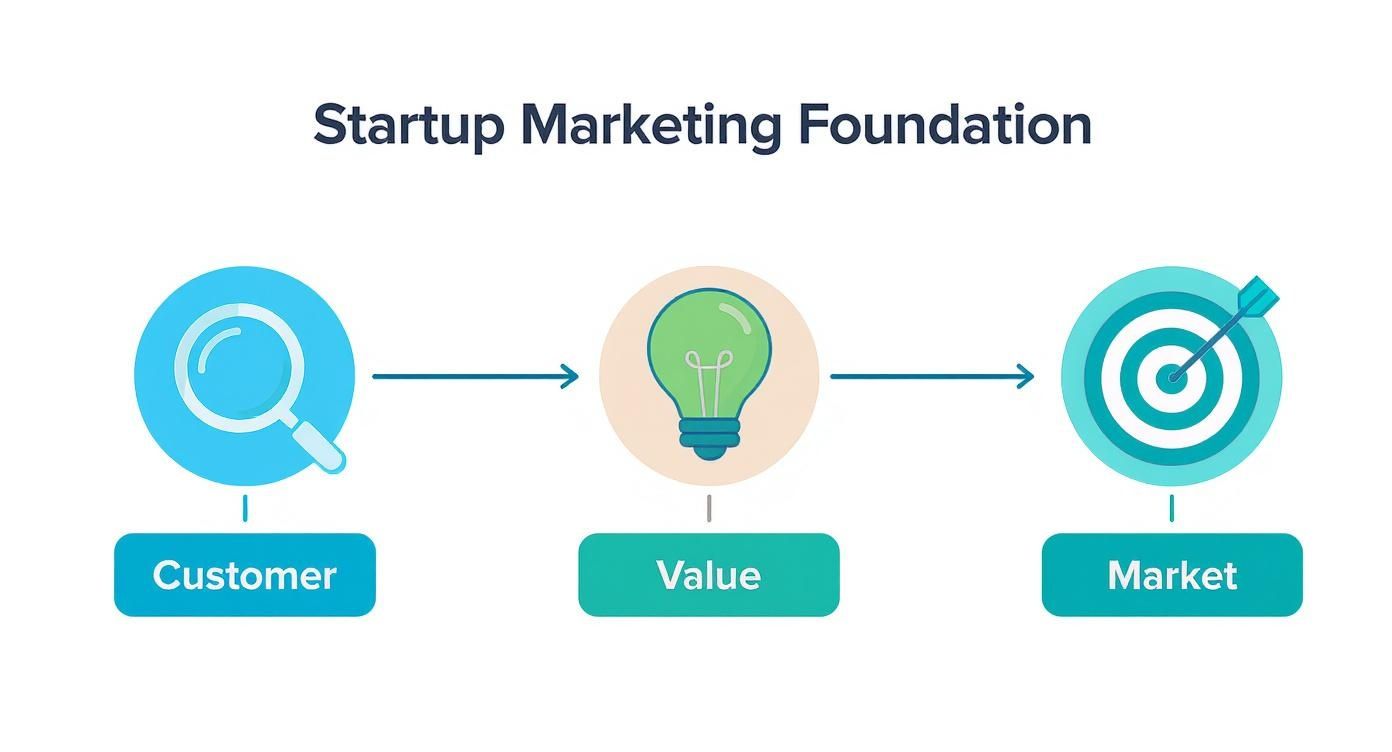
This whole process is about stacking foundational blocks—understanding the customer, defining your value, and knowing the competitive landscape.
As you can see, each piece builds on the last, creating a solid base for all your future marketing efforts.
A weak UVP sounds generic, like "Easy-to-use accounting software." A strong one is specific and outcome-focused. For example, the fintech company Stripe’s UVP is "Payments infrastructure for the internet." It's simple, clear, and instantly tells you who it's for (online businesses) and what it does (handles payments). Another great example: "The simplest accounting software for freelancers to get paid 2x faster." This immediately identifies the audience (freelancers) and a measurable benefit (get paid 2x faster). This level of clarity is vital. For more on this, check out our guide on how to find product-market fit to ensure your product resonates with your audience.
> Your UVP must be the first thing a visitor understands on your website. If they can't figure out what you do and why it matters in five seconds, they're gone.
Analyze The Competitive Market
Finally, you must take an honest look at your competitors. You aren't doing this to copy them. You're looking for gaps in the market—opportunities they've missed that you can claim as your own.
Investigate their messaging, pricing, and target audience. Where are they spending their marketing dollars? More importantly, what are they not doing? Perhaps they all focus on enterprise clients, leaving a wide-open opportunity for you to serve small businesses. Or maybe their product is powerful but notoriously difficult to use. That's your cue to build a simpler, more intuitive alternative. This analysis is about finding a defensible niche where your startup can not only compete but thrive.
Crafting Your Core Message And Content Engine
Your strategy is the map, but your content is the vehicle that drives your startup forward. The most effective marketing digital startups understand that content isn't about shouting into the void. It's about building a sustainable engine that attracts the right people, provides genuine value, and turns them into loyal customers. For a small team, this means being strategic with your resources and prioritizing quality over quantity.
The goal is to create a system where one significant piece of work can fuel multiple marketing channels. This keeps your message consistent and prevents team burnout. It’s how you make a huge impact without a huge budget.

Build Around A Cornerstone Asset
Stop chasing new content ideas every day. Instead, focus your energy on creating one high-value, cornerstone asset. Think of it as the sun in your content solar system—everything else will orbit around it. This central piece should be a definitive resource that solves a major problem for your ideal customer.
This approach gives your content structure and focus, transforming it from a reactive task into a strategic process. More importantly, it instantly positions you as an expert on a topic that matters to your audience.
What does a great cornerstone asset look like? Here are a few examples:
- An in-depth industry report: A company like Buffer could release an annual "State of Social Media" report, using survey data to provide unique insights.
- A definitive "how-to" guide: Ahrefs created a massive guide on "Blogging for Business" that became the go-to resource for anyone starting a company blog.
- An interactive tool or calculator: HubSpot offers a free "Website Grader" tool that provides immediate value and generates leads.
Once you have this core piece, you can strategically slice it up and repurpose it across all your channels to create a powerful, unified message.
Repurpose Ruthlessly To Maximize Reach
Your cornerstone asset is a content goldmine. The secret is to extract and reshape its value for different platforms and formats. This "create once, distribute everywhere" mindset is how lean startups can compete with established players.
Imagine you created a comprehensive guide on "Remote Team Productivity." That single asset can be spun into dozens of content pieces.
- Blog Posts: Turn each chapter into a standalone, SEO-optimized article. (e.g., "5 Best Tools for Asynchronous Communication").
- Social Media Updates: Pull out compelling stats or quotes for LinkedIn and X. (e.g., "Our report found that 74% of remote teams struggle with documentation. Here's how to fix it.").
- Email Newsletters: Create a 5-day email course that breaks down a key concept from the guide each day.
- Infographics: Visualize the key data and takeaways into a shareable graphic for Pinterest or LinkedIn.
This system saves a tremendous amount of time and ensures your brand message remains consistent. You’re not starting from a blank page every day; you're finding new ways to deliver the value you've already created.
This is critical in a rapidly growing market. The digital marketing industry is projected to jump from $667 billion in 2024 to over $1.5 trillion by 2030, yet many businesses still operate without a clear content plan. You can explore more digital marketing industry trends and opportunities on rankings.io.
Write Copy That Converts
All the amazing content in the world is useless if your website copy fails to connect with visitors. High-converting copy isn't about being clever; it's about demonstrating deep empathy for your customer's problems. When done right, your copy should make visitors feel like you’re reading their minds.
To achieve this, your copy must speak directly to their pains and aspirations. It all comes back to the customer research you did earlier. If you want to master this, our guide on how to perform a comprehensive audience analysis provides a framework for finding the insights that make your copy resonate.
> A great landing page answers three questions in under five seconds: What is this? Who is it for? And why should I care? If a visitor has to work to find these answers, they will leave.
Your messaging must be sharp, clear, and benefit-driven. Don't just list features—explain how those features improve your customer's life. Use their language, borrowing the exact phrases you heard in your customer interviews, to build instant trust and a genuine connection.
Choosing The Right Channels For Early Traction
One of the quickest ways for a startup to burn through cash and morale is by trying to be everywhere at once. You see a competitor on LinkedIn, another in Google Ads, and hear buzz about Reddit. The temptation is to do it all. Don't fall into that trap.
For an early-stage startup, your goal isn't just presence; it's impact. Instead of being a faint whisper on five platforms, aim to become a trusted voice on one or two. This focus is your superpower. It allows you to truly understand a channel, create content tailored to its audience, and see a real return on your most precious resource: time.
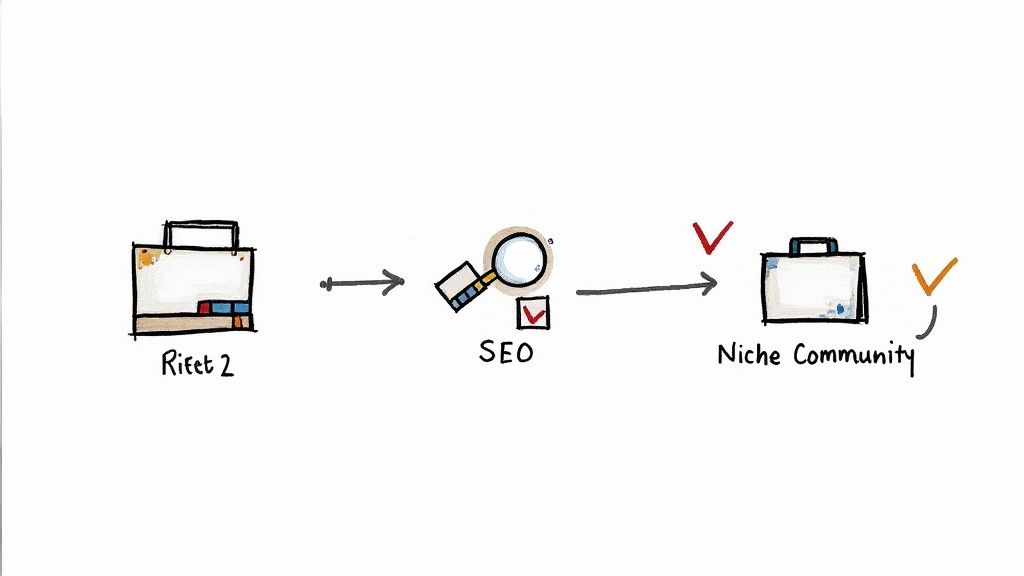
Where Does Your Ideal Customer Live Online?
Before you spend a single dollar or minute, go back to your Ideal Customer Profile. Ask yourself: where do these people go online when they’re looking for solutions to the exact problems my product solves?
This simple question separates a winning strategy from a wasteful one.
For example, if you have a B2B SaaS for enterprise-level Chief Financial Officers, you won't find them on TikTok. They are far more likely to be on LinkedIn, reading industry publications, or searching Google for complex financial modeling terms. A smart strategy would be to combine technical SEO with highly targeted LinkedIn content.
On the other hand, if your startup built a new tool for game developers, your first 100 users are likely in niche subreddits like `r/gamedev` or specific Discord communities. In that environment, a slick ad campaign will fail. What works is authentic engagement—becoming a valued member of the community by offering genuine help.
> The right channel isn’t the most popular one; it's the one with the highest concentration of your ideal customers. Your job is to find that digital water cooler and join the conversation.
Comparing High-Impact Startup Channels
For early-stage companies on a tight budget, a few channels consistently deliver strong results. But each has its own rules, costs, and timeline. Understanding these differences is key to making the right choice.
Here’s a simple visual breakdown of the main contenders.
#### Startup Marketing Channel Focus
| Channel | Best For | Typical Startup Budget | Time to See Results |
|---|---|---|---|
| SEO | Solving problems people actively search for. Builds a long-term, defensible traffic source. | Low cash, high time/content investment | 6-12 months |
| Paid Social | Niche B2B audiences with clear job titles/industries (e.g., LinkedIn). Fast lead generation. | $1k - $5k/mo to start | 1-4 weeks |
| Content Marketing | Building authority and trust. Educating the market and nurturing leads over time. | Low to medium, depends on creation/promotion | 3-6 months |
| Community Building | Getting direct user feedback and building a loyal base of early adopters. | Very low cash, high time/effort investment | 1-3 months |
This table provides a practical framework for decision-making. SEO is a marathon, while paid ads can get you results almost immediately—if you have the budget.
A Practical Framework For Channel Testing
So, you have a hypothesis about where your customers are. Now it's time to test it without risking your entire budget. The key is to run small, measurable experiments to gather real-world data before you commit fully.
Here’s a simple process to follow:
- Define a Clear Success Metric: What does a "win" look like? Is it 10 demo sign-ups? 50 new newsletter subscribers? Be specific.
- Set a Small, Fixed Budget: Allocate an amount you're willing to lose. This could be $500 for a two-week LinkedIn Ads test or 10 hours of your time for community engagement over a month.
- Run the Experiment: Launch the ad campaign. Publish a few high-quality blog posts and promote them. Become an active, helpful member of that Slack group.
- Analyze the Results: After the test period, review the data. Did you hit your goal? What was your cost per acquisition? What did you learn about the channel and your audience's response?
This disciplined approach removes the guesswork. Based on hard data, you can confidently decide whether to abandon a channel, continue experimenting, or double down on a clear winner. This is how you find product-channel fit and turn small bets into sustainable growth.
Putting Your Go-To-Market Launch Strategy into Action
All the foundational work—defining your customer, crafting your message, and selecting your channels—has led to this moment. It's time to launch. But a go-to-market strategy isn’t a single event; it's a coordinated effort designed to make a splash and attract your first wave of users. This is where planning ends and execution begins.
A successful launch for any marketing digital startup is about creating momentum. You need a focused burst of activity that makes your product feel like a can't-miss event. It's about being scrappy and focusing on tactics that deliver a big impact without a massive ad budget.
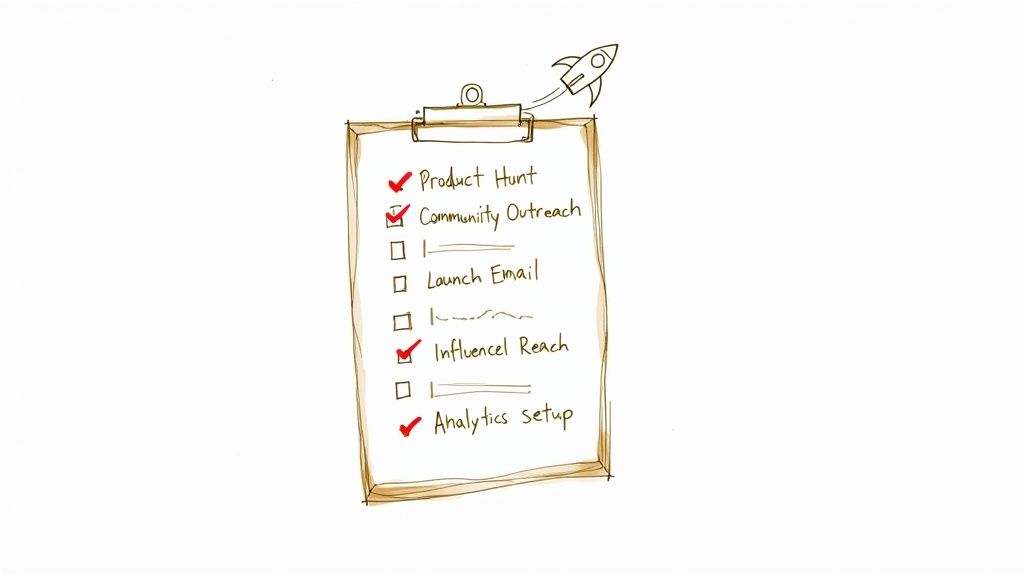
Orchestrate Your Launch Day Push
Your launch should feel like a multi-front campaign, not just a quiet blog post. Platforms like Product Hunt are perfect for this, providing a central stage for your debut. A well-run Product Hunt launch can drive thousands of engaged visitors to your site in a single day, but you can't just show up and expect success.
The work starts weeks in advance. Get involved in the community, support other product makers, and connect with a respected "hunter" who can feature your product. This isn't about gaming the system; it's about being a genuine member of the community you're asking for support.
But don't rely solely on one platform. Coordinate your efforts across other channels simultaneously:
- Tap into Niche Communities: Share your launch in relevant subreddits (like `r/SaaS` or `r/SideProject`) and on forums like Indie Hackers. The key is authenticity. Don't just spam a link. Share your story, explain the problem you're solving, and ask for honest feedback.
- Activate Your Pre-Launch List: These are your warmest leads, so treat them like VIPs. Send a short email sequence: one to build anticipation the day before, one to announce "We're live!", and a third to share early results or a special offer.
> A common mistake is treating a launch as a single-day event. Think of it as "launch week." Plan follow-up content, respond to every comment, and maintain high energy for several days to maximize your initial momentum.
Make Your Outreach Personal
While big announcements generate buzz, targeted outreach is what lands you critical first users and influential supporters. This isn't a numbers game; it's about quality connections. You should have a curated list of influencers, potential early adopters, and industry bloggers ready before launch day.
Generic, templated emails are instantly deleted. Your outreach must show you've done your homework.
Here’s an example of an outreach email that works:
Subject: A new tool for tackling [Specific Problem]
Hi [Name],
I'm a big fan of your work on [Their Blog/Podcast], especially your recent episode on [Specific Topic]. Your point about [Mention a Specific Insight] really hit home.
Inspired by that same challenge, I've spent the last six months building [Your SaaS Name], a tool designed to help [Their Audience] with [Key Benefit].
We just launched today, and I thought you might find it interesting. Would you be open to taking a quick look? No pressure at all, but I’d genuinely value your expert opinion.
Best,
[Your Name]
This approach works because it’s respectful and relevant. It shows you value their time and are genuinely familiar with their work. You're starting a relationship, not just asking for a favor.
Get Your Analytics Set Up From Day One
You cannot afford to fly blind. Measuring your launch's impact is non-negotiable. Before your first visitor arrives, ensure your basic analytics are in place. It doesn't need to be complex or expensive.
Start with these essentials:
- Google Analytics 4: Install this on your website to track traffic sources, user behavior, and conversions. Crucially, set up specific goals, like "Demo Request" or "Free Trial Signup," so you can see which channels are delivering actual results.
- A Simple CRM: You don't need Salesforce on day one. A free tool like the HubSpot CRM is perfect for managing your first leads. It helps you track interactions with potential customers and gives you a clear view of your early sales funnel.
- Customer Acquisition Cost (CAC): Your total sales and marketing spend divided by the number of new customers acquired. This is the price you pay to win a new user.
- Lifetime Value (LTV): The total revenue you can expect from a single customer throughout their relationship with your product. This is the long-term payoff.
- Conversion Rates: The percentage of people who take a desired action, like signing up for a trial or upgrading to a paid plan. Tracking this at each stage of your funnel reveals where your process is strong and where it's leaking money.
- Google Analytics 4: Your source for website behavior. It shows where traffic comes from, who your visitors are, and what content they engage with.
- Google Sheets: Use a simple spreadsheet to manually track your core business metrics. Each month, enter your marketing spend, new customers, and revenue. From there, you can calculate CAC and LTV.
- Increase Budget on Proven Channels: If LinkedIn Ads are consistently delivering high-value customers at a low CAC, carefully increase your ad spend there.
- Hire Your First Marketer: If you, as the founder, are spending too much time on a repeatable marketing process, it’s time to hire someone to own and optimize it.
- Invest in Automation Tools: As you grow, tools for email marketing or social media scheduling can save hundreds of hours, freeing you up to focus on strategy.
- Pre-Product-Market Fit: Your early budget is for learning, not scaling. Set aside a small, fixed amount—perhaps $1,000 to $3,000 a month—to test one or two channels. The goal isn't a flood of users; it's to find a repeatable, profitable way to get customers.
- Post-Product-Market Fit: Once you've found a channel where your Customer Acquisition Cost (CAC) is clearly less than your Customer Lifetime Value (LTV), your marketing spend becomes a direct investment in growth.
- You have at least one marketing channel that reliably brings in quality leads.
- You have a simple, working marketing funnel in place.
- Marketing is consuming more than 30% of your time, pulling you away from product development or fundraising.
This simple setup will provide the data to answer critical post-launch questions: Where did our best users come from? What messaging resonated most? Which channel should we invest more in? This feedback loop will guide your strategy for the months to come.
And you'll need that data. By 2026, the global digital advertising market is projected to hit $715 billion, with mobile traffic now accounting for over 60% of all website visits. Making data-driven decisions is essential for survival. You can dive deeper into the latest digital marketing statistics on theloopmarketing.com to understand these trends.
How To Measure Success And Scale Your Efforts
Launching your startup is just the beginning. The real challenge is making smart, data-driven decisions that turn initial momentum into sustainable growth.
If you're not measuring your marketing, you're just guessing. For early-stage startups, this means ignoring vanity metrics—like social media likes—and focusing on the numbers that directly impact your bottom line.
You don't need a massive, expensive analytics platform. A few key metrics can tell you everything you need to know about the health of your marketing engine, helping you see what's actually working without drowning in data.
The Metrics That Truly Matter
For an early-stage SaaS, your world revolves around two questions: How much does it cost to acquire a new customer? And how much is that customer worth over their lifetime?
Everything else is secondary.
To answer those questions, you need to track three essential metrics.
The real magic happens when you look at these numbers together. A healthy SaaS business needs its LTV to be significantly higher than its CAC. The classic rule of thumb is to aim for an LTV that is at least 3x your CAC. This simple ratio is your north star for making profitable marketing decisions.
Build A Simple Marketing Dashboard
To monitor these metrics, you need a central place to see your progress. This doesn't have to be complicated. You can build a powerful dashboard using free tools.
Start with these two:
Simply tracking these numbers month-over-month is a game-changer. It forces you to confront the reality of your marketing performance. For those running paid ads, it's also vital to distinguish between overall business return and specific campaign performance. You can dive deeper into the differences between ROI vs ROAS in our detailed guide.
> Your dashboard's only job is to turn raw data into clear, actionable insights. At a glance, it should answer one question: Is our marketing getting more or less effective over time?
A Framework For Scaling Responsibly
Once your data shows a channel is working—meaning it's bringing in customers with a healthy LTV to CAC ratio—it's time to scale. But scaling isn't about just throwing more money at the problem. It’s about making calculated investments to amplify what is already proven to work.
Depending on your situation, scaling can look a few different ways.
The key is to scale incrementally. Double down on what works, measure the impact, and adjust based on the results. This disciplined, data-first approach is what separates the startups that achieve explosive growth from those that fizzle out.
Got Questions About Startup Marketing? We've Got Answers.
When you're building a startup, marketing can feel like a black box. Founders often get stuck on the same handful of questions, and the wrong answers can cost you dearly. Let’s clear up some of the most common ones we hear from early-stage teams.
How Much Should We Really Be Spending on Marketing?
There's no single magic number, but a good rule of thumb for early-stage companies is to allocate 20-30% of your total budget to marketing. This covers everything from ads to content creation and software.
However, the real answer depends on your stage.
The key takeaway: Start small. Prove a channel works before you pour money into it.
What are the Biggest Marketing Mistakes Startups Make?
It's easy to make mistakes in the excitement of a launch. The most common and damaging one is trying to be everywhere at once. Founders see competitors on five social platforms and feel they need to match them, but this just spreads limited resources too thin.
> Trying to be everywhere guarantees you’ll be effective nowhere. Your goal isn’t to have a presence on every platform; it's to find the one or two places where your customers actually are and dominate there.
Another major pitfall is marketing without data. Too many startups launch campaigns based on gut feelings and never check the numbers to see if they were right. You must track your key metrics from day one to know what's actually moving the needle.
When Is the Right Time to Hire Our First Marketer?
Hiring your first marketer is a major step, and timing is critical. You're ready when the founder can no longer handle the marketing load because there's a proven, working process that just needs someone to optimize and scale it.
Look for these signals:
Your first hire shouldn’t be a narrow specialist. Look for a T-shaped marketer—someone with broad knowledge across many areas (content, SEO, paid ads) but deep expertise in the one or two channels that are already working for you. They can keep the engine running while exploring new avenues for growth.
---
Ready to stop guessing and find a SaaS idea with built-in demand? Proven SaaS uses AI to analyze millions of ads, revealing which competitors are successfully spending money to acquire customers right now. Discover your next profitable SaaS idea today.
Build SaaS That's
Already Proven.
14,500+ SaaS with real revenue, ads & tech stacks.
Skip the guesswork. Build what works.
Trusted by 1,800+ founders


