


Feeling lost in a sea of over 30,000 SaaS companies? You're not alone. Competitive intelligence is the secret weapon you need. Forget the idea of spying; think of it as a detailed map in a dense fog. While everyone else is stumbling around, you get clear, actionable signals on what's actually working in the market.
Why SaaS Competitive Intelligence Is Your Unfair Advantage
Launching a software product on a hunch is a surefire way to waste time and money. Competitive intelligence (CI) is simply the practice of gathering and analyzing information about your market and competitors to make smarter, faster decisions. It’s about moving from passively watching your rivals to actively learning from their wins and losses.
For founders and indie hackers, this isn't some corporate luxury. It's a fundamental way to de-risk your entire venture before you ever write a line of code.
From Guesswork to Data-Backed Decisions
Traditional market research—think slow, expensive surveys and focus groups—can't keep up. Modern competitive intelligence for SaaS uses real-time data to answer the questions that really matter:
- What problems are people actually paying to solve? When a competitor consistently spends on ads, it's a huge signal they've found a validated market need. For example, if a project management tool is spending $20,000 a month on ads targeting "remote team collaboration," you know that's a painful and profitable problem to solve.
- Which marketing messages turn strangers into customers? Analyzing your competitors' ad copy and creative reveals angles that already resonate. Are they focused on "saving time" or "cutting costs"? This tells you what customers value most.
- How should you price your product? By looking at competitor pricing tiers, you can spot gaps and position yourself for profitability.
- Where are the hidden opportunities in a crowded niche? Customer reviews and public feature requests often point directly to unmet needs.
This is non-negotiable in the SaaS world. The global market is a massive $408.21 billion and is projected to hit $1,251.35 billion by 2034. With over 30,800 companies all vying for the same eyeballs, using data to find your edge is essential for survival.
Mapping the Competitive Landscape
Good CI turns a confusing wall of competitors into a clear strategic map. You start to see where everyone fits, what strategies they're using, and where their weak spots are.
This map isn’t just about knowing who's out there; it's about illuminating the most viable path for your product. It helps you steer clear of oversaturated ideas and move toward validated opportunities. The best part? The market leaves clues everywhere. You just have to learn how to read them.
Competitive intelligence is your best alarm clock. It ensures you’re never caught off guard by market shifts or competitor actions, allowing you to move from a reactive stance to a proactive one.
Ultimately, the goal isn't to copy your competitors—it's to out-innovate them. By truly understanding the existing solutions and where they fall short, you can carve out a unique space for a product people will love. To dig deeper into this process, check out our founder's guide to competitive landscape analysis.
Unpacking Your Competitors: The Five Pillars of SaaS Intelligence
A solid competitive intelligence strategy isn't about aimlessly spying on your rivals. It’s a structured process built on five core pillars, each giving you a different lens to see the market more clearly. When you focus your analysis on these specific areas, you can turn a competitor's actions into a practical playbook for your own growth.
Think of it as deconstructing their entire business model, piece by piece, so you can find gaps and opportunities they've missed.
Pillar 1: Ad Spend and Customer Acquisition
Ad spend is the most direct signal you can get. When a competitor consistently pours thousands of dollars a month into ads, they aren't just burning cash—they're validating a market. It's proof they’ve found a painful problem, a working solution, and customers willing to pay for it.
Consider their ad budget a public vote of confidence in their business model. It tells you their customer acquisition cost (CAC) is likely lower than their customer lifetime value (LTV), making paid growth a viable engine for them. Without peeking at their private financials, this is the clearest sign of product-market fit you can find.
Pillar 2: Messaging and Positioning
How a competitor talks about their product is just as important as what their product actually does. Their messaging is a carefully crafted story designed to resonate with a very specific type of customer. By digging into their ad copy, landing pages, and website headlines, you can decode their entire positioning strategy.
Ask yourself a few simple questions:
- Who are they talking to? Is their language aimed at "small teams," "enterprise clients," or "solo creators"?
- What's the core problem they solve? Look for the main pain point they hammer home in their value proposition. For instance, does their homepage say "The Easiest Way to Send Invoices" or "Powerful Invoicing for Global Enterprises"?
- What makes them special? Pinpoint the key features or benefits they use to stand out from the noise.
This helps you see which market segments they're winning and, more importantly, which ones they might be ignoring. To really sharpen your strategy, digging into competitive intelligence for SEO is a great next step for understanding how rivals capture organic traffic and where you can break through.
Pillar 3: Pricing and Packaging
Pricing is where a company puts a number on its confidence. A competitor's pricing page isn't just a list of numbers; it's a treasure map of strategic decisions, showing you exactly how they segment customers and which features they believe are most valuable.
Breaking down their pricing tiers can reveal huge opportunities. For example, if their entry-level plan is priced at $99/month, you might have an opening for a more accessible $29/month solution. If their plans are a tangled mess of add-ons, you could win with a simple, all-inclusive model. Don’t forget to check out their free trials, money-back guarantees, and annual discounts to get a full picture of their acquisition and retention tactics.
Pillar 4: Product and Feature Velocity
A company’s product roadmap points directly to where they're headed next. While you won’t get a look at their internal Trello boards, you can track their public moves. Keep an eye on their changelogs, "What's New" pages, and product update announcements to see how quickly they’re shipping new features.
This “feature velocity” gives you clues about their development resources and strategic priorities. Are they doubling down on their core product or trying to expand into new territory? Following these updates helps you anticipate their next big play so you aren't blindsided by a new feature that makes your unique selling point irrelevant.
Constant innovation is what keeps you in the game. By watching how your competitors' products evolve, you can spot emerging trends and find opportunities to build a better, more focused solution that solves a real customer need.
Pillar 5: Customer Sentiment and Retention
The most brutally honest feedback you'll ever find comes straight from your competitors' customers. Public review sites like G2, Capterra, and Trustpilot are goldmines of unfiltered insights into what users love and, more importantly, what they hate.
Look for recurring patterns in their comments. Are customers constantly begging for a missing feature? That’s your opening. Do they rave about a specific part of the user experience? That's the new benchmark you need to meet or beat. This pillar helps you understand their real-world strengths and weaknesses, from customer support wait times to product bugs.
Retention isn't just a buzzword; it’s the battlefield. The SaaS market is projected to hit $315.68 billion by 2025, growing at a blistering 18.7% CAGR. With 85% of business software expected to be SaaS by year-end and companies juggling an average of 106 apps, the stakes are high.
Founders are now using ad intelligence tools like Proven SaaS to spy on rivals' Meta ad patterns, especially those with $10K+ monthly spends. This data provides a surprisingly accurate model of their monthly revenue and profitability, revealing who has truly found a sustainable growth model. You can learn more about the growing SaaS market from Fortune Business Insights.
To tie it all together, here's a simple visual guide to the types of data you should be looking for and what they'll tell you.
SaaS Competitive Intelligence Data Sources
| Intelligence Pillar | Primary Data Source | Key Insight To Uncover |
|---|---|---|
| Ad Spend & Acquisition | Ad intelligence platforms (e.g., Proven SaaS) | Is their business model validated and profitable enough for paid growth? |
| Messaging & Positioning | Competitor websites, landing pages, ad copy | Who is their ideal customer, and what specific pain point are they trying to solve? |
| Pricing & Packaging | Pricing pages, free trial offers, annual discounts | How do they segment their market, and which features do they consider premium? |
| Product & Feature Velocity | Public changelogs, "What's New" sections, blog posts | What are their strategic priorities, and are they focused on core improvements or expansion? |
| Customer Sentiment | Review sites (G2, Capterra), social media mentions | What are their biggest product weaknesses and customer service gaps? |
This table gives you a framework to start gathering actionable intelligence. Instead of getting lost in random data points, you can focus on the signals that truly matter for building and growing your SaaS.
Your Step-By-Step Competitive Intelligence Framework
Knowing what data points to look for is one thing. But turning that raw info into a repeatable process that actually helps you make smarter decisions? That's the real game-changer. Without a system, competitive intelligence for SaaS can feel like trying to drink from a firehose—you end up soaked and get nothing done.
Let's break it down into a simple, four-step framework. This workflow will take you from a messy pile of competitor data to a clear, validated strategy.
Step 1: Discover and Map Your True Competitors
First things first: who are you really competing against? This isn't just about listing the big names. The key is to see the market through your customer's eyes. When they search for a solution, who are they comparing?
Your competitive map should include:
- Direct Competitors: They offer a nearly identical solution to the same audience. Example: Asana vs. Monday.com.
- Indirect Competitors: They solve the same problem in a different way. Example: A specialized project management tool vs. a simple Trello board or even a shared spreadsheet.
- Adjacent Competitors: They serve a similar audience with a non-competing product... for now. Example: A time-tracking tool might add project management features later.
A huge mistake founders make is obsessing over industry giants. The real gold is often found by watching scrappy up-and-comers who are testing fresh messaging. A great way to start is by finding competitors actively spending money on ads—it's a strong signal they've found something that works. A SaaS competitor finder can automate this discovery phase and save you hours.
Step 2: Monitor Their Moves Systematically
Once you know who to watch, set up your listening posts. Manually checking websites every week is a recipe for missed opportunities. The goal is to create a steady, automated stream of intelligence that lands in your lap with minimal effort.
Think of it like creating a personalized news feed for your market. This system should track the five key pillars: their ads, messaging, pricing, product changes, and customer sentiment.
This flowchart shows a simple way to connect their public signals. You start with how they get customers (ads), see what they charge (pricing), and finish with how happy those customers are (reviews).
This process helps you connect the dots between how a competitor finds customers, what they're charging, and whether they're actually delivering on their promises.
Step 3: Analyze the Data to Find Patterns
Data is cheap. Insights are priceless. This is where you sift through the noise to find the signal—connecting seemingly random bits of information to spot real patterns, threats, and opportunities.
Don't just be a data logger. Every time you notice a change, ask yourself, "Why?"
Why did they just add a new enterprise pricing tier? Maybe they're trying to move upmarket. Why did they completely change their homepage headline? They might be going after a new type of customer. Why did their ad spend just double overnight? They could have just unlocked a profitable new channel.
This mindset turns raw data into strategic insight. You're not just trying to figure out what they're doing; you're trying to understand the why behind their moves.
Step 4: Turn Insights into Action
This is the most critical step. All the research in the world is useless if it just lives in a spreadsheet. The whole point is to help you make better decisions and get tangible results.
For every important insight you uncover, define a clear next step. This closes the loop and turns your CI work into a real competitive edge.
Here’s what that looks like in the real world:
- Insight: A competitor's reviews are full of customers complaining about a missing integration.
- Action: Bump that integration to the top of your own product roadmap. It’s now a clear differentiator.
- Insight: A new startup is getting buzz with a dead-simple pricing model.
- Action: A/B test a more straightforward pricing page on your own site and see if it boosts conversions.
- Insight: An established player is dropping $50,000+ per month on ads targeting a niche you’d never considered.
- Action: Launch a small, low-budget ad campaign to test if that niche is a viable market for you, too.
When you consistently move from discovery to monitoring, analysis, and action, you build a powerful feedback loop. Competitive intelligence stops being a one-off project and becomes a continuous engine for your company's growth.
Using Ad Intelligence to Discover Validated Niches
One of the smartest ways to use competitive intelligence in SaaS is to let competitors’ ad spend guide you to new market opportunities. The logic is beautifully simple: when a company consistently pumps thousands of dollars a month into ads, they're paying to prove that a market exists.
They’ve already done the hard work of finding a problem people will pay to solve. This is real-world validation, not just survey data or a gut feeling. You're following the money. High, sustained ad spend is a blaring signal that a competitor has a profitable way to get customers. This takes a massive amount of risk off your plate, changing the question from "Is this even a good idea?" to "How can I build a better solution for this proven need?"
Following the Money Trail
Think of ad intelligence as a treasure map where every dollar spent is an "X" marking a validated niche. Businesses don't burn cash on ads for fun; they do it because they’re making more money back than they’re spending. By spotting these heavy spenders, you can quickly build a list of SaaS ideas that are already working.
This approach completely flips the traditional startup model. Instead of starting with an idea and hoping a market exists, you're starting with a proven market and figuring out a better way to serve it.
Ad spend is the ultimate truth serum for a business model. A competitor pouring $20,000 per month into Meta ads isn't just buying clicks; they are publicly declaring they have cracked the code on profitable customer acquisition.
This data doesn't just show you who is spending money, but how they're spending it. You get a front-row seat to their ad creative, you can pick apart their messaging, and you can see exactly which pain points they're hitting. It's a shortcut to understanding what your future customers care about before you even write a line of code. You can learn more by exploring the best Facebook ad spy tools for SaaS.
From Ad Creative to Market Insight
Digging into a competitor's ad creative is like getting a free masterclass in market messaging. You can see the exact headlines, images, and calls to action that are getting people to stop scrolling and click. This is an incredibly rich source of intel.
Here’s how you can break down their ads for real, actionable insights:
- Pain Points: What specific problem is their copy obsessed with? Are they talking about "wasted time," "leaking revenue," or "team chaos"?
- Target Audience: Who are they talking to? The language and imagery will tell you if they're trying to win over developers, marketers, or non-technical founders.
- Value Proposition: What’s their core promise? Are they selling "simplicity," "raw power," or "unbeatable price"?
- Creative Angles: Are they leaning on video testimonials, animated explainers, or just simple, direct ads? This tells you what formats are grabbing attention in that niche.
By pulling all this together, you can spot patterns in their strategy and, more importantly, find gaps you can drive a truck through. Maybe all their messaging is aimed at huge enterprise clients, leaving a wide-open field for you to serve small businesses with a completely different approach.
Validating Revenue Potential Before You Build
The rise of AI in competitive intelligence is making this process faster and more powerful than ever. The global AI SaaS market is absolutely exploding—from $71.54 billion in 2023 to a projected $775.44 billion by 2031. This trend is fueling sophisticated tools like Proven SaaS, which uses pattern recognition to map Meta ads to over 30,800 companies.
By tracking companies with $10K+ in monthly ad spend, founders can instantly surface niches where there's real, validated traction. You can discover more insights about SaaS market growth on BetterCloud.
This is no longer just about finding ideas. It’s about finding ideas that are already proven to make money. Before you sink your time and cash into a new project, you can use ad intelligence to get a solid estimate of a niche's revenue potential, understand who you'd be up against, and build a go-to-market strategy based on what’s already working. This systematic approach dramatically increases your odds of building a SaaS product people will actually pay for.
Actionable CI Playbooks You Can Use Today
Alright, enough theory. Let's get our hands dirty.
A solid framework is a great start, but the real magic happens when you turn insights into action. We’re going to walk through a few practical, step-by-step playbooks you can put to work right now. Think of these as mini-guides for tackling some of the most common—and critical—SaaS challenges.
Each one is designed to take competitor data and turn it into a clear, confident decision for your business.
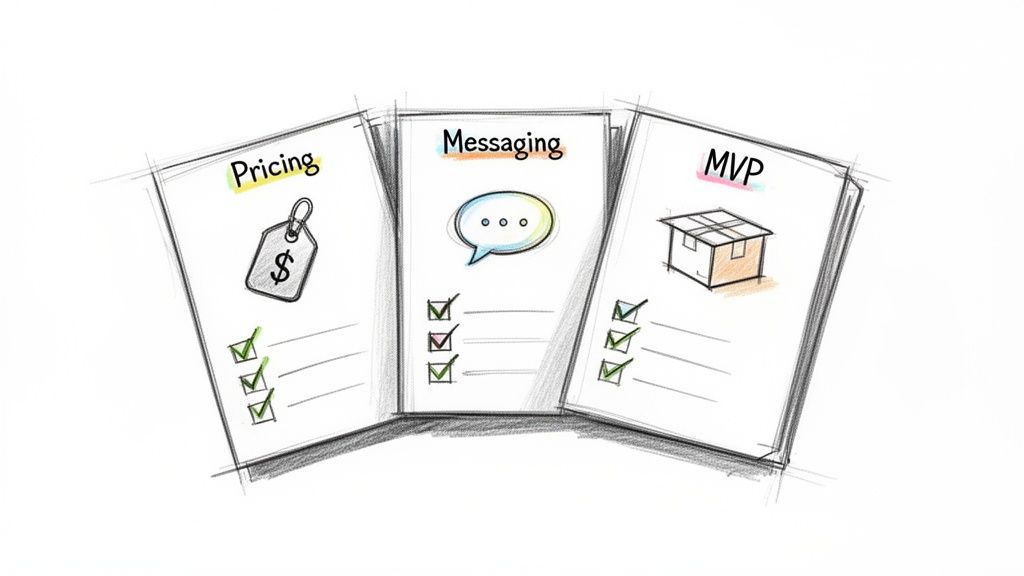
The Pricing Playbook
Your pricing page is one of the most powerful growth levers you have. Get it wrong, and you’re either leaving money on the table or scaring off good-fit customers. This playbook helps you find that sweet spot by looking at what the market already pays for.
Your Goal: Create a smart pricing strategy that reflects your value without pushing away your target audience.
- Map the Landscape: Open a spreadsheet. List your top 3-5 direct competitors. For each one, break down their pricing tiers—note the price, core features, and target user (e.g., "Starter," "Pro," "Enterprise").
- Find the Value Metric: How do they charge? Is it per seat, per 1,000 contacts, by usage, or a flat monthly fee? The most common metric in your niche is what customers already understand and expect.
- Hunt for the Gaps: Look for what they've missed. Is there a huge price jump between their entry and mid-tier plans? That’s an opening for you. Do they all hide a key feature in an expensive plan? Offer it in your standard plan for a killer advantage.
- Check the "Freebies": Note their free trial lengths (14 days is common) and annual discounts (usually 15-20% off). These are the established benchmarks for getting a customer in the door.
When you're done, you'll have a data-backed foundation for your own pricing model—one that's not just competitive but deliberately positioned to win.
The Messaging Playbook
Your messaging is your story. It's how you convince a potential customer you understand their world better than anyone else. This playbook is all about dissecting competitor ads and landing pages to sharpen your own value proposition.
Your Goal: Craft a unique value proposition that resonates with your ideal customer by learning from your competitors' wins and losses.
- Step 1: Collect Their Best Lines. Screenshot 5-10 different ads and landing page headlines from your top rivals. You're looking for the "hook"—the single biggest promise they’re leading with.
- Step 2: Uncover the Core Pains. Group those messages by the problem they solve. Are they all talking about saving time, making more money, or reducing complexity? This tells you what motivates buyers in your market.
- Step 3: Decode Their Language. Pay attention to the specific words they use. Is the tone super corporate or casual and friendly? This gives you a sense of who they're trying to attract.
- Step 4: Find Your Unspoken Angle. Now, look for the message that isn't being said. If everyone is yelling about "more features, more power," your winning angle might be "the simplest tool that just works." This is how you find your own voice in a crowded room.
Your competitors' most successful ads are a masterclass in market psychology. They've already spent thousands of dollars figuring out which buttons to push. Learn from their budget to craft your own winning narrative.
The MVP Validation Playbook
Building a Minimum Viable Product (MVP) is about one thing: learning as much as you can while risking as little as possible. This playbook helps you design a first version of your product that solves a real, validated, high-value problem.
Your Goal: Define an MVP feature set that you know people will pay for because it solves a proven market need.
- Follow the Money (The Ad Spend). Use an ad intelligence tool like Proven SaaS to find competitors with a sustained ad budget (think $10k+/month). The problems they hammer on in their ads are validated—people are already paying to solve them.
- Listen to the Complaints. Head to review sites like G2 and Capterra and dive into your competitors' negative reviews. Look for complaints about missing features or clunky workflows that relate to those high-value problems. That's where your opportunity is hiding.
- Connect Problems to Price Tags. Now, see where the features that solve these core problems live in your competitors' pricing. If they're all locked away in expensive, high-tier plans, a more focused and affordable MVP has a built-in advantage.
- Define Your Laser-Focused MVP. Your MVP should do one thing exceptionally well: solve that validated, high-value problem in a way that directly addresses the common complaints about everyone else. Anything more is a distraction.
This process transforms your MVP from a hopeful guess into a strategic first move. It’s built on a foundation of solid competitive intelligence for SaaS and designed to solve a problem you already know the market is desperate to fix.
To make these playbooks even easier to use, here's a quick summary of how they fit together.
CI Playbook Quick-Reference
| Playbook | Primary Goal | Key CI Signal to Analyze | Example Action |
|---|---|---|---|
| The Pricing Playbook | Find a competitive and profitable price point. | Competitor pricing tiers, value metrics, and discount structures. | Position your mid-tier plan to fill a significant price gap in the market. |
| The Messaging Playbook | Craft a unique value proposition that resonates. | Ad copy hooks, landing page headlines, and customer pain points. | If competitors focus on "features," build your message around "simplicity." |
| The MVP Validation Playbook | Build a first product people will actually pay for. | Sustained ad spend on specific problems and negative customer reviews. | Launch an MVP that solves one high-value problem from a competitor's enterprise plan. |
Each playbook provides a different lens through which to view the market, but they all lead to the same outcome: making smarter, faster, and more confident decisions for your business.
Common Questions About SaaS Competitive Intelligence
Even with a solid plan, jumping into competitive intelligence for the first time can feel a little murky. Let's clear the air and tackle the most common questions from SaaS founders.
Getting these fundamentals right from the start is the key to gathering powerful insights without ever crossing a line.
How Often Should I Analyze My Competitors?
The short answer? Continuously. Competitive intelligence isn't a project you complete and file away. It's a living, breathing part of your strategy.
Think of it less like a massive annual audit and more like checking your company's pulse. You don’t need a full-blown analysis every day, but you need a system to monitor important signals weekly. A quick scan of a competitor's new ads or a sudden shift in their customer reviews can tip you off to a market trend long before it becomes obvious.
The best founders treat competitive intelligence as a continuous feedback loop—observe, analyze, act, repeat. It’s what keeps them from getting caught flat-footed and helps them stay agile.
This consistent, low-effort monitoring turns CI from a reactive chore into a proactive habit. It's how you spot opportunities and threats while you still have time to do something about them.
Is This Ethical or Is It Spying?
This is a huge one, and the distinction is critical. Ethical competitive intelligence is all about analyzing publicly available information. Corporate espionage involves illegal or shady methods to get private data. The line is very bright and clear: if anyone in the public can find it, it's fair game.
Here's what is firmly on the ethical side:
- Analyzing ads in a public ad library.
- Reading customer reviews on sites like G2 or Capterra.
- Tracking pricing updates on their public website.
- Monitoring official press releases and public announcements.
Spying would be things like hacking their servers, tricking employees into sharing secrets, or stealing documents. The goal of CI isn’t to steal secrets; it's to understand the public signals the market is sending you. Stick to public sources, and you're always on solid ground.
What Is the Biggest Mistake Startups Make with CI?
Without a doubt, the single biggest mistake is becoming a copycat. The point of competitive intelligence is not to just clone what your rivals are doing. If you just copy their features and messaging, you're always one step behind, stuck in a race to the bottom with no unique identity.
Your real mission is to find their blind spots. Find the gaps in their product, the weaknesses in their messaging, and the customer needs they are ignoring. Use competitor data to carve out a different angle or a unique position in the market. A true competitive advantage comes from being genuinely different, not just marginally better.
Think of it this way: use CI to understand the rules of the game so you can figure out how to change them in your favor.
Ready to stop guessing and start building with a real advantage? Proven SaaS shows you exactly which SaaS ideas are already profitable by tracking real-world ad spend. Find validated niches where customers are already proving they're willing to pay.
Build SaaS That's
Already Proven.
14,500+ SaaS with real revenue, ads & tech stacks.
Skip the guesswork. Build what works.
Trusted by 1,800+ founders


