

At its heart, prestige pricing is a strategy of setting a high price to signal superior quality, exclusivity, and status. It’s a deliberate move to shape how people see your brand, using the price tag itself as a powerful cue for value.
This isn't just about covering costs. It's a form of storytelling. When a SaaS company uses prestige pricing, they are making a bold claim: "We're not just another tool. We are a premium investment for those who want the best." This taps into a deep-seated psychological shortcut we all use—if it costs more, it must be better.
The Foundation of Prestige Pricing
Prestige pricing is a complete strategy, not just a high price. To make it work, every part of your business must communicate a premium experience. The goal is to attract a specific type of customer: one who sees price as a sign of value and is actively looking for the best solution available.
Imagine you're choosing between two project management tools. One is cheap, designed for everyone. The other is significantly more expensive. Right away, you assume the pricier option is more powerful, more secure, and built for serious businesses that can't afford to fail.
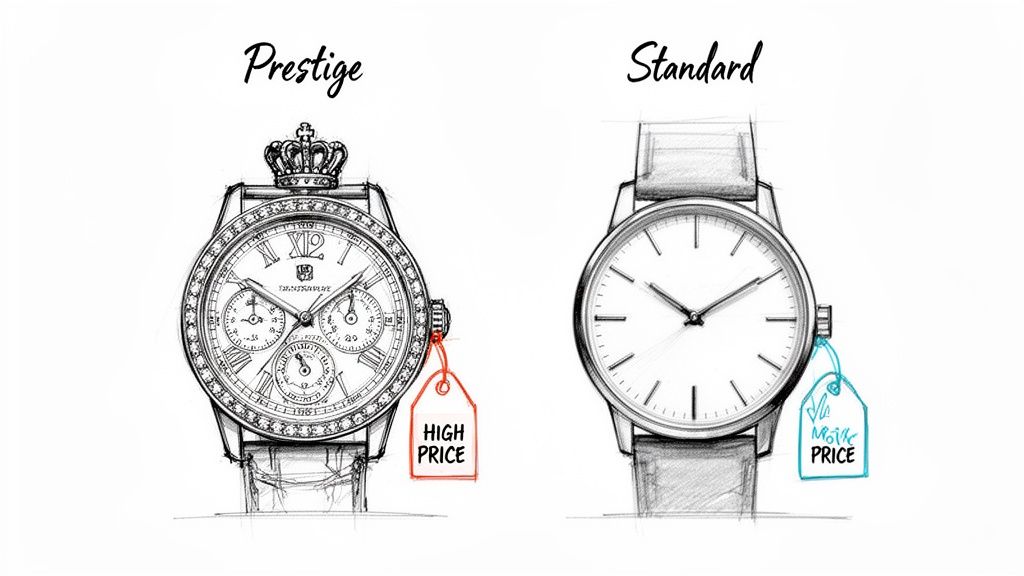
More Than Just a High Price Tag
Simply increasing your price is not prestige pricing; that's just being expensive. A true prestige strategy must be built on a solid foundation. You have to deliver on the promise your price makes.
"Prestige pricing largely relies on consumers' perceived value and the brand's reputation. When used effectively, it can increase profit margins and build brand equity."
Here’s what you need to deliver:
- Superior Product Quality: Your software must be genuinely better. This could mean more advanced features, flawless reliability, or an exceptionally intuitive user interface.
- Exceptional Customer Experience: Every interaction, from the first demo to a support ticket, must feel high-end and personal. This reinforces the customer's belief that they made a wise investment.
- Strong Brand Reputation: Your website, marketing materials, and overall brand image must consistently project expertise and leadership.
The goal isn't just to make one sale. It’s to build a loyal user base that sees your software as a critical asset, turning customers into advocates who are proud to use a top-tier product.
The Psychology Behind Paying More
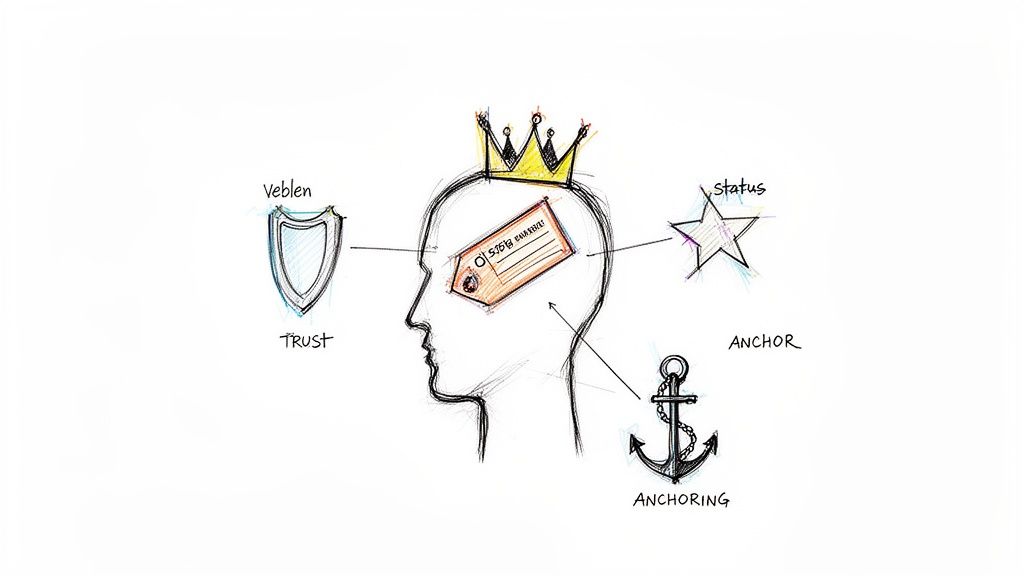
Prestige pricing works because it taps directly into how our brains connect price with value. It leverages powerful mental shortcuts that convince us a higher price tag means a better, safer, and more exclusive product. It turns a simple purchase into an emotional, aspirational decision.
This isn't just for luxury cars. In B2B SaaS, a high price can be a surprisingly effective signal. When a manager is choosing a critical piece of software, a premium price suggests superior security, reliability, and dedicated support. It minimizes the perceived risk of making the wrong decision.
The Power of Perceived Exclusivity
At the core of this strategy is the Veblen effect, an economic principle where demand for a product increases as its price goes up. Why? Because the high price itself becomes a desirable feature, signaling exclusivity and status. It makes the customer feel like they're joining a select group.
For a SaaS platform, this creates the feeling of having bought the "best-in-class" solution. The price naturally filters out casual users, cultivating a community of dedicated professionals. This sense of exclusivity reinforces the idea that the software is for market leaders, not the masses.
By pricing your SaaS as a premium offering, you are not just selling a tool; you're selling confidence. Customers are often willing to pay more for the assurance that they have chosen a market-leading platform that won't let them down.
Using Cognitive Biases to Your Advantage
Another powerful psychological tool is the anchoring effect. This is our tendency to rely heavily on the first piece of information we receive. When it comes to SaaS pricing, a very high-priced enterprise tier can serve as an "anchor," making your other premium plans seem much more reasonable in comparison.
Here’s how these psychological drivers work together:
- Status Seeking: A high price implies the product is trusted by top-tier companies, creating a desire for other businesses to join that successful circle.
- Risk Reduction: For a manager, choosing an expensive but well-regarded software is a safer career move than gambling on a cheap, unproven tool. The high price signals reliability.
- Perceived Quality: We are all conditioned to believe "you get what you pay for." A premium price automatically frames your product as a high-quality, robust solution.
By understanding these psychological triggers, you can build a narrative that goes beyond a simple feature list. You’re no longer just justifying a price; you're confirming your buyer's belief that they're making the smartest investment possible.
How Salesforce Wins with Premium Pricing
Let's look at a real-world example: Salesforce, the undisputed leader in the CRM market. Salesforce built its empire not by being the cheapest option, but by positioning its high prices as a direct investment in innovation, security, and unmatched reliability.
For Salesforce, the premium price tag is a core feature. It’s a powerful signal that says, "This isn't just software; it's the essential platform that serious businesses depend on for their most critical operations."
Turning Price into a Promise
Salesforce brilliantly connects its pricing to tangible business results. Customers aren't just buying a CRM—they're buying into a legendary ecosystem known for its scalability and constant stream of new features. This shifts the conversation from "How much does it cost?" to "What's the return on my investment?"
This strategy powers Salesforce's incredible growth. For example, in July 2023, Salesforce announced a 9% price increase across its core products, with another 6% increase planned for 2025. These hikes alone are projected to drive 25% of its total revenue growth between 2022 and 2025. You can get more details on this at Valueships.
By timing price increases with major feature releases and constantly emphasizing the value they deliver, Salesforce makes its premium position feel completely justified. This builds deep customer loyalty that cheaper competitors find nearly impossible to break.
A Look at the Pricing Structure
A quick glance at their pricing page reveals this strategy in action. Each tier is designed to solve bigger, more complex business challenges, with prices that reflect the immense value provided.
Here’s a snapshot of the pricing for their flagship Sales Cloud product.
Notice how the "Unlimited" and "Unlimited+" tiers are presented. They are framed as complete solutions, not just software subscriptions. The language focuses on outcomes like "grow faster" and "maximize productivity," reinforcing the idea that the price is an investment in your company's success.
Actionable Lessons for Founders
The Salesforce playbook offers valuable lessons for any SaaS founder considering a premium strategy.
Here are the key takeaways:
- Anchor Price to Value: Never apologize for your price. Instead, constantly prove the ROI with compelling case studies, hard data, and clear messaging.
- Align Increases with Innovation: Announce price hikes when you launch significant new features. This makes the increase feel earned.
- Filter for Serious Customers: A higher price naturally attracts customers who are committed to solving a major problem and are less likely to churn.
- Invest in Brand Perception: Every piece of marketing, every sales call, and every support ticket must reflect the premium quality of your product.
For founders studying the CRM market or learning from industry leaders, Salesforce's approach is essential reading. Check out our guide on top sales CRM tools to see how they stack up.
Building Your Prestige Pricing Strategy
Let's get practical. Implementing a prestige pricing strategy requires a solid plan. It's not just about raising your price; it's about building a brand where every touchpoint communicates premium value.
It all starts with a genuinely superior product. From there, your goal is to communicate that value effectively. Focus your messaging on outcomes and ROI, not just features. A high price tag needs a high-value story to back it up.
Laying the Foundation for Premium Positioning
Before you can command a top-tier price, your brand and product must be perceived as elite. This goes beyond a slick website; you need to create an entire ecosystem that signals quality and earns the trust of a discerning audience.
A deep understanding of your ideal customer is crucial. An audience analysis for SaaS growth is a non-negotiable first step.
Here's what you need to get right:
- Exceptional Product Quality: Your software must be reliable and solve a major problem better than any alternative. Charging a premium for a buggy tool is a recipe for disaster.
- Superior Customer Experience: Provide white-glove service. Every interaction—from demos to support—must be world-class. Fast, expert help reminds customers why they pay more.
- Polished Branding and Design: Your logo, website, and marketing materials must all look and feel high-end. In prestige pricing, perception is reality.
Structuring Your Tiers and Messaging
How you present your prices is just as important as the numbers themselves. A well-designed pricing page can guide customers toward your premium plans. A common tactic is using a high-priced "anchor" tier to make other premium options seem more reasonable by comparison.
When you back up price increases with real value, it creates a powerful growth cycle.
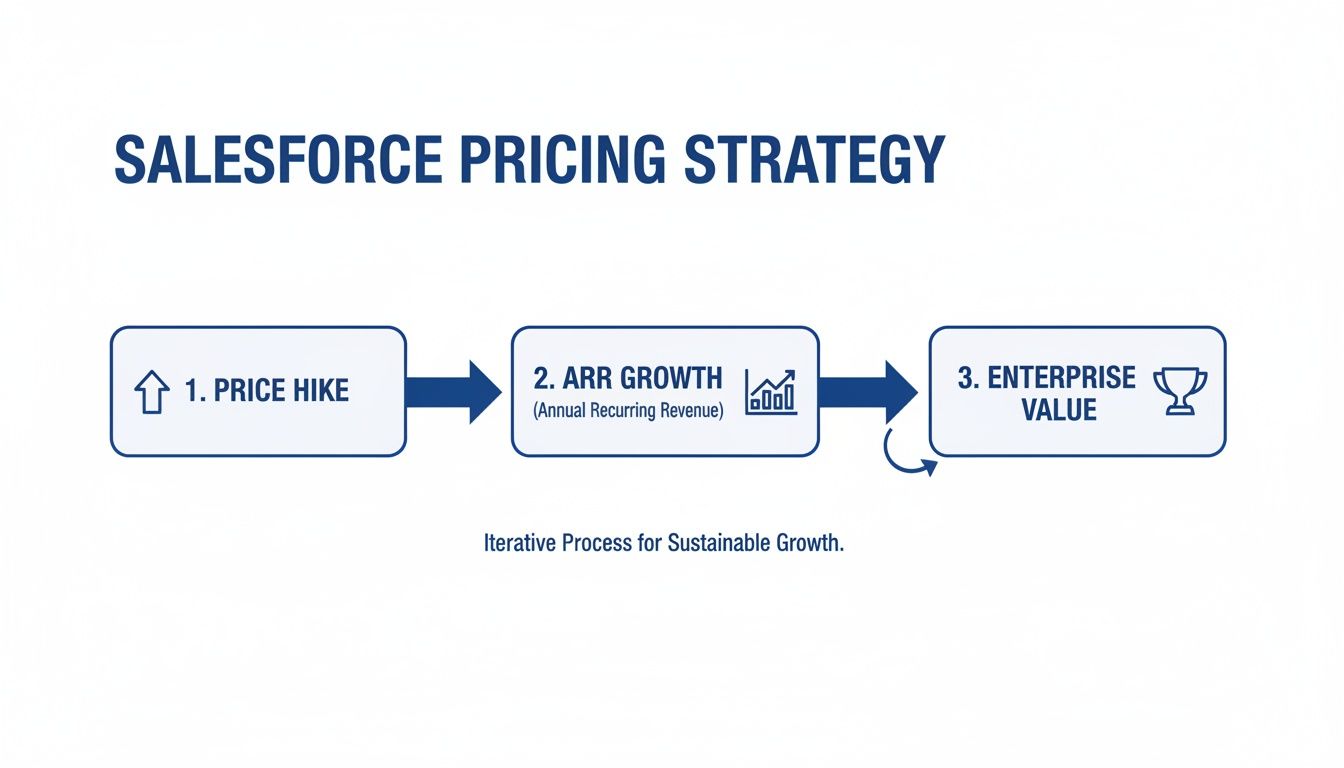
This cycle is simple but effective: strategic price hikes drive Annual Recurring Revenue (ARR) growth, which in turn builds significant enterprise value.
Your messaging must consistently reinforce this value. Talk about benefits, not just features. Frame your software as a critical investment in your customer's success. A strong conversion rate optimization strategy for luxury brands is key to turning that premium feel into actual sales.
A prestige pricing strategy is built on a simple promise: "You will get what you pay for." Your job is to make sure every aspect of your product, messaging, and customer experience delivers on that promise without fail.
By carefully crafting each element, you carve out a defensible premium position in the market, attracting serious customers who are focused on long-term results.
How HubSpot Creates Premium Positioning
While Salesforce started with a high-price foundation, HubSpot uses prestige pricing differently. They have built an exclusive, high-value ecosystem around their Enterprise tiers, using a steep price point to attract serious, committed customers.
HubSpot’s strategy isn't just about charging more—it's about creating a partnership. The high cost and mandatory onboarding fees for their Enterprise tiers send a clear signal: this is not a tool you just "try out." It is a long-term investment in your company's growth infrastructure.
This approach segments the market effectively. It filters out casual browsers and attracts high-intent customers who are focused on deep integration and long-term value, not just the initial price.
Building a Brand That Justifies the Cost
HubSpot's true genius lies in its content marketing. For over a decade, they have educated the market on inbound marketing, sales, and customer service, building immense trust and authority. By the time a potential customer reaches the Enterprise pricing page, HubSpot has likely already spent years proving its value.
This long-term educational approach makes the high price feel earned and logical. They also strictly avoid offering discounts on premium tiers—a critical move to protect their brand's value. The moment you offer a discount, you signal that the price is negotiable, which cheapens the perceived value.
HubSpot's prestige pricing model is an exercise in brand confidence. They tell the market what their premium solution is worth and then use their vast educational resources to show customers why it's a smart investment, not an expense.
The Anatomy of HubSpot's Premium Offer
HubSpot’s Sales Hub is a perfect case study. The Enterprise tier starts at €14,160 per year, plus a required €2,930 one-time onboarding fee. These numbers signal premium quality. By refusing to offer discounts, HubSpot protects this perception.
This model is designed for serious users who see the cost as an investment in advanced tools like predictive lead scoring and powerful integrations, creating a loyal customer base. For more on this, check out these SaaS pricing model insights from Custify.
By building a brand that justifies the cost before the sale, HubSpot makes its premium positioning feel natural. You can explore a detailed breakdown of HubSpot's business model and growth to see how all the pieces fit together.
Common Mistakes and When to Avoid This Strategy
Prestige pricing is not a one-size-fits-all solution. While it can build a powerful brand and deliver high margins, getting it wrong can be disastrous. Attempting this strategy in the wrong market or without a truly premium product can damage your reputation and halt your growth.
The single biggest mistake is the value gap: charging a premium price but failing to deliver a matching premium product and experience. If customers pay top dollar for a buggy tool with poor support, they won't just leave—they'll become vocal critics. This mismatch destroys trust and poisons your brand's reputation.
Spotting When This Strategy Just Won't Work
Beyond your product, you must consider your market. In a crowded, commoditized space where products are very similar, being the "premium" option is a losing battle. If customers can easily find a "good enough" alternative for a fraction of the cost, your high price will seem out of touch.
Prestige pricing also requires a significant marketing investment. You are selling an image of exclusivity and superior status, which demands a sophisticated marketing engine to reach customers who prioritize value over price.
A high price sets high expectations. Failing to meet them doesn't just lose a sale; it creates a vocal detractor who feels they've been overcharged and underserved.
The risks are real. The SaaS world has seen a wave of price hikes, with average spend per employee hitting $8,700. Sometimes it works, like when Slack increased its Business+ plan by 20% to $15/user/month. But it can also lead to lower sales volume or open the door for competitors to undercut you, especially if your value proposition isn't crystal clear. You can dig into more data behind this pricing surge on SaaStr.
Frequently Asked Questions About Prestige Pricing
Here are answers to some common questions that arise when considering a move upmarket with your SaaS pricing.
Can an Early-Stage Startup Use Prestige Pricing?
Yes, but you have to earn it. Your product must solve a critical, high-value problem for a specific audience and provide an exceptional user experience from day one.
As a new company, you lack a long track record. Your reputation is built on product quality and the results of your first customers. Every touchpoint—from onboarding to support—must communicate a premium feel. If you can demonstrate undeniable ROI from the start, a high price can attract the serious, committed customers you need.
What Is the Difference Between Prestige and Value-Based Pricing?
They are closely related, but distinct.
Value-based pricing is a broad strategy where you set your price based on the perceived value your customer receives, rather than your costs or competitors' prices. It’s a smart approach for any business.
Prestige pricing is a specific, more psychological type of value-based pricing. It takes the concept a step further. Here, the high price isn't just about capturing value—it's about creating it. The price itself becomes a feature that signals exclusivity and superior quality. The price makes the brand feel more valuable, which in turn justifies the price.
How Do I Test This Model Without Alienating Existing Customers?
This is a critical concern. The key is to be strategic and respectful of your loyal user base. You can't simply triple everyone's bill overnight.
Introduce your premium pricing to new customers first. This allows you to test the market without creating a backlash from your existing users.
Here’s a safe, phased approach:
- Grandfather Your Current Users: Allow existing customers to keep their current plans at their original price. This is a powerful way to reward their loyalty.
- Launch for New Sign-Ups: Implement the new, higher-priced structure for all new customers going forward.
- Introduce a New Top Tier: Add a new, ultra-premium tier with exclusive features. Price this tier at a prestige level and monitor adoption.
This method provides real-world data on whether your premium positioning is working, all without risking the customer relationships you've worked so hard to build.
Ready to stop guessing and start building? With Proven SaaS, you can discover profitable SaaS ideas backed by real-world advertising data. Find your validated niche and launch with the confidence that you're building something the market is already paying for. Explore your next big idea at https://proven-saas.com.
Build SaaS That's
Already Proven.
14,500+ SaaS with real revenue, ads & tech stacks.
Skip the guesswork. Build what works.
Trusted by 1,800+ founders


