

Let's get straight to it: there’s no single magic number for a “good” CPM.
A good Cost Per Mille (what you pay for 1,000 ad impressions) is simply one that’s profitable for your business. Chasing a universal benchmark is one of the fastest ways to waste your ad budget.
Why "What Is a Good CPM?" Is the Wrong Question
Think of it like buying ad space on a billboard. A billboard in Times Square will cost thousands more than one on a quiet suburban street. Is one "better"? No. Their value depends on the business and the customers it’s trying to attract.
It’s the same with your CPM. A super-low CPM that brings in a flood of irrelevant clicks is worthless. In contrast, a high CPM that consistently delivers your ideal, high-value customers is a huge win.
The real focus shouldn't be on the cost of the impressions, but on the profit you generate from them.
Your CPM Depends on Context
Instead of hunting for a one-size-fits-all number, it’s far more useful to understand the factors that drive your costs. A "good" CPM is always relative to your unique situation.
The table below breaks down the key variables that directly influence what you'll pay.
Understanding Your CPM Context
| Factor | How It Impacts Your CPM | Simple Example |
|---|---|---|
| Platform | Different platforms have different audiences and ad formats, leading to varied costs. | Reaching professionals on LinkedIn will naturally cost more than reaching a broad consumer base on Facebook or TikTok. |
| Industry | More competition means more advertisers are bidding for the same audience, driving up prices. | The B2B software space is highly competitive, so expect higher CPMs than in a less crowded B2C niche like hobbyist knitting. |
| Audience | The more specific and valuable your target audience, the more you'll pay to reach them. | Targeting VPs of Engineering at Series B startups will always be more expensive than targeting general tech enthusiasts. |
As you can see, what you pay is a direct reflection of who you're trying to reach and where you're trying to reach them.
A profitable CPM isn’t about finding the lowest cost; it’s about finding the sweet spot where your ad spend generates a positive return. A $50 CPM that leads to a $500 customer is far better than a $5 CPM that leads to nothing.
Ultimately, a good CPM is just one that fits into a profitable customer acquisition machine. It’s a single piece in a much larger puzzle. Before you can judge your CPM, you must connect it to the metrics that actually move the needle: leads, customers, and revenue.
What's a Good CPM on Major Ad Platforms?
To figure out what a "good" CPM is for your SaaS, you first need a realistic baseline. Costs vary wildly because each platform serves a different purpose, attracts a different crowd, and runs on its own unique auction system.
Think of it like choosing a venue for an event. A huge music festival (like Meta) can attract thousands of people for a relatively low cost per person. On the other hand, an exclusive industry conference (like LinkedIn) costs more per head, but you're guaranteed to be in a room full of high-value decision-makers.
Let's break down the typical CPM ranges for the platforms most relevant to SaaS founders.
Meta Ads (Facebook and Instagram)
Meta's platforms are known for their massive, diverse user base. This makes them great for everything from broad brand awareness campaigns to highly specific targeting. Because the audience is huge and ad space is plentiful, CPMs here tend to be lower than on more specialized B2B networks.
But the cost isn't uniform. Instagram, being highly visual, often has higher CPMs, especially when targeting tech and SaaS audiences who respond well to polished product demos.
A "good" CPM on Meta is simply one that matches your targeting strategy. Go after a broad audience, and you'll see lower CPMs. But if you get super specific—like targeting "VPs of Marketing at companies with 50-200 employees"—expect those costs to climb.
You can dig into more detailed Facebook ad spend benchmarks to see exactly how these costs change with different campaign setups.
Google Ads and LinkedIn
When you shift to platforms where users have stronger professional or buying intent, the costs naturally go up.
A "good" CPM really depends on the platform and your industry. Here are some examples:
- On Google Ads, the average CPM across all industries is around $11.12. For software and SaaS companies, that number is closer to $17.80.
- On Meta (Facebook & Instagram), the combined average is about $6.59. Instagram alone can reach $9.46, as its visual format works well for tech products.
- LinkedIn, the king of B2B networking, sits at the top. Its targeting is incredibly powerful, letting you zero in on people by job title, company size, and industry—but that precision comes at a price. It's not unusual to see a CPM of $30-$60 for a well-defined B2B audience.
The cost per impression on LinkedIn is high, but the value of that impression can be off the charts if you’re selling an expensive SaaS product to the right person.
The takeaway is that each platform offers a different value proposition. Your job isn't to find the cheapest CPM, but to find the platform that gives you the most efficient path to your ideal customer.
So, What's a "Good" CPM, Really?
A CPM number on its own is just that—a number. It tells you nothing about your success. Is a $5 CPM good? Is a $25 CPM bad? The honest answer is: it depends entirely on your goal.
Judging your ad performance by CPM alone is like tracking your car's RPMs but ignoring the speedometer. You're measuring something, but not the thing that gets you where you want to go.
Think of it this way: buying ad impressions is like buying tools. A simple hammer is cheap and perfect for hanging a picture. That’s your awareness campaign—low cost, simple job. But if you're building a house? You'll need specialized, more expensive equipment. That's your customer acquisition campaign. The cost of the tool is meaningless until you know what job it needs to do.
The Big Trade-Off: Awareness vs. Acquisition
At its core, the difference in CPM comes down to a simple trade-off: reach versus intent.
When your goal is broad brand awareness, you're playing a numbers game. You want to get your SaaS name in front of as many people as possible for the lowest cost. The audience is wide, and their intent to buy is low.
But when you want to acquire high-value leads or paying customers, you're not shouting into a crowd. You're whispering to a very specific, smaller group of people who are actively looking for a solution like yours. That precision is valuable, and platforms charge a premium for it.
A $5 CPM might feel like a win, but if it only results in a few likes and zero sign-ups, it did nothing for your bottom line. In contrast, a $25 CPM might seem high, but if it consistently brings in qualified leads who book demos, it’s an investment that pays for itself many times over.
It all comes down to aligning your cost expectations with the result you actually want.
Matching CPM to Your Marketing Funnel
To truly understand your CPM, you need to map it to your marketing funnel. Each stage has a different job, which means you'll run different types of campaigns with very different CPMs.
- Top of Funnel (Awareness): The goal here is pure reach. You're introducing your brand to a cold audience. Campaigns are usually optimized for impressions or video views, which keeps the CPM low. Example: A short, engaging video showing what your SaaS does, targeted broadly to an entire industry.
- Middle of Funnel (Consideration): Now you're talking to people who know they have a problem. You might run ads for a webinar or a lead magnet. Because this audience is more engaged, your CPM will be higher. Example: An ad promoting a free ebook, "10 Ways to Automate Your Workflow," targeted to people who visited your blog.
- Bottom of Funnel (Conversion): This is where you make the sale. You're targeting people ready to make a decision, running ads for demo requests or free trials. This is your most valuable audience, so you'll see your highest CPMs here. Example: A direct-response ad offering a 14-day free trial, targeted to people who viewed your pricing page.
In the end, a "good" CPM isn't a static number. It’s a flexible metric that should rise and fall depending on whether you're introducing your brand or closing your next deal.
Translating CPM Into Metrics That Actually Matter
Obsessing over CPM is a classic mistake. It's like staring at the speedometer without checking the map—you know how fast you're going, but you have no idea if you're headed in the right direction. It's a vanity metric unless you connect it to what really moves the needle: profit.
The real magic happens when you translate that top-of-funnel cost into metrics that hit your bottom line. We need to follow the money from the first impression all the way to a paying customer. This means shifting your focus from CPM to the heavy hitters: Cost Per Lead (CPL) and Customer Acquisition Cost (CAC). A high CPM can be fantastic if it's driving a profitable CAC.
From Impressions to Profit: A Step-by-Step Scenario
Let's walk through a real-world example for a SaaS company. This is how you turn a simple ad metric into a clear signal of your campaign's health.
Imagine you're running a campaign with these numbers:
- CPM (Cost Per 1,000 Impressions): $15
- CTR (Click-Through Rate): 2%
- Landing Page Conversion Rate: 5% (people signing up for a free trial)
The goal of your campaign dramatically changes what a "good" CPM looks like. Are you just trying to get your name out there, or are you hunting for qualified leads?
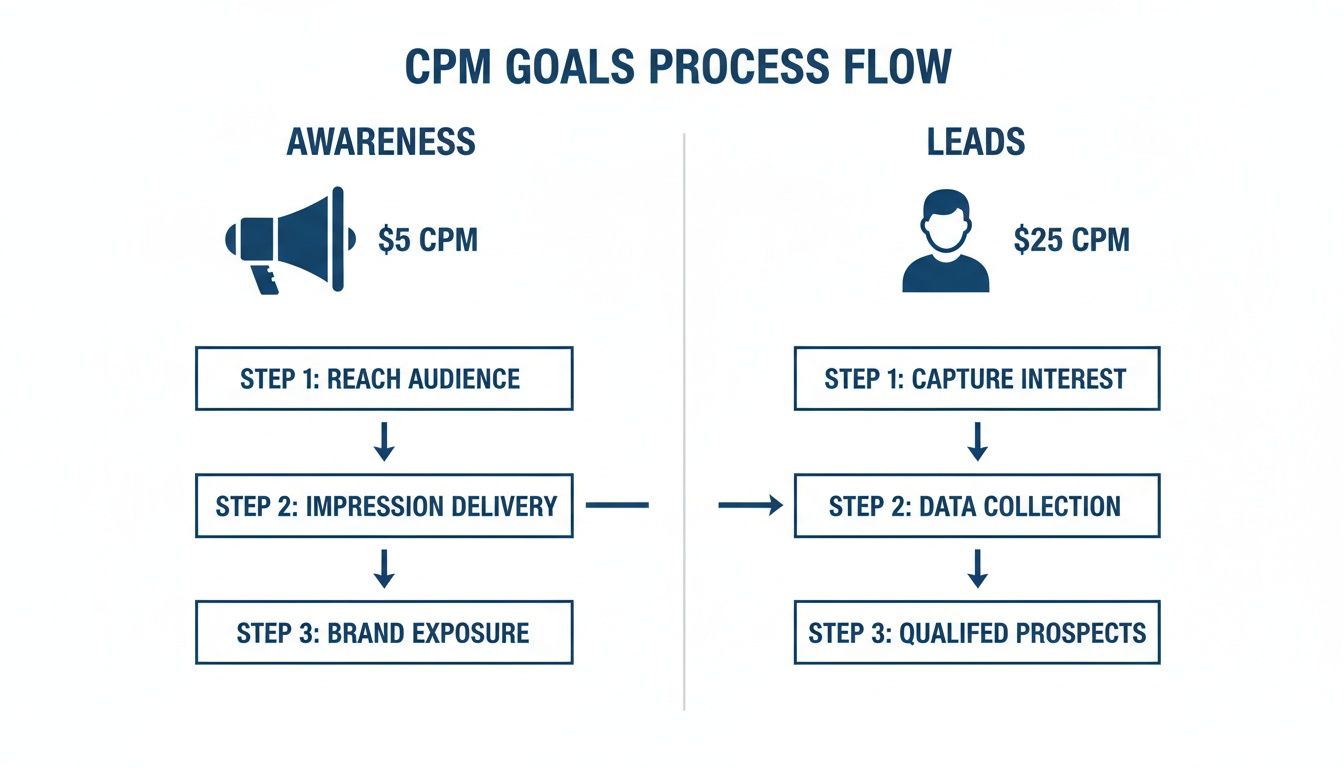
As this visual shows, a cheap awareness campaign is all about broad reach. A lead generation campaign costs more because you're targeting a much more valuable, action-oriented audience.
Now, let’s figure out what that actually costs you.
The Calculation Breakdown
Let’s connect the dots. The math here is straightforward, but it reveals everything you need to know about whether your ads are actually working.
First, let's find your Cost Per Click (CPC). This is how much you pay each time someone clicks your ad.
Next up is your Cost Per Lead (CPL). This is what it costs to get one person to sign up for your trial.
Finally, we have the Customer Acquisition Cost (CAC), the total cost to land one new paying customer.
This simple table breaks down how to get from impressions to real business results.
From Impressions to Profit: A Simple Breakdown
Use this step-by-step guide to connect your CPM to real business results.
| Metric | Simple Formula | Example Calculation |
|---|---|---|
| Cost Per Click (CPC) | (CPM / 1000) / CTR | ($15 / 1000) / 0.02 = $0.75 per click |
| Cost Per Lead (CPL) | CPC / Landing Page Conversion Rate | $0.75 / 0.05 = $15 per lead |
| Customer Acquisition Cost (CAC) | CPL / Lead-to-Customer Rate | $15 / 0.10 = $150 per customer |
Suddenly, that abstract $15 CPM is grounded in a very real outcome: you're paying $15 for every single trial sign-up. That's a number you can build a business on.
And if you know from your internal data that 10% of trial users become paying customers, your Customer Acquisition Cost (CAC) is $150.
This exercise is about tying your ad spend directly to revenue. Once you understand these connections, you can confidently decide if your CPM is "good" based on whether it produces a profitable Return on Ad Spend (ROAS). To get a better handle on this, check out our guide explaining ROI vs. ROAS for SaaS profitability.
This is how you turn abstract ad data into a predictable growth engine for your SaaS.
Using Competitor Ads to Set Realistic CPM Targets
Instead of throwing money at ads and hoping for the best, what if you could figure out a realistic CPM target before you spend a dime? The smartest way to do this is to stop guessing and start looking at what your competitors are already doing.
If another SaaS company is pouring thousands of dollars into ads month after month, that’s the ultimate validation. It proves they’ve found a profitable funnel at a specific price point. You can learn directly from what's working for them.
This approach de-risks your ad strategy from the start. You're not entering the market blind; you're entering it with hard evidence of what it takes to succeed.
Finding Your Baseline in the Wild
Your first step is to find competitors who are clearly winning. Tools like the Meta Ad Library are a goldmine, giving you a transparent look at who's advertising, what their ads look like, and—most importantly—how long they've been running. Sustained, long-term spending is the signal you’re looking for.
Example: Let's say you find a direct competitor who has been running the same set of ads for over six months. You've just struck gold. They've obviously cracked the code. If you can find out that typical CPMs in that niche hover between $10-$12, you suddenly have a realistic, data-driven target for your own campaigns. You’re not starting from zero; you're starting from a proven benchmark.
For early-stage founders, a "good" CPM is all about context. If you're tracking competitors and see them successfully holding a $7 CPM for six months straight, that’s a massive green light to launch your MVP. It dramatically cuts down your validation time.
This kind of intelligence is priceless. A 2023-2025 study of 100 advertisers revealed just how varied these costs can be. It showed that Google's average CPM bids were a whopping $37.60, while giants like Procter & Gamble and Intuit were at $12.13 and $11.66, respectively. For SaaS founders, these numbers provide crucial context. You can dig into more of this data in the CPM bid data study on Adalytics.
Turning Competitor Data Into Action
Analyzing competitors' ad spend isn't about blindly copying their CPM. It’s about understanding the entire profitable ecosystem they've built. When you see a company thriving at a certain CPM, it tells you a few key things:
- The audience is receptive: People are engaging with ads for this kind of product.
- The price point is viable: Their customer lifetime value (LTV) is high enough to support their customer acquisition cost (CAC).
- The channel works: The platform they're using, whether it's Meta or LinkedIn, is an effective place to find these customers.
By using an ad intelligence platform, you can systematically track all these signals. This helps you build a financial model for your own campaigns with much more confidence, turning a shot in the dark into a calculated business decision.
Practical Ways to Optimize Your CPM
Knowing what a good CPM is gets you halfway there. The other half is actually improving it. Lowering your CPM isn't just a race to the bottom; it's about making every ad dollar work harder to attract the right customers.
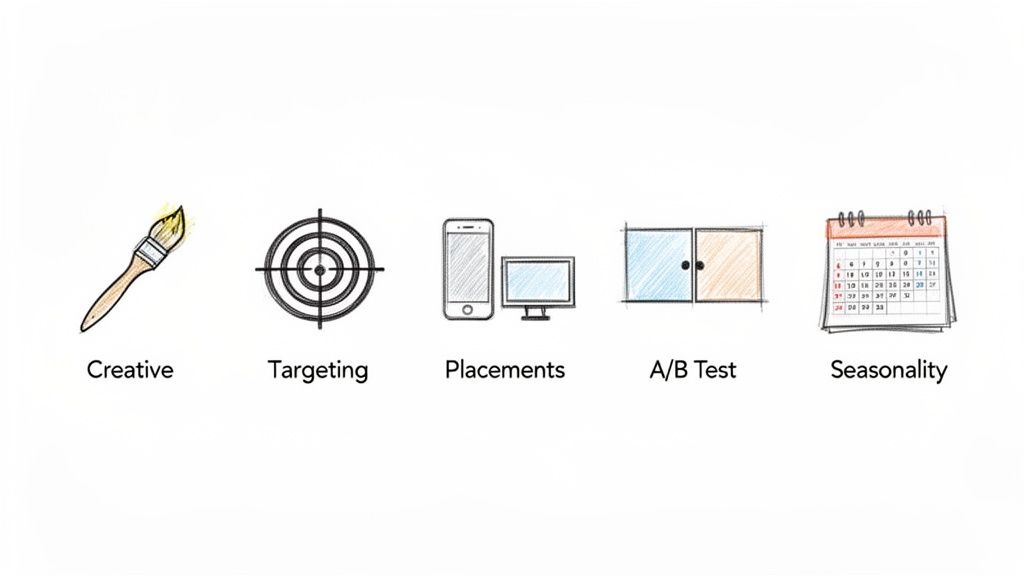
Here are five straightforward strategies to optimize your CPM without sacrificing quality.
Refine Your Audience Targeting
One of the fastest ways to watch your CPMs climb is to target an audience that’s either too broad or too competitive. The trick is to find the sweet spot—an audience specific enough to care about your offer but not so small that you're paying a premium for every impression.
- Why it works: Ad platforms reward relevance. When your ad resonates with a well-defined audience, engagement goes up. This signals to the algorithm that you're showing people something they want to see, which can lower your costs.
- How to do it: Start with your ideal customer profile, but don't be afraid to test adjacent audiences. A great starting point is creating lookalike audiences from your best customers or website visitors to uncover new segments that behave just like them.
Enhance Your Ad Creative
Think of your ad creative as your first impression. If it’s weak, generic, or confusing, people will scroll right past it. That low engagement forces the platform to charge you more to find anyone willing to interact with your ad.
On the flip side, a strong creative with a clear value proposition stops the scroll and gets people clicking.
Your ad’s performance is directly tied to its relevance. Better creative drives higher engagement, which tells the ad platform your ad is a great fit. The result? Often, a lower CPM.
Optimize Your Ad Placements
Not all ad placements are created equal. An ad that performs well in Instagram Stories might be a total dud in the Facebook News Feed. By default, platforms will spread your budget across every available placement, but many will be inefficient and overpriced for your campaign.
The fix is simple: dig into your ad reports. Find out which placements are giving you the best results for the lowest cost, and double down on what’s working. Cut the placements that are just eating up your budget. This simple tweak focuses your spending where it's actually making an impact.
Manage Spend Around Seasonal Trends
Ad costs are never static; they swing with market demand. The most famous example is Q4, when the holiday shopping storm sends CPMs through the roof as massive consumer brands flood the ad auctions. As a SaaS company, competing in that environment is often a great way to burn cash.
Understanding a "good" CPM means accounting for this volatility. For instance, while Meta's average CPM might be $6.59, it can spike dramatically during peak seasons. By timing your big campaigns for Q1 or Q2—for example, taking advantage of the typical dip on Google in February—you can potentially cut your costs by 10-20%. You can learn more about these CPM trends and platform dynamics on Quimby Digital.
Got Questions About CPM? We've Got Answers.
We've walked through the ins and outs of CPM, but you probably still have a few questions. That's normal. Here are some of the most common ones we hear from SaaS founders, with straight-to-the-point answers.
Why Is My CPM So High?
A sky-high CPM usually boils down to one of three things: stiff competition, low ad relevance, or targeting that’s too narrow. For instance, if you're trying to reach a small pool of C-level executives, you're going to pay a premium for that access.
The first place to look is your audience definition. Can you widen it without sacrificing quality? Next, take a hard look at your ad creative. If it isn't grabbing attention, the platform's algorithm will notice and charge you more for impressions.
Is a Low CPM Always Good?
Nope. In fact, an unusually low CPM can be a huge red flag. It often means you’re serving ads to a low-quality audience that has zero interest in your product and will never convert.
It's always better to pay a higher CPM to reach actual potential customers than to chase a rock-bottom CPM that brings in zero business. Keep your eye on the real prize: a profitable CPL and CAC.
How Often Should I Check My CPMs?
When you first launch a campaign, check your CPMs daily for the first few days to catch any major problems. Once things settle down and the campaign finds its rhythm, you can switch to checking in weekly.
Remember, CPMs will naturally fluctuate day-to-day because of how the ad auction works. Don't panic and make drastic changes based on one weird day. Instead, look for the week-over-week trend and how it’s affecting the metrics that truly matter, like your CPL and ROAS.
Stop guessing and start winning. With Proven SaaS, you can uncover validated SaaS ideas by analyzing what your competitors are already spending money on. Find your next profitable niche today.
Build SaaS That's
Already Proven.
14,500+ SaaS with real revenue, ads & tech stacks.
Skip the guesswork. Build what works.
Trusted by 1,800+ founders


