

Startup Accelerator vs. Incubator: Which One Is Right for Your Business?
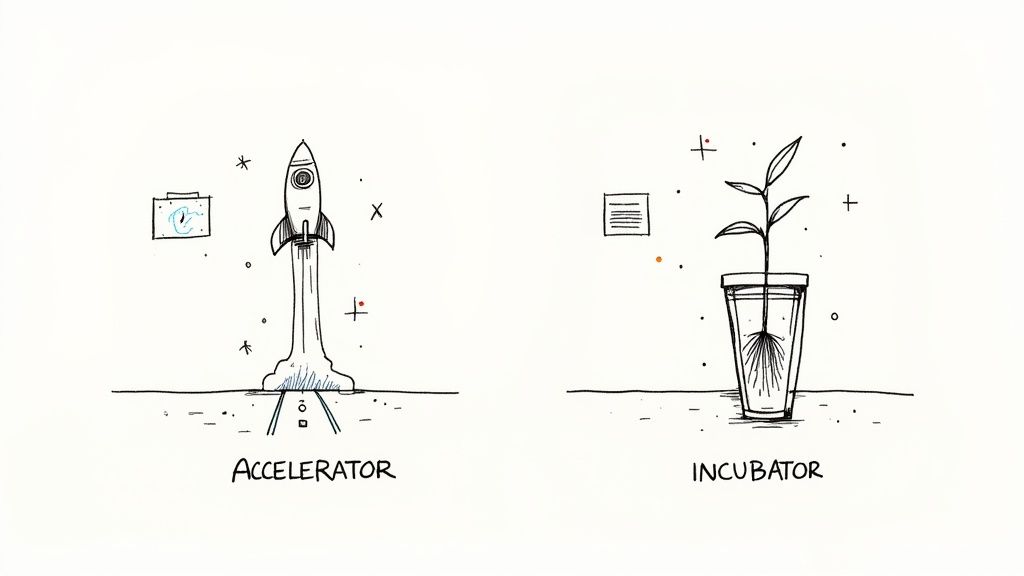
So, what's the real difference between a startup accelerator and an incubator? It’s pretty straightforward once you get down to it. A startup accelerator is all about scaling a company that's already got its feet wet with a proven idea. Think of it as a boot camp for rapid growth. A great example is Y Combinator, which helped companies like Airbnb and Dropbox go from promising startups to global giants.
On the other hand, a startup incubator is designed to help build a brand-new idea from the ground up. It’s more like a greenhouse, carefully nurturing a tiny seed of an idea—like a concept on a napkin—until it’s strong enough to stand on its own.
Accelerator vs. Incubator: What Is the Core Difference?
Figuring out whether to join a startup accelerator or an incubator is one of the most important early decisions a founder can make. While both programs offer invaluable support, they're built for completely different purposes and serve startups at very different points in their journey. Nailing this distinction is crucial to putting your new venture on the right track.
An accelerator is built for speed. The whole point is to cram years' worth of growth and learning into just a few super-intense months. These programs are on the lookout for startups that have already built a minimum viable product (MVP) and are showing some early signs of traction.
Incubators, however, play the long game. They provide a nurturing, often open-ended environment for founders who might only have an idea on a napkin. The focus here isn't on explosive, immediate growth but on building a rock-solid foundation for the business.
Defining Your Startup Stage
The right choice for you boils down to one simple question: where is your startup right now?
If you're ready to fine-tune your go-to-market strategy and gear up for a serious funding round, an accelerator is probably the right fit. But if you're still in the process of validating your core concept, doing market research, or building the very first version of your product, an incubator is where you want to be.
> The simplest way to see it is this: Incubators build founders and their ideas into businesses. Accelerators build existing businesses into scalable companies ready for major investment.
To give you a clearer picture, let's look at their key differences side-by-side. This quick comparison breaks down their main goals and how they operate, making it easier to see which path lines up with your startup's current needs and future goals.
Quick Look: Accelerator vs. Incubator At a Glance
This table gives you a snapshot of the main differences between the two, so you can see at a glance which program style fits your current situation.
| Attribute | Startup Accelerator | Startup Incubator |
|---|---|---|
| Primary Goal | Rapid Growth & Scaling | Idea Development & Stability |
| Typical Stage | MVP & Early Traction | Idea or Concept Stage |
| Program Duration | 3–6 Months (Fixed-Term) | 1–5 Years (Flexible) |
| Pace | Intense & High-Pressure | Slower & Nurturing |
| Funding Model | Seed Investment for Equity | Resources & Grants (Rarely Equity) |
| Outcome Focus | "Demo Day" & Investor Pitches | Market Readiness & Sustainability |
As you can see, the timelines, goals, and even the pressure levels are worlds apart. One is a sprint, the other is a marathon, and choosing the right race is half the battle.
A Detailed Comparison of Key Program Differences
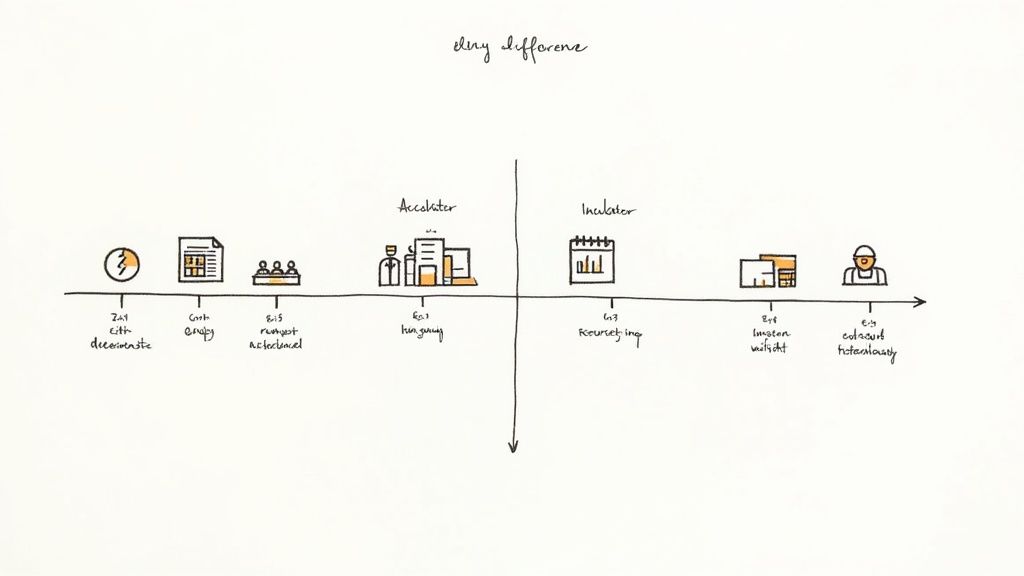
On the surface, the difference between an accelerator and an incubator seems simple: one is about speed, the other is about development. But when you get into the weeds, the operational details are what really matter. Founders need to understand these nuances to pick a program that truly fits their company's immediate needs and long-term vision. The timelines, funding models, and even the style of mentorship create wildly different experiences.
An accelerator is a high-stakes sprint. For example, a program like Techstars pushes its startups through a rigorous 3-month cycle of mentorship and development, culminating in an investor Demo Day. In contrast, an incubator is more like a long-distance training camp.
Program Duration and Pace
The first thing you’ll notice is the clock. Accelerators are all about intensity and operate on a fixed, compressed timeline, usually lasting just 3 to 6 months. This structure is designed to force-function progress. It puts you under immense pressure to hit key milestones, all leading up to a final "Demo Day" where you pitch your heart out to a room full of investors.
Incubators play a much longer game. Their timelines are flexible, and it’s not uncommon for a startup to be part of one for 1 to 5 years. You're encouraged to work at a sustainable pace, giving you the breathing room to explore, pivot, and build a rock-solid foundation without the constant pressure to show explosive growth.
Funding Models and Equity Stakes
Money is where the motivations of these two models really become clear. Accelerators almost always put cash on the table—anywhere from $20,000 to over $120,000—but it comes at a price: equity in your company. For instance, Y Combinator famously invests $500,000 in exchange for a percentage of the company. They are quite literally investing in your business, so they expect a significant return.
Incubators, however, rarely write checks. Their value is in the resources they provide, like free office space, legal advice, and access to a network of professionals. Since they’re often funded by universities or government agencies, they typically don’t take any equity. Their mission is to spark innovation and support the local economy, not to chase a financial exit.
> An accelerator buys a piece of your company and gives you fuel for a rocket ship. An incubator gives you a workshop and tools to build the rocket ship from scratch.
This is a huge fork in the road for any founder. Giving up equity so early is a massive decision. But for the right company, the capital and connections from an accelerator are exactly what’s needed to ignite rapid growth. On the flip side, holding onto 100% of your company while using an incubator's resources can be the smarter play for founders who need more time.
Ideal Startup Maturity
The single biggest factor in choosing between them is the stage your startup is in right now. Accelerators are on the hunt for companies that have already cleared some early hurdles. To get their attention, you typically need:
- A Minimum Viable Product (MVP): A real product or service that people can actually use.
- Early Traction: Some data to prove people want what you're building—think early users, initial revenue, or strong market signals.
- A Cohesive Team: You’ve assembled the core group of people needed to make your vision a reality.
Incubators are the opposite. They exist for the very beginning of the entrepreneurial journey. They are the perfect environment if you're still at the:
- Idea or Concept Stage: You have a brilliant idea but haven't built anything yet.
- Pre-Product Phase: You're deep in the business plan, working on sketches and figuring out your first prototype.
- Solo-Founder Stage: It might just be you, and you’re still looking for a co-founder.
A founder with just a great idea on a napkin would get turned away by almost every accelerator. At the same time, a startup that’s already generating revenue would probably find an incubator’s pace frustratingly slow.
How the Accelerator Model Fosters Rapid Growth

If you had to boil down a startup accelerator to one word, it would be speed. These programs are intense, high-pressure sprints designed to cram years of learning and business development into just a few months. It's all about building momentum and hitting key milestones at a pace that would be almost impossible to achieve on your own.
What makes this work is the cohort-based structure. Accelerators accept startups in batches, which immediately creates a powerful sense of community and competition. You're in the trenches with other smart, driven founders, which keeps motivation high and provides a built-in support system.
The Curriculum and High-Stakes Culmination
The curriculum isn't academic; it's a practical, no-fluff playbook for scaling a business. You're not just learning theory—you're doing the work, week after week, with direct feedback from people who have been there before.
The focus is squarely on what matters most for an early-stage company:
- Achieving Product-Market Fit: Accelerators are relentless about pushing you to validate your idea with actual users. It's a constant cycle of testing, learning, and iterating. We cover this in-depth in our guide on how to find product-market fit.
- Mastering Fundraising Strategies: You’ll get hands-on coaching on how to tell a compelling story, craft a killer pitch deck, and confidently walk into a room with venture capitalists.
- Scaling Operations: Mentors help you figure out the nitty-gritty of growth, from building a sales process and nailing your marketing message to hiring your first critical employees.
> The entire program builds toward one make-or-break event: Demo Day. This is your chance to pitch your business to a hand-picked room full of investors, press, and potential partners. It’s a massive opportunity to secure that crucial seed round.
Real-World Success and Market Impact
You don’t have to look far to see the proof. Giants like Airbnb and Dropbox are both graduates of Y Combinator. They went in with a solid idea and came out with the funding, network, and refined strategy needed to become the household names they are today. Another success story is SendGrid, an email delivery service that went through the Techstars program and was later acquired for $3 billion.
This track record has made the accelerator model a huge economic driver. The global market is expected to skyrocket from USD 5.02 billion in 2024 to USD 163.3 billion by 2034. It's no wonder they're so selective, with acceptance rates often below 3%.
How Incubators Build Businesses to Last
If accelerators are all about hitting the gas, incubators are about building the engine. They act as a nursery for brand-new ventures, sometimes starting with nothing more than a napkin sketch of an idea. The main goal here isn't a quick exit; it's about carefully nurturing a concept until it becomes a real, sustainable business.
This environment is designed to give founders the basic necessities to survive those tough first months. We're talking about tangible things like office space, shared administrative support, and fundamental business coaching—all of which take some of the initial risk off the table.
A Focus on Getting the Foundation Right
Accelerators run on a ticking clock, but incubators work on a much more flexible, open-ended timeline. This gives founders the space they need to breathe, flesh out a solid business plan, do their market research, and build a prototype without a demo day hanging over their heads.
That slower, more deliberate pace is a lifesaver for first-time founders or anyone trying to crack a complex industry. It allows you to focus on getting the product and business model right from the very beginning.
> An incubator isn’t chasing explosive growth metrics. It’s focused on making sure the business has strong roots. Success is measured by the long-term health of the companies they help, not a splashy pitch at the end of a program.
This long-term perspective is a key driver of innovation worldwide. The global business incubator market is expected to grow significantly, hitting an estimated USD 25.93 billion in 2026 and climbing to USD 44.15 billion by 2032. For a deeper dive into these numbers, check out the full business incubator market research.
Turning Ideas into Real-World Products
The kind of support you get in an incubator is intensely practical and hands-on, aimed at transforming a raw concept into something customers can actually use.
- Validating the Idea: Mentors will push you to test your core assumptions and prove that people actually want what you're building.
- Building Your First Product: You’ll get access to the tools and people needed to develop a prototype or a Minimum Viable Product (MVP). We cover this in-depth in our guide to MVP development for startups.
- Setting Up the Business: Incubators often have a network of legal and accounting pros to help you get your company structure right from day one.
Since many incubators are connected to universities or local economic development groups, their mission is often about fostering innovation and creating jobs. As a result, they rarely take equity, which means founders can keep full ownership while they build a solid foundation.
How to Choose the Right Path for Your Startup
Figuring out whether to join a startup accelerator and incubator isn't just a simple box to check. It's one of the most important strategic decisions you’ll make early on, and it really boils down to one thing: where you are right now. Picking the right program can set you up for success, while the wrong one can be a costly distraction.
Think of it this way: an accelerator is like hitting the gas. It's the perfect move if you already have a minimum viable product (MVP), maybe a few early customers, and you're ready to commit everything to scaling fast. These programs are designed to pour fuel on a fire that’s already burning.
On the other hand, an incubator is a greenhouse for your idea. It’s a better fit if you have a brilliant concept but still need the time, space, and resources to flesh out your business model and actually build your first product.
Answering Key Questions About Your Startup
Before you even start filling out applications, you have to get real with yourself about your startup’s current stage, your goals, and what your team can handle. The trade-offs are significant—you might be weighing speed against slow-and-steady development, or giving up equity in exchange for resources.
Here are the critical questions every founder should ask:
- What is our current stage? Do we have a product people are actually using, or are we still sketching out the core idea on a whiteboard?
- What are our immediate goals? Is the number one priority to land seed funding in the next six months? Or do we need to spend the next year building a rock-solid product?
- Is our team ready for a full-time, high-pressure program? Accelerators are intense. They demand an all-in commitment that can burn out teams that aren't prepared for the pace.
- Are we willing to give up equity? If keeping 100% ownership is a deal-breaker, then an incubator is probably your only realistic option.
This simple decision tree helps visualize the core choice based on where you stand.
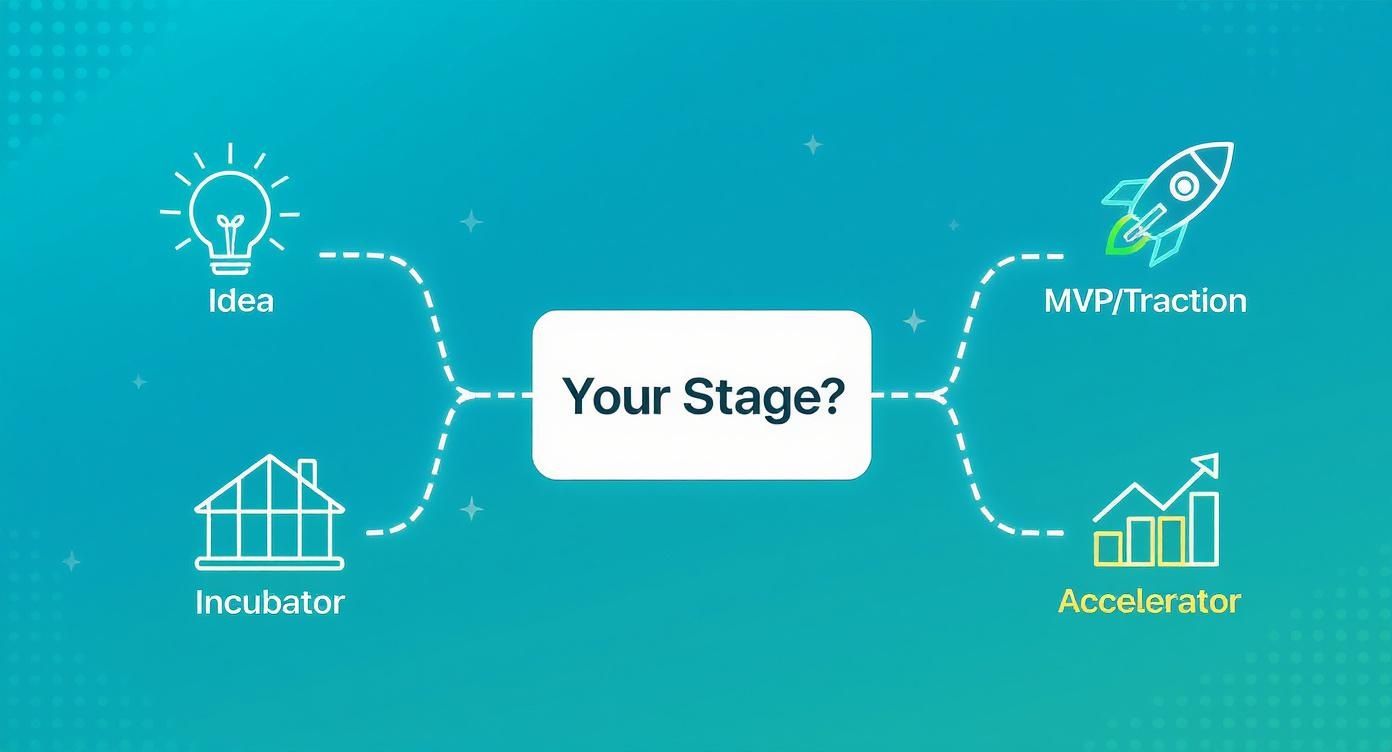
As you can see, the journey starts with an honest look in the mirror. Are you at the idea stage, or do you have a product that’s starting to gain traction?
> Your answer to that single question directs your path. An idea needs nurturing in an incubator, while an MVP with early momentum is ready for the high-speed environment of an accelerator. This isn’t just a preference—it’s about aligning the support you receive with the needs you actually have.
Making a Data-Informed Decision
At the end of the day, the right choice comes from knowing your own business inside and out. If you're still figuring things out and validating your concept, it's critical to nail the fundamentals first. You absolutely must understand your target audience before you even think about hitting the accelerator. For more on that, our guide to conducting effective startup market research is a great place to start.
Choosing the right program is one of the first big tests for a founding team. It shows you can be realistic about where you are and make smart, strategic calls that will shape your company's future.
What's Next for Startup Support?
The startup support world never sits still. What started out as just cheap office space has morphed into a complex ecosystem dedicated to launching and growing the next big thing. The once-clear lines between a startup accelerator and incubator are getting fuzzier as both models become more holistic.
These days, it's less about a desk and more about becoming a one-stop-shop for innovation. Since popping up in the 1980s, these programs have changed dramatically, adding mentorship, funding, and crucial support in marketing, legal, and operations. You can dig deeper into this journey and see where things are headed in the startup accelerator landscape.
This evolution means founders can now find a complete toolkit for success, all in one place.
Niche is the New Normal
One of the biggest shifts we're seeing is the move toward specialization. The old generalist programs that would take any tech company are giving way to incubators and accelerators with a laser focus on specific industries.
This is a huge win for founders. Think about it:
- A FinTech accelerator can plug you directly into banking partnerships and help you navigate tricky regulations.
- A HealthTech incubator might offer access to clinical trial networks or vital healthcare data.
- A Social Impact program will focus on building sustainable models and measuring what matters.
For example, Rock Health is an accelerator specifically for digital health startups, providing industry-specific connections that a general program couldn't offer. When you join a program that lives and breathes your industry, you get mentors, investors, and partners who truly get the unique hurdles and opportunities you're facing.
> The future of startup support isn't one-size-fits-all. It's about finding an environment that gives you more than generic business advice—it gives you deep, relevant expertise for your specific market.
This trend highlights just how important these programs have become to the economy. They help de-risk the earliest, most fragile stages of a startup, validate ideas, and give founders the solid footing they need to build something that lasts.
Common Questions from Founders
Founders are always trying to figure out the best way forward, and the world of startup accelerators and incubators can be tricky to navigate. Here are some of the most common questions that come up.
Can I Do an Incubator First, Then an Accelerator?
Yes, absolutely. In fact, it's a well-trodden and often very smart path for early-stage companies. Many founders start in an incubator to really nail down their core idea and build a solid minimum viable product (MVP).
Once they have that initial product and maybe a few early users, they’ll apply to an accelerator. The goal then shifts from building to scaling—fast.
Do Accelerators Always Take a Slice of My Company?
Most of them do. The standard model for the vast majority of accelerators is to offer seed funding and resources in exchange for equity, usually somewhere in the 5% to 10% range.
You might find a few exceptions, like programs run by universities or non-profits that are more mission-driven, but they are definitely not the norm.
What’s the Best Path for a Solo Founder?
While you can succeed as a solo founder in either program, incubators are often a better fit. Their longer timelines and more flexible structure give you the breathing room you need to find a co-founder and build out your team.
> It's worth noting that many top-tier accelerators heavily favor teams with at least two co-founders. They see a strong founding team as a key indicator of a startup's ability to handle the intense pressure and workload, making it a crucial factor in their selection process.
---
Ready to skip the guesswork and find a profitable SaaS idea that's already working? Proven SaaS uses AI to analyze millions of ads, showing you what competitors are successfully spending money on right now. Find your next validated SaaS idea today!
Build SaaS That's
Already Proven.
14,500+ SaaS with real revenue, ads & tech stacks.
Skip the guesswork. Build what works.
Trusted by 1,800+ founders


