


The SaaS landscape is crowded with generic advice. Scaling isn't about chasing every trend; it's about executing a few high-impact strategies with precision. Forget the noise and the endless "Top 10 Hacks" lists that offer little more than surface-level tips. Real, sustainable growth comes from a disciplined, data-driven approach.
This article breaks down 10 proven, actionable SaaS growth strategies that actually move the needle. We're skipping vague theories and diving straight into practical playbooks designed for founders and growth teams who need results. This is a clear roadmap for building a scalable business.
Each strategy is built on a core principle: validation before execution. We’ll show you how to analyze existing market signals, identify what customers are already paying for, and uncover genuine demand. This process significantly de-risks your efforts, ensuring every dollar you invest and every feature you build is based on proven market needs, not just guesswork.
Inside, you will find:
- Specific implementation steps for each growth strategy.
- Real-world examples to make concepts easy to grasp.
- Key performance indicators (KPIs) to track your success.
Our goal is simple: to provide a comprehensive yet clear guide that helps you prioritize the most impactful initiatives. This is the playbook for building a growth engine that lasts. Let's get started.
1. Competitive Intelligence & Market Gap Analysis
Instead of building a product and hoping customers will come, this strategy flips the script: find where customers are already spending money, and build something better. Competitive intelligence involves using public data—especially from ad libraries—to identify SaaS niches with proven demand. The core idea is that a competitor's significant, sustained ad spend is a powerful validation signal. It proves there is a market willing to pay for a solution to a specific problem.
By analyzing what competitors are doing, you can reverse-engineer their success and find an underserved angle. This approach de-risks your market entry by confirming that a customer acquisition channel already exists and is profitable. This is one of the most effective SaaS growth strategies for founders who want to build on proven market demand rather than unproven assumptions.
How It Works: A Practical Playbook
The process involves systematically analyzing competitor advertising to uncover strategic opportunities. You can identify underutilized customer segments, weaknesses in competitor messaging, or emerging product categories before they become saturated.
- Identify High-Spend Competitors: Use tools like the Meta Ad Library or platforms such as Proven SaaS to find companies consistently spending significant amounts (e.g., $10K+ per month) on ads. Sustained spending over 6+ months indicates a profitable customer acquisition model.
- Analyze Messaging & Creative: Deconstruct their ad copy, visuals, and calls-to-action. What pain points are they targeting? What unique value propositions do they highlight? Look for patterns and gaps.
- Map the Market Landscape: Track multiple competitors in a niche to understand the dominant angles. For instance, in the AI writing assistant space, you might find most ads target content marketers, revealing an opportunity to create a specialized tool for academic writers.
Key Insight: A competitor's ad spend is like a public R&D budget. By analyzing it, you get free access to the market validation they paid for. This allows you to enter a market with a clear picture of what works.
When to Use This Strategy
This method is ideal for early-stage founders seeking a validated product idea or for established SaaS companies looking to expand into new verticals. It provides a data-backed foundation for your growth efforts, ensuring you build something people have already shown they will pay for. For a deeper dive, explore our guide on how to perform a SaaS competitive analysis that actually works.
2. Rapid MVP Validation Through Existing Market Signals
This strategy radically compresses the typical product validation timeline. Instead of spending months on customer interviews and building an MVP based on assumptions, you build and launch directly into a niche where competitors have already proven market demand through measurable ad spend. The core idea is that a competitor's consistent investment in customer acquisition is your proof of concept.
By leveraging these existing market signals, you de-risk the entire launch process. You start day one with a validated niche, build a focused MVP to address a specific gap you've identified, and immediately market on channels where customers are actively looking for a solution. This approach is one of the most efficient SaaS growth strategies for founders who want to move fast and build on a foundation of proven demand.
How It Works: A Practical Playbook
The process involves identifying a profitable market first, then building a targeted solution. This flips the traditional "build it and they will come" model on its head, ensuring there's an audience ready to pay before you write a single line of code.
- Identify a Validated Niche: Use competitor intelligence to find a SaaS category where multiple companies are spending heavily and consistently on ads (e.g., $10K+ per month). This confirms the market is large and profitable enough to support a new entrant.
- Pinpoint a Specific Gap: Analyze competitor ads, landing pages, and user reviews to find their blind spots. For example, if project management tools are all targeting large enterprises, there might be an opening for a simpler, more affordable solution for small agencies.
- Build a Hyper-Focused MVP: Develop a minimum viable product that solves just that one specific problem better, faster, or cheaper than the incumbents. Avoid feature bloat and focus on delivering immediate value to this underserved segment. Launch within weeks, not months.
Key Insight: Competitor ad spend is a direct proxy for market demand. By using this data, you bypass the traditional validation phase and go straight to building for a market you know exists and is willing to pay.
When to Use This Strategy
This method is perfect for indie hackers, early-stage founders, and teams who prioritize speed and capital efficiency. It's also highly effective for established companies looking to quickly test and launch new product lines with minimal risk. By building on proven signals, you ensure your efforts are directed toward opportunities with a high probability of success. For a comprehensive overview, explore our guide on what market validation is and how to achieve it.
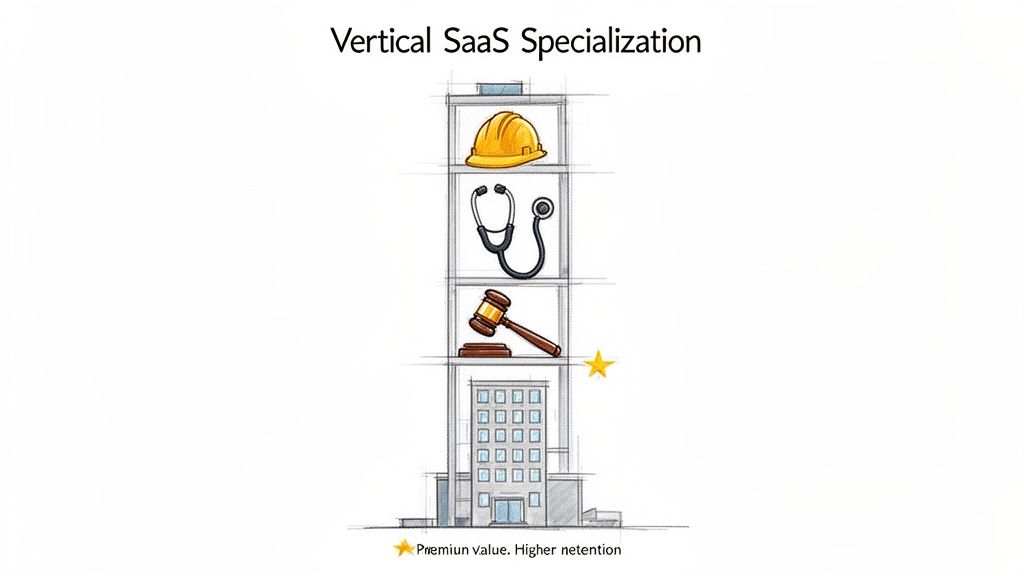
3. Vertical SaaS Targeting & Industry Specialization
Instead of building a horizontal solution for everyone, this strategy focuses on creating a deeply specialized product for a single industry. Vertical SaaS often commands higher prices, achieves lower churn, and closes sales faster because it is purpose-built to solve the precise, complex pain points of a specific niche, like construction or legal tech. It trades a massive potential market for a smaller, more accessible one where you can become the clear best-in-class solution.
Analyzing ad spend is a powerful way to validate which verticals have both established demand and room for a more specialized competitor. For example, sustained advertising for a general CRM in the legal space proves lawyers are paying for software. This creates an opportunity for a tool built specifically for immigration law or intellectual property case management. This makes it one of the most powerful SaaS growth strategies for building a defensible, high-margin business.
How It Works: A Practical Playbook
The goal is to identify a profitable niche and build a solution that feels custom-made for its users. This involves deep industry research, confirming pain points, and creating marketing that speaks the specific language of the vertical. This approach creates a strong moat that horizontal players struggle to cross.
- Validate a Vertical with Ad Spend: Use ad intelligence tools to find industries where horizontal SaaS tools are spending heavily (e.g., $10K+ per month) to acquire customers. This signals a proven budget for software solutions in that niche.
- Confirm Specific Pain Points: Before building, interview 10-15 professionals within the target vertical. Understand their unique workflows, compliance requirements, and the biggest frustrations they have with current generic tools.
- Build with Domain Expertise: Create a product roadmap guided by industry-specific needs. You can establish credibility by forming an advisory board of domain experts from your chosen vertical.
- Market with Vertical-Specific Assets: Develop marketing content that directly addresses the industry's challenges. This includes case studies from similar businesses, ROI calculators using industry benchmarks, and guides on vertical-specific compliance.
Key Insight: Vertical SaaS wins by trading a broad feature set for deep, domain-specific functionality. Customers are willing to pay a premium for a solution that understands their world and solves their niche problems better than any generic tool ever could.
When to Use This Strategy
This strategy is perfect for founders who have existing expertise in a specific industry or for those looking to build a highly defensible business with strong unit economics. It is also ideal for entrepreneurs seeking profitable, low-churn SaaS businesses in overlooked markets. By focusing on a single vertical, you can achieve market leadership and pricing power far more quickly than you could in a crowded horizontal space.
4. Pricing Strategy Optimization & Willingness-to-Pay Analysis
Pricing is one of the most powerful but often overlooked SaaS growth strategies. Instead of guessing what to charge, this strategy uses competitor and market data to anchor your pricing to the actual value you deliver and what customers are willing to pay. Many founders underprice their products out of fear, leaving significant revenue on the table. By analyzing what successful competitors charge and how much they spend to acquire customers, you can price with confidence.
This data-driven method helps align your revenue model with market reality from day one. When you see competitors in high-value verticals like legal or finance spending heavily to acquire customers, it’s a clear signal that those customers have a high willingness to pay, justifying premium pricing.
How It Works: A Practical Playbook
Optimizing your pricing involves systematically evaluating market signals, segmenting your audience, and testing your assumptions. The goal is to find the sweet spot where your price reflects the value delivered without creating friction for potential buyers.
- Benchmark Against High-Spend Competitors: Use ad intelligence to identify the top spenders in your niche. Analyze their pricing pages to establish a market-validated price range. If they can sustain high ad costs, their pricing model is likely profitable.
- Segment Customers by Value: Not all customers are created equal. Create pricing tiers that correspond to the value each segment receives. For example, a SaaS for healthcare compliance can charge far more than a simple content creation tool.
- Test Price Elasticity with A/B Tests: Create different versions of your pricing page with varying price points and present them to different audience segments. Measure conversion rates to understand how price changes affect demand and identify the optimal price. A simple test could reveal that a 20% price increase has no impact on sign-ups, instantly boosting revenue.
Key Insight: Your competitors' customer acquisition cost (CAC) is a direct indicator of customer lifetime value (LTV). A high, sustained ad spend implies a high LTV, which means you can and should charge a premium price for a similar or better solution.
When to Use This Strategy
This strategy is critical during the initial product launch and should be revisited at least annually or when entering new markets. It's especially vital for founders who are unsure how to price their SaaS and risk undervaluing their solution. For established companies, periodic pricing optimization can unlock new revenue streams and improve unit economics, making it a cornerstone of sustainable growth.
5. Product-Market Fit Discovery Through Competitor Feature Analysis
Achieving product-market fit is the holy grail for any SaaS startup. This growth strategy removes the guesswork by reverse-engineering what product-market fit already looks like in your niche. Instead of relying solely on customer interviews, you systematically analyze which features your successful competitors promote most heavily in their advertising. Their marketing spend reveals what truly drives customer value.
By observing which features competitors highlight in ad headlines and which customer segments they target, you can map out the market's core demands. For instance, if an email marketing tool's ads consistently feature "AI-powered subject line generation," you know that's a high-value feature for their customers. This data-driven approach helps you prioritize your own product roadmap, ensuring you build the features that customers have already proven they will pay for. This is one of the most direct SaaS growth strategies for building a product that solves a validated problem.
How It Works: A Practical Playbook
The process involves treating competitor advertising as a public-facing roadmap that highlights the most valuable and marketable features. This allows you to identify the "table stakes" features required to compete and uncover potential gaps in the market.
- Create a Feature Comparison Matrix: List your top 5-10 competitors and map out their core features. Note which ones appear consistently across all of them, as these often represent the minimum requirements to enter the market.
- Analyze Feature Emphasis in Ads: Use tools like the Meta Ad Library to track competitor ad creative over several months. A feature consistently in the headline is likely a primary value driver.
- Identify Feature Gaps & Weaknesses: Look for customer problems that competitors are either ignoring or solving poorly. For example, if all project management tools focus on team collaboration, there might be an unmet need for a tool tailored to solo freelancers.
Key Insight: A competitor's ad creative is a direct reflection of what they believe resonates most with paying customers. By analyzing this, you can understand the value hierarchy of a market and prioritize your own feature development accordingly.
When to Use This Strategy
This strategy is crucial for early-stage founders building an MVP or for established companies planning to enter a competitive market. It provides a clear, evidence-based blueprint for your product roadmap, minimizing the risk of building features that nobody wants. For more guidance, check out our deep dive on how to find product-market fit for your SaaS.
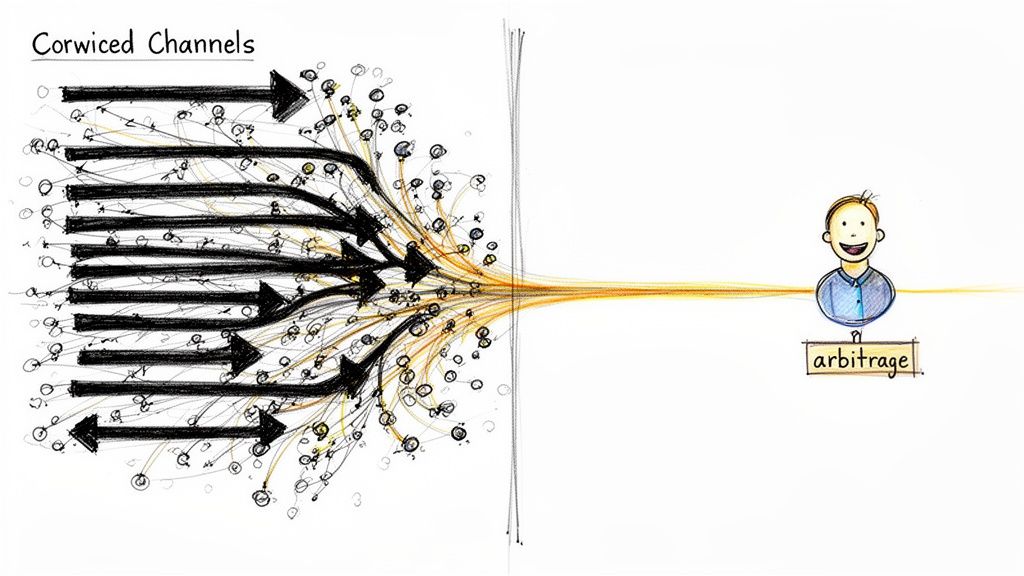
6. Distribution Channel Arbitrage & Customer Acquisition Strategy
Instead of reinventing the wheel, this strategy focuses on outsmarting it. Distribution channel arbitrage means finding where your competitors are successfully acquiring customers and then doing it better, cheaper, or through an overlooked channel they’ve ignored. It’s about reverse-engineering their acquisition model to find an efficiency gap you can exploit.
The core principle is that if a competitor is consistently spending on a channel, it works. Your job isn't to discover a brand-new channel but to find an "arbitrage" opportunity—a way to acquire customers from that same channel at a lower cost or with higher efficiency. This is one of the most powerful SaaS growth strategies for startups that need to compete with established players on a smaller budget.
How It Works: A Practical Playbook
This process involves a deep analysis of your competitors' customer acquisition mix to pinpoint opportunities for superior execution. For example, if a competitor relies heavily on paid search, you could target the same keywords with a better landing page and offer, thereby achieving a higher conversion rate and lower customer acquisition cost (CAC).
- Identify Competitor Channels: Use tools like Similarweb or SEMrush to see where their traffic comes from (e.g., paid search, social, organic). Analyze their ad spend in the Meta Ad Library to confirm which paid channels they prioritize.
- Analyze Channel Strategy: For each key channel, deconstruct their approach. What content are they creating for SEO? What messaging do they use in their ads? Which influencers or partners are they working with?
- Find the Arbitrage Gap: Look for weaknesses. Is their ad creative stale? Is their blog content generic and easy to improve upon? Are they ignoring a platform like TikTok or LinkedIn where your audience spends time? This gap is your entry point. For example, Monday.com saw competitors focusing on text-based Google Ads and went all-in on highly visual YouTube ads, dominating a less crowded space.
Key Insight: A competitor's acquisition strategy is a roadmap showing you where the customers are. Your goal is not to copy the map, but to find a faster, more efficient route to the same destination.
When to Use This Strategy
This method is perfect for SaaS companies entering a competitive market or for those who have hit a growth plateau. It provides a data-driven way to optimize your marketing spend and find scalable acquisition channels without the high cost and risk of pure experimentation. It allows you to build a smarter growth engine by learning from others' successes and failures.
7. Network Effects & Platform Strategy Development
This strategy focuses on building a product that becomes more valuable as more people use it. Instead of relying solely on paid ads or content, a network effects strategy engineers a self-reinforcing loop where user growth drives product value, which in turn attracts more users. This creates a powerful, long-term competitive moat that is difficult for others to replicate.
By designing features that encourage collaboration or content creation, you transform your SaaS from a simple tool into an ecosystem. Figma is a prime example; each designer who uses it can share files with collaborators, pulling more users onto the platform and making it the industry standard. This is one of the most powerful SaaS growth strategies for building a dominant, defensible business.
How It Works: A Practical Playbook
Developing a network effect requires intentional product design and a go-to-market strategy that prioritizes reaching a critical mass of users. The goal is to create a positive feedback loop where each new user adds value to the existing user base.
- Identify the Right Network Type: Determine if your product benefits from direct network effects (e.g., Slack, where more users mean more people to communicate with) or two-sided network effects (e.g., Notion's template marketplace, connecting creators and users).
- Seed the Initial Network: Overcome the "cold start" problem by providing immediate value to the first users even before the network is large. Start with a strong single-player mode and add multi-player features, or manually onboard early adopters to create initial density.
- Build for Integration and Expansion: Develop a robust API early on. This encourages other developers to build on your platform, creating a platform effect like Stripe, where the ecosystem of integrations becomes a core part of the value proposition.
Key Insight: A network effect is your best defense against competitors. Even with a superior product, a new entrant will struggle to overcome the value created by your established and interconnected user base.
When to Use This Strategy
This strategy is ideal for SaaS businesses in markets where collaboration, user-generated content, or a marketplace dynamic can be a core part of the product experience. It's particularly effective for founders aiming to build a category-defining company rather than a niche tool. While it requires a longer-term vision, the payoff is a highly defensible and scalable growth engine.
8. Retention Optimization & Land-and-Expand GTM Strategy for Account Growth
This strategy shifts focus from endless new customer acquisition to maximizing the lifetime value of existing customers. By combining retention optimization with a land-and-expand go-to-market (GTM) model, SaaS businesses can create durable, profitable growth. The core idea is to first land a customer with a focused, low-friction offering, ensure they achieve value quickly, and then systematically expand the account by upselling more features or seats.
This dual approach turns your customer base into your primary growth engine. High retention creates a stable revenue foundation, while expansion drives negative churn, where the revenue gained from existing customers surpasses the revenue lost from churned ones. This is one of the most powerful SaaS growth strategies because it’s far more cost-effective to grow an existing happy customer than to acquire a new one.
How It Works: A Practical Playbook
The process involves building operational systems for both retaining and expanding accounts. You must deeply understand what drives customer value and identify the natural inflection points where they are ready for more.
- Map the Customer Journey: Identify key activation milestones that correlate with long-term retention. For Slack, this was a team sending 2,000 messages. Build your onboarding to drive users to this "aha!" moment as fast as possible.
- Implement Engagement Tracking: Use product analytics to monitor user behavior and create health scores. This allows you to proactively identify at-risk users who show declining engagement and intervene before they churn.
- Design Expansion Pathways: Structure your pricing and product tiers to create a clear upgrade path. HubSpot excels here, allowing customers to start with a free CRM and then expand into their Sales, Service, and Operations Hubs as their needs grow.
Key Insight: The most predictable revenue in SaaS comes from customers who have already achieved success with your product. A land-and-expand model systematically capitalizes on that success to fuel new growth.
When to Use This Strategy
This strategy is essential for any SaaS business with a subscription model, particularly those serving B2B clients where account sizes can grow significantly. It is most effective for products that can be adopted by a single team or department before spreading organization-wide. From early-stage startups to mature companies seeking to improve capital efficiency, focusing on retention and expansion is a cornerstone of sustainable success.
9. Strategic Partnerships & Integration Strategy for Market Expansion
Instead of trying to build every feature yourself, this strategy leverages the ecosystems of other successful products. A strategic partnership and integration approach involves connecting your SaaS with complementary tools to expand your market reach, add value to your product, and create a stickier customer experience. The core idea is that your customers don't use your tool in a vacuum; they use it alongside others. By integrating, you tap into existing workflows and user bases.
Analyzing a competitor's integration marketplace can reveal gaps you can fill. For example, if a major competitor integrates with Salesforce but not HubSpot, you've found a clear opening to serve the HubSpot ecosystem. This approach accelerates growth by borrowing credibility and distribution from established players, making it one of the most capital-efficient SaaS growth strategies.
How It Works: A Practical Playbook
The process focuses on identifying and executing partnerships that create a "1+1=3" effect for both you and your partner's customers. The goal is to make your combined solution more valuable than either tool on its own, like how Zapier connects thousands of apps to automate workflows.
- Identify Complementary Tools: Pinpoint 5-10 non-competing tools your ideal customers already use and love. Check forums, review sites, and competitor landing pages to see what other software is frequently mentioned.
- Prioritize High-Leverage Partners: Focus on partners with large, engaged user bases or strong brand affinity in your target niche. A successful integration with a platform like HubSpot or Stripe can become a significant customer acquisition channel.
- Execute a Tiered Partnership Approach: Start with low-effort initiatives like co-marketing (webinars, blog post swaps). Use the success of these campaigns to justify a deeper, API-driven technical integration.
Key Insight: Every integration you build turns a complementary product into a new distribution channel. It embeds your SaaS directly into your customer's existing workflow, increasing value and making it much harder for them to switch to a competitor.
When to Use This Strategy
This strategy is ideal for SaaS companies that have achieved product-market fit and are looking for scalable growth levers beyond direct marketing. It's especially powerful for tools that serve a specific function within a larger business process (e.g., email marketing, analytics, accounting). By building a strong integration ecosystem, you not only acquire new customers but also increase retention and defensibility.
10. AI-Powered Product Development & Competitive Differentiation
This growth strategy moves beyond simple features and focuses on integrating artificial intelligence into your product's core. The goal is to create meaningful differentiation by automating complex workflows, generating better outcomes, and solving customer problems in ways that manual software cannot. By building a product with an AI-powered moat, you can leapfrog competitors and command premium positioning.
AI integration is one of the most powerful SaaS growth strategies today because it unlocks new capabilities that fundamentally change a product's value. Instead of just offering a better user interface, you offer a smarter, more efficient solution. A great example is Gong, which uses AI to analyze sales calls and provide teams with actionable insights to close more deals. The key is using AI to solve a real customer problem, not just as a marketing gimmick.

How It Works: A Practical Playbook
Successfully integrating AI requires a strategic approach focused on customer value. It's not about having AI for its own sake, but about applying it to create a superior user experience and outcome. The process involves identifying high-impact areas where intelligence can create a competitive advantage.
- Identify High-Value AI Use Cases: Analyze your customer journey and product workflows to find bottlenecks, repetitive tasks, or areas where data-driven insights are critical. Where could automation or prediction deliver a 10x improvement?
- Choose Your AI Model: Decide whether to build a proprietary model or leverage third-party APIs like OpenAI or Anthropic. For many, integrating existing large language models (LLMs) is a fast and effective way to add value.
- Build a Customer Feedback Loop: Implement systems to gather user feedback on AI performance. This data is crucial for continuously training and improving your models, creating a virtuous cycle where your product gets smarter with every use.
Key Insight: A competitor's lack of genuine AI integration is a strategic weakness. By embedding AI into core workflows, you can build a product that not only works better but also becomes increasingly difficult for others to replicate as your proprietary data and models grow.
When to Use This Strategy
This strategy is ideal for SaaS companies aiming to disrupt an established market or create an entirely new category. It's particularly effective for founders who can identify a specific, high-value problem that current AI capabilities are uniquely positioned to solve. It allows you to build a product that isn't just different, but fundamentally better and more intelligent than the competition.
10-Point SaaS Growth Strategy Comparison
| Strategy | Complexity | Resources Needed | Key Outcome | Best For... | Key Advantage |
|---|---|---|---|---|---|
| 1. Competitive Intelligence | Medium | Analyst Time, Tools | Validated Niches | Early-Stage Founders | Data-backed validation |
| 2. Rapid MVP Validation | Medium | Small Dev Team | Fast Market Validation | Indie Hackers | Speed & low risk |
| 3. Vertical SaaS | High | Domain Experts | Higher Prices, Low Churn | B2B Niches | Defensible moat |
| 4. Pricing Optimization | Medium | A/B Testing Tools | Higher ARPU | Any SaaS | Increased revenue |
| 5. PMF via Competitors | Medium | Research Time | Faster Product-Market Fit | Early-Stage Products | Reduced guesswork |
| 6. Channel Arbitrage | Medium | Marketing Budget | Lower CAC | Growth Stage | Efficient scaling |
| 7. Network Effects | High | Engineering, Time | Exponential Growth | Platforms, Collab Tools | Strong defensibility |
| 8. Retention & Expansion | High | CS & Product Teams | Higher LTV, Negative Churn | B2B Subscription Models | Predictable revenue |
| 9. Partnerships | Medium | BD & Eng. Teams | Faster Market Reach | Ecosystem Plays | Capital-efficient growth |
| 10. AI Differentiation | High | ML Engineers, Data | Superior Product | Data-Rich Markets | Powerful tech moat |
From Strategy to Execution: Your Next Move
We've covered a wide range of powerful SaaS growth strategies, from leveraging competitive intelligence to find your market gap to optimizing your pricing for maximum revenue. The journey from a promising idea to a category-defining SaaS company is built on a series of smart, validated decisions. Each strategy shares a common DNA: it’s about reducing guesswork and maximizing impact.
Growth is not a mystical force; it's a systematic process of identifying an opportunity, forming a hypothesis, and executing with precision. The days of building in a vacuum and hoping for the best are over. The most successful founders and product leaders are those who listen intently to the market's signals before they write a single line of code or spend a dollar on ads.
Your Roadmap for Actionable Growth
As you move forward, the key is to avoid analysis paralysis. You don't need to implement all ten strategies at once. Choose the one or two that will have the most significant impact on your business right now. To make that choice, consider these next steps:
- Audit Your Current Stage: Are you pre-launch? Focus on Competitive Intelligence (#1) and Rapid MVP Validation (#2). Are you an established player looking to scale? Then Retention Optimization (#8) and Strategic Partnerships (#9) might be your highest-leverage plays.
- Formulate a Testable Hypothesis: For each potential strategy, define what success looks like. For example: "By introducing a new pricing tier, we can increase our Average Revenue Per Account (ARPA) by 15% within one quarter." This makes your efforts measurable.
- Gather Your Intelligence: Before you execute, validate your hypothesis. Use market and advertising intelligence to see what’s already working for others. Are competitors successfully monetizing the feature you plan to build? Answering these questions first de-risks your execution.
- Execute, Measure, Iterate: Launch your initiative with clear Key Performance Indicators (KPIs) in place. Track your progress, learn from the results, and refine your approach. This continuous loop of execution and learning is the engine of sustainable growth.
The Power of Validated Action
The most important takeaway is this: every strategic move you make can be informed by real-world data. From identifying underserved niches to crafting a go-to-market plan, the market is already showing you the path to success. By embracing a data-driven mindset, you transform high-risk bets into calculated investments. The SaaS growth strategies outlined in this guide provide the framework, but it's your commitment to validated execution that will ultimately determine your trajectory.
Ready to stop guessing and start executing with confidence? The strategies in this article are most effective when powered by real-time market data. Proven SaaS provides the competitive and advertising intelligence you need to validate your ideas, uncover hidden market gaps, and build your growth engine on a foundation of proven signals. Explore Proven SaaS today and turn market insights into your unfair advantage.
Build SaaS That's
Already Proven.
14,500+ SaaS with real revenue, ads & tech stacks.
Skip the guesswork. Build what works.
Trusted by 1,800+ founders


