

Most SaaS competitor analysis templates are a waste of time. Founders diligently fill out a spreadsheet, fixate on features, and end up with a "me-too" product that goes nowhere.
This happens because they copy tactics without understanding the underlying strategy. A powerful analysis isn't about listing what your competitors have; it's about digging into what they do to win and keep customers. This guide provides a clear template and examples to help you do just that.
Why Traditional Competitor Analysis Fails SaaS
Staring at a spreadsheet of feature comparisons is a recipe for disaster. The old way of doing this—obsessing over surface-level data—is a trap that pushes SaaS founders down the wrong path, locking them into a reactive cycle instead of a proactive one.
This outdated approach is built on flawed ideas that are especially dangerous in the fast-paced SaaS world. It leads directly to a feature-matching arms race, where you're always one step behind, playing catch-up instead of carving out your own space.
The Feature-Matching Trap
The biggest mistake is creating a simple checklist of competitor features and feeling obligated to build every single one. This misses the most important question: did those features actually move the needle, or were they just expensive distractions? Blindly copying features is the fastest way to build a product nobody truly loves.
Example: Imagine your competitor adds a complex reporting dashboard. Instead of immediately adding "reporting dashboard" to your roadmap, ask: "What customer problem were they trying to solve?" Maybe their users just needed a simple way to export data. You could solve that problem better with a simple CSV export button, saving months of development time.
Ignoring Profitability Signals
Traditional analysis often misses the one metric that matters most: profitability. Sure, a competitor might have a slick website, but are they actually making money? If you don't know, you could be modeling your business after a sinking ship. A modern analysis looks at the financial health of the competition.
Key Metrics for a Modern SaaS Competitor Analysis
This template shifts your focus from vanity metrics to actionable business intelligence. Here’s a clear summary of what to track.
| Metric Category | What to Track | Why It Matters |
|---|---|---|
| Acquisition & Growth | Ad spend, traffic sources, growth trends, hiring velocity. | These are direct signals of a validated customer acquisition funnel and a growing business. |
| Monetization | Pricing tiers, revenue estimates, pricing page changes. | Reveals their business model, target customer, and potential struggles with market fit. |
| Product Strategy | Core feature matrix, recent launches, product positioning. | Helps you understand their unique value proposition and identify underserved user needs. |
| Customer Sentiment | Churn signals, online reviews, social media mentions. | Uncovers weaknesses, customer pain points, and opportunities to offer a better experience. |
By focusing on these areas, you get a much clearer picture. For example, when you look for financial indicators, you start to see the real story:
- Sustained Ad Spend: A company consistently spending $10,000+ per month on ads is a huge signal. It means they've likely found a profitable customer acquisition channel.
- Growth and Hiring Trends: Is the company hiring for sales and engineering roles? Tools like Proven SaaS can surface this data, which often points directly to revenue growth and expansion.
- Pricing and Positioning Shifts: If a competitor is constantly tweaking their pricing or marketing copy, it could be a sign they’re struggling to find product-market fit. That’s an opportunity for you.
When you shift your focus from features to financial viability, your saas competitor analysis template becomes a powerful strategic tool. It helps you find validated market niches, not just a long list of code to write.
How To Build Your Competitor Analysis Template
Let's build a practical template. A solid saas competitor analysis template isn't just a place to dump data; it's a strategic framework that forces you to ask the right questions.
The goal is to create a living document that shows you what your competitors are actually doing to win customers. It helps you organize your findings into clear, comparable sections, making it much easier to spot patterns and opportunities. This is about shifting from static data collection to a more dynamic, insight-driven analysis.
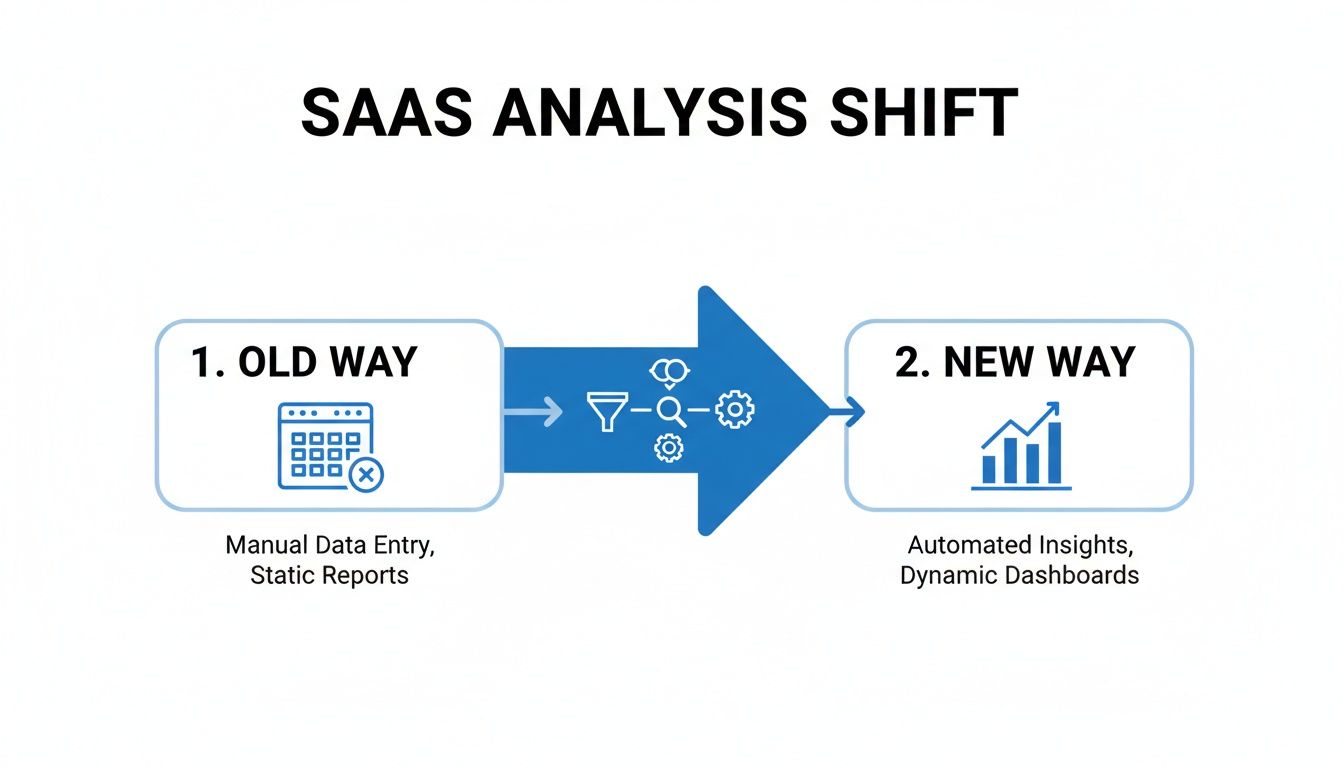
The big idea here? Prioritize actionable business signals over simple feature checklists. That’s what leads to smarter strategic decisions.
Structuring Your Template Categories
The backbone of a great template is its categories. These are the columns or tabs in your spreadsheet that keep your research organized.
Here are the five essential categories to include:
- Company Profile: A high-level snapshot. Note the company size, funding status, primary target audience, and their core value proposition. This is about understanding who they are at a glance.
- Product & Features: Don't just list features. Map out core functionalities, but also note the user experience, key integrations, and recent updates. The goal is to understand how they solve the customer's problem.
- Pricing Strategy: Document everything about their pricing—tiers, free trials, and any add-ons. Are they the premium choice or the budget-friendly option? Their pricing reveals their ideal customer.
- Marketing Channels: How are they getting customers? Track their main traffic sources (organic, paid, social), content strategy (blogging, webinars), and overall messaging. This reveals their go-to-market playbook.
- Financial Signals: This is where a modern analysis shines. Track metrics like estimated monthly ad spend, hiring trends (especially for sales and engineering), and estimated revenue. These are powerful indicators of their growth.
Populating The Template With Strategic Intelligence
Once you have your structure, it's time to fill it in. But here’s the most important part: don't just copy and paste information. For every piece of data, add a column for your own insights. This turns a boring list of facts into a powerful strategic weapon.
Simple Example:
- Data Point (Pricing): "Competitor A has a Pro Plan at $99/month."
- Your Insight: "This tier seems aimed at mid-market teams. They might be ignoring smaller businesses or freelancers, which could be our opening."
See? That’s how you turn raw data into something you can actually use. If you're struggling to even build your initial list of competitors, there are tools built just for that. You can learn more by checking out the SaaS Competitor Finder.
Remember, the purpose of your saas competitor analysis template is not just to collect data, but to fuel your own strategic decisions. Every cell should contribute to a clearer understanding of the market landscape and your unique place within it.
Finding The Financial Signals That Truly Matter
A feature-by-feature comparison is a good start, but the real gold is in your competitors' financial signals. These hard numbers tell you if a business is just getting by or genuinely thriving. When you can estimate revenue and see ad spend, you stop guessing and start making strategic moves.
Forget product details for a moment. Instead, hunt for signs of a validated business model. A company consistently spending over $10,000 a month on ads isn't just throwing money away. They’ve found a profitable way to bring in customers. That's one of the strongest indicators of product-market fit you can find.
Decoding Ad Spend and Revenue Estimates
Tracking ad spend manually is impossible. This is where you need a good intelligence tool. A platform like Proven SaaS lets you filter for companies that are already investing seriously in paid acquisition. It’s a massive shortcut that points you straight to markets with proven demand.
These tools use models to estimate revenue and bring growth signals to the surface—signals that would otherwise be invisible. This data-driven approach is how you fill out your SaaS competitor analysis template with metrics that actually drive decisions.
The process is straightforward:
- Pinpoint High-Spenders: Find competitors with significant, sustained ad budgets.
- Analyze Their Strategy: Look at their ad creatives and messaging to see how they’re positioning themselves.
- Estimate Their Health: Use revenue estimates to get a feel for their financial growth and stability.
The goal isn't just to find competitors; it's to find profitable competitors. A high ad spend is a proxy for high confidence. It tells you they've nailed their customer acquisition cost (CAC) and lifetime value (LTV).
The view below is a simple visual example of how these signals are often presented, giving you a clear snapshot of ad spend and estimated revenue.
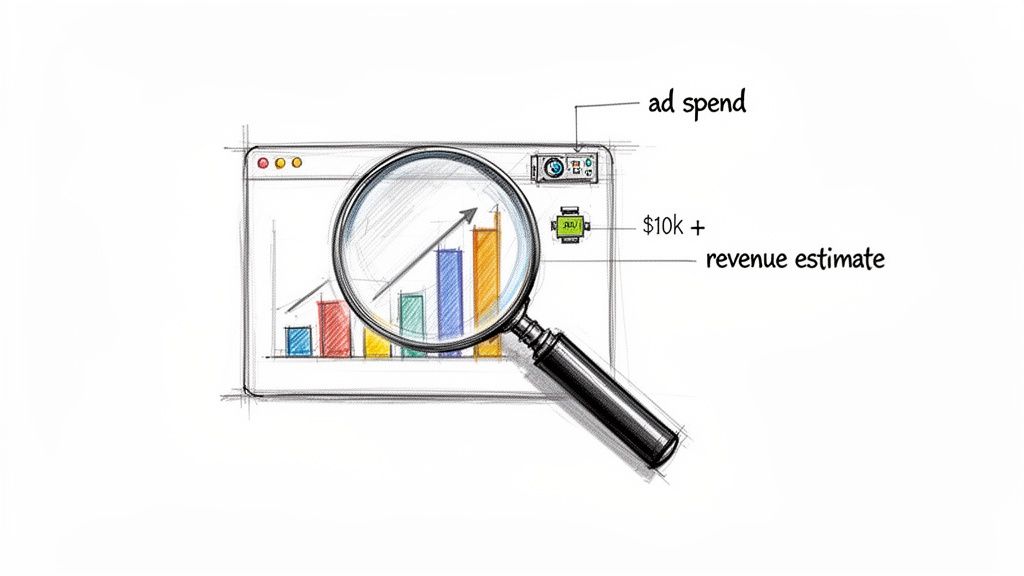
This kind of dashboard instantly shows you who's successfully making money and scaling up, effectively handing you a curated list of validated business models to learn from.
Tying Financials to Pricing and Positioning
These financial signals are linked to pricing. As you identify these indicators, learning how to monitor competitor prices effectively gives you a clearer picture. A competitor with high ad spend and premium pricing is likely targeting enterprise clients. One with lower spend and budget-friendly tiers is probably playing a volume game.
When you connect these dots, powerful strategic insights emerge. This knowledge helps you find profitable niches with proven demand, steering you clear of the classic startup mistake: building a product for a market that doesn't exist or isn't willing to pay.
How To Analyze And Score Your Competitors
Okay, you've filled out your saas competitor analysis template. Now what? A spreadsheet full of data is just that—data. The value comes from turning it into a strategic compass that points you toward market gaps and your unique angle.
The best way to cut through the noise is a simple scoring system. Assign a score (from 1 to 5) to each competitor across a few critical areas. This gives you a clear, visual way to see who’s a real threat and who’s just making noise.
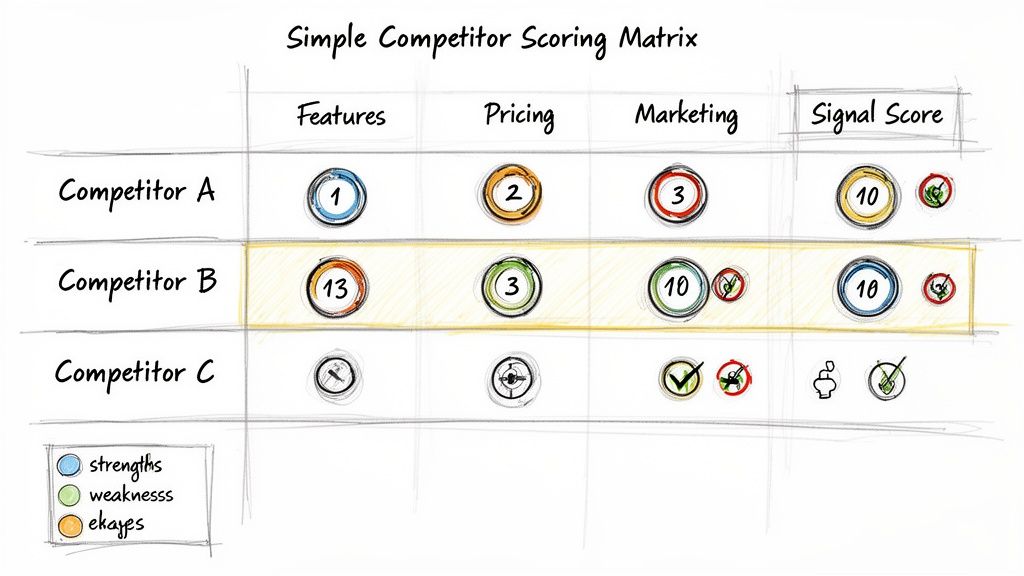
This simple visual immediately clarifies who is strong and where their weaknesses might be. It helps you focus your limited time on the rivals that truly matter.
Deconstructing The Data
With your template filled in, it's time to look for patterns. The goal is to translate what you’ve found into something you can act on.
- Feature Analysis: Look for what isn't there. If every competitor builds complex, enterprise-level features while ignoring small teams, that’s a huge market gap.
- Pricing Dissection: A competitor's pricing page tells a story. If they constantly change prices, it might be a sign they’re struggling to find product-market fit—an opportunity for you to offer a clear, stable solution.
- Marketing Evaluation: Where are they spending their ad budget? If everyone is fighting for Google's top spots with content marketing, perhaps a strong paid social campaign could capture an audience they're all ignoring.
When you look at these pillars together, you’re reverse-engineering their entire go-to-market strategy. This is how you find out where they’re strong, where they’re vulnerable, and where you can build a unique advantage.
Applying A Scoring Framework
To add structure, you can apply a framework like a competitive analysis SWOT. This helps you organize thoughts around each competitor's Strengths, Weaknesses, Opportunities, and Threats.
Then, combine that with your scoring system. For each competitor, give them a rating from 1 to 5 on a few key metrics:
- Product-Market Fit (1-5): How well does their product solve the customer's problem? Dig into reviews to get a real sense of sentiment.
- Marketing Execution (1-5): How good are they at getting new customers? A high, consistent ad spend is a very strong signal here.
- Financial Strength (1-5): What do their revenue and growth signals tell you? Are they hiring? Does their ad spend suggest profitability?
Once you add up the scores, your top threats will become immediately obvious. This simple exercise gives you a clear framework for figuring out how to be different and where to focus your efforts.
Turning Your Analysis Into An Actionable Growth Plan
A well-researched SaaS competitor analysis template is worthless if it just sits in a folder. The final step is turning that data into a concrete plan for growth. This is where your spreadsheet becomes a strategic roadmap.
A good analysis doesn't just tell you what your competitors are doing; it tells you where to go next. The data you've gathered is your key to validating a product idea, sharpening your positioning, and building a go-to-market strategy that has a real chance of success.
From Insights To A Better MVP
Your analysis should be the single most important input for your Minimum Viable Product (MVP). Stop guessing which features matter. You now have data to make confident decisions based on actual market gaps.
Example: Your research shows that the three biggest players all cater to large enterprise teams with complex, bloated feature sets. They’ve completely ignored the solo founder. Their pricing is too high, and their user interface is complicated. This is a massive opportunity.
- Your Action Plan: Build an MVP that is ruthlessly simple. Focus only on the core features a freelancer actually needs.
- Your Positioning: Price it for an individual, not a corporation. Make it a no-brainer.
- Your Message: Market your tool as the "un-enterprise" solution. Emphasize ease of use and speed.
This approach gives you a built-in audience and a clear differentiator before you write a single line of code.
The point of an MVP isn't just to have fewer features. It's to launch with the right features for a hungry, underserved audience. Your competitor analysis is how you find them.
Crafting A Unique Value Proposition
A powerful value proposition is almost always born from contrast. By showing you how everyone else is the same, your analysis gives you the perfect blueprint for being different.
Example: You discovered that your competitors are all winning on feature depth, but they are getting roasted in reviews for terrible customer support. You see endless complaints about 24-hour response times and chatbot loops.
Your unique value proposition could be: "The only project management tool for small agencies that guarantees a human response in under five minutes."
Boom. You've just positioned your entire company against the market's biggest weakness. It doesn't mention a single feature—it sells a solution to a proven, painful problem. This is how you stop being just another alternative and become the only choice for a certain type of customer.
A Few Common Questions About SaaS Competitor Analysis
Even with a solid template, questions will come up. Here are answers to a few common ones to keep you on the right path.
How Often Should I Update My Competitor Analysis?
For an early-stage startup or a fast-changing market, a quarterly review is best. This frequency is enough to catch important shifts like new feature releases, pricing experiments, or a change in marketing strategy. For more mature, stable markets, a bi-annual check-in is probably sufficient. The key is to treat your saas competitor analysis template as a living document, not a one-time project.
What Is The Biggest Mistake To Avoid?
The single biggest mistake is getting obsessed with features and falling into the "feature parity" trap. Seeing a competitor's feature and feeling you have to build it too is a reactive strategy that ensures you're always playing catch-up.
Instead of making a checklist of features, your job is to uncover the strategy behind them. Who are they building for? What's their profitable customer acquisition channel? Answering those questions will show you where the real market opportunities are.
How Can I Analyze Private SaaS Companies?
Since you can't look up their financial statements, you have to become a detective and rely on public signals. The good news is that a company's marketing footprint offers powerful clues about its health.
Look for these signals:
- Ad Spend: Tools that estimate ad spend show you who's investing heavily in customer acquisition—a strong signal of a working funnel.
- SEO Performance: A competitor's organic traffic and keyword rankings tell you about their content strategy and target audience.
- Hiring Trends: I always check LinkedIn for new job postings. If a company is suddenly hiring a dozen sales reps or engineers, it’s a clear giveaway about where they're investing and growing.
These external signals are often more up-to-date and actionable than any internal financial report.
Ready to stop guessing and start building with confidence? Proven SaaS gives you the advertising intelligence to find profitable, validated SaaS ideas in minutes. See what your future competitors are spending on ads and estimate their revenue to find your unfair advantage. Discover your next profitable SaaS idea today.
Build SaaS That's
Already Proven.
14,500+ SaaS with real revenue, ads & tech stacks.
Skip the guesswork. Build what works.
Trusted by 1,800+ founders


