

You wouldn't build a house without a blueprint, right? Marketing for your startup company is the same. Too many founders make the classic mistake of throwing money at ads before they even know if people want what they're selling. We need to flip that script.
The goal isn't just to "get your name out there." It's to build a rock-solid plan based on real-world data before you spend a single dollar. This groundwork is what separates startups that succeed from those that burn through cash and disappear.
Build Your Marketing Blueprint Before Spending a Cent
Think of this first phase as your marketing research. Instead of jumping straight to tactics like running ads or posting on social media, you’ll do the unsexy but vital work of validation. It's about finding out if you're solving a problem people are actually willing to pay to fix.
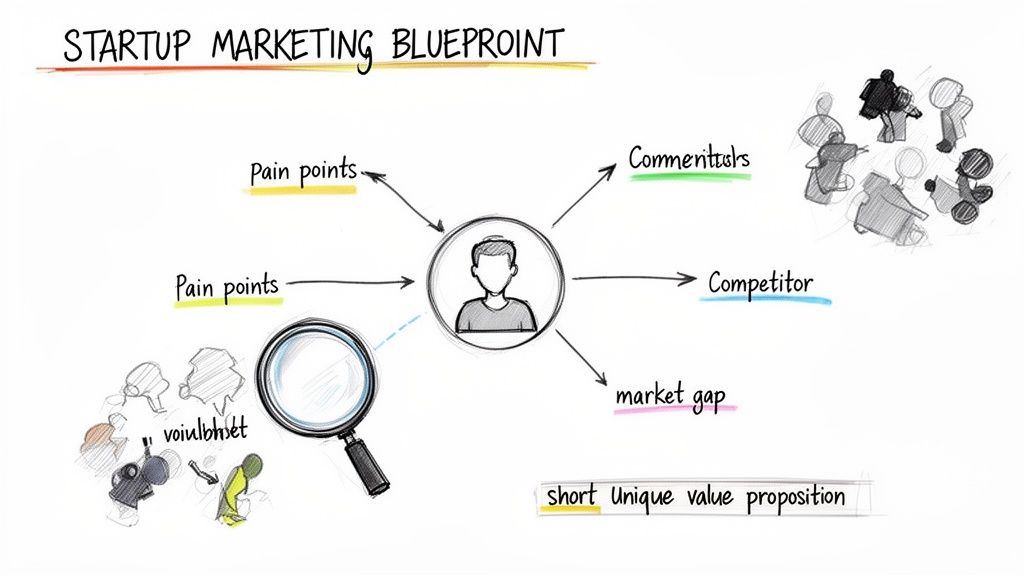
Forget generic "buyer personas." Let's get specific. Where do your potential customers struggle? What tools have they tried that didn't work? Answering these questions helps you find the exact gaps your competitors are missing.
Validate Demand and Analyze Competitors
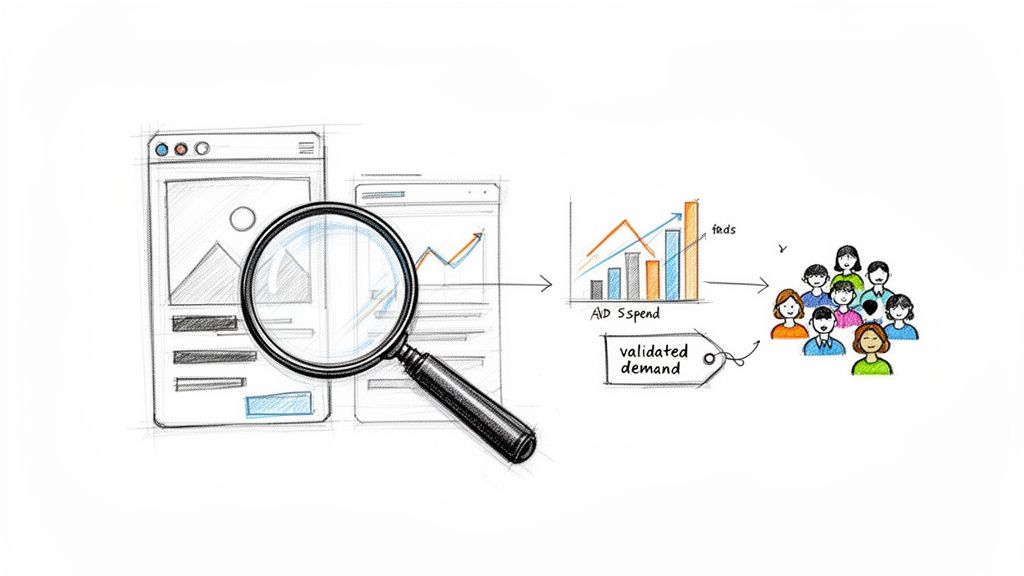
Here’s a simple trick: one of the best ways to see if your idea has potential is to check if other companies are already spending money on ads for it. If a competitor is pouring thousands into Google Ads for specific keywords, that's a huge signal. It means there's a profitable market there, and they've already done the hard work of proving it.
This whole process is about being strategic. You validate the demand, see what the competition is up to, and then you can build an offer they can't refuse.
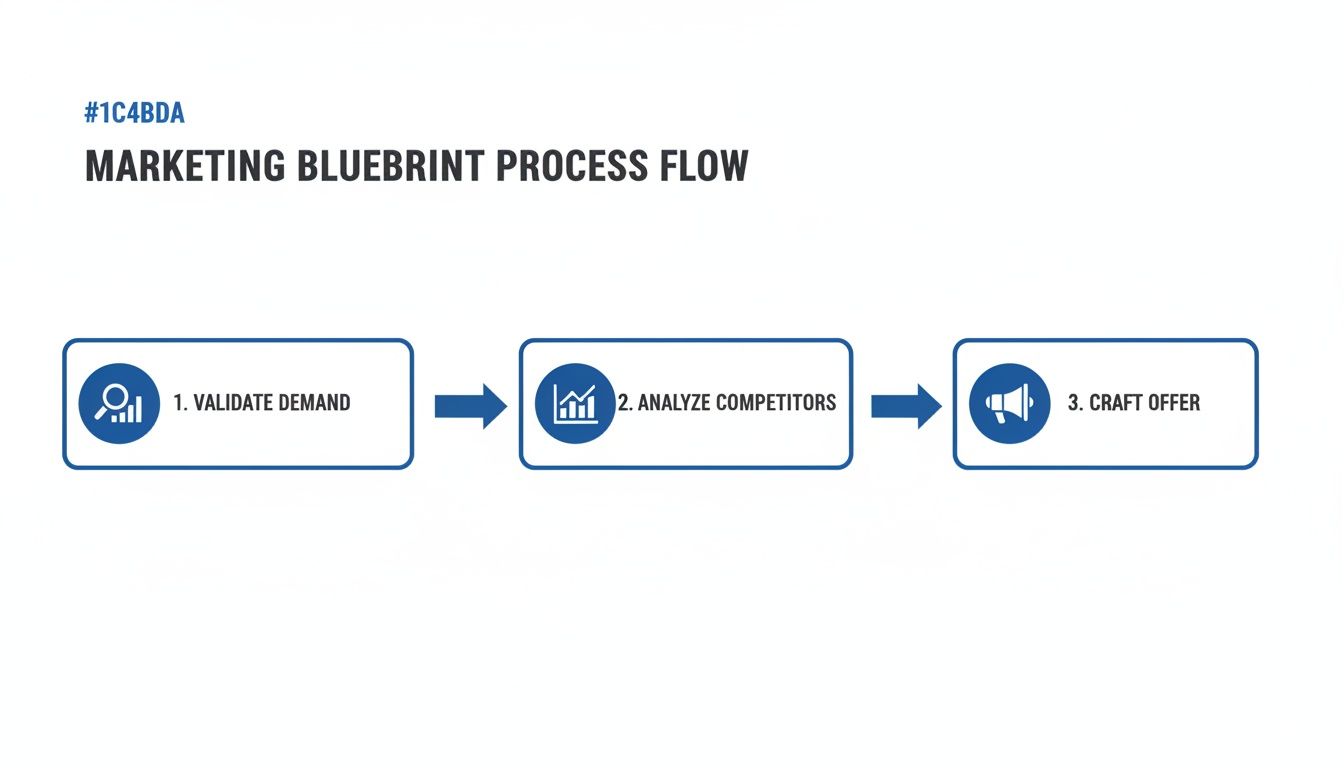
A powerful offer isn’t just a creative idea. It’s the logical result of understanding what people want and what competitors aren’t giving them. Using ad intelligence tools can shortcut this process by showing you exactly where others are winning. For a deeper look, this startup marketing strategy guide is a great resource.
To stay on track, use a simple checklist to cover all your bases before you launch.
Pre-Launch Marketing Validation Checklist
This checklist isn't about ticking boxes. It's about ensuring every move you make is backed by evidence, not just a gut feeling.
| Validation Step | Key Action | Why It Matters |
|---|---|---|
| Problem Validation | Talk to 10-15 potential customers about their biggest frustrations. | Confirms you're solving a real problem people will pay to fix. |
| Competitor Ad Spend | Use ad-intel tools to see if competitors are consistently buying ads. | Verifies a profitable market exists; others are already making money in it. |
| Keyword Analysis | Find keywords with high "buy now" intent and decent search volume. | Shows that people are actively looking for a solution like yours. |
| UVP Test | Run a simple landing page with your proposed value proposition. | Measures interest before you build the full product or campaign. |
Completing these steps gives you confidence that you're building your marketing on solid ground.
Craft a Unique Value Proposition
Once you've done your homework, it’s time to create your Unique Value Proposition (UVP). This is a crystal-clear sentence that explains how you solve your customer's problem better than anyone else.
A great UVP is specific, pain-focused, and highlights what makes you different. It’s the core of your messaging.
Let's look at an example. A generic UVP is "Easy-to-use project management software." It's forgettable. A stronger one is: "The first project management tool for remote teams that eliminates pointless meetings." See the difference? It speaks directly to a specific audience's frustration.
Use Ad Intelligence to Find Your First Customers
Stop guessing where your customers are. The fastest way to find them is to see where your competitors have already succeeded. Instead of wasting your marketing budget, use real data to make smart bets on channels that are already working for similar companies.
This is where ad intelligence tools come in. They sift through public ad libraries (like Meta's) and show you what’s actually working. You get a behind-the-scenes look at who’s advertising, what their ads look like, and how much money they're spending.
Spotting Markets Where Money Is Being Made
Consistent ad spend is one of the clearest signals of a healthy market. When you see a company spending $10,000 or more per month on ads, it's a huge clue. They have almost certainly found a product that people want. Companies don't burn that kind of money unless it’s bringing in profitable customers. This data-first approach lets you focus on markets where demand is a sure thing.
For SaaS startups, paid channels like Meta ads are often the go-to for proving an idea and scaling fast. B2B SaaS firms with under $1 million in revenue are growing at a median rate of 50%, much of it fueled by targeted ads. Tools that show sustained ad spends over that $10K monthly threshold are pointing you directly to real market demand.
Focusing on these high-spend competitors isn't just about finding a niche; it’s about finding a validated business model.
Deconstruct Your Competitors' Playbook
Once you’ve identified the key players, it's time to be a detective. Break down their strategy. The goal isn't to copy them, but to understand what works in that market.
Look for patterns in a few key areas:
- Ad Creative: What visuals do they use? Slick videos or simple images? Notice the style and tone.
- Messaging & Hooks: What specific pain points do they mention in their ad copy? How do they frame their product as the solution?
- Calls to Action (CTAs): What are they asking people to do? "Sign Up for a Free Trial"? "Book a Demo"? "Download a Guide"?
By analyzing these elements, you get a free masterclass in what your audience responds to. You learn from their wins without spending your own money.
Example: Let's say you notice three top competitors are all running video ads with customer testimonials. That’s a powerful clue that social proof is a huge conversion driver in this niche. You can then make gathering testimonials a top priority for your own first campaigns.
This reverse-engineering process helps you build a strategy that’s already in tune with what the market wants. An ad library provides these insights and dramatically shortens your learning curve, turning competitor analysis into your secret weapon.
Choosing and Testing Your Go-To Marketing Channels
With so many marketing channels out there, focus is your superpower. The goal isn't to be everywhere; it's to be exactly where your ideal customers are. Too many startups spread their budget so thin that they make zero impact anywhere.
The trick is to run small, cheap experiments to get data, fast. This is how you learn what works without burning your budget. Don't commit to a channel because of a hunch—commit because the numbers tell you to.
Design and Run Small-Scale Tests
Before you scale, you have to test. A good test doesn't need a massive budget. Its only job is to answer one question: "Can I get customers from this channel at a price that makes sense?"
Start with a clear hypothesis. For example: "If we spend $500 on targeted LinkedIn ads, we can get at least 10 qualified demo requests for our SaaS tool this month." Now you have a specific, measurable goal.
Keep your Key Performance Indicators (KPIs) simple:
- Cost Per Acquisition (CPA): What does it cost to land one new paying customer?
- Click-Through Rate (CTR): Is your ad compelling enough for people to click?
- Conversion Rate: How many people who visit your page from this channel sign up?
This discipline tells you which channels to double down on and which ones to cut.
Real-World Example: A B2B SaaS Test
Let’s walk through a simple scenario. Imagine a startup with a new SaaS tool for accounting firms. They have a tight budget of $1,000 to find their first customers.
- Test A: LinkedIn Ads ($500): They create a campaign targeting "Accounting Firm Partners." The ad directs people to a landing page for a free 15-minute demo.
- Test B: Niche Newsletter Sponsorship ($500): They find a popular weekly newsletter for accountants and pay for a sponsored link that also goes to the same demo page.
After two weeks, they check the data.
Key Takeaway: The goal of these early tests isn't explosive growth—it's learning. The results show you where your message works best, telling you exactly where to put your next marketing dollar.
The LinkedIn ads brought in 80 clicks and 3 demo requests. The newsletter sponsorship generated 120 clicks and 9 demo requests.
The data is clear. The newsletter delivered a much lower cost per lead. This tells the founder to find more newsletters to sponsor and pause the LinkedIn campaign to rethink the ad.
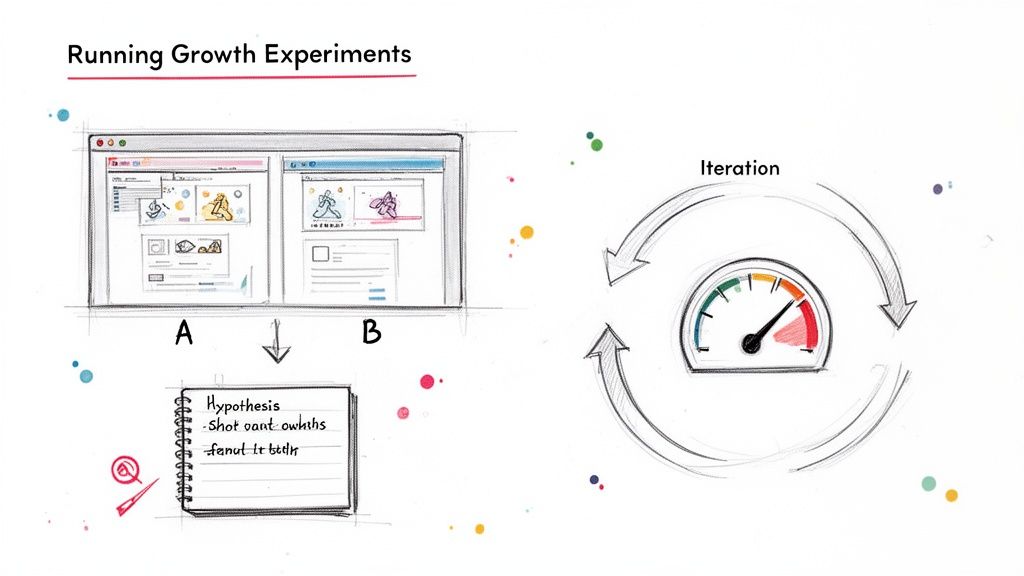
Creating a System for Growth Experiments
Alright, you have some early traction. Fantastic. Now the real work begins: building a marketing engine that drives sustainable growth. This means shifting from random acts of marketing to a disciplined system of experiments.
Start thinking like a scientist. You're not just throwing ideas at the wall; you're forming a hypothesis, running a test, and analyzing the results. Speed and learning are your best friends.
Forming a Clear Hypothesis
Every good experiment starts with a testable question. A weak hypothesis is vague, like "Let's make our landing page better." A strong one is sharp and measurable: "Changing our headline from 'Project Management Software' to 'Stop Wasting Time in Meetings' will boost free trial sign-ups by 15%."
This structure gives you a clear win or loss. You know exactly what you're testing and what success looks like.
The most successful startups treat marketing like a series of well-run science experiments. Every result, good or bad, is just data that informs the next move.
Bootstrapped SaaS companies are often masters of this. Data from places like SaaS Capital's benchmarks on growth shows that nimble startups can outmaneuver larger competitors with rapid-fire testing.
High-Impact Experiments for Startups
You don't need a huge budget to run tests that matter. The best experiments are often simple. For example, some clever companies acquire customers by creating the free tool that sells your main product.
Here are a few simple ideas to get you started:
- Test Your Pricing Tiers: Try offering a "Pro" plan with one extra, high-value feature. See if people are willing to pay a premium for it. It's a quick way to learn what your customers really value.
- Tweak Your Call-to-Action: A/B test the main button on your homepage. Does "Get Started for Free" get more sign-ups than "Request a Demo"? The results can be surprising and take minutes to set up.
- Launch a Simple Referral Program: Give existing customers a reason to talk about you. Offer a $50 credit for every new customer they bring in. This is a low-cost way to see if word-of-mouth can become a real growth channel.
Each of these tests can be set up in a day or two and will give you direct, actionable feedback.
Setting a Realistic Budget and Tracking What Matters
Let’s be honest: marketing without a clear budget is just burning cash. I've seen too many startups run out of money because they had no system to track where it was going and what it was bringing back.
The key is a straightforward, disciplined system. This lets you confidently double down on what’s working and cut what isn't, turning your marketing spend into a true investment.
Focus on Metrics That Actually Move the Needle
It’s easy to get distracted by "vanity metrics" like social media likes. They look great, but they don't pay the bills. For a startup, obsess over the few Key Performance Indicators (KPIs) tied directly to revenue.
These are the numbers that really matter:
- Customer Acquisition Cost (CAC): What is the total cost to get one new paying customer from a specific channel?
- Lifetime Value (LTV): How much total revenue does one customer bring in over their entire time with your company?
- Conversion Rate: What percentage of people who hit your landing page or trial actually become a paying customer?
The core math is simple: if your LTV is greater than your CAC, you're on the path to a sustainable business.
How to Set a Practical Startup Budget
You don't need to over-engineer this. Instead of a generic rule like "spend 10% of revenue," work backward from your goals.
Example: If your goal is 20 new customers next month and you've set a target CAC of $250, your starting budget is clear: $5,000. This ties every dollar directly to a business outcome.
The most important thing about your initial budget is flexibility. Think of it as a series of small, calculated bets. When one channel starts delivering a great CAC, be ready to shift more of your budget there—fast.
In the competitive world of SaaS, this precision is crucial. Marketing performance is a massive driver of company value. With SaaS industry trends and their impact on marketing showing constant change, a data-first approach is your best bet for survival. You can also check out these CAC payback benchmarks to compare your numbers against industry standards.
Scaling Your Marketing as Your Startup Grows
The hustle that got you your first 100 customers won't get you to 1,000. As your startup grows, your marketing has to grow up, too. It needs to evolve from a scrappy, founder-led effort into a structured, scalable machine.
This transition is a major turning point. A big part of it is recognizing when you, the founder, have become the bottleneck. If you're spending more time tweaking ad copy than thinking about the product roadmap, it's time to bring in help.
Making Your First Marketing Hire
Resist hiring a senior VP of Marketing right away. What you need now is a doer. You need a generalist who loves getting their hands dirty—someone who can run campaigns, write blog posts, and analyze data.
This person’s job is to take over daily execution, which frees you up to focus on the big picture.
Another smart move is hiring an agency for specialized skills like SEO or complex Google Ads campaigns. An agency gives you immediate access to a team of experts without the long-term cost of a full-time salary.
The real shift is mental. You have to go from doing all the marketing to building a marketing function. That means creating playbooks, documenting what works, and empowering your new team to run with it.
Evolving Your Channels and Strategy
Once you have more budget and manpower, you can look beyond quick-win channels. Early on, it's all about direct acquisition. As you scale, the game shifts to building a real brand and a sustainable inbound pipeline that works for you 24/7.
This is when you can start making bigger bets:
- Authority-Building Content: Go deeper than basic blog posts. Create comprehensive guides, publish original research, or host webinars to become the go-to expert in your space.
- Brand Building: Now is the time to invest in channels that create an emotional connection, like a podcast or YouTube series. A strong brand is a long-term advantage that makes customer acquisition cheaper over time.
- Customer Nurturing: It's not just about getting new customers; it's about keeping them. Use email automation and build a community to boost customer lifetime value and drive referrals.
This pivot ensures your early traction isn't a fluke. It's how you turn initial wins into a defensible market position that will fuel your growth for years to come.
Frequently Asked Questions
So, How Much Should I Actually Spend on Marketing?
Forget generic advice like "10-20% of your projected revenue." At this early stage, it's all about unit economics.
The only number that truly matters is this: can you get a new customer for less than they're worth to you over time (Lifetime Value, or LTV)? If your Customer Acquisition Cost (CAC) is healthy, you've found a gold mine. Start with small experiments and only pour more money into channels that deliver profitable customers.
What’s the One Metric I Should Obsess Over at the Start?
If you can only track one thing, make it your conversion rate. Specifically, what percentage of people who visit your website sign up for a trial or become a paying customer?
A high conversion rate tells you that your message is connecting and your product solves a real problem. All the website traffic in the world is useless if none of those visitors become actual customers. A low conversion rate is an alarm bell that you need to fix your value proposition or you're targeting the wrong people.
Should I Jump into SEO or Paid Ads First?
Go with paid ads. It's not a debate in the early days.
Paid advertising gives you immediate feedback. You can launch a campaign and get real data on your messaging, offer, and customer demand within days. You learn what works, fast.
SEO is a fantastic long-term investment, but it’s a slow burn. You could wait 6-12 months to see meaningful results. You don't have that kind of time when you're trying to validate an idea. The smart move? Use paid ads to quickly find your best keywords and ad copy, then use that data to build a much smarter SEO strategy.
Ready to stop guessing and start building on proven demand? With Proven SaaS, you can analyze what’s already working for top competitors, find validated niches, and build a product the market is already paying for. Discover your next profitable SaaS idea today.
Build SaaS That's
Already Proven.
14,500+ SaaS with real revenue, ads & tech stacks.
Skip the guesswork. Build what works.
Trusted by 1,800+ founders


