

Forget dusty reports and expensive focus groups. For a startup, market research isn't about guesswork; it's about finding hard evidence that people will pay you to solve their problem.
The smartest founders don't ask what people say they'll do. They look at what people already do. This playbook is your guide to a faster, evidence-based approach that saves your two most precious resources: time and money.
Why Startups Need a New Market Research Playbook
Let's be clear: the old way of doing market research is broken for startups. Traditional methods are too slow, too expensive, and often deliver the wrong answers.
Founders fall into a classic trap: asking potential customers, "Would you use this?" The answer is almost always a polite "yes," which is completely misleading. People are terrible at predicting their own future behavior. This well-intentioned but useless feedback sends you down a rabbit hole, building something nobody actually buys.
This outdated model creates a dangerous gap between your idea and the real world. You burn through your budget and precious months, only to end up with a pile of opinions instead of paying customers.
Shifting from Opinions to Evidence
The modern approach flips the script. Instead of asking what people might do, you find out what they're already doing. The clearest signal of a problem worth solving is finding customers who are already paying someone else to fix it.
This is a mindset shift from guesswork to observation. When you see a competitor successfully attracting customers, you've found proof that a market exists and is willing to pay.
Key takeaway: Find signals of real customer commitment. The most powerful signal is money. When a company spends thousands each month on ads, it's because those ads are generating a profitable return. That's your validation.
This research is a core part of building a solid founder's go to market strategy for startups playbook that guides you from concept to launch. It’s about taking action, not getting stuck in analysis paralysis.
The Power of Following the Ad Spend
Not long ago, proper market research could easily cost $10,000 to $50,000 and take months. That model is obsolete. Modern AI-powered tools can deliver 80% of the same insights for 5% of the cost, often in just a few minutes.
This guide will show you how to use one of the most powerful signals available: competitor ad spend. When a rival pours money into ads month after month, they’re broadcasting that they’ve found a profitable way to get customers. That’s your cue to dig in, understand their strategy, and find your own unique angle.
Follow the Money to Find a Profitable Niche
Forget gut feelings. The fastest way to validate a startup idea is to find hard proof that a market is already profitable. And the loudest signal you can find is consistent, heavy ad spend.
Imagine seeing a company pour $10,000, $20,000, or even $50,000+ into ads every single month. They're not gambling; they've cracked the customer acquisition code. Every dollar they spend is a flashing arrow pointing to a painful problem that customers are happily paying to solve.
Instead of trying to create demand from scratch, just follow the money. This simple shift de-risks your venture by focusing you on problems with an established, paying audience.
Why Ad Spend Is the Ultimate Validation Signal
Let’s be honest, traditional market research is slow and often misleading. Surveys tell you what people say, not what they do. Focus groups can be biased. But ad spend? That’s cold, hard cash on the table.
Think about it: a company's ad budget is a direct investment in growth. If they keep spending, it means their ads are working—they're turning clicks into paying customers. This tells you three critical things about a niche:
- Real Pain: A genuine problem exists that has people actively searching for a fix.
- Willingness to Pay: The audience isn't just looking for freebies; they're pulling out their credit cards.
- A Clear Path to Customers: There are proven channels to reach and convert these people.
By tracking ad spend, you let other companies validate your business idea with their own marketing dollars.
Key Signals of a Validated SaaS Niche
Historically, getting this data was a grind. Today, ad intelligence gives you a much faster, clearer picture.
| Validation Signal | Traditional Method (Slow & Expensive) | Modern Method (Fast & Data-Driven) |
|---|---|---|
| Problem-Market Fit | Running surveys, focus groups, and customer interviews over weeks or months. | Spotting multiple competitors advertising solutions to the same specific pain point. |
| Willingness to Pay | Launching a landing page with a waitlist and hoping for sign-ups. | Seeing competitors consistently spending thousands on ads, proving a positive ROI. |
| Viable Acquisition Channels | Trial-and-error marketing campaigns across different platforms. | Analyzing a competitor's winning ad platforms, creative angles, and messaging. |
| Market Size & Health | Commissioning expensive industry reports or manually compiling market data. | Observing total ad spend in a niche and the number of active, funded competitors. |
This modern, data-driven approach isn't about guesswork; it's about seeing what's already working and building on that foundation.
A Practical Way to Uncover These Opportunities
So, how do you actually do this? The secret is to systematically analyze advertising data from platforms like the Meta (Facebook) Ad Library. You could browse the library manually, but it's like trying to find a needle in a haystack—wildly inefficient.
This is where specialized ad intelligence tools come in. Platforms like Proven SaaS do the heavy lifting for you. They connect the dots by linking ads to the SaaS companies running them and tracking their spending over time. This gives you a curated, real-time list of validated niches.
Here’s a glimpse of the kind of data an ad intelligence tool surfaces, showing you exactly where the opportunities are.
A dashboard like this instantly flags companies with significant, sustained ad spend, giving you a shortcut to identifying hot markets. It turns a sea of raw data into actionable insights about where the money is flowing right now.
The goal is to look past a single ad and see the bigger picture. Is a company spending consistently? Are multiple competitors targeting the same problem? That's where you'll find gold.
Example: From a Floundering Idea to a Validated Niche
Let's see this in action. Imagine a founder, Alex, who spent three months building a generic project management tool with zero traction. Frustrated, Alex tries the ad-intelligence approach.
- Spot the Signal: Alex uses a tool to filter for SaaS companies spending over $15,000/month on ads. A clear pattern emerges around tools built for one specific audience: residential construction contractors.
- Dig Deeper: These companies aren't advertising "task tracking." Their ads talk about "managing subcontractors," "client approvals," and "daily job site reports." The pain points are incredibly specific.
- Find the Gap: Alex notices most competitors offer clunky, desktop-first software. He sees an opening for a dead-simple, mobile-first app for contractors who are always on the move.
In one afternoon, Alex pivoted from a failing, generic product to a highly specific, validated niche with a clear customer profile and a proven need. That’s the power of following the money.
This method isn’t about copying. It's about learning from what works to find an underserved segment or a unique angle within a profitable market. The data gives you a map showing you where to start exploring. You can even use a dedicated tool to validate your SaaS niche and speed up the process.
This strategy saves you from the #1 startup killer: building something nobody wants or will pay for. It lets you build with the confidence that you’re entering a market where real demand already exists.
How to Decode Your Competitors' Winning Strategies
Finding a profitable niche is a great start. Now, it’s time to put on your detective hat and dig deeper.
For a startup, competitive analysis isn't just a list of rivals. It's about reverse-engineering their entire go-to-market strategy. You need to look past their homepage and figure out what’s actually driving their customer acquisition. By dissecting their ads, landing pages, and pricing, you can see who they're targeting, what problems they’re solving, and how they convince people to buy.
Deconstruct Their Ads and Messaging
Your competitors' most consistent ads are a goldmine. They’ve already spent thousands testing different images, headlines, and calls to action. Think of it as market research they paid for, and you get to learn from it for free.
Start by breaking down their successful ads:
- The Hook: What's the first line? A question? A shocking stat? This is how they grab their audience's attention.
- The Problem: What exact words do they use? "Wasted time," "lost revenue," "messy communication?" This tells you the precise frustration they solve.
- The Solution: How do they position their product as the hero? They sell "effortless collaboration" or "automated client follow-ups," not just software features.
- The Audience: Who is this ad for? The tone says it all. Is the language corporate or casual? The imagery and jargon reveal their ideal customer.
Analyze Their Landing Page Funnel
The learning continues after the click. Their landing page is where they close the deal, and every element is there for a reason. Take it apart piece by piece.
Notice how the landing page headline mirrors the promise from the ad. That message matching is crucial for a high-converting funnel. Check their social proof. Are they using testimonials from Fortune 500 execs or from small business owners? That tells you who their ideal customer is.
Finally, look at their call to action (CTA). Is it "Request a Demo," "Start a Free Trial," or "Buy Now"? This small detail reveals a ton about their sales process and pricing complexity.
The Big Idea: A competitor's go-to-market strategy is a proven roadmap. By studying their ads and landing pages, you get a free masterclass in what works for your audience. This lets you build a smarter strategy from day one.
Spot the Gaps Your Competitors Are Ignoring
The most valuable part of this research is finding what your competitors aren't doing. This is where you find your unique angle and carve out a defensible space in the market.
As you do your research, keep asking these questions.
A Quick Checklist for Finding Your Edge:
- Who are they ignoring? If every competitor targets huge enterprises, there might be a massive, underserved market of small businesses (SMBs) waiting for a tool built for them.
- What features are missing? Read customer reviews on sites like G2 or Capterra. Are people constantly asking for a specific integration that nobody offers? That’s a clear sign of an unmet need.
- Is their pricing a nightmare? Many SaaS companies have confusing pricing. Offering a simple, transparent model could be a huge differentiator.
- Is their product a pain to use? If reviews complain about a "steep learning curve," you have a clear opening to win by focusing on a better user experience.
This process helps you track opportunities, filter them with real data, and validate your niche before writing any code.
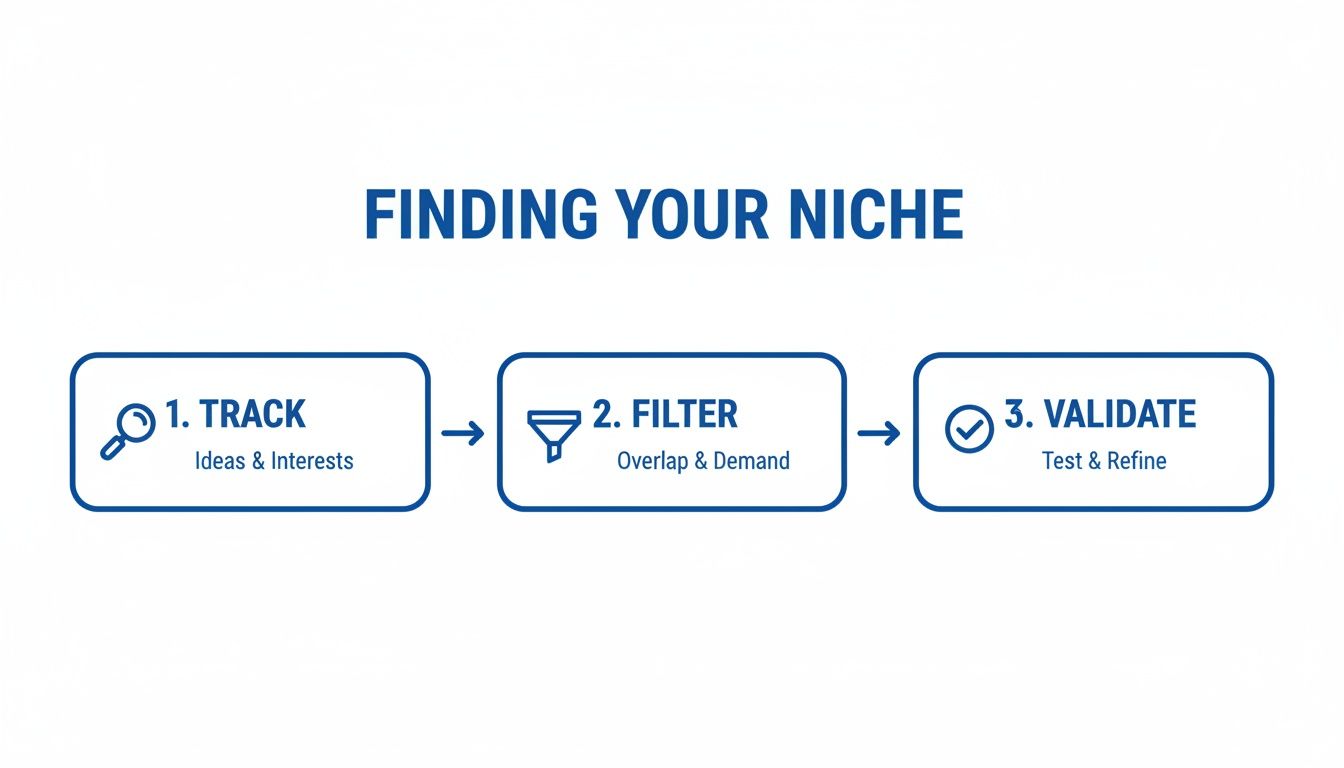
Finding your niche isn’t a single "aha!" moment. It's a structured workflow, moving from broad observation to specific, evidence-backed validation.
Answering these questions turns competitor analysis from a boring exercise into a strategic weapon. You can learn more about the best SaaS competitor analysis tools to help automate this work. This way, you enter the market not as a copycat, but as a challenger with a clear advantage.
Building an MVP That the Market Actually Wants
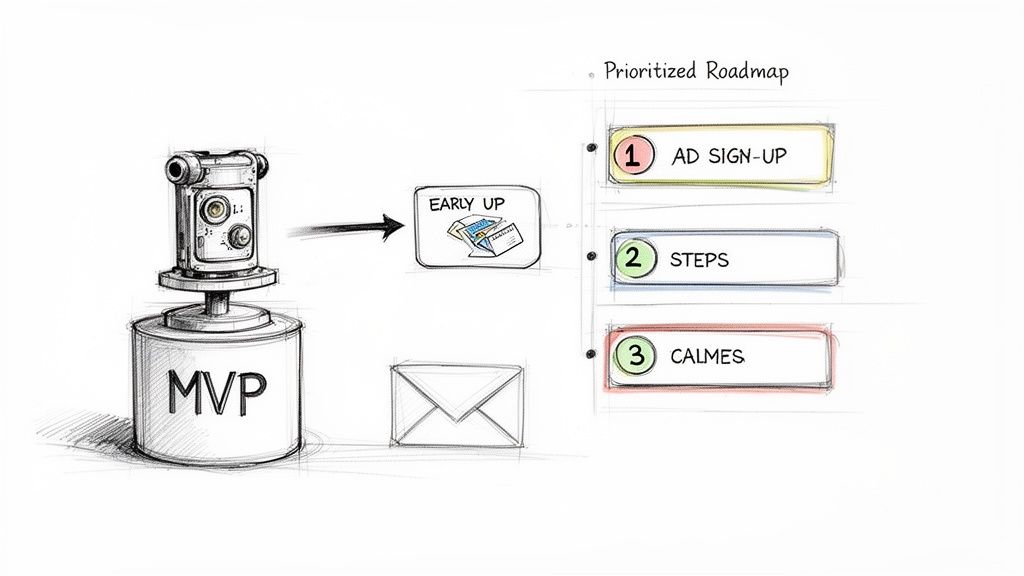
Execution is everything. This is where your research transforms from data into a real company. Your market research isn't just a box-checking exercise; it’s the blueprint for your Minimum Viable Product (MVP).
The goal is to build the right thing, not the biggest thing. An MVP isn't a watered-down version of your grand vision. It's a laser-focused experiment designed to test your single most important assumption with actual users.
Your ad-spend research showed you what problems people already pay to fix. Your job now is to build the smallest possible thing that solves one of those problems incredibly well. This stops you from wasting months building something nobody asked for.
From Research to a Lean MVP
It's time to get practical. Distill all your competitive analysis into a single, testable hypothesis. Don’t get lost in a massive list of features. Focus on the one core value proposition you found in the market gap.
Here's an example hypothesis, continuing with our construction contractor idea:
"Construction contractors will sign up for a mobile-first app that simplifies daily job site reports, because current tools are too clunky to use on the go."
This statement is powerful because it specifies:
- Target Audience: Construction contractors
- Core Problem: Making daily reports easier
- Unique Value: Mobile-first simplicity
- Testable Action: Signing up
Every line of code in your MVP must serve this one hypothesis. If a feature doesn't help prove or disprove it, it goes on the "someday/maybe" list. This ruthless focus keeps you lean and fast.
Designing the Actual Test
With your hypothesis locked in, you can design the experiment. An MVP test isn’t just about the product—it’s about defining what success looks like beforehand. You need clear, measurable signals to know if you've found something real.
These signals must show genuine commitment, not just casual interest. Forget vanity metrics like website visits. Track actions that represent a real investment of time or money.
Strong MVP Success Metrics:
- Pre-orders: Ask people to pay a small amount upfront. This is the ultimate validation.
- Sign-ups with a Credit Card: Offer a free trial that requires a card to filter out tire-kickers.
- High-Fidelity Waitlist: Ask qualifying questions to ensure you're attracting your ideal customer.
Set a concrete goal, like getting "50 pre-orders in 30 days." This gives you a clear pass/fail outcome for your experiment. For a deeper dive, check out this excellent guide on MVP development for startups to help you launch fast and learn faster.
Let Real Data Drive Your Roadmap
Your long-term product roadmap shouldn't come from your gut. It should be built directly on the customer problems you proved exist. Remember the competitor ads you analyzed? The pain points they kept highlighting are your first set of feature priorities.
Simple truth: Your competitor's ad copy is a feature request list that's already been validated with thousands of marketing dollars. If they constantly advertise a feature that solves "messy subcontractor scheduling," that’s a powerful clue for your MVP.
Once you launch, feedback from your first users becomes your new guide. Pay close attention to what they’re doing, where they get stuck, and what they ask for. This feedback loop, combined with your initial research, creates a powerful, data-driven engine for your product.
Connecting Your Niche to Global Trends and Funding
Smart founders know a great idea isn't enough. To attract investors, you must connect your niche solution to the bigger picture. Weaving your specific product into the story of broader market trends and venture capital activity is how you turn a small idea into a massive opportunity.
It’s about showing that you’re not just building a product for today, but a company positioned for future growth. A huge part of that is understanding where the smart money is going. VCs bet where they expect serious growth—a signal you can’t afford to ignore.
Reading the Signals from Global Funding
Venture capital flows tell a story about emerging opportunities. The maturity of a local startup scene often dictates what kinds of ideas get a serious look.
For example, a founder in a hyper-competitive market like the US needs a laser-focused, validated niche to get noticed. But in a growing ecosystem, like parts of Asia Pacific or Latin America, there might be more appetite for broader ideas tackling fundamental market needs.
Valuable Insight: Watching global investment patterns helps you tune your pitch to what investors in your region actually want to see.
To get funded, you need to find investors whose interests align with your niche. For instance, you could seek out top early-stage market research investors who are already looking for bets in your space. This is strategic alignment that can make or break your fundraising.
Aligning with Tech Trends Investors Are Backing
Beyond geography, investors love to back big technological shifts. When billions of dollars flood into a sector like AI, it validates the entire technology and signals a fundamental change.
The data is clear: over one-third of all global venture funding is currently pouring into AI startups. This massive concentration of capital shows a clear preference for anything related to automation and intelligence. This is exactly why tools that analyze competitor ad spend are gaining traction—they offer an intelligent edge.
This trend gives you a powerful narrative. If your niche solution leverages a hot technology like AI, you’re not just solving a small problem anymore. You’re riding a giant wave that investors are desperate to catch. Your market research must prove you’re aligned with the major investment themes of the day.
Common Market Research Mistakes and How to Dodge Them
It's one thing to collect data; it's another to know what to do with it. Many promising startups get derailed by a few common, but critical, blunders. Avoiding these traps is as crucial as gathering good information.
One of the biggest killers is analysis paralysis. This is the trap where founders get so obsessed with collecting data—endless surveys, massive competitor spreadsheets—that they never actually build anything. The research becomes the work, instead of informing the work.
Another classic mistake is misreading early signals. A brilliant one-week ad test is a great sign, but it's not a guarantee of long-term demand. Confusing a short-term win with a sustainable business model is a recipe for a painful reality check.
Staying on the Right Track
How do you keep your research focused and productive? It comes down to discipline and a clear process. The goal is to use research to fuel action, not postpone it.
- Give yourself a hard deadline. Set a timer. A tight deadline forces you to focus only on the questions that truly matter. You're looking for directional evidence, not a PhD thesis.
- Stay laser-focused on the customer's problem. It's easy to get sidetracked by a competitor's flashy feature. Always bring it back to the core question: "Does this help me solve my customer's pain point better?" If not, ignore it.
- Mix quantitative and qualitative data. Use data (like ad spend) to find a promising niche. Then, find five people in that niche and talk to them. This adds the "why" to the "what."
Clear Advice: The best market research isn't just about numbers; it's about the stories behind them. Quantitative data tells you what is happening, but only talking to real people can tell you why.
This simple step adds the color and context that raw numbers will never give you, ensuring you're building something people actually want.
Frequently Asked Questions
When you're starting out, market research can feel like a huge, expensive beast. Let's tackle some common questions founders have.
How Much Should My Startup Budget for Market Research?
Forget the old way of spending tens of thousands on research projects. With modern tools, it's become shockingly affordable.
Instead of hiring pricey consultants, you can use platforms that analyze ad data for a small monthly fee. This gives you the core insights you need, freeing up your cash to build a lean MVP and get it in front of real users.
Is Competitor Ad Spend Really Enough to Validate an Idea?
It’s the strongest signal you can get right out of the gate. If a company is consistently pouring money into ads, it's hard proof they've found a real pain point with a message that converts. It validates both the market and the problem in one go.
This doesn't mean your work is done. It's your cue to take that information, build your own MVP, and talk to potential customers to validate your specific solution. You’re letting competitors spend their money to prove demand exists first.
The real power here is shifting your perspective: You stop asking, "Will people pay for this?" and start asking, "How can I build a better solution for a market that's already proven it will pay?"
What If My Chosen Niche Has No Competitors Advertising?
This is almost always a red flag, not a green light. It’s tempting to think you’ve found an untapped "blue ocean," but the reality is often much harsher: it usually means there's no money to be made there.
Profitable problems always attract competition. A total lack of advertisers is a strong sign that others have already tried and failed to build a sustainable business. It’s far safer and faster to enter a market with proven demand and carve out your own unique angle.
Ready to stop guessing and start building with confidence? Proven SaaS gives you an unfair advantage by revealing the validated, profitable SaaS ideas that competitors are already spending thousands to acquire customers for. Find your next winning idea today.
Build SaaS That's
Already Proven.
14,500+ SaaS with real revenue, ads & tech stacks.
Skip the guesswork. Build what works.
Trusted by 1,800+ founders


