


When most founders hear "market research," they picture endless surveys and stuffy focus groups. That's the old way—a slow, expensive trap that burns through your two most precious assets: time and cash.
This traditional approach is built on asking hypothetical questions like, "So, would you buy this?" People often say yes to be polite, but their real-world actions tell a different story. Their answers in a sterile room rarely match their behavior when their wallet is on the line.
Why Old-School Market Research Is a Startup Trap
Spending months and a small fortune chasing "perfect data" is a great way to end up with a beautiful report and a failed startup. You can't afford to sit on the sidelines while the market moves on. The entire game has changed.
The modern playbook isn't about asking people what they might do. It's about finding hard evidence of what they are already doing. You need to trade speculation for proof. Why waste time guessing if a market exists when you can find out who's already paying to solve the exact problem you're tackling?
From Guesswork to Real-Time Signals
The ultimate validation isn't someone ticking "yes" on a survey. It's a credit card transaction.
When you see competitors shelling out serious cash on ads, month after month, you're looking at a live, blinking demand signal. Companies don't keep burning money on ads that don't work. That ad spend is your proof that a profitable market exists. It's the bedrock of a much smarter, faster validation workflow.
This new process is all about tapping into real-time data to find validated niches in days, not months. You're looking for signals like:
- Sustained Ad Spending: Who is consistently pouring money into advertising? For example, a competitor spending over $10,000 a month on Facebook Ads for the last six months shows they've found a profitable customer acquisition channel.
- Existing Customer Pain Points: What problems are competitors solving right now? Their ad copy and landing pages tell you exactly what hurts enough for people to pay. An ad that says "Tired of messy spreadsheets? Automate your invoicing in 60 seconds" points to a clear pain.
- Market Growth: Which industries are already on a clear upward trajectory?
Take the global SaaS market, for example. It hit a massive $273.55 billion in 2023 and is on track to reach $1,228.87 billion by 2032. The Asia Pacific region alone is projected to grow at a blistering 22% CAGR. Those numbers aren't just stats; they're giant neon signs pointing to where the demand is. You can read the full research on SaaS market growth to dig deeper.
By focusing on what the market is already buying, you de-risk your entire venture. You're no longer hoping for a market to exist—you're entering one with a clear, data-backed signal that it’s ready for a new solution.
Finding Proven Demand with Ad Intelligence
Let's be honest, asking potential customers if they would buy your hypothetical product is a terrible way to do market research. People are nice. They’ll say "yes" to be polite. The most reliable data comes from watching where they actually spend their money.
The clearest signal of a profitable market? A competitor consistently pouring cash into advertising. Companies don't keep burning money on ad campaigns that don't convert. This is where ad intelligence becomes your secret weapon.
Think of it this way: a competitor's sustained ad spend is like a high-stakes, real-time focus group where the only vote that matters is cast with a credit card. When a company is spending over $10,000 per month on ads, they aren't just guessing. They've found a real pain point and a message that profitably solves it. Your job isn't to copy them, but to learn from the trail of cash they've left for you.
Deconstructing Competitor Success
Digging into ad intelligence goes way beyond just looking at pretty ad creatives. It's about reverse-engineering the entire customer acquisition machine that a competitor has validated with their own money.
Here’s a look at how this modern, signal-driven approach stacks up against the old, slow way of doing things.
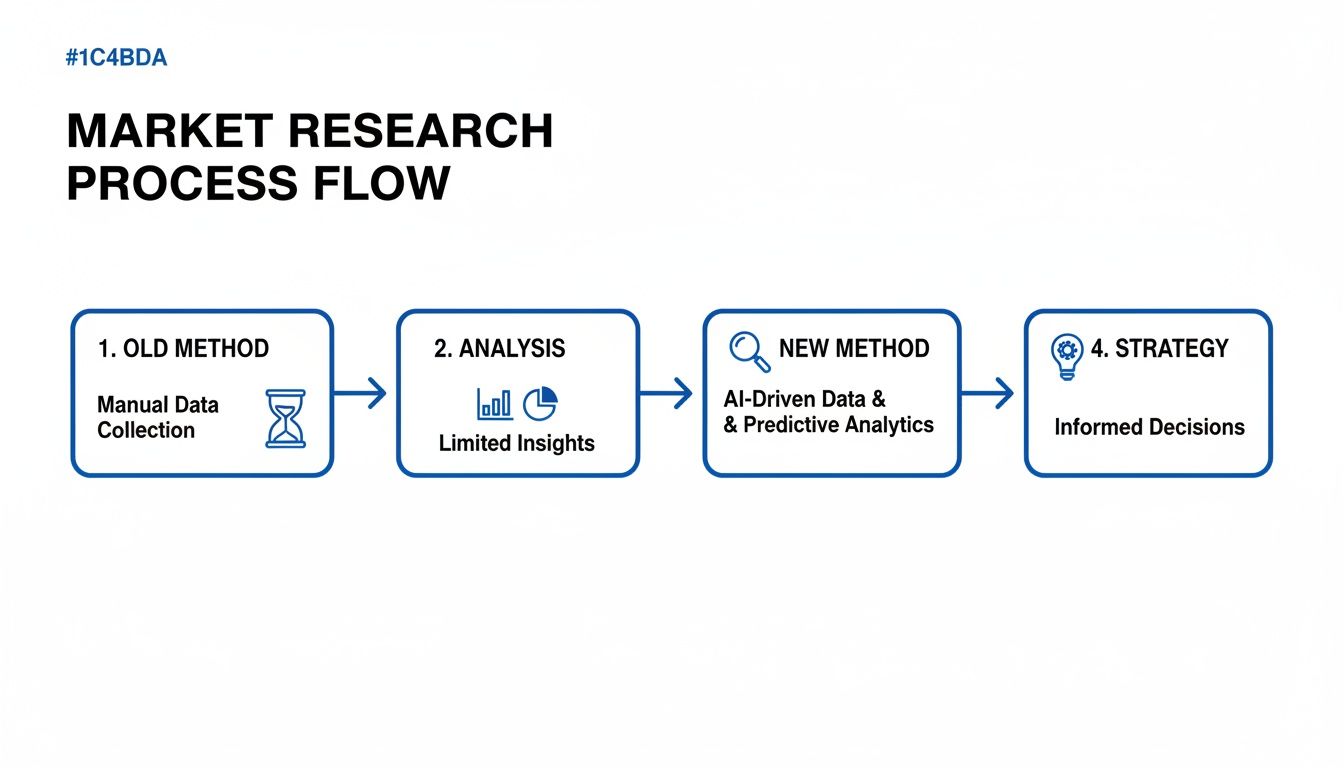
This workflow shows the shift from time-consuming guesswork to a streamlined process that piggybacks on existing market signals for much faster validation. By focusing on what's already working, you build your strategy on a foundation of proven demand from day one.
Turning Ad Spend into Revenue Models
Once you've identified a competitor with a healthy, consistent ad budget, you can start to sketch out their potential revenue. The goal isn't a perfect financial statement; it's about getting a solid, data-backed estimate of the market's value.
For example, you find a competitor spending $15,000/month on ads for their project management tool priced at $20/month. You can drill down into their ad copy to see the exact pain points they're hammering ("Stop missing deadlines"). Click through to their landing pages to see how they capture leads and close sales. This process is incredibly effective and can seriously level the playing field, especially for bootstrapped founders.
Believe it or not, a study on SaaS benchmarks found that bootstrapped companies can hit $1M ARR in just two years—only four months behind their VC-backed counterparts. By using an ad library intelligence tool, you can model competitor revenue and find profitable niches where independent founders are already crushing it.
The core idea is simple: Follow the money. A competitor's ad budget is a public ledger of what problems are worth solving. Use it to find your entry point into a market that's already validated.
This data-driven approach takes so much of the initial "I hope this works" anxiety out of the startup journey.
Demand Signal Validation Checklist
Use this checklist to quickly evaluate the strength of a market based on advertising intelligence signals. It helps you focus on the metrics that truly indicate a validated, profitable niche.
| Signal to Check | What It Means | Where to Look (Example Tools) |
|---|---|---|
| Consistent High Ad Spend | The competitor has a positive ROI and has found a profitable customer acquisition channel. They aren't just testing; they're scaling. | Proven SaaS, Semrush, Ahrefs |
| Long-Running Ad Campaigns | Certain ads have been running for months, meaning the messaging and targeting are highly effective and resonating with the audience. | Ad library tools (look for "first seen" dates) |
| Diverse Ad Creatives & Angles | They are targeting multiple customer segments or pain points, suggesting a broad and deep market. This gives you more angles to enter. | Facebook Ad Library, Proven SaaS |
| High Traffic to Landing Pages | The ads are successfully driving significant, targeted traffic, which is the first step to conversion. | Similarweb, Ahrefs |
By systematically checking these signals, you move from a vague idea to a concrete opportunity backed by real-world spending data. This is how you build a business on a solid foundation, not on a whim.
How to Size Your Market Opportunity
So, you've found a hot niche and you can see competitors are already spending money on ads to get customers. That's a fantastic sign. But hold on a second before you start coding. We need to answer one crucial question: is this market actually big enough to build a real business?
This is where market sizing comes in. Don't worry, it's not some abstract, academic exercise. We’re going to use the competitor data you've already found to get a realistic handle on TAM, SAM, and SOM. Think of this as building a financial case for your idea.
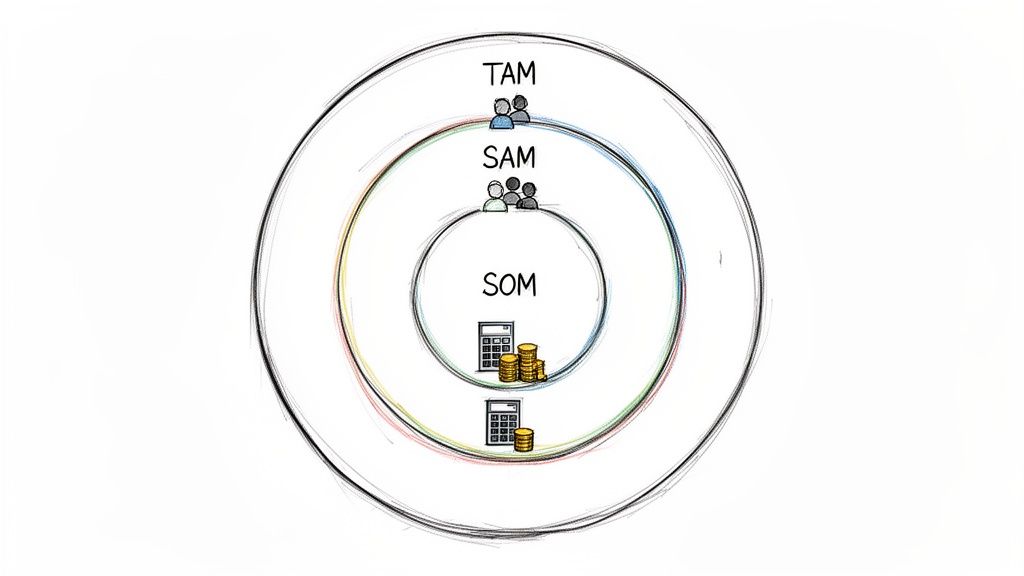
This simple framework is your best friend for turning a vague "this could be big" feeling into a measurable, defensible goal.
What Are TAM, SAM, and SOM, Really?
Think of these terms as a set of nesting dolls. Each one fits inside the other, giving you a clearer picture of your opportunity—from the massive "what if" scenario down to what you can actually achieve right now.
Total Addressable Market (TAM): This is the big one. It's the total revenue opportunity for your entire product category. If every single person or company that could possibly use a solution like yours bought one, this would be the total pot of money.
Serviceable Available Market (SAM): This is the slice of the TAM that you can realistically serve with your specific product. It’s smaller because of constraints like geography, language, or the specific features you’re building for a particular segment.
Serviceable Obtainable Market (SOM): This is your bullseye. It’s the portion of the SAM you can realistically capture in the near future, say, the next couple of years. This number accounts for your competition, your budget, and your go-to-market plan.
Your SOM is your battleground for the next 12-24 months. While investors might love to hear about a massive TAM, as a founder, your job is to obsess over winning a tangible, reachable SOM.
A Real-World Example: Sizing an AI Scheduler
Let's make this practical. Imagine your research points you to a niche: an "AI-powered social media scheduler for solo creators." Here’s how you’d use the TAM-SAM-SOM framework with a bottom-up approach, which is the most realistic way.
First, start with your direct competitors to find your SOM. You've already identified five key players who are spending a ton on ads. Using ad intelligence and traffic estimation tools, you figure out their combined annual revenue is roughly $20 million. Boom. That $20 million is your initial, validated SOM. It's not a guess; it's a real number based on what customers are already spending.
Next, expand outward to find your SAM. You start looking for similar tools that serve a slightly broader audience—maybe they also cater to small marketing agencies or e-commerce store owners. You find another 20 companies in this adjacent space and estimate their combined revenue is around $100 million. This is your SAM, the total market you could grow into.
Finally, you estimate the TAM. For this, you might turn to an industry report from Gartner or Forrester on the overall social media management software market. Let's say the report states it's a $1.5 billion market globally. That's your TAM—the whole pie.
See how that works? Starting with real competitor data makes the whole process tangible. You can now confidently say, "There's an existing $20 million market for this exact problem, and my initial goal is to capture 5% of that—$1 million in revenue—within two years."
Suddenly, your idea isn't just an idea anymore. It has a number attached to it. If you want a hand running these numbers, our SaaS revenue calculator can be a great place to start modeling your projections.
Running Rapid Validation Experiments That Work
All the data in the world points you in a direction, but it's not the same as getting a real "yes" from a potential customer. This is where you have to stop observing and start testing. The idea is to run small, cheap experiments that tell you whether your idea has legs—long before you ever write a line of code.
This isn't about building out your grand vision. It's about building a convincing front door and seeing if anyone knocks. This simple mindset helps you dodge the number one startup killer: building something nobody wants.

The Smoke Test Landing Page
The quickest and most effective validation experiment is the "smoke test." You're basically creating a landing page that sells your product as if it already exists. Find a successful competitor you've been tracking, mirror their value proposition, but add your unique spin to it.
Your page only needs three things to work:
- A sharp, clear headline: "The AI social scheduler that writes posts for you."
- A few benefit-driven bullet points: "Save 10 hours a week," "Never run out of content ideas."
- A single, obvious call-to-action: "Join the private beta" with a simple email signup form.
Once that’s live, you need to get some eyeballs on it. Launch a small ad campaign on a platform like Meta or LinkedIn, targeting a lookalike audience based on the competitor's customer profile. A small budget of $100 to $200 is typically all you need to see a signal. The only metric you care about right now is the email sign-up conversion rate. If you can get anything over 5%, that’s a very strong sign you’re onto something.
An experiment like this isn't about making money; it's about buying data. Every single email sign-up is a vote of confidence. It’s someone telling you the problem you're targeting is real enough for them to take action.
Uncovering Pain Points with Customer Discovery
Your smoke test gives you the numbers, but you need the stories behind those numbers to truly understand the customer's pain. This is where customer discovery calls are invaluable. Reach out to the people who actually signed up on your landing page—these are your warmest leads.
Your only goal on these calls is not to pitch your solution. It’s to listen. Your job is to shut up and let them talk, to understand their problem in excruciating detail.
Here’s a simple script framework I've used to guide the conversation:
- Set the Context: "Hey, thanks for signing up! I saw you were interested in [your value prop]. Could you tell me a bit about how you're currently handling [the problem area]?"
- Dig into the Problem: "What's the hardest part about that for you? Have you tried to solve this before?"
- Find the Consequence: "When that issue pops up, what's the actual impact? Does it cost you time, money, or just a lot of frustration?"
- The "Magic Wand" Question: "If you could wave a magic wand and have the perfect solution, what would that look like for you?"
Think about this: by 2026, over 80% of companies will be deploying AI-enabled apps, a massive leap from just 5% in 2023. That trend is shrinking the window of opportunity for everyone, making this kind of fast, direct validation more critical than ever.
To learn more, check out this excellent founder's guide on SaaS product validation. And if you want to apply these ideas in a more structured way, our free Niche Validator tool can walk you through the process.
Making a Confident Go or No-Go Decision
You've done the work. The numbers are in from your landing page test, and you’ve heard the stories straight from potential customers. Now comes the moment of truth where all that research comes together to answer one question: do you build this thing or not?
This isn't just about a gut feeling. It's about looking at the signals you've gathered and making an informed, confident call.
Before you even launched that landing page, you should have set clear success metrics. For example, a common benchmark for an email sign-up conversion rate is 5% or higher. If you’re falling short, it might mean the interest just isn't there. But if you hit 10% or more? That’s a powerful sign you've tapped into a real need.
The same goes for your customer interviews. You weren't just fishing for compliments. You were listening for patterns—for that moment when multiple people, unprompted, describe the exact same frustrating or expensive problem. That's validation gold.
The Decision Matrix Framework
To keep emotion out of it and make a clear-headed choice, use a simple decision matrix. It forces you to look at the idea objectively by scoring key factors.
Rate each of these on a scale of 1 to 5, where 1 is weak and 5 is a home run.
Validation Signal Strength (1-5): How strong was the evidence? Did your landing page crush its conversion goal? Did people in interviews practically beg you to solve their problem? You absolutely need a 4 or 5 here. No exceptions.
Market Size (SOM) (1-5): Realistically, is the market you can capture right away big enough to be worth it? A $20M SOM from our earlier example would be a 4 or 5. A $500k market might be a 1.
Competitive Landscape (1-5): Are there competitors? Good. If they're spending money on ads, that proves there's a market. The trick is finding the gaps they’ve left open for you. An empty market is usually a bad sign.
Founder-Market Fit (1-5): How much do you care about this space? Do you have unique knowledge or a personal connection to the problem? Your passion is what will get you through the inevitable tough times.
Add up your scores. A total over 15 is a strong "Go." If you're looking at a score below 10, it's a clear "No-Go." Anything in the middle means you need to dig into your weakest category and figure out if it's fixable.
A "No-Go" decision isn't a failure. It's the whole point of this exercise. It means you just saved yourself months, maybe years, building something nobody was going to buy. It frees you up to find the right idea.
Making a sound go or no-go decision starts with knowing how to Validate Product Ideas Fast and trusting the data you collect. This framework isn't magic, but it gives you a repeatable process to move forward with conviction or pivot with wisdom.
Your Continuous Market Research Flywheel
Let’s be honest, market research for a startup can feel like a one-and-done chore. You check a few boxes, then dive into building. But the founders who actually succeed treat it completely differently—it’s not a checklist, it's a continuous cycle.
Think of it as a flywheel. Every bit of research you do adds momentum, spinning you closer to a product that’s perfectly tuned to what people will actually pay for. It’s a simple, repeatable loop that takes you from a vague idea to a confident decision.
The Three Stages of Your Flywheel
This whole process boils down to three core actions that feed into each other. Each rotation of the flywheel makes you smarter, faster, and less likely to waste your time and money.
Discover
This is your starting line. Forget brainstorming in a vacuum. Instead, you're on the hunt for real, proven demand signals using ad intelligence tools and digging into what competitors are spending their money on. You're not guessing what problems exist. You're finding the exact pain points that businesses are already paying thousands to solve. This gives you a data-backed foundation to build on.
Validate
Once you've spotted a promising opportunity, it's time to validate it. This is where you get scrappy. You run small, cheap experiments—things like smoke-test landing pages or quick-and-dirty ad campaigns. At the same time, you get on the phone for targeted customer discovery calls. This mix of qualitative feedback and hard data will quickly tell you if your hypothesis is solid or if you need to pivot before sinking serious resources into a dead end.
Decide
Finally, you take everything you've learned—the market data from the Discover stage and the customer insights from the Validate stage—and make a call. Is it a go or a no-go? This isn’t about trusting your gut. It’s about using a clear framework to weigh the evidence. You either commit to the idea with confidence or kill it fast and move on to the next one.
The real magic here is that this flywheel never stops spinning. Every decision you make, every experiment you run, and every new competitor you find just feeds back into the loop. It creates a constant stream of insights that systematically de-risks your entire journey. Stop guessing and start validating—build what the market is already begging for.
Common Questions and Sticking Points
As you start putting this process into action, a few questions always seem to pop up. Here are some of the most common ones I hear from founders, with clear, direct answers.
How Much Money Do I Really Need for a Test Ad Campaign?
This is probably the #1 question, and the answer is usually less than you think. You don't need to break the bank here. A budget of around $100 to $300 is a perfect starting point.
Remember, the goal isn't to build a profitable ad funnel right out of the gate. The goal is to learn. You're just buying data. That small budget should be enough to get a few hundred targeted clicks to your landing page, which is plenty to see if your core message is hitting the mark. It will give you a real signal on metrics like sign-up rates and tell you if you're onto something.
I Found a Niche With High Ad Spend, but It Feels Way Too Crowded. Now What?
Seeing a ton of consistent ad spend is a fantastic sign. It's direct proof of strong, monetizable demand. Don't let the "saturation" scare you off—think of it as a huge, flashing green light.
Instead of backing away, lean in and get specific. The big players have validated the market for you; now you have to find your unique entry point.
- Dissect their messaging: What specific pain points are they hitting on repeat? What language do they use?
- Become a review detective: Go read the 1-star and 3-star reviews for their products. What are people constantly complaining about? What features do they wish existed? That's your roadmap.
- Find a niche within the niche: Can you carve out a space for a specific audience? For example, instead of another generic project management tool, what about one built from the ground up just for freelance designers?
High ad spend confirms people will pay to solve a problem. Your job is to solve it better for a specific group of people.
Isn't Staring at Competitor Ads Just Ripping Off Their Ideas?
Let's be clear: this is about validation, not imitation. We're not looking to build a clone of someone else's product.
Think of it this way: competitor ads are the signal that a customer problem is so painful, people are willing to spend money to fix it. Your job is to obsess over that underlying problem, not the competitor's specific solution.
You’re using their ad spend as a shortcut to confirm that a market exists. Your unique take on the solution, your brand, and your go-to-market strategy are what will set you apart. This process just makes sure you’re building on solid ground with proven demand.
Stop guessing and start validating. Proven SaaS gives you the ad intelligence to find profitable SaaS ideas with clear, data-backed demand. Discover your next startup idea today.
Build SaaS That's
Already Proven.
14,500+ SaaS with real revenue, ads & tech stacks.
Skip the guesswork. Build what works.
Trusted by 1,800+ founders


