

Starting a SaaS business isn't about chasing a revolutionary idea. It's about finding a painful problem people are already paying to fix, building a sharp solution, and then finding your customers one by one. The foundational rule is simple: confirm market demand first, before you even think about writing a line of code. This approach takes the guesswork out of the equation and sets you up for success from the start.
Your Data-Driven Path to Building a SaaS Business
Building a SaaS company can feel like a gamble. Too many founders sink months—or even years—into a passion project, only to launch to the sound of crickets. This guide lays out a smarter path, one built on real-world data, not just a gut feeling.
The old-school way was to chase a "cool idea," build a product loaded with features, and then hope for the best after a big, splashy launch. We're going to flip that model on its head. The modern way starts by finding markets where customers are already spending money, validating that demand with your own research, and then building the most focused, leanest solution possible.
This journey breaks down into four straightforward stages, moving you from concept to a successful launch.
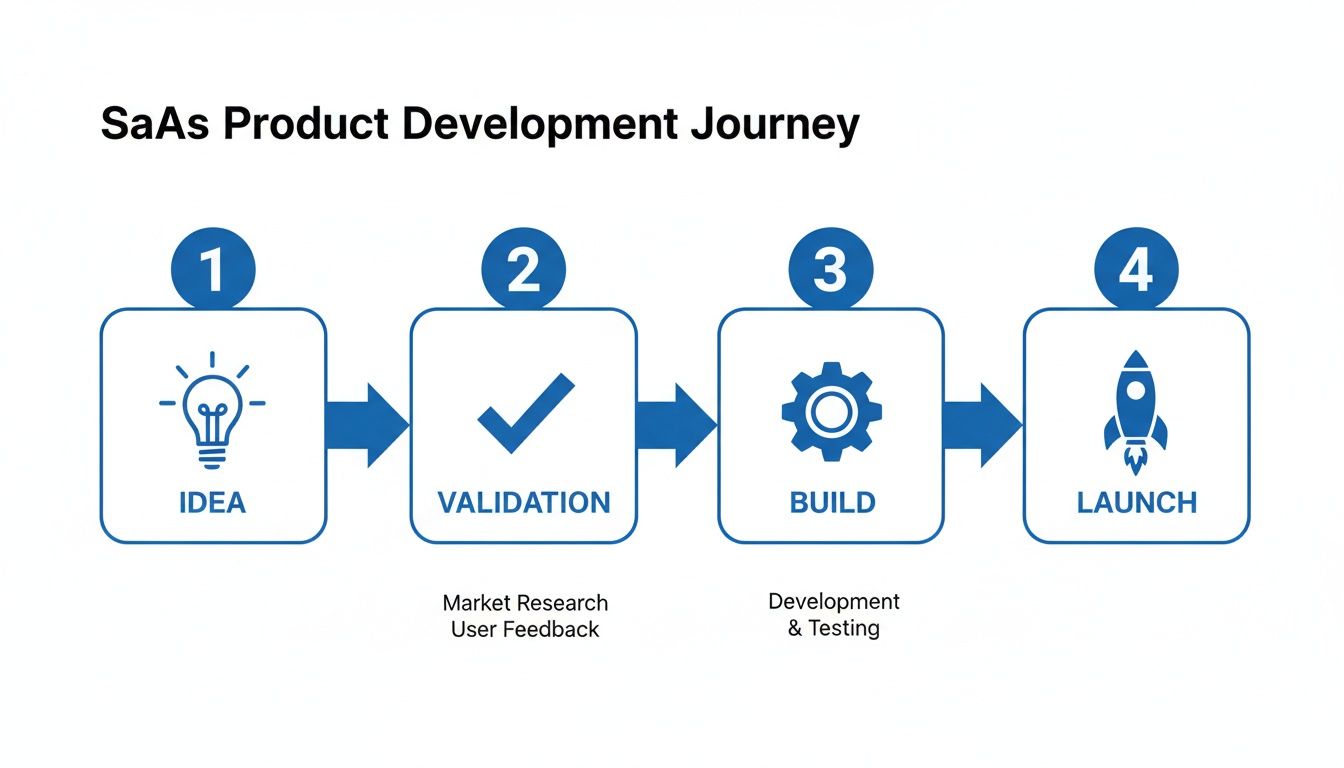
By putting validation before building, you’re tackling the single biggest risk factor that sinks new ventures before they even get off the ground.
Why Market Demand Is Non-Negotiable
Here’s a hard truth: the number one reason startups fail isn't a buggy product or a clumsy marketing plan. It's building something nobody actually needs. In fact, some studies show that 42% of AI businesses fail for this exact reason—a lack of genuine market demand.
This is precisely why a data-first mindset is your greatest asset. Instead of guessing, you're hunting for cold, hard proof that a market exists and that people are willing to open their wallets. It all begins with solid market research. To dive deeper into this, check out our guide on SaaS market research that actually works.
The most powerful way to de-risk your SaaS idea is to find evidence that people are already spending money to solve the problem you've identified. If competitors are successfully spending thousands on ads, they've already proven the market for you.
To see this shift in action, let's compare the two mindsets.
The Modern SaaS Startup Blueprint
This simple visual contrasts the old, high-risk way of building a SaaS with the modern, data-driven approach that minimizes risk and maximizes your chance of success.
| Phase | Traditional Approach (High Risk) | Data-Driven Approach (Low Risk) |
|---|---|---|
| Idea | "I have a great idea for a product!" | "I see a problem people are paying to solve." |
| Validation | Build it and see if they come. | Find evidence of paying customers first. |
| Build | Develop a feature-rich "perfect" product. | Build a focused Minimum Viable Product (MVP). |
| Launch | Big, expensive marketing launch. | Quietly launch to a small, targeted audience. |
Adopting the data-driven column is the key difference between hoping for a hit and engineering one.
Find a Problem People Already Pay to Solve
The biggest mistake founders make is trying to invent a problem. They dream up a cool idea in a vacuum, build it, and then wonder why nobody's buying. The best SaaS businesses don't start that way. They start by finding a painful, expensive problem that people are already trying to solve.
Your first job isn't to be a visionary; it's to be a detective. Find where the money is already flowing.
Forget brainstorming what people might want. Look for hard evidence of existing demand. And the loudest, clearest signal you can find? A competitor spending serious cash on ads to get customers. If a company can afford to drop thousands of dollars month after month on Google or Facebook ads, they've already proven two massive things for you: a market exists, and customers in that market are willing to pay.
This simple shift in perspective turns a wild startup gamble into a calculated business move.

Use Ad Spend as Your Compass
Think of a competitor's ad budget as a market validation engine running on their dime, not yours. When you see a SaaS company consistently advertising, you're looking at a proven business model in real-time. They’ve figured out a product that works, a price point customers accept, and a way to acquire them profitably.
This is your unfair advantage.
Instead of starting from zero, you can piggyback on their research. Tools built to track ad intelligence, like Proven SaaS, are perfect for this. They help you cut through the noise and see exactly which companies are spending big, month after month.
Here's what that data actually looks like. It's not just about spend; it's about connecting that spend to real business health.
This screenshot shows a direct line between significant ad spend and healthy revenue estimates. That's your green light. It validates the market's potential and gives you a clear signal to start digging deeper into the specific problem they're solving.
How to Evaluate a Niche
Okay, so you've found a niche where competitors are spending money. Great. But not all validated ideas are created equal. You need a framework to decide if it's the right fit for you. You're looking for markets that are not just profitable but also have a door open for a new player.
Here's a quick checklist I use to size up a potential SaaS idea:
- Sustained Ad Spend: Is the company spending consistently? A one-off campaign means nothing. But a competitor spending $10,000+ per month for several months is a powerful sign of product-market fit. It tells you they have a profitable customer acquisition funnel.
- A Specific, Painful Problem: Can you state the one core problem the software solves in a single sentence? If the product is a vague, all-in-one "platform," it's going to be tough to compete. Look for tools that do one thing exceptionally well for a very specific type of customer.
- Room for Improvement: Are there obvious gaps you can fill? Maybe their user interface is a clunky nightmare from 2010. Perhaps they're missing a killer feature everyone in their reviews is begging for. Or maybe their pricing is just way too high. These are your entry points.
This whole process of finding and vetting ideas is called market validation. It's the most critical step. To go deeper on this, check out our guide on what market validation is and how to ensure a successful launch.
Don't fall in love with your own ideas. Fall in love with your customer's problems—specifically, the ones they're already paying to get rid of.
This strategy works so well because of how the SaaS world operates. The global market is projected to hit roughly $300 billion in annual spend by 2025. And get this: in 2024, the average company was already using 106 different SaaS apps.
This tells us two things. First, businesses are completely comfortable paying for software. Second, they're juggling dozens of subscriptions, which means a tool that solves a specific pain point better than the rest can easily win a spot. If you want to dive into more numbers, you can discover more insights about SaaS statistics.
Ultimately, following the money removes the biggest risk of starting a SaaS company. By fishing where the fish are already biting, you guarantee you're building something for a problem the market has already confirmed is worth solving.
Building a Minimum Viable Product That Works
You've validated your idea. Now comes the fun part: actually building something. But hold on. This isn't the time to build your grand, all-encompassing dream product. We’re starting with a Minimum Viable Product (MVP)—the absolute leanest version of your software that solves one core problem for one specific user.
Don't mistake an MVP for a buggy first draft. It's a sharp, focused tool designed to deliver value right away and, more importantly, to start a conversation with real customers. Think of it as a perfectly crafted scalpel, not a clunky Swiss Army knife. Its entire purpose is to prove your core assumption: that people will actually use and pay for what you've built.
Speed is your biggest ally here. Getting a working product into users' hands quickly is infinitely more valuable than spending six months perfecting it in a vacuum. This is where your validated idea stops being a concept and starts becoming a real asset.
Defining Your Core Feature Set
Building an MVP is an exercise in saying "no." You have to be ruthless. For every feature idea, ask yourself one question: "If I remove this, does the product still solve the user's main problem?" If the answer is yes, it gets cut. For now.
Your MVP should do one thing flawlessly. Everything else is just noise at this stage.
A great way to stay on track is to use user stories. Frame every potential feature from the customer's point of view to see if it holds up. For instance, instead of a vague task like "build export function," you'd write, "As a marketing manager, I need to export my report to a CSV so I can easily share it with my team." This simple shift forces you to justify every bit of development work with a genuine user need.
An MVP isn't about the minimum number of features. It's about the maximum amount of validated learning you can get with the least amount of effort. You're hunting for feedback, not applause.
Just look at a classic example like Buffer. When it first launched, it wasn't a complex social media suite. It was a simple two-page site that did one thing: let you schedule tweets. That's it. It solved a single, specific problem, proved people wanted it, and only then did they start adding more.
Choosing a Smart Tech Stack
Especially for solo founders or small teams, your tech stack needs to be all about speed and simplicity, not scaling to a million users on day one. You're not there yet. You're building to learn.
You generally have two smart paths to choose from:
- No-Code/Low-Code Platforms: Tools like Bubble or Webflow are no longer just for simple websites. They are incredibly powerful, allowing you to build a fully functional SaaS MVP without writing a line of code. For non-technical founders, this is the absolute fastest way to get to market.
- Lean Code Frameworks: If you’re a developer, stick with what you know and what lets you move fast. Frameworks like Ruby on Rails, Django, or a modern JavaScript setup like Next.js with a simple backend are perfect. The goal is rapid development, not building a technical masterpiece.
Keep your research and development (R&D) spending lean. Industry data shows the median private SaaS company spends about 22% of revenue on R&D. When you're pre-revenue, every single dollar you spend on development has to be laser-focused on one thing: getting you to your first paying customer.
From Wireframe to Simple UI
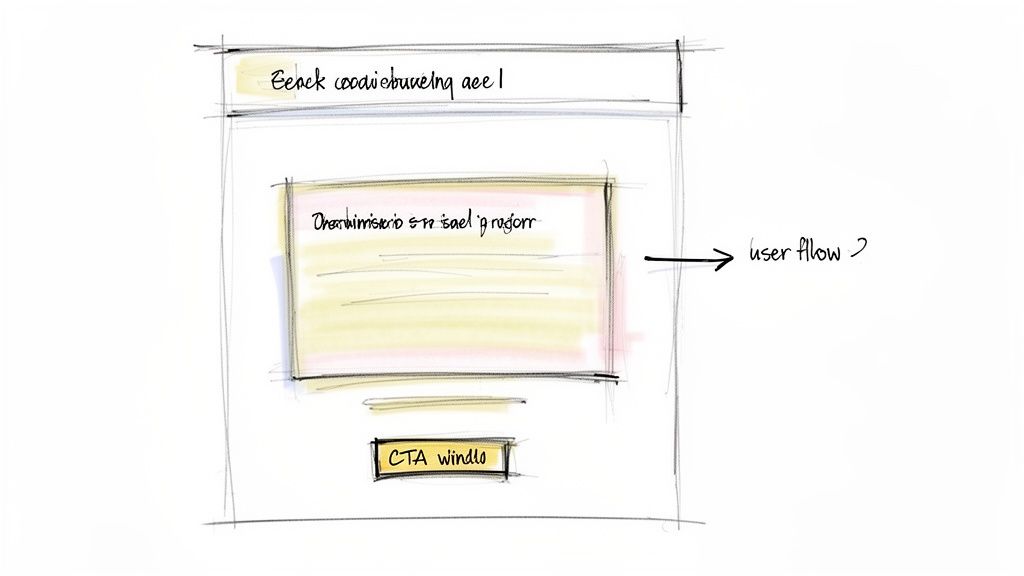
You don't need a professional designer to create a usable interface. At this early stage, clarity trumps creativity every time. Start with simple wireframes—literally just basic sketches of each screen—to map out how a user will move through your app.
Put yourself in their shoes and walk through the entire journey.
- Sign-Up: How do they create an account? Keep it dead simple. Email and password. That’s all.
- Onboarding: What's the very first thing they see after logging in? Guide them straight to the core feature. No detours.
- The "Aha!" Moment: How quickly can they experience the value your product delivers? Make this path as short and intuitive as humanly possible.
You can use a tool like Figma or just a good old-fashioned pen and paper to sketch these flows out. A logical user journey is far more critical than a pretty color palette right now. Once the flow feels right, use a simple UI component library like Tailwind UI or Bootstrap to build a clean interface without reinventing the wheel.
Remember, your MVP is the start of the conversation, not the final word. Build it, ship it, and then get ready to listen.
Pricing Your SaaS for Profit and Growth
You've built your MVP. Now comes the million-dollar question: how much are you going to charge for it?
Pricing isn't just about slapping a number on a webpage. It's one of the most powerful tools you have for growth. Get it right, and you've got a sustainable business on your hands. Get it wrong, and even a fantastic product can stall out before it ever gets a chance.
So many founders fall into two traps: they either lowball their price out of fear, or they just copy a competitor's pricing page and hope for the best. A much smarter way to think about it is to ground your price in the actual value you deliver. Your price should be a direct reflection of the painful, expensive problem you're solving.
Choosing Your Pricing Model
Before you can pick a price point, you need a pricing model—the fundamental way you charge for your service. This decision is huge because it dictates how your revenue will scale as your customers find more success with your product.
Most SaaS companies use some variation of these three core models:
- Tiered Pricing: The classic "Good, Better, Best" approach. You create packages like Basic, Pro, and Enterprise, each with more features and higher limits. It’s popular for a reason—it appeals to different types of customers and gives them a clear path to upgrade as they grow.
- Per-User Pricing: Simple, predictable, and easy for customers to understand. You charge a flat fee for every person on a team using the software. Think of tools like Slack or Asana—their value grows as more people on a team use them, and so does the price.
- Usage-Based Pricing: With this model, customers pay for what they use. This could be per API call (like a payment gateway), per gigabyte of storage, or per contact in an email list. This model is powerful because it perfectly aligns your price with the value a customer is getting.
There's no single right answer here. A project management tool is a perfect fit for per-user pricing, but a video hosting platform almost certainly needs a usage-based model. Look at your MVP and ask yourself: how will my customers get the most value out of this? Let that guide your choice.
Setting Your Initial Price Points
Okay, you have a model. Now it's time to talk numbers. While it's smart to see what competitors are charging, don't let that dictate your price. Your north star should be value-based pricing.
This means anchoring your price to the tangible, monetary value your product delivers.
For example, if your software helps an e-commerce store recover $1,000 a month in abandoned carts, then charging $99 a month feels like a complete no-brainer for them. You aren't selling a piece of software; you're selling a return on investment.
Your first attempt at pricing won't be perfect. And that's fine. The goal is to land on a reasonable starting point you can test and tweak with real customer feedback. Don't let the fear of getting it wrong paralyze you.
The final piece of the puzzle is actually collecting the money. A service like Stripe is the gold standard for SaaS. It makes it incredibly simple to set up subscriptions, manage different pricing tiers, and handle payments securely. Integrating it is usually one of the last steps before you're ready to open the doors. To get a handle on your numbers, our guide on how to estimate SaaS revenue can help you build a clearer financial picture.
The Long-Term View on Pricing
Your pricing strategy is the foundation of a healthy, growing company. For bootstrapped SaaS businesses, the median annual growth rate is around 20%, and the median net revenue retention (NRR) is about 104%.
That 104% figure is crucial. It means the average customer account grows by 4% every year, all on its own. That's the magic of expansion revenue, and it’s driven entirely by a smart pricing strategy. If you want to dive deeper, you can learn more about these key SaaS benchmarks from industry reports.
Remember, pricing isn't a "set it and forget it" task. As your product evolves and you learn more about your customers, you should be revisiting your pricing regularly. Think of it as an ongoing conversation—one that ensures you're always delivering incredible value at a fair price.
Getting Your First 10 Customers
Alright, your MVP is live and you've figured out your pricing. Now for the hard part—and the most important part: landing your first paying customers. Forget about scalable marketing campaigns for now. Getting your first ten users on board is all about doing things that don't scale. Think of it as a hands-on, roll-up-your-sleeves mission to prove people will actually pay for what you've built.
This is a personal game. You're not just selling a piece of software; you're starting conversations and building real relationships. These first brave souls are more than just subscription fees—they are your most crucial source of feedback, and their insights are pure gold.
When you're a founder running on a shoestring budget, you have to get creative with tactics that rely on effort, not cash.
Go Where Your Customers Already Hang Out
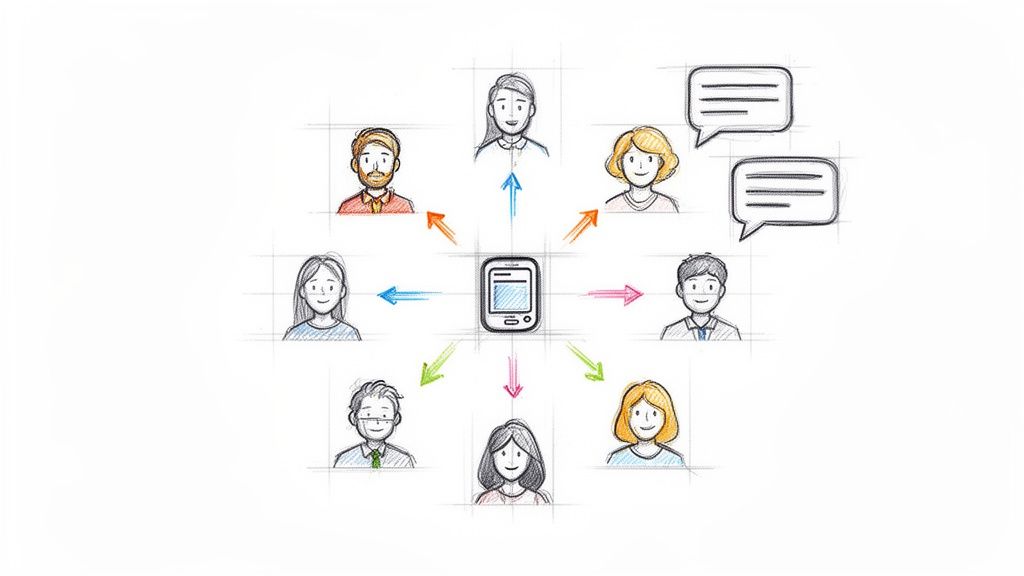
The quickest way to find your people is to meet them on their own turf. Don't waste energy trying to pull them over to a brand-new website. Instead, become a familiar face in the online communities where they already spend their time.
Your mission here isn't to spam links. It’s to listen, be genuinely helpful, and add real value to the conversation.
Here are the best places to embed yourself:
- Niche Subreddits: Find the subreddits where your ideal customers live. If you built a tool for podcast editors, for example, you need to be an active member of
r/podcasting. - Slack and Discord Communities: Professionals in almost every niche have private communities. These are absolute gold mines for direct conversations with people who are openly discussing their pain points.
- LinkedIn Groups: Join groups that align with your customer's job title or industry. Jump into discussions and establish yourself as someone who knows their stuff.
- Indie Hackers: If you're building for other founders or developers, the Indie Hackers community is non-negotiable. Share what you're building, ask for feedback, and be part of the scene.
Your first ten customers won't come from a clever ad. They'll come from a direct message, a helpful comment, or a one-on-one demo where you solve their problem right in front of them. It's about personal connection, not mass marketing.
This takes patience. You're building social capital before you ever ask for the sale. When you finally do bring up your product, it’ll feel like a natural suggestion to a problem someone just mentioned, not a cold pitch.
Steal Your Competitors' Playbook
Remember all that market validation work you did? Digging into your competitors’ ad spend is about to pay off—again. Why guess which marketing channels work when they’ve already spent thousands of dollars figuring it out for you?
This intelligence is basically a proven roadmap for your own small-scale marketing experiments.
For instance, if you saw that a major competitor gets a ton of traffic from Google Ads targeting a few specific keywords, that’s your signal. You don’t need their massive budget. Just start a tiny, hyper-focused campaign around those same terms. It’s a data-backed starting point instead of just a shot in the dark.
Nail Your Personal Outreach
While being active in communities builds your reputation, direct outreach is often what seals the deal for those first few customers. This isn't about blasting out a thousand generic cold emails. This is all about highly personalized, one-to-one communication.
Here’s a simple process that works:
- Spot a Problem: Find someone in a community or on LinkedIn who just posted about a struggle your SaaS solves.
- Do Your Homework: Take five minutes. What's their role? What have they been talking about? Find a real connection point.
- Craft a Human Message: Keep it short and make it about them. Reference their specific problem and gently offer your product as a potential solution.
- Offer a Personal Demo: The goal is a quick, 15-minute call. This is your chance to show them exactly how your tool works for their specific issue and, just as importantly, to listen to what they have to say.
Get Simple Analytics Running From Day One
Even with just a handful of users, you need to know what's working. Setting up basic analytics isn't optional, and it doesn't need to be some complicated beast.
- Website Analytics: A simple tool like Plausible or Google Analytics can show you where visitors are coming from. Are people clicking from your Reddit comments? Your LinkedIn profile? This tells you where to spend more of your time.
- In-App Usage: Basic event tracking helps you see if people are actually using your core feature. Are they getting to that "aha!" moment you designed the whole product around?
This early data, combined with all the direct conversations you're having, creates an incredibly powerful feedback loop. You'll refine not just your product but your messaging, too, ensuring you're solving the problems your customers truly care about. The lessons from these first ten customers will be the bedrock for landing the next hundred.
Tracking the SaaS Metrics That Actually Matter
Running a SaaS business without tracking metrics is like flying a plane blindfolded. You might be moving, but you have no clue if you're heading for the clouds or straight into a mountain. The numbers tell the real story of your business's health, and you need to get fluent in their language. Fast.
Don't get bogged down with a hundred different data points. Early on, you only need to obsess over a handful of core metrics that directly measure whether you have a viable business. These are the numbers that should guide every decision, from your next feature build to where you spend your marketing dollars.
Your Core SaaS Dashboard
Think of these four metrics as the vital signs of your startup. They work together to give you a clear, no-fluff picture of how you're actually doing.
- Monthly Recurring Revenue (MRR): This is your lifeblood. It’s the predictable revenue you bring in from all your active subscriptions each month. It's the cleanest signal of your growth trajectory.
- Churn Rate: This is the percentage of customers who cancel their subscriptions every month. Churn is a leaky bucket—it doesn't matter how many new customers you pour in the top if your existing ones are constantly slipping out the bottom.
- Customer Acquisition Cost (CAC): This is simply how much it costs you in sales and marketing to land one new paying customer. You absolutely have to know your CAC to build a profitable machine.
- Customer Lifetime Value (LTV): This is the total revenue you can reasonably expect from a single customer over their entire time with you. A high LTV means you've built something sticky that people value.
These aren't just numbers on a screen; they're deeply interconnected. Understanding how they influence each other is what separates the founders who make it from those who don't.
The Most Important Ratio in SaaS
If you only have the mental bandwidth to track one relationship, make it this one: the LTV to CAC ratio. This simple formula tells you how much long-term value you're creating compared to what you spend to get it.
For a SaaS business to be healthy, you're aiming for an LTV to CAC ratio of at least 3:1. For every dollar you spend to get a customer, you need to make at least three dollars back over their lifetime.
Let’s say your LTV is $900 and your CAC is $300. Your ratio is 3:1. Great! You have a sustainable business model. But if your LTV is $300 and your CAC is also $300, your ratio is 1:1. You're basically lighting money on fire with every new sign-up, because that doesn't even account for your other operational costs.
This ratio is your ultimate gut check. It forces you to ask tough questions. Is our pricing wrong? Is our marketing spend efficient? Is the product good enough to keep people paying? A bad ratio is the clearest warning sign you'll get that something fundamental needs to change.
Setting Up Your Operational Foundation
Beyond the numbers, you need to get your basic legal and operational house in order. Don't let this part scare you off—you can start simple and add complexity as you grow.
- Legal Structure: For most founders starting out in the US, a Limited Liability Company (LLC) is a great, straightforward choice. It protects your personal assets if things go south with the business.
- Terms of Service & Privacy Policy: You don't need a high-priced lawyer to get your first draft done. Use a trusted template generator like Termly to create your initial documents. You can always invest in custom legal work later on.
- Essential Tools: Keep your initial toolkit lean. You don't need a dozen subscriptions.
- Analytics: A privacy-first tool like Plausible gives you the user behavior insights you need without the complexity of Google Analytics.
- Customer Support: A simple shared inbox works fine at first. When you're ready for a dedicated tool, something like Crisp is perfect for managing those early customer conversations without breaking the bank.
Common Questions About Starting a SaaS Business
Even with a great roadmap, you're bound to have questions. Let's tackle some of the most common ones I hear from founders who are just getting started.
What's the Real Cost to Start a SaaS Business?
This is the classic "it depends" question, but here are some real-world goalposts.
If you're a solo founder getting scrappy with no-code tools, you can absolutely launch a functional MVP for under $1,000. That covers your basic software subscriptions, hosting, and maybe a simple legal setup. Your biggest investment here is your own time.
Now, if your idea is more complex and you need to bring in a freelance developer, the budget expands significantly. You're probably looking at a range between $10,000 and $50,000. The trick is to keep that first version laser-focused on solving one core problem. This keeps your costs down until you have undeniable proof that people will pay for what you're building.
Do I Absolutely Need a Technical Co-Founder?
Honestly, not anymore. While a fantastic technical partner can be a massive asset, it's no longer the barrier it once was.
Modern no-code platforms like Bubble are incredibly powerful, allowing non-technical founders to build and scale real applications. Alternatively, you can hire talented freelancers to handle the initial build.
What's truly non-negotiable isn't your coding ability—it's your deep, obsessive understanding of the customer's problem. If you're not the technical one, it just means you have to be even more rigorous about validating your idea and getting customer buy-in before you write a single check to a developer.
How Long Until I Get My First 10 Customers?
After you launch your MVP, a realistic timeframe to land your first 10 paying customers is anywhere from one to three months.
How fast you get there depends entirely on two things: how well you validated the problem beforehand and how effectively you execute your initial outreach. If you’ve truly hit on a painful, urgent problem, you'll find that early adopters are often surprisingly eager to give your solution a shot.
Getting those first ten is almost never about scalable marketing. It's a game of grit and manual effort. Think about doing things that feel completely unscalable, like:
- Direct Outreach: Sending highly personalized messages to people you've hand-picked as your ideal customer.
- Personal Demos: Hopping on calls and walking users through your product one-on-one, showing them exactly how it solves their problem.
- Community Engagement: Showing up consistently and being incredibly helpful in the niche online forums and groups where your target customers live.
This initial grind is where the magic happens. It's how you'll collect the priceless feedback that shapes your product and lights the path to your next hundred customers.
Ready to find a validated SaaS idea without all the guesswork? Proven SaaS uses ad intelligence to uncover profitable niches where competitors are already spending thousands to acquire customers. Start building a business with proven demand from day one. Find your next profitable SaaS idea today.
Build SaaS That's
Already Proven.
14,500+ SaaS with real revenue, ads & tech stacks.
Skip the guesswork. Build what works.
Trusted by 1,800+ founders


