

How to Follow Up on an Email When You Get No Response
Sending an email into the void is frustrating. You know your message has value, but all you hear back is silence. Figuring out how to follow up on an email with no response seems simple: be polite, remind them of the context, and ask again. But an effective follow-up starts long before you hit "send."
It begins with a quick look at your original email to understand why it might have been ignored.
Why Your First Email Was Ignored
It’s easy to assume the other person is just “too busy.” While often true, that’s rarely the whole story. More often than not, an ignored email has a few common problems that made it easy to skip over.
The trouble often starts with the subject line. Was it something generic like "Checking In" or "Following Up"? These create zero curiosity and are prime candidates for the delete button. People are drowning in emails; yours has to earn the click.
Common Reasons for Silence
If they did open it, the email body is the next likely culprit. A lack of personalization is a huge red flag. If your message reads like a copy-paste template, you've already lost. This is where knowing your recipient is crucial. A solid audience analysis can make all the difference in crafting a message that truly connects.
Beyond that, here are a few other classic mistakes:
- A vague call-to-action (CTA). If they don’t know what you want them to do, they’ll do nothing. "Let me know your thoughts" is a recipe for inaction. Be specific.
- It was too long. Dense paragraphs are a non-starter. If your email looks like a wall of text, it gets mentally filed under “I’ll read this later”… which usually means never.
- No clear value for them. Your email must immediately answer their unspoken question: “What’s in it for me?” If the message is all about what you need, there’s no incentive for them to reply.
The Art of Timing Your Follow-Up
Deciding when to send a follow-up is a balancing act. Nudge them too soon, and you seem pushy. Wait too long, and your original email is forgotten. The goal is to find that sweet spot that keeps the conversation alive without being annoying.
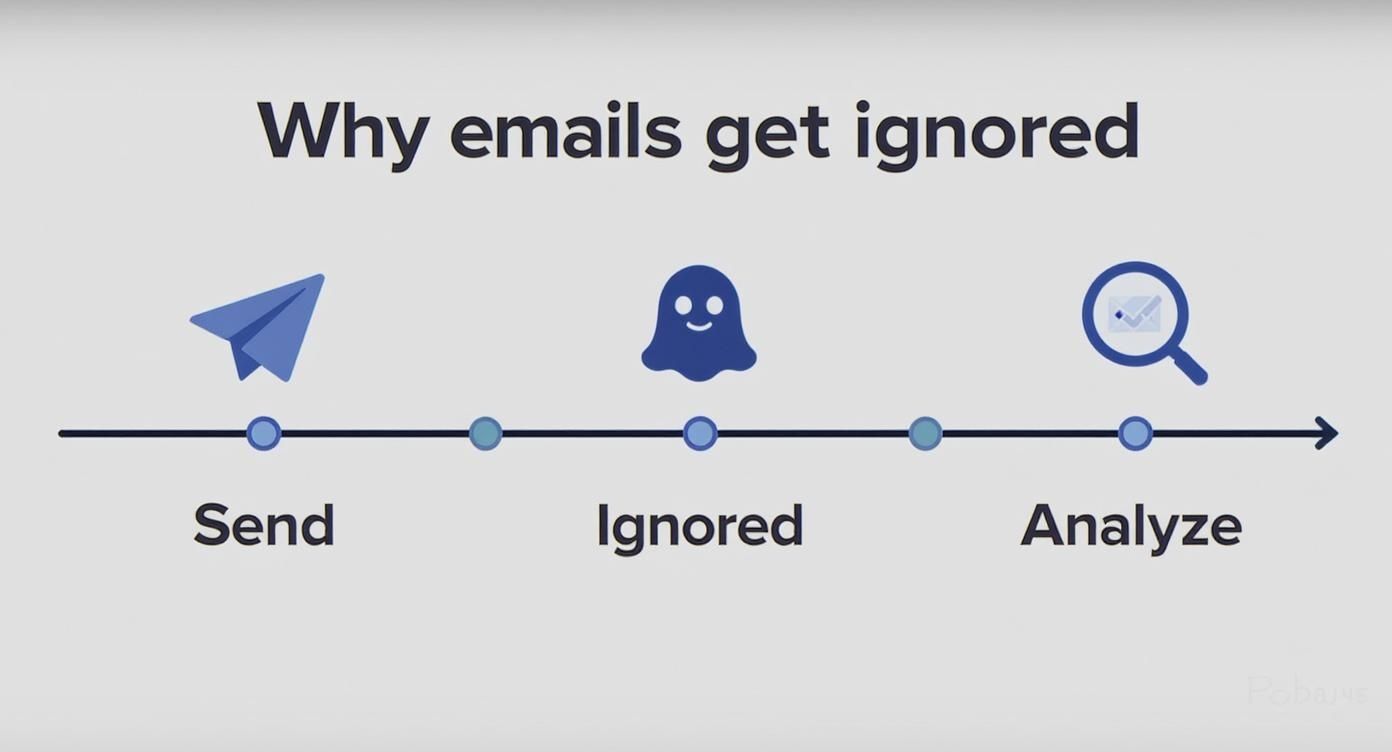
Most emails don't get an instant reply. They land in a busy inbox and get buried. Your job is to bring your message back to the top at the right moment.
As you can see, that "ignored" phase is where your timing strategy is critical. It’s your chance to re-engage effectively.
Finding the Right Cadence
A good rule of thumb is the "three-day rule." Wait about three business days before sending your first follow-up. This gives them enough time to manage their inbox without completely forgetting your initial message.
Data supports this. Waiting three days can boost reply rates. What's really telling is that 95% of cold emails that get a response are opened within the first 24 hours. If you don't hear back after a day or two, the odds of a reply drop significantly. This makes your timing absolutely critical. You can dive deeper into these cold email statistics and findings to see just how much timing matters.
> Key Takeaway: Be persistent, not a pest. A systematic, patient approach respects their time while keeping your message on their radar.
Of course, three days isn't a magic number for every situation. The context of your first email changes everything. You wouldn't wait the same amount of time to follow up after a job interview as you would for a cold sales pitch.
To help you get it right, here’s a quick guide on how to adjust your timing based on your reason for reaching out.
Recommended Follow-Up Timing by Scenario
| Scenario | Recommended Wait Time | Reasoning |
|---|---|---|
| Post-Job Application | 5-7 business days | This gives HR a realistic window to review applications without feeling rushed. |
| After a Sales Demo | 2-3 business days | You want to maintain momentum while your product's value is still fresh in their mind. |
| Cold Outreach | 3-5 business days | Since they weren't expecting your email, this buffer shows respect for their time and priorities. |
| Post-Networking Event | 1-2 business days | The goal here is to capitalize on the new connection while the conversation is easy to recall. |
Think of these as starting points. Always consider the other person's perspective and the context of your relationship before hitting send.
Writing a Subject Line That Actually Gets Your Email Opened
Let's be honest: if your follow-up email never gets opened, it might as well not exist. Getting the timing right pushes your message to the top of their inbox, but it's the subject line that convinces them to click.
Many people fall into the trap of using generic phrases like "Following up" or "Just checking in." These are inbox killers. They create zero curiosity and signal "I want something" without offering any value in return. A great subject line, on the other hand, should feel like a natural continuation of your last conversation.
The trick is to be specific and immediately relevant. You want to jog their memory instantly, reminding them who you are and why you're reaching out.
Proven Subject Line Formulas You Can Steal
You don't need to reinvent the wheel. The key to a solid how to follow up email no response strategy is to adapt a proven formula that gives the other person a clear reason to open your message.
Here are a few approaches that work time and time again:
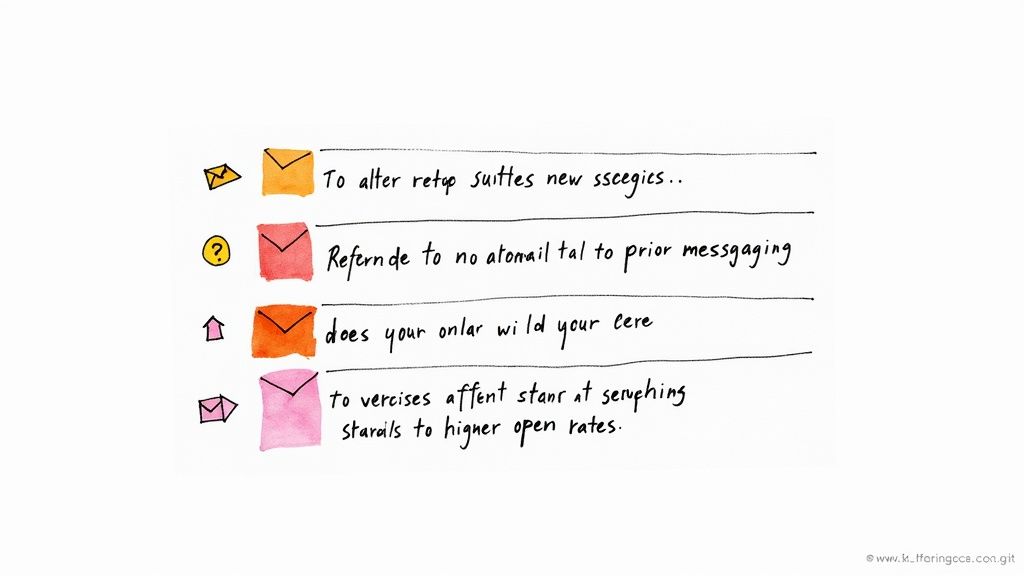
- Reference Your Last Chat: This is simple, effective, and provides instant context.
- Example: "Next steps on the Q4 marketing proposal"
- Example: "Following up on our chat about project management"
- Ask a Simple, Relevant Question: A direct question can be intriguing and makes them want to find the answer inside.
- Example: "Any feedback on last Tuesday's demo?"
- Example: "Quick question about your hiring process"
- Offer New Value: This is a powerful approach. It shows you’re not just chasing them for a reply; you’re genuinely trying to help. We cover this in our sales email follow up template.
- Example: "Found an article you might find useful"
- Example: "An idea for the inventory issue we discussed"
> My Two Cents: Keep your subject lines short—aim for under 50 characters. A huge chunk of emails get read on phones first, and you don't want your killer subject line getting cut off. Brevity and clarity will always win in a crowded inbox.
How to Write Follow-Up Emails That Actually Get Replies
Your clever subject line got them to open the email. Now what? The body of your message has to deliver on that initial interest.
The best follow-ups are short, add real value, and make it ridiculously easy for the other person to reply. Ditch the long, rambling messages. Your only mission here is to be polite, professional, and get straight to the point.
The basic flow is simple: give a quick reminder of who you are, offer something new, and then wrap up with a clear, low-effort call-to-action.
The Anatomy of a Great Follow-Up
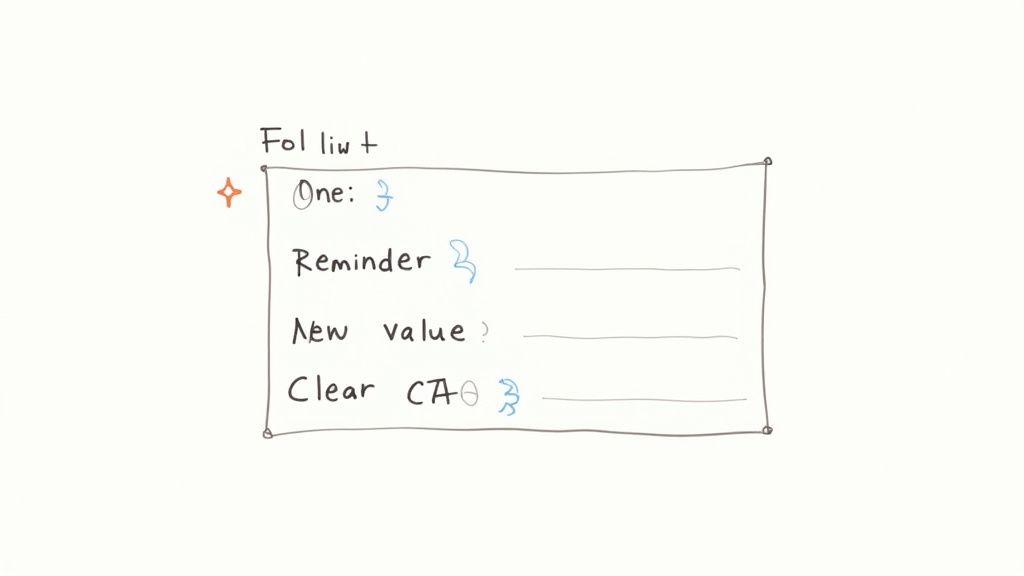
Every effective follow-up email breaks down into three key parts. If you're trying to figure out how to follow up on an email with no response, getting these fundamentals right is everything.
- A Gentle Reminder for Context: Never assume they remember you. Start by briefly jogging their memory.
- Example: "Hi Jane, just following up on my email from last Tuesday about the new marketing software."
- An Offer of New Value: This is the most important part. Never send a follow-up that just says "checking in." Offer a new resource, a relevant case study, or a fresh insight.
- Example: "I came across this article on boosting team productivity and thought of you."
- A Simple Call-to-Action (CTA): Make it crystal clear what you want them to do next. Vague questions like "What are your thoughts?" create more work for them.
- Example: "Are you free for a quick 15-minute call next week to discuss this?"
- Using guilt-tripping language: Phrases like "I know you're busy, but..." or "Since I haven't heard from you..." put people on the defensive. Stay positive and assume they just got swamped.
- Being vague about next steps: If your CTA is fuzzy, you’re creating a puzzle they have to solve. Be specific.
- Sending the same message on repeat: Each follow-up needs to bring something new to the table. If you're stuck, check out these actionable sales follow-up email examples for inspiration.
- Warm Leads: If you just had a great call or demo, sending two or three follow-ups over a few weeks makes sense. They already know you.
- High-Value Relationships: For a potential partner who could change your business, it might be worth extending the sequence. The key is making sure every message offers something genuinely new and helpful.
- Job Applications: Following up once after you apply and once after an interview is standard. Any more than that and you risk looking desperate.
> Pro Tip: Keep your follow-up emails under 100 words. Short, scannable messages show you respect their time, which makes them far more likely to get read and acted upon.
Don't just send one email and give up. A structured follow-up process works. In fact, sales teams that standardize their follow-up see a 78% higher conversion rate. Even just referencing a past conversation can boost response rates by a massive 62%. Context is king.
Sidestepping Common Follow-Up Blunders
Even with the right formula, it's easy to get this wrong. The fastest way to get your email deleted—or worse, marked as spam—is to sound passive-aggressive or demanding.
Here are a few common traps to watch out for:
How Many Follow-Ups Are Too Many?
Knowing when to stop is just as important as knowing what to say. It's a tricky balance—you want to be persistent, but you don't want to become a nuisance.
While it’s tempting to keep nudging someone, you can quickly do more harm than good. An overly aggressive campaign can burn a bridge for good, and every email you send after the first couple has a much lower chance of getting a response.
Finding the Sweet Spot
So, what's the magic number? One analysis of millions of cold emails found that sequences with just one follow-up had the best reply rate at 8.4%. Even the open rates were highest in this group, hitting 45.37%. You can dig into this in-depth analysis of follow-up statistics.
This drives home the idea that it's about quality, not quantity. One thoughtful, well-timed follow-up that adds real value is worth far more than a dozen generic "just checking in" pings.
> Key Takeaway: Sending four or more follow-ups? You're playing with fire. This can triple your unsubscribe and spam complaint rates—a massive red flag telling you it's time to stop.
Knowing When to Bend the Rules
Of course, these aren't ironclad laws. The "one-and-done" follow-up is a solid guideline for cold outreach, but the right number depends on who you're talking to and why.
At the end of the day, one or two thoughtful messages is usually your best bet. If you get radio silence after that, take it as a sign. Their priorities are elsewhere, and it's time to focus your energy where it will count.
Got a Tricky Follow-Up Situation? Here’s What to Do
Even with a perfect plan, things can get awkward. You hit "send" and immediately see a typo, or you get a verbal "no" and aren't sure what to do next. Let's walk through a few common scenarios and how to handle them.
Whoops, I Messed Up My First Email. Now What?
It happens. You send an email and then your stomach drops—you spotted a typo, forgot an attachment, or used the wrong name. Breathe. It's not the end of the world.
Act fast and keep it simple. Send a brief, corrective email with a subject line like "Correction on my last email" or "Me again (with the attachment this time!)." A quick note like, “My apologies, I just realized I sent the wrong file. The correct one is attached here,” is human, professional, and gets the job done without drama.
How Do I Follow Up After Someone Verbally Said "No"?
This feels counterintuitive, but sending a quick, polite closing email after a verbal "no" is one of the smartest things you can do. It leaves the door open for the future.
The goal isn't to change their mind—it's to end on a high note. Thank them for their time and honesty. Something as simple as, “Thanks again for the chat today. I really appreciate you being straightforward. I'll keep you in mind if something more aligned with your needs comes up,” works wonders.
> This small gesture keeps the relationship warm. Their needs might change in six months, and a graceful exit means you’ll be remembered positively.
Can I Reach Out Again After a Long Silence?
Absolutely, but you can't just pick up where you left off. A standard "just following up" email after months of silence feels out of place. This calls for a re-engagement email.
Your best bet is to come back with something genuinely new and valuable. Maybe you saw their company in the news, you have a new case study they'd find interesting, or you noticed a post from a mutual connection on LinkedIn.
For example: “Hi Jane, hope you're doing well. I saw your team just won that industry award—huge congrats! It made me think of our conversation last year about [Topic]…” This gives you a natural, relevant reason to pop back into their inbox.
---
Stop guessing which business ideas have real demand. Proven SaaS analyzes millions of ads to show you what's already working. Find profitable, validated SaaS niches where competitors are spending thousands on ads today. Get your unfair advantage and start building with confidence.
Build SaaS That's
Already Proven.
14,500+ SaaS with real revenue, ads & tech stacks.
Skip the guesswork. Build what works.
Trusted by 1,800+ founders


