

Forget brainstorming. The secret to finding a truly profitable niche isn’t about inventing ideas—it’s about observing where money is already flowing. The fastest way to know if a market is real? Find companies consistently spending a fortune on advertising. That spending is a massive, blinking sign that points directly to a healthy, paying customer base.
This isn't about guesswork; it's about smart, evidence-based observation.
Stop Guessing, Start Validating

The biggest fear for any founder is building something nobody wants. We’ve all heard the advice to "scratch your own itch," but that’s often a fast track to creating a product for a market of one: yourself. There's a much more reliable path.
This guide is your playbook for finding a profitable niche with data, not just a gut feeling. We'll start with the market, not a random idea. The core principle is simple: follow the money.
The Power of Following the Money
Think of consistent ad spending as a loud, clear signal of pre-validated demand. When you see companies shelling out cash day after day to get customers, they're doing your initial market research for you. It's a strategic shortcut to pinpointing SaaS ideas with a built-in audience before you write a single line of code.
This approach flips the traditional model on its head:
- Instead of ideation, you practice observation.
- Instead of guessing, you analyze real-world data.
- Instead of hoping for a market, you enter one that's already proven.
The global SaaS market is huge—projected to grow from $317.55 billion in 2024 to $1,228.87 billion by 2032. But the real opportunity is in the focused segments. In fact, one study found that micro-niches saw 340% more growth than broad market platforms. For more B2B SaaS marketing insights, Directive Consulting is a great resource.
Key Takeaway: Don't invent a problem. Find an existing, expensive problem that people are already paying to solve. By focusing on where ad dollars are concentrated, you de-risk your venture from day one.
I'm going to walk you through an actionable workflow, from spotting these money-trail signals to validating your unique angle within a market that's already shown it can pay the bills.
Find Ideas Where the Money Is Already Flowing
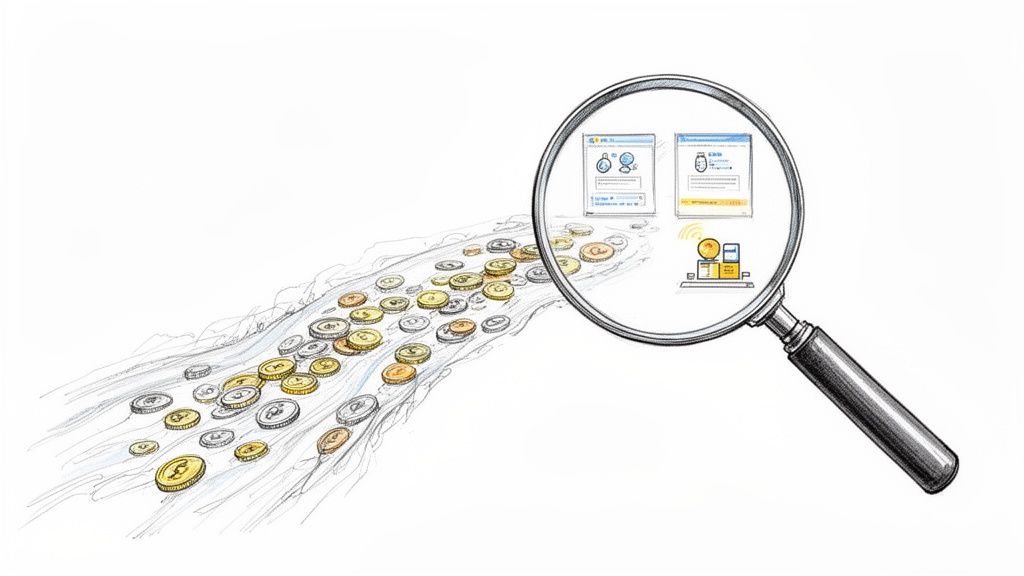
Forget waiting for a lightning bolt of inspiration. The most reliable way to find a profitable niche is to become a market detective. Your first clue? Money. When a company pours thousands of dollars into advertising every month, they aren't doing it for fun. They're doing it because it works.
This sustained ad spend is your clearest signal that a healthy, paying market exists. It’s real-world proof that a specific problem is painful enough for a specific audience to open their wallets for a solution. Following this cash trail is how you move from pure guesswork to evidence-based ideas.
Comparing Niche Sourcing Methods
The contrast between guessing and following the evidence is stark. High-risk, intuition-based methods are a gamble, while low-risk, evidence-based techniques use clear market signals to guide you.
| Method | Risk Level | Validation Signal | Example |
|---|---|---|---|
| Guesswork | High | Gut feeling, personal problem | "I think pet groomers need a better booking app." |
| Data-Driven | Low | Sustained ad spend by competitors | "Three companies have been running ads for 90+ days for a pet groomer booking app." |
As you can see, following the money trail dramatically de-risks the entire process from day one.
Become a Digital Detective in Ad Libraries
Your best tool for this investigation is a public ad library. The Meta Ad Library (covering Facebook and Instagram) is the most accessible place to start. Thanks to transparency laws, you get a free, searchable database of every ad running on their platforms. It’s a goldmine.
Your mission is simple: find SaaS companies running ad campaigns consistently over a long period. A one-off ad could just be a test, but a campaign running for 90+ days is a powerful indicator of a positive return on investment.
What to Look For in an Ad Library
Not all ads are created equal. You need to filter the noise and focus on the signals that point to a lucrative SaaS niche.
As you browse, keep an eye out for these patterns:
- Sustained Campaigns: This is your #1 signal. An ad running for several months is much stronger than one launched last week.
- Consistent Messaging: Do you see multiple companies using similar language to describe the same problem? This is a huge clue that they've found a message that resonates.
- Direct SaaS Funnels: Click the ads. Do they lead to a landing page with a clear "Start Free Trial" or "Book a Demo" button? This confirms you're looking at a SaaS product.
Pro Tip: Don't just find an ad; find a pattern. One company advertising might be an outlier. Three or more companies advertising similar solutions to the same audience for over six months? That's a validated market.
Example in Action: Imagine you're scrolling and spot three different companies running ads for a "social media scheduler for real estate agents." Each ad has been active for over four months. You've just stumbled upon a potentially profitable niche without ever having to brainstorm. You can learn how to structure this kind of research in our founder's guide to competitive landscape analysis.
If you're interested in high-growth sectors, you can also browse lists of established AI SaaS companies to see where venture capital and ad budgets are already flowing. This can highlight the next wave of profitable problems to solve.
This detective work gives you a shortlist of highly qualified leads. It tells you exactly where to dig deeper, armed with the confidence that others have already proven customers exist.
Is This Niche Actually Profitable? A Quick Analysis
Seeing a company spend a ton on ads is a great starting point, but it's just the first clue. It tells you something is working, but not why. To know if you’ve truly struck gold, you have to dig deeper and figure out how they can afford that ad spend in the first place.
This is where you switch from private eye to financial analyst. By piecing together a few public data points, you can paint a surprisingly clear picture of a niche’s financial health, customer loyalty, and overall potential.
A Back-of-the-Napkin Guide to Estimating Revenue
First, you need a rough idea of how much money is flowing through the niche. You don't need their private financial statements; you just need to be a little resourceful.
Let’s walk through a real-world example. Say you've spotted a niche: social media scheduling tools built specifically for financial advisors. You notice a couple of players advertising heavily. Here's how to estimate what they might be making:
- Check Their Pricing: Go to their pricing page. Maybe they have a $49/month plan, a $199/month team plan, and a $499/month "Enterprise" option. The middle tier is often the most popular, so let's use $199/month as our average revenue per user (ARPU).
- Count Employees on LinkedIn: Head over to LinkedIn and search for the company. Let's say the biggest competitor has 30 employees. A conservative rule of thumb in SaaS is that a company generates $150,000 to $200,000 in annual revenue per employee.
- Run the Numbers: Using the low-end estimate of $150,000 per employee, that 30-person company is likely pulling in around $4.5 million in annual recurring revenue (ARR). That breaks down to $375,000 a month. Divide that by their average $199/month plan, and you get about 1,884 customers.
This simple calculation tells you a business in this niche can easily support a 30-person team. That’s a massive signal of a healthy, paying market. For a deeper dive into this kind of investigation, check out our guide on how to conduct effective SaaS market research that actually works.
Looking for Signs of "Customer Stickiness"
Big revenue is great, but it's only half the puzzle. The most profitable niches have "sticky" customers who don't just sign up—they stick around for years. High retention means you aren't stuck on a treadmill, constantly trying to replace users who leave.
How do you measure customer loyalty from the outside? Look for clues that suggest people are happy and deeply invested in the product.
- Vibrant User Communities: Are there active Facebook Groups, Slack channels, or Reddit communities dedicated to the product? A place where users are swapping tips and helping each other out screams "sticky product."
- Long-Term Job Postings: Look at their careers page. Are they consistently hiring for roles like "Customer Success Manager" or "Onboarding Specialist"? A company scaling its support teams is a company that's successfully keeping a growing customer base happy.
- Consistent Product Updates: Check their company blog. If they're regularly shipping features that address user feedback, it shows they’re reinvesting in the product to keep customers from leaving.
The Winning Formula: When you find a niche with both high estimated revenue and strong signals of customer retention, pay attention. You've likely found a winner.
Micro SaaS businesses, in particular, have become incredibly profitable, often hitting profit margins of up to 80% thanks to lean operations. The median net revenue retention for SaaS companies sits at a healthy 102%, proving they grow revenue from existing customers faster than they lose it to churn. This powerful mix of high margins and built-in retention is what makes niche SaaS such an attractive model.
By combining these simple analytical techniques, you build a repeatable process. You can go from a vague idea to a well-researched, data-backed opportunity in just a few days. You’re no longer guessing; you’re using real evidence to build a case for a niche that can actually support a thriving business.
Validate Your Niche Without Building a Product
You've followed the money and decoded the market signals. You've pinpointed a promising niche where competitors are spending on ads and customers are sticking around. Now comes the most important step: proving people want your specific solution before you write a single line of code.
It's tempting to jump into development, but that’s a classic, high-risk move. Instead, run a quick and cheap experiment to turn your educated guess into cold, hard data.
Create a Simple Validation Machine
Your goal right now isn't to build a product. It's to build a "validation machine" that measures genuine interest from potential customers. Learning how to test a business idea properly is the single best way to avoid wasting months on something nobody will pay for.
Here’s what this simple machine looks like:
- A Compelling Landing Page: Your digital storefront. A single page built with a tool like Carrd or Webflow is all you need.
- A Targeted Ad Campaign: A small, focused campaign on Facebook or LinkedIn drives the right kind of traffic.
- One Key Metric: Success is measured by one thing: email sign-ups for your waitlist.
You can get this entire setup live over a weekend. Its sole purpose is to get a clear "yes" or "no" from the market before you commit serious time or money.
Crafting a Landing Page That Converts
Your landing page must do one thing well: nail a painful problem and present your unique solution. Since you’ve already studied successful competitors, you have a blueprint.
Take their value proposition and give it a sharp, specific angle. For instance, if the big players offer a generic "social media scheduler," your page should scream: "The Only Social Media Scheduler Built for Financial Advisors."
Your page needs just a few core elements:
- A Killer Headline: State who it's for and the specific problem it solves.
- Three Key Benefits: List the top three outcomes your users will achieve.
- A Clear Call-to-Action (CTA): "Join the Waitlist for Early Access."
This isn't about beautiful design; it’s about clarity. You're selling the outcome, not the features of a product that doesn't exist yet. If you need help structuring this, our free Niche Validator tool walks you through crafting a value prop designed for this kind of test.
The signals you've already decoded—like competitor pricing and team size—are what got you here.
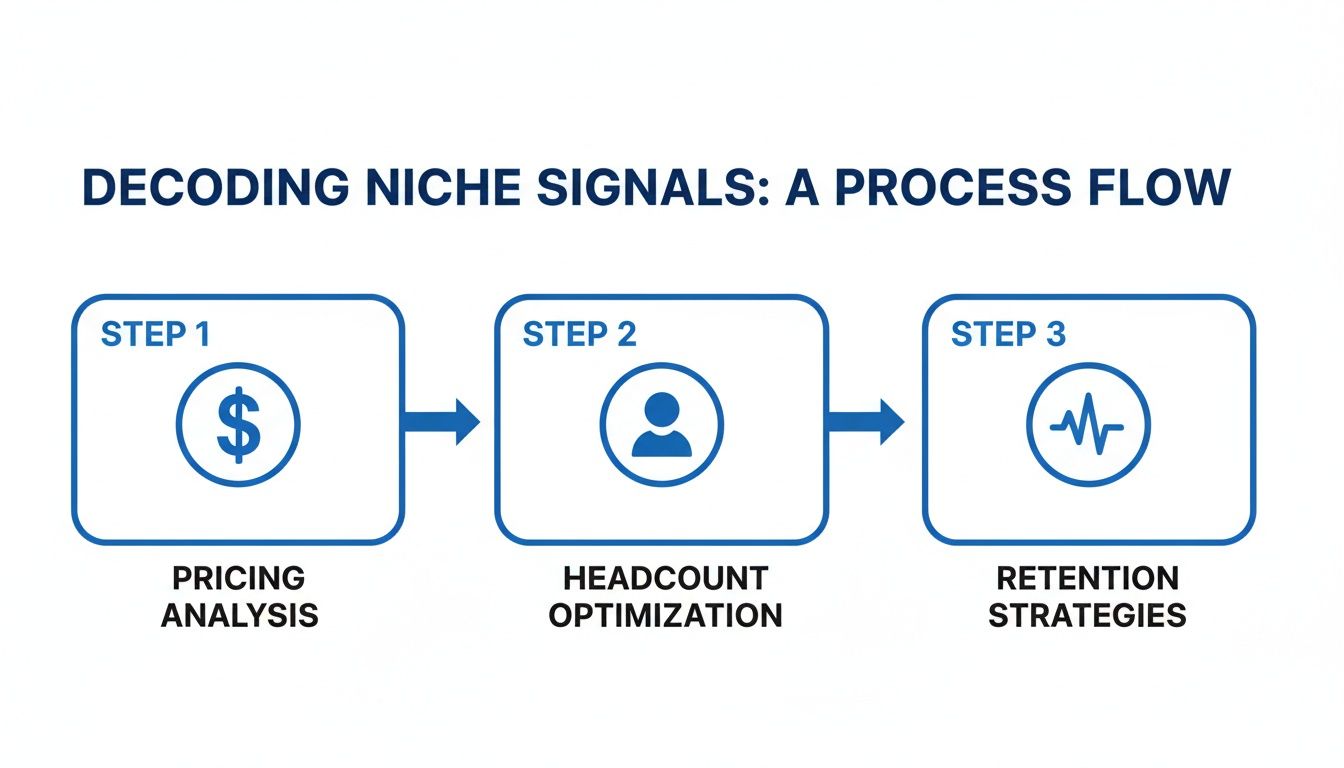
Those metrics helped you spot the opportunity. Now, your landing page test will confirm if your specific angle connects with your target audience.
Running a Small-Budget Ad Campaign
Time to get some eyeballs on your page. You don't need to break the bank. A $100 spend on Facebook or LinkedIn is more than enough to get the initial data you need.
The magic is in the targeting.
Example: If your niche is "project management software for architects," use the ad platform’s tools to show your ad only to people with "Architect" in their job title. You’re paying to put your message directly in front of the exact people you think you can help.
The Only Goal: Measure the conversion rate on your landing page. How many targeted visitors were interested enough to leave their email?
A high conversion rate (think 5% or more) is an incredibly strong signal. It's proof that the problem you're aiming to solve is real and urgent. A low rate (under 1-2%) is equally valuable feedback. It tells you to rethink your messaging or pivot entirely—before you’ve sunk thousands of dollars into building the wrong thing.
Common Mistakes When Niche-Hunting (and How to Avoid Them)
The path to a profitable niche is littered with common traps. Knowing what they look like is your best defense against wasting time and energy.
Mistake #1: Analysis Paralysis
One of the sneakiest traps is getting stuck in endless research. You spend weeks buried in spreadsheets and mapping out competitors, but you never actually do anything. It feels productive, but you're just delaying the one thing that matters: validation.
How to Avoid It:
- Set a Deadline: Give yourself one week for research. At the end of seven days, you must pick one idea to test.
- Aim for "Good Enough": You don't need perfect certainty. You just need enough of a signal to justify a small, cheap experiment.
The point of research isn't to eliminate all risk. It's to gather enough data to make an educated guess, then test that guess in the real world as fast as you can.
Mistake #2: Building a Solution Without a Problem
This is a classic. You fall in love with a brilliant idea before you have any proof that anyone else cares. You might even build a beautiful product, only to launch to the sound of crickets.
How to Avoid It: Anchor every idea in market evidence. Before dreaming up features, ask: "Where's the proof that people are already spending money or time to solve this?" If you can't find competitors running ads or online communities buzzing with complaints, you might be the only one who thinks it’s a problem.
Mistake #3: Ignoring "Boring" Industries
So many founders chase shiny, trendy niches like AI or Web3, completely overlooking the goldmines in "boring" industries like construction, plumbing, or manufacturing.
These sectors are often stuck with clunky, outdated software, yet they face clear and expensive problems. A scheduling mix-up for a plumbing company can cost thousands in a single day. A compliance oversight in manufacturing can lead to six-figure fines. Businesses are happy to pay to make these high-stakes problems go away.
Example: Vertical SaaS—software for a specific industry—is a massive opportunity. The market is valued at $94.86 billion. Just look at Toast, which built a multi-billion dollar business focusing only on restaurant management. You can dig deeper into the rise of vertical SaaS at Qubit Capital.
By sidestepping these common mistakes, your search becomes much more direct. You'll choose action over analysis, evidence over ego, and real-world problems over glamorous but unproven ideas.
Your Top Niche-Finding Questions, Answered
Even with a plan, questions will pop up. Here are answers to the most common ones.
How much should I budget to validate an idea?
Good news: this shouldn't be expensive. A lean budget of $100 to $300 is more than enough to get the initial signal you need.
Here’s the breakdown:
- A Simple Landing Page: A tool like Carrd or a basic Webflow page is perfect and very low-cost.
- A Small, Targeted Ad Campaign: Putting $100-$200 into a focused Facebook or LinkedIn ad campaign is plenty to get the right eyeballs on your page.
Remember, you're not trying to get paying customers yet. You are simply trying to measure interest by tracking email sign-ups for a waitlist. This small spend is your insurance policy against building something nobody wants.
What if my chosen niche already has competitors?
Finding competitors is a great sign. It's strong proof that a market is healthy and that people are already paying for a solution. Competition should bring relief, not panic.
Perspective Shift: Don't see competitors as a stop sign; see them as proof of concept. They've already validated that a paying market exists.
Your job isn't to be the first. It’s to be different and better for a specific group. Look at what competitors are doing and find their weak spots or an underserved corner of the market they're ignoring. Instead of another generic project management tool, build one specifically for freelance writers. That's how you carve out your own space.
How do I know when to give up on an idea?
Let the data decide for you. It’s easy to get emotionally attached to an idea, which can be your worst enemy. To combat this, set a "kill switch" based on cold, hard numbers before you start.
Before launching your validation page, decide on a clear success metric. A simple benchmark is your waitlist conversion rate. If a targeted ad campaign is converting visitors to email sign-ups at a rate below 1% or 2%, that's a powerful signal that your idea or messaging isn't hitting the mark.
If you don't hit your target, it's not a failure. It's a successful experiment that gave you a clear answer. It's your cue to move on to the next idea without wasting another minute.
Can I really find a profitable niche in a "boring" industry?
Absolutely. In fact, you should be looking there. "Boring" sectors like construction, logistics, or compliance are often SaaS goldmines because they get overlooked. These industries are full of expensive, urgent problems and are usually underserved by modern software.
Consider this:
- High-Stakes Problems: A software bug in a social media app is an inconvenience. A bug in a manufacturing plant can cost millions. Businesses will pay for reliability.
- Less Competition: While everyone chases the same trendy ideas, you can find incredible opportunities in less glamorous spaces.
- Proven Demand: Vertical SaaS giants like Toast (for restaurants) and Procore (for construction) have built massive businesses by solving unsexy but critical problems.
Some of the most profitable companies are built on solving the tedious, everyday headaches in these established industries.
Ready to stop guessing and start finding real, data-backed SaaS ideas? Proven SaaS gives you an unfair advantage. We analyze millions of ads to show you what's already working, so you can build with confidence.
Build SaaS That's
Already Proven.
14,500+ SaaS with real revenue, ads & tech stacks.
Skip the guesswork. Build what works.
Trusted by 1,800+ founders


