

The best business ideas aren’t born in a flash of inspiration. They’re discovered. The key is to find proof that a problem exists—and more importantly, that people are already paying to solve it. This changes your approach from a creative guessing game to a strategic investigation.
Find Real Problems, Not Just Passion Projects
We've all heard the advice to "follow your passion." While inspiring, it’s a trap that leads countless founders to build products nobody wants. A passion is great for a hobby, but a business needs paying customers.
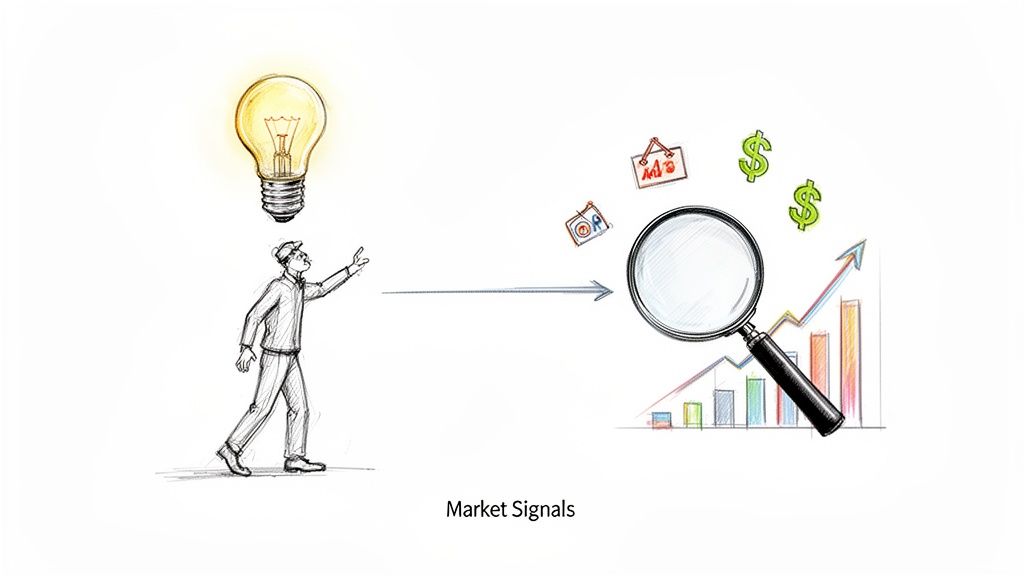
The most important shift you can make is from inventing ideas to discovering existing problems. It’s about listening to the market, not just your own thoughts. Your goal is to find undeniable proof that a market exists before you build anything. This proof comes from "market signals"—clear, tangible signs of customer demand.
What Market Signals Look Like in the Real World
So, what are these signals? They aren't hidden. A market signal is any action showing people are actively trying to solve a problem.
Here are the strongest signals to look for:
- Sustained Ad Spend: This is the gold standard. If a company consistently spends thousands of dollars every month on ads, it's working. They wouldn't burn cash if it wasn't profitable.
- Growing Online Communities: Look for active forums, subreddits, or Facebook groups dedicated to a specific challenge. A busy community is a magnet for people desperate for answers.
- High Search Volume for "How-To" Keywords: When thousands of people are Googling "how to automate my accounting," they're screaming for a solution.
- Niche Job Postings: Companies hiring for specialized roles like "Salesforce integration specialist" are signaling a clear and expensive business pain.
The key takeaway is simple: Find the pain, then build the painkiller. Stop asking, "What can I build?" and start asking, "What problems are people already paying to solve?"
This simple visual breaks down the difference between old-school brainstorming and a modern, signal-driven approach.
Old Way vs. New Way
| Method | Core Principle | Risk Level | Validation Speed |
|---|---|---|---|
| Traditional Brainstorming | "What can I build?" (Based on personal passion) | High | Slow |
| Signal-Driven Discovery | "What pain are people paying to solve?" (Based on market data) | Low | Fast |
As you can see, looking for signals first dramatically reduces your risk.
Why SaaS Is the Perfect Place to Look
The Software as a Service (SaaS) model is perfect for this signal-driven approach. The global SaaS market is massive—projected to grow from $273.55 billion in 2023 to an incredible $1,228.87 billion by 2032.
With nearly every business using at least one SaaS tool, new opportunities are everywhere. By analyzing the ad spend of the 30,000+ SaaS companies, you can pinpoint validated niches where competitors are already making money.
You don't need a world-changing idea. You just need to find one group of people with a specific problem and offer them a better, more focused, or cheaper solution. For inspiration, check out these 31 weird business ideas that often tap into very specific market signals.
Uncover Proven SaaS Ideas in Public Ad Libraries
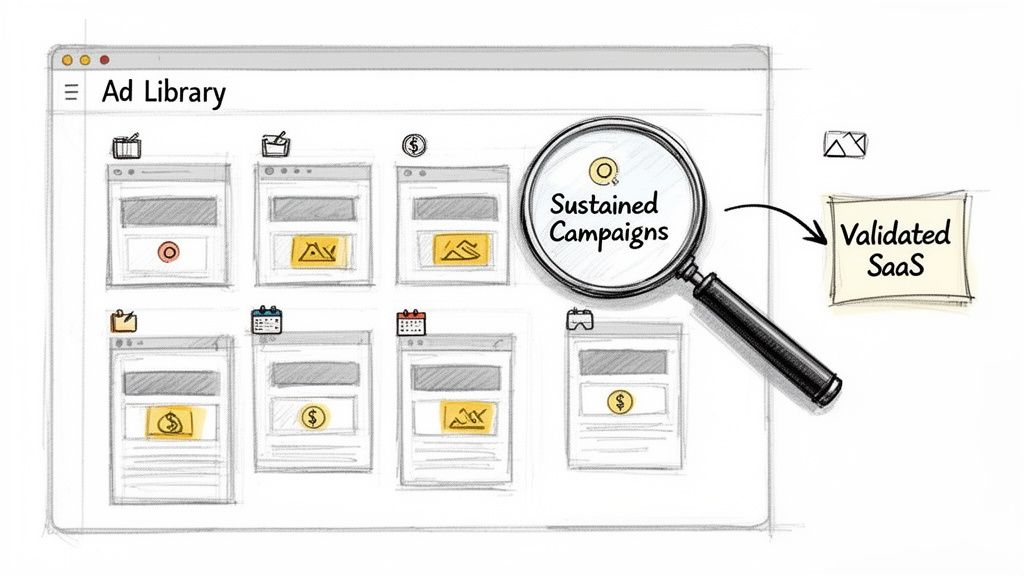
If you want to know if a market is profitable, follow the money. Luckily, platforms like the Meta Ad Library are public goldmines of business intelligence, free for anyone to access.
Think of these libraries as a searchable database of every ad running on Facebook and Instagram. For an aspiring founder, they're an unfiltered look into what's working. You can see which companies are spending money, the exact ads they're running, and—most importantly—how long they've been running them. This is the raw data you need.
Why Ad Libraries Are Your Secret Weapon
Every ad campaign is a bet. A company bets its money that an ad will bring in more revenue than it costs. When you see a company making that same bet for months, it's a huge signal that the bet is paying off. They've found a real problem people will pay to solve.
This flips brainstorming on its head. Instead of starting with a blank slate, you start with a list of proven winners.
Your job is to be a digital detective. Use these free tools to look for a few key clues:
- Longevity: Has the ad been running for 90+ days? That's a strong sign it's profitable.
- High Volume: Is the company running dozens of ad variations? This signals a serious investment.
- Consistent Messaging: Do you see a pattern? If multiple companies are running ads for a "social media scheduler for real estate agents," you've found a profitable niche.
The goal isn't to chase trends. It's to find sustained, profitable ad campaigns that prove a market’s viability. These long-running ads are your proof.
A Quick Guide to the Meta Ad Library
Let's put this into practice. The Meta Ad Library is simple to use. You can search for a company name or a keyword related to a problem.
For example, if you think there's an opportunity in software for dentists, you could search "dental practice software." You'll immediately see who is spending money to reach that audience.
Once you find a few promising companies, dig deeper. Click on their page to see all their ads. Pay close attention to the language they use, the pain points they highlight, and the solutions they promise.
This isn't just about finding an idea; it's about understanding the entire market conversation. To speed this up, you can use specialized tools that analyze ad library data for you, like the one we've built at Proven SaaS.
Deconstruct Competitor Ads to Find Opportunities
Finding a SaaS company with a big ad spend is like finding a treasure map. But you still have to do the digging. The real magic happens when you deconstruct their campaigns to figure out why they’re working.
This is reverse-engineering a proven business model. You're turning a simple ad into a blueprint for a validated idea. It’s a powerful shortcut for coming up with a business idea that has a built-in advantage.
Decode the Language Customers Use
First, look at the ad copy. Companies don't guess with their words. They've likely spent thousands testing every headline and phrase. The language they use is the language that connects with their target audience.
Pay attention to how they frame the problem. This is the exact vocabulary their customers use.
- Are they talking about “ending communication chaos” or “streamlining workflows”?
- Is the focus on “saving 10 hours a week” or “increasing revenue by 20%”?
- What specific outcomes do they promise, like "closing more deals"?
This is a direct peek into the customer's mind. You’re learning the precise value that makes people click.
Analyze Visuals for Emotional Triggers
Next, look at the visuals. The images and videos in an ad are designed to trigger an emotion. They show the painful "before" state and the aspirational "after" state.
For example, do their ads consistently show a frazzled manager buried in spreadsheets? Or do they feature a relaxed team leader smiling at a clean dashboard? These choices are never random.
The imagery reveals the core emotional drivers behind the purchase. Are customers motivated by fear, the desire for control, or the promise of looking good at work? Understanding these emotional hooks helps you build a product that connects on a deeper level.
Your goal is to find the story behind the sale. Combine the logical appeal from the ad copy with the emotional pull from the visuals to get the full picture.
Your Ad Analysis Checklist
To make this process concrete, use this checklist. When you find an interesting ad, run it through these questions.
| Signal Category | What to Look For | What It Tells You |
|---|---|---|
| Problem/Pain | Specific pain points mentioned (e.g., "messy inboxes," "missed deadlines"). | The core, validated problem the market is willing to pay to solve. |
| Solution/Promise | The "after" state or benefit (e.g., "your calmest quarter yet," "double your leads"). | The main value proposition that resonates with the target audience. |
| Target Audience | Clues in language or imagery (e.g., "for agencies," "for e-commerce"). | The specific, profitable customer segment they are targeting. |
| Emotional Angle | The feelings the ad evokes (e.g., frustration, relief, confidence). | The emotional drivers you can tap into for your own marketing. |
| Call to Action | The specific action requested (e.g., "Start Free Trial," "Get a Demo"). | Their primary conversion goal and a hint at their sales model. |
Running a few ads through this framework will give you a surprisingly clear picture of the opportunity.
Spot Patterns to Find Underserved Markets
After analyzing a handful of ads, you'll start to see patterns. This is where big opportunities hide.
For example, say you notice three different SaaS companies all spending big money to target "creative agencies" with a "client reporting tool." That’s a massive signal that creative agencies have a recurring problem and are paying for software to fix it.
This technique is perfect for identifying validated niches. Maybe the existing tools are too expensive, clunky, or missing one killer feature. Your analysis reveals an opening where a better, cheaper, or more focused product could win.
If you want to go deeper, exploring SaaS competitor analysis tools can give you an even clearer picture of the competitive landscape.
By deconstructing what’s already working, you create a blueprint for success. You know the audience, their pains, and the messaging that gets them to open their wallets.
Pick a Winner: A Simple Framework for Prioritizing Ideas
After a few days of digging, your list of ideas is probably full. This is exciting, but it can also be paralyzing. How do you know which idea is the one?
The biggest mistake is picking the idea you're most passionate about. Passion is crucial, but it can blind you. We need an objective lens. The goal isn't to ask, "Which idea do I like most?" It's to ask, "Which idea has the best shot at succeeding, specifically for me?"
The Four Pillars of a Solid SaaS Idea
To bring clarity, let's use a simple scoring system. For each of your top ideas, score it from 1 (terrible) to 5 (fantastic) across these four pillars.
Market Demand (Score 1-5): How many people need a solution? Your ad research gives you a head start. If multiple companies are spending $10k+ per month on ads, you have high demand.
Founder-Market Fit (Score 1-5): Is this a world you understand and enjoy? Building a company is a long process. You'll have a better chance if you're genuinely interested in the problem.
Unfair Advantage (Score 1-5): What do you bring to the table? This could be industry experience, a unique marketing skill, or a network of potential first customers.
Profit Potential (Score 1-5): Can you make good money? Look for signs that customers already pay for similar software. A high-value problem for a B2B customer will have a higher profit ceiling.
Don't overthink the scores. This is a gut-check to force critical thinking and compare your options in a structured way.
Putting It All Together: A Real-World Example
Let's see this in action. Imagine a founder named Sarah has narrowed her list to three SaaS ideas:
- Idea A: A project management tool for freelance writers.
- Idea B: An inventory management system for Etsy sellers.
- Idea C: A compliance reporting software for small dental practices.
Now, Sarah uses the framework to score them.
| Criteria | Idea A (Writers) | Idea B (Etsy Sellers) | Idea C (Dental) |
|---|---|---|---|
| Market Demand | 4 | 5 | 3 |
| Founder-Market Fit | 5 | 2 | 4 |
| Unfair Advantage | 5 | 1 | 3 |
| Profit Potential | 2 | 3 | 5 |
| Total Score | 16 | 11 | 15 |
Here's Sarah's thinking:
Idea A (Writers): Sarah was a freelance writer. She gets a perfect 5 for Founder-Market Fit and Unfair Advantage because she knows the customer's pain. But, she also knows freelancers hate spending money, so Profit Potential gets a low score of 2.
Idea B (Etsy Sellers): The Market Demand is huge. But Sarah knows nothing about e-commerce. She has no personal connection or special edge, leading to low scores for Fit and Advantage.
Idea C (Dental Practices): The market is smaller (Market Demand of 3), but dental offices have real budgets and need compliance software. That earns a top score for Profit Potential. Sarah's cousin is a dentist, giving her a decent starting point.
Suddenly, the path is clearer. Idea A is the passion project but a tough business. Idea C has a much better balance of opportunity and viability for Sarah. This simple exercise turned a confusing decision into a strategic one.
Validate Your Idea in 7 Days With a Simple Test
You've done your homework and picked your best idea. Now for the moment of truth: will anyone actually pay you for it? Thankfully, you don't have to disappear for six months to build a full product.
The goal is simple: get real-world feedback as fast and cheaply as possible. You need to test your core idea with minimal risk, and the best tool is a lean Minimum Viable Product (MVP).
What a 7-Day MVP Looks Like
Forget months of coding. For this first test, your MVP is often just a simple landing page. Its only job is to communicate the value you're offering and see if anyone bites.
Think of this landing page as a storefront for a product that doesn’t exist yet. It only needs to do three things:
- Hook them with the problem: Use a headline that mirrors their frustration (e.g., "Tired of Manually Tracking Project Hours?").
- Present your solution: Briefly explain how your tool makes that pain go away.
- Ask for a commitment: Have a clear call to action, like "Join the Waitlist," to see who's genuinely interested.
This approach lets you test the waters without investing thousands of dollars. For a deeper dive, check out this guide on how to launch fast and learn faster with an MVP.
Finding Your First Potential Customers
With your landing page live, it's time to see if anyone cares. The most direct way is to run a small, targeted ad campaign that mimics the competitors you've been studying.
Set aside a small budget, maybe just $100 to $200, and create a simple campaign on a platform like Meta. Target the same audience your competitors are going after and use similar messaging. Then, send all that traffic to your landing page.
This isn't about making money yet. Think of it as an experiment to capture real purchase intent.
The most valuable currency at this stage isn't revenue; it's email addresses. An email sign-up is a powerful signal that someone is interested enough to want to hear more.
The entire process is about making sure you're building on solid ground. Your idea should satisfy three core criteria before you build anything.
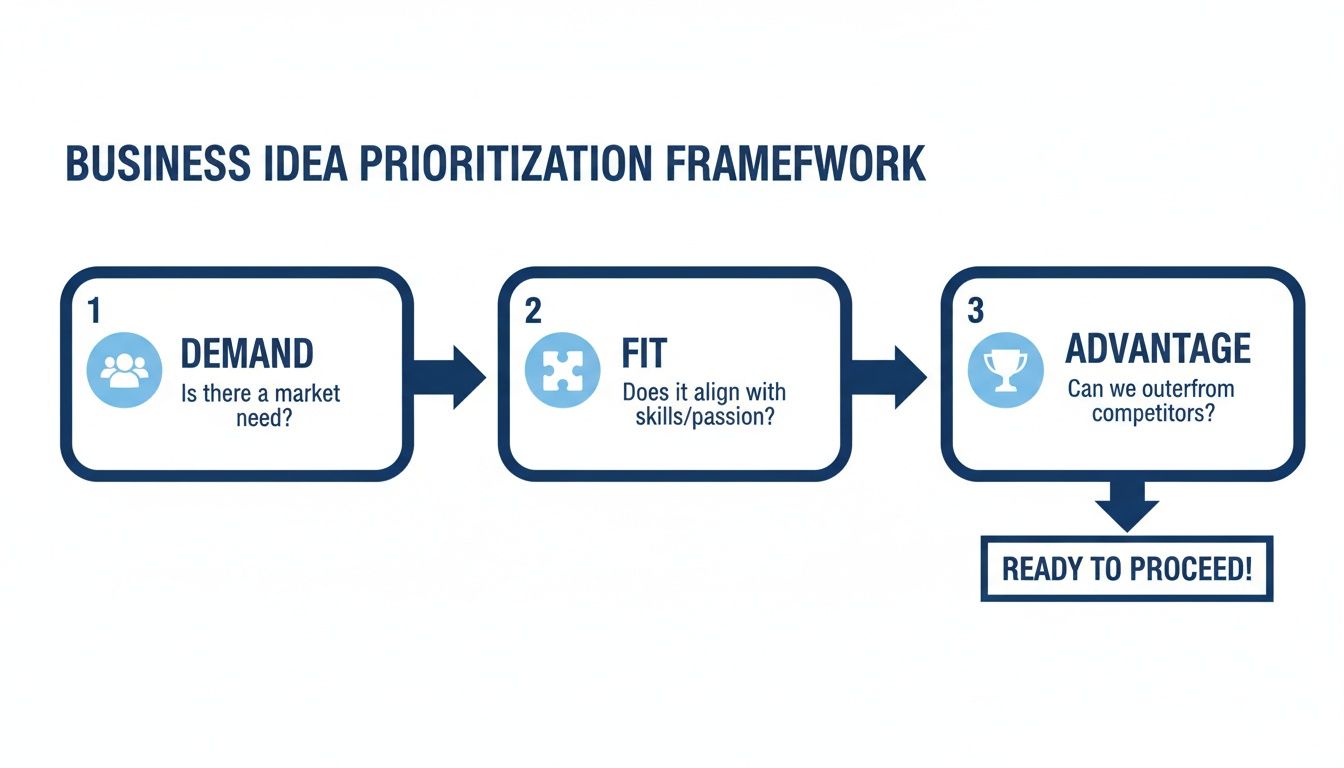
Once your idea checks these boxes—Demand, Fit, and Advantage—it’s ready for this real-world test.
The Only Metrics That Matter
After a week, look at the results. Forget vanity metrics like page views. You need to focus on signals that show a real intent to buy.
- Email Sign-up Rate: What percentage of visitors gave you their email? A conversion rate of 5-10% is a fantastic signal.
- Cost Per Lead (CPL): How much did you pay for each email address? Your CPL should be in a sustainable ballpark.
- Pre-orders (The Ultimate Test): For the bold, adding a "Pre-order for 50% Off" button is the strongest validation you can get. Even a few pre-orders is undeniable proof.
If the numbers look good, you have a green light. If not, you just saved yourself months of work. To help with the next steps of building your product, this comprehensive MVP Development Guide for Founders is a fantastic resource.
Answering Your Lingering Questions
Even with a solid framework, a few questions always pop up. Let's tackle the most common ones.
"Isn't This Market Too Crowded?"
It’s easy to look at a crowded market and think, "I'm too late." But you should do the exact opposite.
Competition is validation. It’s a giant, flashing sign that says, "People pay money to solve this problem!" A market with zero competitors is often a ghost town for a reason.
Your job isn't to find an empty field; it's to find your own patch of ground in a proven landscape. The big guys often leave gaps.
- Go Niche: Can you serve a specific slice of the market better? For example, create a project management tool just for architectural firms.
- Be the Simple Choice: Many SaaS products get bloated over time. You can win by building a clean, intuitive solution that solves 80% of the core problem with 20% of the complexity.
- Play the Price Card: Undercutting overpriced incumbents can be a great way to land your first customers.
Remember, seeing competitors spending money on ads isn't a red flag; it's a green light.
"What If Someone Steals My Idea?"
This is the number one fear for first-time founders, and it's almost always overblown. Ideas are cheap. The real magic is in the execution.
It's about your ability to build the product, get it in front of customers, and create a brand they trust.
Think about it: if you told ten people your brilliant idea, how many would have the skills and determination to turn it into a real business? Probably zero.
Success hinges on your unique ability to make it happen. Your "unfair advantage"—be it industry know-how, a knack for marketing, or relentless drive—is what's truly hard to copy.
"But I'm Not a Technical Founder..."
So what? You don't need to write code to start a SaaS company. Some of the most successful founders are non-technical. Your job at the beginning is to prove people want your product.
You can get surprisingly far with no-code tools and a simple landing page. Focus on what you can do: understand the customer, validate the problem, and build an audience.
Once you have a waitlist of people eager to pay you, finding a technical partner or hiring a developer becomes much easier.
Here are a few paths you can take:
- Find a Technical Co-founder: Look for someone whose skills complement yours.
- Embrace No-Code: Tools like Bubble, Webflow, and Adalo are incredibly powerful.
- Hire Help: Use initial validation (and maybe pre-orders) to fund the first version with freelancers.
Your lack of technical skills is only a roadblock if you let it be one. Validate first, build second.
"How Do I Know If My Idea Is Really Good Enough?"
Here’s the simple truth: you don’t. Not for sure, anyway. Not until you put it out into the world.
No amount of brainstorming can guarantee success. This whole process is designed to stack the odds in your favor and dramatically lower your risk of building something nobody wants.
An idea becomes "good enough" the moment you have proof that people will pay you to solve their problem. That proof starts with a few sign-ups on a landing page and grows with every customer who decides you're worth their money.
Ready to stop guessing and start finding real, profitable business ideas? Proven SaaS uses AI to analyze ad libraries and surface validated SaaS opportunities where competitors are already making money. Find your next great idea today.
Build SaaS That's
Already Proven.
14,500+ SaaS with real revenue, ads & tech stacks.
Skip the guesswork. Build what works.
Trusted by 1,800+ founders


