

Founder's Guide to Digital Marketing for Startups
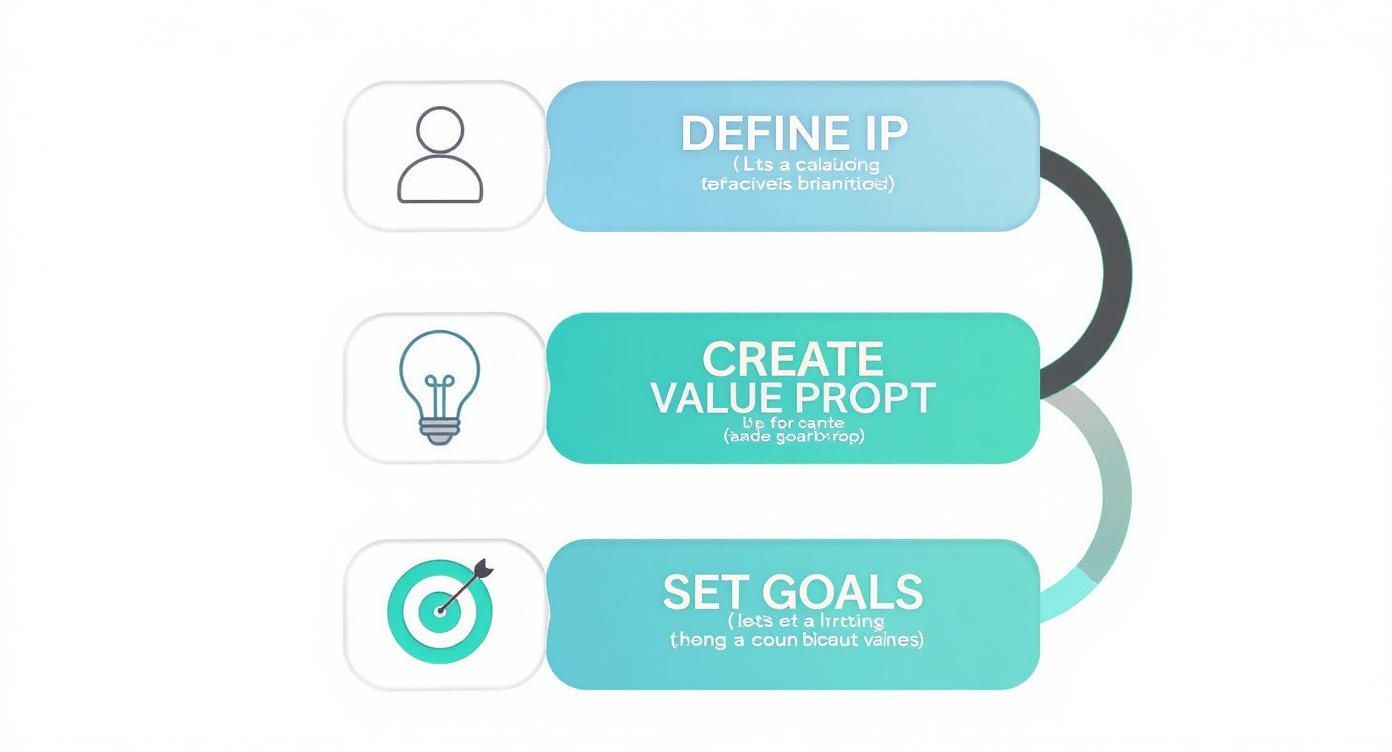
Starting your marketing plan can feel like you've been handed a puzzle with a million pieces and no picture on the box to guide you. It's overwhelming. The trick is to ignore all the noise and focus on just two things to start: who you're selling to and what you're promising them.
When you nail those two things, you stop throwing random tactics at the wall and start building a real engine for growth.
Building Your Marketing Foundation from the Ground Up
Before you spend a dime on ads or write a single word for your website, you need to lay a solid foundation. Many startups fail not because their product is bad, but because they never figured out who it was for or why anyone should care.
This initial work is all about creating clarity. Without it, every marketing decision you make—from which social media platform to use to the copy you write for an email—is just a guess.
Who Are You Really Selling To? Define Your Ideal Customer
You can't sell to everyone. The absolute first step is to define your Ideal Customer Profile (ICP). This isn't just a dry list of demographics; it's a living, breathing sketch of the perfect person who needs your product right now.
Think of it like creating a character for a movie. What are their biggest challenges? What goals are they trying to achieve? Answering these questions makes your marketing personal and effective.
For example, a startup selling project management software shouldn't target "all remote workers." A better ICP would be: "Maria, a 35-year-old Head of Operations at a 50-person tech company. She's struggling to track project progress across different time zones and is always chasing down updates for her CEO."
See the difference? Now you know exactly who you're talking to and what problem you're solving for them. For a deeper guide, check out this post on how to conduct an audience analysis.
What's Your Promise? Craft a Killer Value Proposition
Once you know who you're talking to, you have to perfect what you're going to say. Your value proposition is a short, punchy statement that answers one critical question from your customer's point of view: "Why should I care?"
It must be crystal clear and instantly communicate the unique benefit you offer. Ditch vague promises like "we streamline your workflow." Get specific. For example, when Slack first launched, its value prop wasn't just "a messaging app," it was "Be less busy." That's powerful because it sells an outcome.
> Your value proposition should be so clear that a potential customer gets it in five seconds flat. It's the hook that grabs their attention and makes them want to learn more.
How Will You Measure Success? Set SMART Goals
Finally, every marketing action needs a purpose. Setting SMART goals (Specific, Measurable, Achievable, Relevant, Time-bound) is how you connect your day-to-day activities to actual business outcomes.
A vague goal like "get more users" is useless. A SMART goal sounds like this: "Acquire our first 100 paying customers within 90 days by converting 5% of our free trial sign-ups." Now you have a clear target to hit.
The digital ad market is enormous, but most startups have small teams. With limited resources, you can't afford to waste time or money. Clear, measurable goals aren't just a nice-to-have; they're essential for survival.
---
To get started, it helps to break down these foundational pieces into a simple framework. Think of them as the three pillars holding up your entire marketing strategy.
Your Startup's Core Marketing Pillars
This table breaks down the three essential pillars for any new startup's marketing plan, outlining the objective and a simple first step for each.
| Marketing Pillar | Primary Objective | Your First Actionable Step |
|---|---|---|
| Ideal Customer Profile (ICP) | To achieve deep clarity on exactly who you are selling to. | Interview 5 people who you believe fit your target audience. |
| Value Proposition | To clearly articulate the unique benefit you offer your ICP. | Write a single sentence that explains what you do and why it matters. |
| SMART Goals | To connect marketing activities to measurable business outcomes. | Define one specific, measurable business goal for the next quarter. |
Focus on these three pillars first. Getting them right will give you the direction and confidence you need to tackle everything else that comes next.
Choosing Your First Marketing Channels Wisely
So, you've got your foundation set. The next big question is always, "Where do I actually start?" As a startup with limited time and an even tighter budget, you simply can't be everywhere at once. The goal is to make a few smart, focused bets on the channels where your ideal customers already spend their time.
Spreading yourself too thin guarantees you’ll make a tiny splash in many places instead of a huge impact in one or two. Think of digital marketing channels—SEO, paid ads, social media—as a menu of options, not a checklist you have to complete.
This decision tree gives you a simple way to visualize how your groundwork leads to choosing the right channels to pour your energy into first.
As you can see, picking a channel isn't a random guess. It should be the logical next step after you've figured out your customer, your value, and your goals.
Match the Channel to the Customer
Here’s the single most important rule: go where your audience is. It doesn't matter what your favorite platform is. All that matters is where your Ideal Customer Profile (ICP) hangs out.
Is your product a B2B SaaS tool for finance teams? They're probably searching on Google and connecting on LinkedIn to solve their problems. That immediately points you toward SEO, content marketing, and targeted LinkedIn outreach.
But if you're launching a direct-to-consumer brand selling sustainable home goods, your audience is likely scrolling Instagram and TikTok for inspiration. In that case, visual social media platforms and influencer collaborations are your best bet.
> Choosing a channel is less about the channel itself and more about the context of your customer's life. Where do they go to solve problems or discover new things? Be there.
For example, Ahrefs, a B2B SEO tool, invests heavily in creating detailed blog posts and YouTube tutorials because they know marketers are already on Google and YouTube looking for answers. In contrast, Gymshark built its brand on Instagram by teaming up with fitness influencers, meeting its audience exactly where they were.
Pick One or Two Core Channels to Master
Once you've identified the most promising channels, resist the urge to do a little bit of everything. The goal is to become an expert in one or two areas before expanding. Every channel has its own rules and best practices. Mastering just one takes focus.
Here’s a quick breakdown of common starting points to help you decide:
- Content & SEO: The long-term play. Choose this if your customers are actively searching for solutions to problems you can solve. It’s a slow burn, but it builds a sustainable engine for high-quality leads.
- Paid Ads (Google/Social): The accelerator. Use this if you need data fast, want immediate traffic, and have an offer you know converts. It’s perfect for testing your message and customer acquisition costs.
- Social Media & Community: The relationship builder. This is for you if your product thrives on visual storytelling and brand personality. It’s a natural fit for D2C brands.
Your decision should also be informed by your competitors. A deep dive into their strategies can show you what's working or reveal gaps you can exploit. Our guide on conducting a competitive landscape analysis breaks it down step-by-step. By focusing your energy, you can trade the anxiety of "doing everything" for the confidence of doing a few things exceptionally well.
Mastering SEO and Content for Sustainable Growth
Paid ads are great for short-term results, but they're like renting an audience. The second you stop paying, the traffic disappears. SEO and content, on the other hand, are like buying a home—it’s an asset you own, and its value grows over time. For any marketing digital startup, this is your ticket to a powerful, long-term customer acquisition machine.
Think of SEO and content as two sides of the same coin. Your content answers your customers' most urgent questions. SEO ensures Google shows that content to the right people. Together, they create a system for attracting high-quality leads for years.
The Three Pillars of Startup SEO
SEO can feel complicated, but for a startup, it boils down to three core parts. Getting these fundamentals right is what separates startups that get a steady stream of free traffic from those who remain invisible.
These three pillars build on each other to create a rock-solid foundation.
- Keyword Research: Discovering the exact phrases your ideal customers are typing into Google.
- On-Page SEO: Optimizing your web pages to make it clear to search engines what they're about.
- Link Building (or Earning): Getting other credible websites to link back to yours. These links act like votes of confidence for Google.
- Targets a specific keyword: It attracts founders who are actively searching for this solution.
- Provides immense value: It answers a critical question and gives them a practical tool.
- Generates leads: It captures emails when people download the template.
- Earns links naturally: Other blogs for founders will want to link to such a useful resource.
- Ad A (Feature-focused): "Our AI Email Assistant Uses Advanced Algorithms"
- Ad B (Benefit-focused): "Spend 5 Hours Less in Your Inbox Every Week"
- Cost Per Acquisition (CPA): This is how much you spend, on average, to get one new customer. If you spend $500 on ads and get 10 customers, your CPA is $50.
- Return on Ad Spend (ROAS): This shows you how much revenue you get back for every dollar you put in. If you spend $500 and that brings in $2,000 in sales, your ROAS is 4x (or 400%).
- For B2B SaaS Startups: You’ll likely find your crowd on LinkedIn and X (formerly Twitter). People on these platforms are looking for industry insights and professional advice. Focus on content that positions you as an expert.
- For Visual D2C Brands: Your natural home is on platforms like Instagram, TikTok, or Pinterest. These are perfect for telling your brand’s story with stunning visuals and behind-the-scenes moments.
- Product Gifting: Offer your product for free in exchange for an honest review or a few social media posts.
- Affiliate Commissions: Give the influencer a unique discount code. They’ll earn a percentage of every sale they drive, aligning their incentives with yours.
- Content Collaborations: Team up to co-create something valuable, like a webinar or a joint Instagram Live session. This gives them great content and introduces your brand to their followers.
- Email Marketing Platform: Your relationship-building engine. Tools like Mailchimp or ConvertKit let you automate welcome emails and send newsletters to different audience segments.
- Analytics Tool: You can't improve what you don't measure. A free tool like Google Analytics is non-negotiable. It tells you who is visiting your site, how they found you, and what they do once they're there.
- Simple CRM: A Customer Relationship Management (CRM) tool is your central command for customer interactions. Even a free version from a provider like HubSpot helps you keep track of conversations and manage sales leads.
- Website Traffic: Are more people finding your site over time?
- Conversion Rate: What percentage of visitors are taking the action you want (like signing up or buying)?
- Customer Acquisition Cost (CAC): How much do you spend, on average, to get one new customer?
- Return on Ad Spend (ROAS): For every dollar you put into ads, how many dollars in sales are you getting back?
By concentrating on these three areas, you can stop feeling overwhelmed by SEO and start turning it into a repeatable process for growth.
Finding the Right Keywords Your Customers Use
Before you write anything, you have to know what your audience is searching for. The goal is to find phrases that signal a customer has a problem your startup can solve.
We often call these "long-tail keywords." They’re longer, more specific phrases like "best project management tool for remote marketing teams." This type of search has much higher intent than a broad term like "project management," meaning the searcher is closer to making a purchase.
For a concrete example, if you sell scheduling software for small businesses, a great long-tail keyword might be "easy appointment scheduling software for salons." You can use a tool like Ahrefs to find these specific questions and terms.

As you can see, a single starting keyword can reveal dozens of specific, high-intent questions that are perfect fuel for your next blog post.
Creating Content That Attracts and Converts
Once you have your target keywords, it’s time to create content that is genuinely helpful. For startups, it's always quality over quantity. One incredibly valuable article that completely solves a customer's problem is worth more than a dozen shallow posts.
> The best content doesn't just rank on Google; it builds trust. It positions your startup as an expert and naturally guides the reader toward your product as the logical solution.
Imagine a startup with a SaaS product for financial modeling. Instead of a generic post, they could create an in-depth guide titled "How to Build a Financial Model for Your First SaaS Seed Round," complete with a free downloadable template.
This one piece of content accomplishes so much:
This is what it means to build a content asset. You create it once, and it keeps working for your marketing digital startup—attracting traffic, building authority, and generating leads, month after month.
Using Paid Ads for Quick Wins and Fast Learning
While SEO is a long-term strategy, sometimes your startup needs answers now. This is where paid advertising comes in. It's your accelerator—the fastest way to put your product in front of real people, test your message, and land your first customers.
Think of it like this: SEO is planting an apple orchard that will feed you for years. Paid ads are like ordering a pizza—it shows up in 30 minutes and solves your immediate hunger. Paid ads give you the crucial, instant feedback you need early on.
The goal isn't to burn through funding. It's to start with a small, test-driven budget to figure out what works. Once you find a profitable formula, you can increase your spend.
Launching Your First Campaign
Jumping into platforms like Google Ads or Facebook Ads can feel overwhelming, but the core idea is simple. Start with a very specific audience. Don't just target "small businesses." Target "founders of B2B SaaS companies with under 10 employees."
Once you have your audience, your ad copy needs to grab their attention by speaking directly to their biggest pain points. Great ads are clear, punchy, and sell the outcome, not the tool.
For instance, a startup selling an AI email assistant could test two headlines:
Ad B will almost always win because it sells a result people want, not the process behind it. Your first campaigns should be full of small experiments like this to see which messages resonate most.
Knowing if Your Ads Are Actually Working
Running ads without tracking is like driving blindfolded. For a startup, two numbers matter more than all the rest.
> The only metrics that truly matter tell a simple story: are you spending less to get a customer than that customer is worth to you? Forget vanity metrics like impressions and focus on what actually moves the needle.
Here are the two key performance indicators (KPIs) you absolutely must track:
These two numbers are your compass. A low CPA and a high ROAS tell you it’s safe to start spending more. To get a firm grip on these concepts, check out our guide on ROI vs. ROAS.
By starting with small tests and obsessing over CPA and ROAS, you can turn paid advertising from a money pit into a predictable engine for growth.
Building a Community With Social Media and Influencers

For any startup, social media isn’t just a digital billboard—it’s your first town square. It's the place where you can have real conversations with the people who will become your first true fans. The goal here isn't about chasing follower counts; it’s about creating a space where your audience feels seen, heard, and valued.
This comes down to a simple shift in mindset: stop selling and start serving. Share content that solves problems, sparks interesting discussions, and reveals the human side of your brand. When you do this, you build a loyal community that trusts you and happily spreads the word for you.
Choosing the Right Platform
First, figure out where your ideal customers are online. The golden rule is simple: go where your audience is. Don't stretch yourself thin trying to be everywhere. Pick one or two platforms and commit to them.
Tapping Into Influencer Marketing on a Startup Budget
Once you've set up shop, influencer marketing can be a powerful way to gain instant credibility. For a lean startup, this doesn't mean chasing celebrities. The real magic is in working with micro-influencers—creators with smaller, but highly engaged, audiences in a specific niche.
A recommendation from a trusted micro-influencer feels less like an ad and more like a helpful tip from a friend. Their followers trust their judgment, making their endorsement a powerful way to build early traction.
> The power of micro-influencers comes from their authenticity. A partnership with them isn't about massive reach; it's about borrowing their highly concentrated trust to introduce your product to an audience that is primed to listen.
This approach is a cornerstone of modern marketing digital startup strategies. The influencer marketing industry has exploded, with 76% of users saying social content has influenced their buying decisions. You can learn more by exploring these digital marketing statistics.
Structuring a Win-Win Partnership
The good news is you don’t need a huge budget to work with micro-influencers. Many are open to creative partnerships that offer mutual value.
Here are a few ways to structure a deal that won’t break the bank:
By focusing on authentic community building and smart partnerships, you can generate serious buzz and turn your first customers into a powerful marketing engine.
Choosing the Right Tech to Amplify Your Efforts
As a founder, your most valuable resource is time. The right marketing tech allows a tiny team to make a massive impact. It’s the difference between running a well-oiled machine and getting bogged down in manual tasks.
Building a lean "tech stack" is about picking a few powerful tools that automate repetitive work and give you insight into what your customers are actually doing.
Your Startup Marketing Tech Essentials
You don’t need a dozen expensive platforms to get started. A new startup can make serious progress with just three core, affordable tools that cover the entire customer journey.
The Rise of Accessible AI Tools
Not long ago, artificial intelligence was reserved for giant corporations. Not anymore. Today, AI is an incredibly powerful and accessible co-pilot for lean startups, letting you punch way above your weight class.
You can use it for anything from brainstorming ad copy and drafting blog posts to personalizing a visitor's experience on your website.
> Think of AI as your first marketing hire—one that works 24/7. It can spot patterns in your data you’d miss and handle creative tasks, freeing you up to focus on strategy.
This isn't a future trend; it's happening now. Nearly 20% of startups plan to use AI to automate core marketing jobs by 2026. A staggering 71% of marketers plan to invest at least $10 million in AI tech over the next three years. You can dig into more of this data in this report on startup marketing statistics.
Your Top Startup Marketing Questions, Answered
Jumping into marketing for the first time can be confusing. Let's clear up some of the most common questions founders have so you can start moving in the right direction.
How Much Should My Startup Spend on Marketing?
Forget fixed percentages. A better way to start is to think small and prove your strategy works first.
Take a small test budget—just a few hundred dollars—and invest it in a single channel. The goal is to figure out two numbers: your Customer Acquisition Cost (CAC) and your Customer Lifetime Value (LTV). A good rule of thumb is that your LTV should be at least three times your CAC. Once you hit that ratio, you have a signal to start spending more.
Which Marketing Channel Is Best to Start With?
There's no single "best" channel. The right one is simply wherever your customers are. Don't get caught up in the latest trends or feel like you need to be on every platform.
Figure out where your ideal customers spend their time online. Building a B2B software tool? They're probably on Google or LinkedIn, so start with SEO and content. Launching a D2C clothing brand? Your customers are likely on Instagram and TikTok. Pick one channel and master it before adding another.
> The best marketing doesn’t try to drag customers to a new platform; it meets them where they already are. Go to the places they already frequent, and you'll gain traction much faster.
How Do I Know if My Marketing Is Actually Working?
It's easy to get excited about vanity metrics like likes and shares, but those numbers don't pay the bills. You need to focus on data that directly shows the health of your business.
For any startup, these are the Key Performance Indicators (KPIs) that truly matter:
Set up a free tool like Google Analytics from day one. This data will give you the hard truths you need to decide what’s working and what to cut.
---
Finding profitable marketing ideas can feel like searching for a needle in a haystack. With Proven SaaS, you can skip the guesswork. We analyze millions of ads to show you which SaaS niches already have proven demand, so you can build your next venture with confidence. Start exploring validated SaaS ideas today at https://proven-saas.com.
Build SaaS That's
Already Proven.
14,500+ SaaS with real revenue, ads & tech stacks.
Skip the guesswork. Build what works.
Trusted by 1,800+ founders


