

Forget the old advice about starting a digital marketing business. The "build a website and hope for clients" model is dead. Today, launching a successful digital marketing startup is about precision and proof, not just passion.
This guide is a step-by-step playbook for building a business on a solid foundation. We'll start with one critical action: finding where potential clients are already spending their money and using that data to build an agency they desperately need.
Your Blueprint for a Data-Driven Agency
Starting a digital marketing startup can feel overwhelming. The real challenge isn't the lack of opportunity—it's knowing which services businesses are actually ready and willing to pay for. This entire guide is built on a simple, powerful principle: follow the money.
Instead of guessing what services might sell, we'll use data as our guide. By looking into public ad libraries, you can see exactly which companies are investing heavily in marketing. This tells you what they value and where you can provide a solution. It’s a data-first approach that removes the guesswork from building a business people want to hire.
Why This Approach Works in Today's Market
The shift to digital is massive. Global digital ad spending is projected to hit a staggering $786.2 billion by 2026, a huge jump from $350 billion in 2020. This isn't just growth; it's a fundamental change in how businesses find customers.
What does this mean for you? With digital channels expected to account for 72% of all marketing spend by 2025, companies are urgently looking for specialists who can deliver results. They prove this need with their credit cards every single day. You just have to know where to look. For a deeper dive, you can explore these digital marketing statistics to see how big the opportunity is.
Key Takeaway: The marketing agencies thriving today are specialists. They pinpoint a specific, proven market need and build a laser-focused service around it. Your first step isn't building a website; it's finding that proven need.
A Clear Framework for Success
To build a lasting business, you need a clear plan. We've broken down the entire process into a simple, step-by-step framework so you can focus on what matters at each stage. This method is about moving smart, staying lean, and getting results.
Here’s a quick overview of the path we'll follow. This table breaks down the key stages of building your digital marketing startup, giving you a simple roadmap for the journey ahead.
Digital Marketing Startup Framework
| Stage | Core Activity | What You'll Achieve |
|---|---|---|
| Validation | Use ad intelligence to find a profitable niche. | A proven service idea with clear client demand. |
| Positioning | Define your unique value and target client. | A clear market position that sets you apart. |
| Packaging | Create a simple, high-value service offer. | An irresistible offer that is easy to sell. |
| Acquisition | Build a repeatable client-getting system. | A predictable pipeline of qualified leads. |
| Operations | Set up lean systems for delivery and growth. | A scalable business model ready for expansion. |
Think of this as your roadmap. Each stage builds on the last, ensuring you create a solid foundation for growth without wasting time or money. Let's get started.
Step 1: Find Your Niche by Following the Money
The fastest way to fail is to build a service nobody wants to pay for. Instead of guessing what might work, you can take a smarter path: find out what's already profitable by following the advertising dollars.
Public ad libraries, like the one from Meta, are treasure maps. They show you exactly which companies are pouring cash into acquiring new customers. This is a massive, blinking sign of a healthy market, pointing you directly to validated business opportunities.
Use Ad Spend to Uncover Profitable Niches
The logic is simple. Companies with a consistent ad spend—think over $10,000-$20,000 a month—aren't experimenting. They have a product that sells and they're actively buying customers because they know it generates revenue. This investment is your proof that a hungry market exists.
Your job is to find these high-spending companies and spot the gaps in their strategy. For example, are a dozen fintech SaaS companies all running the same uninspired ad creative? That’s a potential niche. Are multiple e-commerce brands driving traffic to poorly designed landing pages? That’s your entry point.
This simple process—validate, package, and acquire—is built on real-world data, not just a hunch.
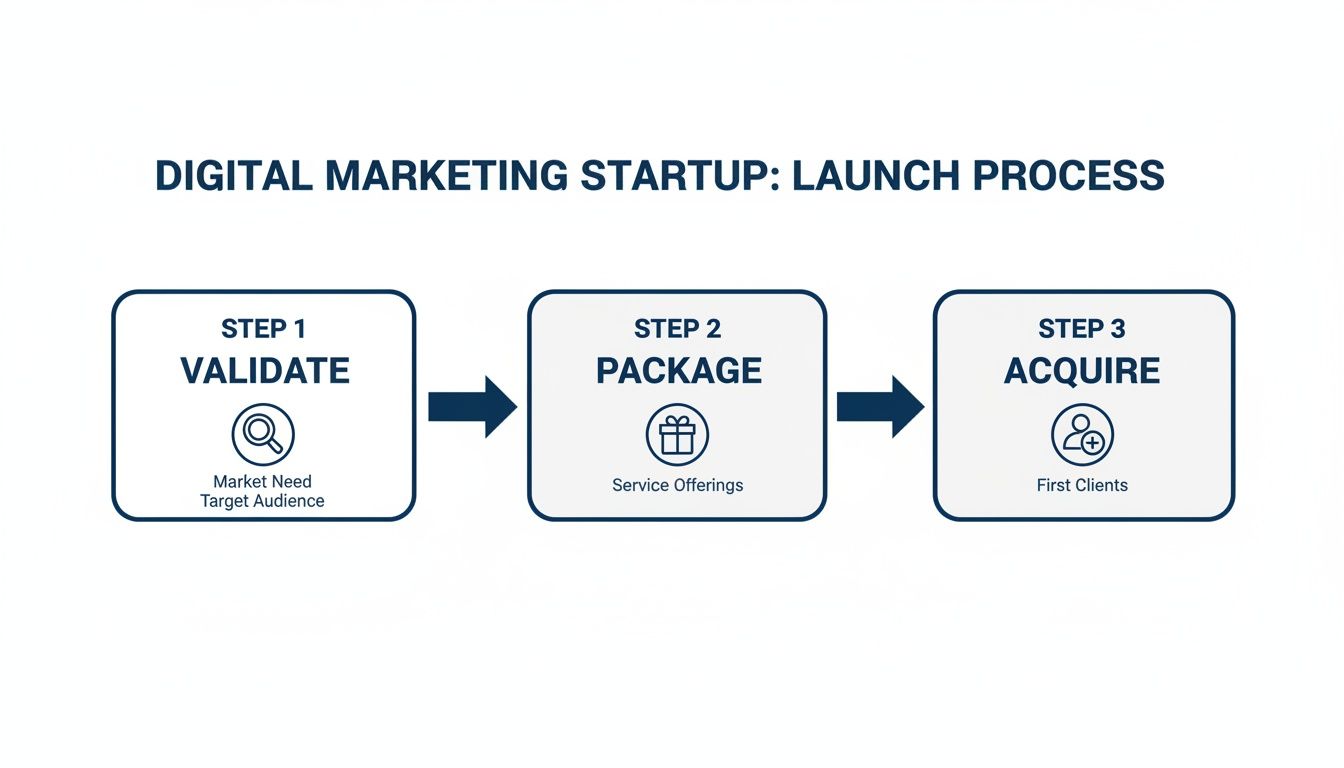
Following this simple visual ensures every move you make is grounded in proven market demand.
A Real-World Example of Finding a Niche
Let's make this practical. Imagine you're looking for opportunities in the B2B software industry.
You use an ad intelligence tool to filter for SaaS companies running ads on Meta's platforms. You narrow your search to companies that have been spending consistently for at least three months, which filters out hobbyists and leaves you with serious businesses.
Suddenly, you see a pattern. Several project management tools, all targeting construction firms, are spending a fortune on video ads. You investigate further and see their ad copy is all about boosting efficiency. But when you click through to their landing pages, they are generic, slow, and not optimized to convert visitors into leads.
This is your lightbulb moment.
You’ve just discovered a promising niche: Performance Marketing for Construction Tech SaaS. These companies have already validated the market, have a budget, and are actively seeking customers. You've spotted a clear weakness in their marketing funnel that your new agency can fix.
Key Takeaway: You're not inventing demand; you're discovering it. By seeing where the money is already flowing, you can position your services as the missing piece in a company's successful growth strategy.
From a Vague Idea to a High-Value Service
This data-driven approach transforms a generic idea like "I want to offer PPC services" into a powerful, specific pitch: "I help construction tech SaaS companies lower their cost-per-demo with optimized landing pages and targeted ad creative."
This level of specificity is what separates a thriving agency from one that struggles. It allows you to:
- Charge Premium Rates: You're not a generalist; you're a specialist solving a specific, high-value problem.
- Market Yourself Effectively: Finding clients becomes easier because you know exactly who to talk to and what their pain points are.
- Build a Strong Reputation: It’s faster to become the go-to expert in a small niche than to compete in the vast ocean of general marketing.
The best part is that this method is repeatable. Once you learn how to spot these opportunities, you can continuously find new gaps in the market. To learn more, check out our guide on how to find profitable niches that actually work.
Ultimately, you want to build a business on certainty, not hope. Following the ad spend is the most direct way to find clients who are ready and willing to pay for results.
Step 2: How to Package and Price Your Services
You've done the research and validated your niche. Now, it’s time to create an offer that is easy to understand and hard to refuse.
This isn't just about listing tasks. A great service package is a direct solution to a specific problem your ideal client faces. How you frame this solution—and how you price it—will determine your profitability and the quality of clients you attract.
The goal is to escape the "trading hours for dollars" trap. You're not selling "SEO services"; you're selling "more demo bookings for construction tech SaaS." This subtle shift in language changes everything. It positions you as a growth partner, not just another expense.
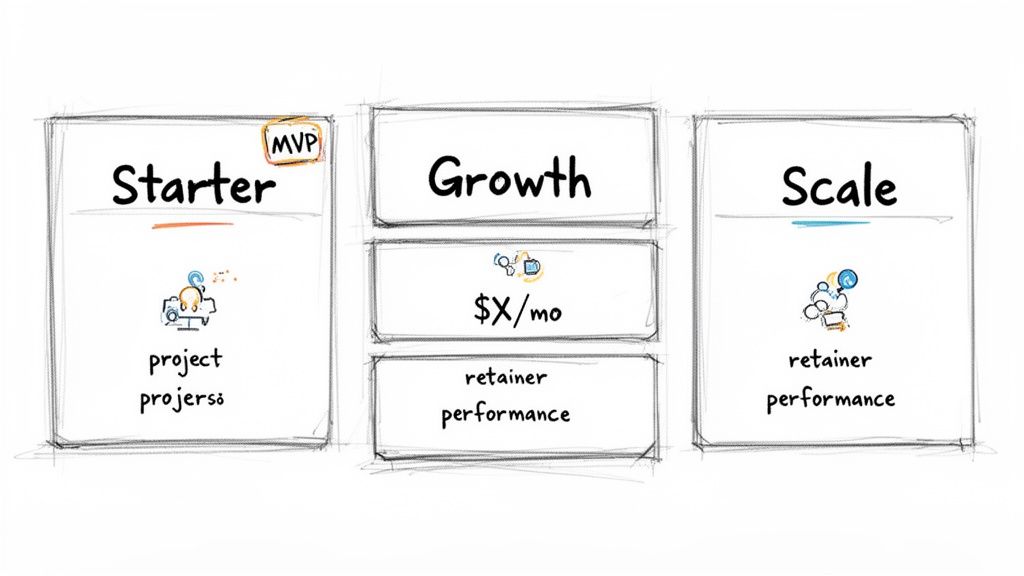
This visual shows a simple growth path. Starting with a single project allows you to prove your value before moving to a recurring retainer, which provides stable income.
Choosing Your Pricing Model
When you’re starting out, you'll encounter three common pricing models. The right one depends on what you’re selling and who you’re selling it to.
Project-Based Fees: This is ideal for one-off jobs with a clear start and end, like building a landing page or conducting an SEO audit. It's a great way to start with a new client because it’s a low-risk, defined commitment for them.
Monthly Retainers: This is the goal for most agencies. The client pays a set fee each month for ongoing work, such as managing their ad accounts. This creates predictable, recurring revenue—the foundation of a stable business.
Performance-Based Models: This model is for the confident. Your payment is tied directly to the results you generate, such as a percentage of ad spend or a fee for each qualified lead. It's higher risk, but the reward can be significant, and it shows clients you have skin in the game.
A common path for a new agency is to begin with a project to prove your value, then transition that happy client into a monthly retainer.
Crafting Your Minimum Viable Package
When you're starting, keep it simple. You don't need a long menu of services. You need one simple, high-impact offer that solves one urgent problem. This is your Minimum Viable Package (MVP).
It should be easy for clients to understand, easy for you to deliver, and priced as a clear win for them.
Let's return to our niche: "Performance Marketing for Construction Tech SaaS." You identified that their expensive ad traffic wasn't converting on their landing pages.
A perfect MVP would be a "Landing Page Conversion Boost" package. Here's a simple visual breakdown:
| Component | What You Do | The Value for the Client |
|---|---|---|
| Landing Page Audit | Analyze their current page to find all conversion blockers. | They get a clear, data-backed report on exactly why they're losing leads. |
| Competitor Teardown | Research what their top competitors are doing successfully. | They get actionable insights and see what's working in their industry. |
| New Page Wireframe | Provide a blueprint for a new, high-converting landing page. | They get a tangible asset to give their developer, saving them time and guesswork. |
This package is focused and delivers immense value quickly. You could price this one-time project at $2,500. For the client, it's a small investment to test your expertise, which can open the door to a larger, ongoing retainer relationship.
Key Takeaway: Your first offer shouldn't cover everything you can do. It should be the one thing your client needs you to do right now. Solve one painful problem exceptionally well, and you'll earn the trust to solve more.
This targeted approach makes selling much easier. You're no longer just "another marketing agency"; you're the specialist who fixes leaky funnels for construction software companies. That clarity helps you stand out and build a profitable startup from day one.
Step 3: Building Your Client Acquisition System
You’ve validated your niche and created a compelling offer. Now, let’s build the engine that brings clients to you. This is about creating a repeatable system that generates leads and closes deals, ensuring a steady stream of revenue.
Forget generic advice. We'll use the same ad intelligence that helped you find your niche to now target your ideal clients with precision. The goal is to build a reliable sales pipeline, not just a list of one-off projects.
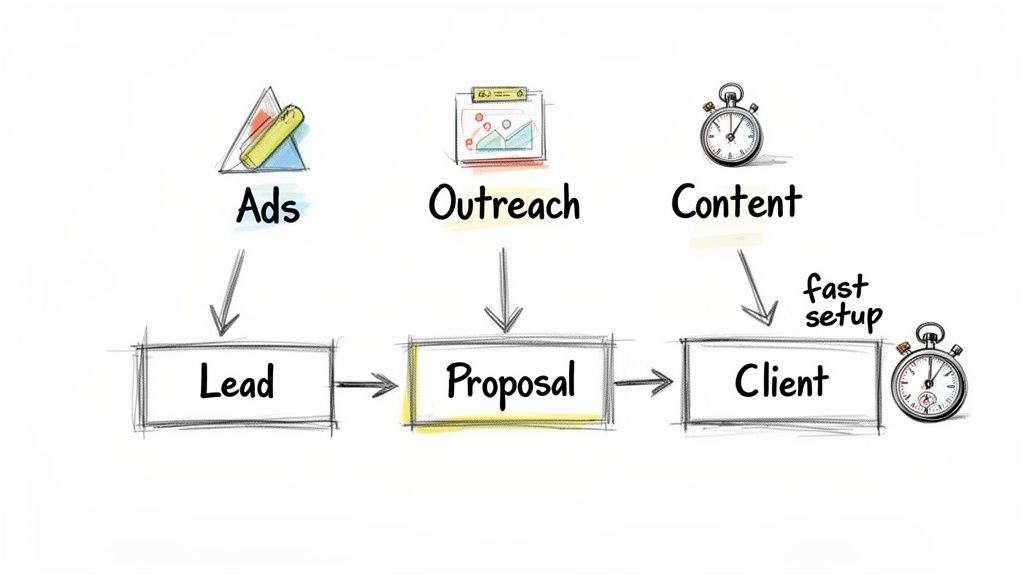
This visual shows a simple path: use ads, outreach, and content to get leads, then move them to a proposal and win them as a client.
Use Competitor Insights for Precision Targeting
You already have a huge advantage. Your niche research didn't just give you an idea; it gave you a ready-made list of potential clients and a deep understanding of their challenges. Now, we use that intelligence to create marketing that connects.
Let's return to our "Performance Marketing for Construction Tech SaaS" niche. You know who the key players are, you’ve seen their ads, and you’ve spotted their weak landing pages. This is the perfect information to fuel your first client acquisition campaigns.
Initially, focus your energy on three core channels:
- Paid Ads: Run tightly focused campaigns on platforms like LinkedIn or Meta to get your message directly in front of decision-makers at your target companies.
- Intelligent Outreach: Ditch generic templates. Write personalized emails that highlight specific issues you found in their marketing, positioning yourself as an expert from the first interaction.
- Simple Content: You don't need a massive blog. Create a short case study or a practical guide that shows how you solve their exact problem.
These channels work together to build awareness, demonstrate your value, and start conversations with potential clients.
Executing Your First Acquisition Campaigns
When you're starting, you must be efficient. Your budget is tight, and your time is valuable. The key is to run small, focused campaigns that generate leads while teaching you what works.
Running a Hyper-Targeted Ad Campaign
Forget about broad "brand awareness." Your first ad campaign should be designed to reach a handful of key people. On a platform like LinkedIn, you can target by specific company names, job titles like "VP of Marketing," and industry, such as "Construction Software."
Here is a practical example of LinkedIn ad copy:
Example Ad Copy:
"Construction Tech SaaS companies: Are your ads sending traffic to landing pages that don't convert? We found a common mistake that costs demo bookings. We fix it."
This ad is direct, speaks to a specific pain point, and is based on your research. It can lead to a simple landing page offering a free "Landing Page Teardown" to capture their contact information. For more on this, our guide on the 12 best Facebook ad spy tools for SaaS founders can be very helpful.
Crafting Outreach That Gets a Reply
Cold outreach works best when it's not actually cold. Your research is your secret weapon, allowing you to send "warm" emails because you know their problems—you've seen them.
Keep your email simple and valuable:
- The Observation: "Hi [Name], I noticed you're running some great video ads on Meta for your project management tool."
- The Insight: "I spotted one opportunity on your landing page that could potentially boost your demo sign-up rate by 15-20%."
- The Offer: "I recorded a quick 5-minute video showing the exact change. Would you be open to me sending it over?"
This approach is helpful, not pushy. It gives value upfront and makes it easy for them to say yes.
The market you're entering is growing rapidly. Digital channels are set to consume 72% of total marketing budgets by 2025, with overall spending climbing to 9.4% of company revenue. As digital ad spend rockets toward $730 billion in 2025, this data-driven environment creates massive opportunities for startups that can turn ad intelligence into client results.
Creating Content as Your Salesperson
You don't need a huge blog or a polished YouTube channel to start. Your first piece of content should be a simple asset that solves your niche's biggest problem. For our example, a perfect start would be a short PDF: "The 3 Landing Page Mistakes Costing Construction SaaS Companies Leads."
This single asset works hard for you. You can promote it in your ads and offer it in your outreach. It does three crucial things:
- Builds Authority: It immediately positions you as an expert.
- Generates Leads: It’s a simple, valuable exchange for a prospect’s contact information.
- Qualifies Prospects: Anyone who downloads it is signaling that they have this problem.
To keep your pipeline full while you focus on closing deals, you might consider outsourcing lead generation services. This mix of targeted ads, smart outreach, and valuable content creates a powerful, repeatable system for getting your first clients.
Step 4: Setting Up Lean Operations to Scale Smart
You can be the best marketer in the world, but without solid operations, your startup can't grow. A common founder trap is getting so buried in administrative work that you have no time for clients.
The goal is to be lean, smart, and intentional. A streamlined setup allows a small agency to deliver top-tier work and keep clients happy from the start.
Building Your Core Tech Stack
Your initial tech stack should be simple and affordable. The idea is to automate repetitive tasks and keep everything organized. Think of these tools as the central nervous system for your business.
You only need to cover three key areas:
- Project Management: This is your command center. Tools like Trello, Asana, or ClickUp are excellent. A simple board showing tasks moving from "To-Do" to "In Progress" to "Done" reduces confusion.
- Client Communication: Clear communication builds trust. While email is fine, a dedicated space like a Slack channel keeps everything organized and easy to find.
- Financial Tracking: You must know your numbers. Tools like QuickBooks Self-Employed or Wave are built for startups. They make it easy to send invoices, track expenses, and see your profitability.
Most of these tools have generous free plans that are more than enough for your first few clients.
Defining KPIs That Actually Matter
It’s easy to get lost in vanity metrics like likes and impressions. To prove your worth, you must focus on Key Performance Indicators (KPIs) that truly matter—for your clients and for your own agency.
Your success is measured by your clients' success. When you report on the metrics they care about most, you change the conversation from cost to investment.
For your clients, the KPIs that matter are almost always tied to revenue.
Client-Facing KPIs to Track:
- Return on Ad Spend (ROAS): This is the ultimate measure of profitability. A 4:1 ROAS means for every dollar they spend on ads, you're making them four dollars back. It's a powerful and undeniable metric.
- Cost Per Acquisition (CPA): How much does it cost to get a new customer? Your job is to lower this number over time.
- Lead-to-Close Rate: For B2B clients, this is crucial. It shows the quality of the leads you're generating by tracking how many become paying customers.
While focusing on client results, don't forget to monitor the health of your own agency.
Internal Agency KPIs to Monitor:
- Client Lifetime Value (LTV): How much is a client worth to you over your entire relationship? A high LTV means you're retaining clients, which is key to sustainable growth.
- Profit Margin: This is your revenue minus your costs. For a service business, aim for a healthy margin of 50% or more to reinvest in the business.
- Customer Acquisition Cost (CAC): How much do you spend to land a new client? This must be lower than your LTV. You can see how you compare by exploring CAC payback benchmarks.
Investor confidence in this sector signals its potential. Funding for digital marketing startups has hit staggering numbers, with companies like Integrity Marketing Group securing over $2.1 billion. With the industry projected to grow at a 13.9% CAGR and hit $807 billion by 2026, agencies with lean, scalable operations are positioned for success. You can discover more about the trends driving digital marketing investment to see how it’s shaping the industry.
Your Questions Answered: Starting Your Agency
Even with a solid plan, starting your own digital marketing agency brings up questions. It's normal to feel a mix of excitement and uncertainty. You're not alone.
To help you move forward, here are answers to the most common questions from founders in your position. These are practical answers to help you overcome the first hurdles.
How Much Money Do I Really Need to Get Started?
The good news is that a service-based agency is one of the most budget-friendly businesses you can start. Unlike a tech startup that needs significant capital, your main investment is your time and expertise.
You can genuinely get started on a very small budget. Forget a fancy office or a large team—your first costs are for essential tools.
A Lean Startup Budget for Your First Three Months
| Category | Estimated Monthly Cost | Total 3-Month Cost | Practical Advice |
|---|---|---|---|
| Business Registration | $0 (One-time) | ~$100-$500 | Varies by location. Don't skip this legal step. |
| Project Management | $0 - $15 | $0 - $45 | Trello and Asana have excellent free plans. |
| Invoicing/Accounting | $0 - $30 | $0 - $90 | Wave is free; QuickBooks is a good next step. |
| Domain & Email | ~$5 | ~$15 | A professional email address is essential for credibility. |
| Client Acquisition | ~$100 | ~$300 | A small, focused budget for your first ads. |
| Total Estimated Cost | ~$120 - $150 | ~$455 - $950 | This is a bootstrapped start. Reinvest your first profits. |
As you can see, you don’t need a massive investment. The plan is simple: stay lean, reinvest your first profits back into the business, and only add costs when your revenue can easily support it.
What's the Fastest Way to Land My First Client?
Getting your first paying client is a huge milestone—it proves your business is viable. For now, forget complex funnels. The quickest path to a signed contract is direct, personal, and value-driven.
Here's a simple 30-day plan based on your niche research:
List 10 Dream Clients: From your research, identify ten companies in your niche that are already spending on ads but have a clear weakness you can fix.
Create a "Mini-Audit": Spend an hour on each. Create a simple, one-page report or a five-minute Loom video pointing out one specific, high-impact opportunity you found. This is a free sample of your expertise.
Send a Hyper-Personalized Note: Don't use templates. Write a short email or LinkedIn message. Mention their ads and the specific opportunity you found. Then, offer to share your mini-audit for free.
Pitch a Low-Risk Project: Once they see the value you provided, suggest your Minimum Viable Package. Position it as a low-commitment way to solve the exact problem you highlighted. A one-time project fee of $1,500 - $2,500 is often an easy "yes" for a business already spending thousands on ads.
This works because you lead with undeniable value, not a generic sales pitch.
Should I Specialize or Offer Everything?
It's tempting to be a "one-stop shop," but this is one of the biggest mistakes a new agency can make.
Specialization is your superpower. In a crowded market, being a generalist makes you a commodity. Being a specialist makes you an expert.
Especially in the beginning, you must specialize. Choosing a niche like "PPC for B2B SaaS" or "Email Marketing for E-commerce" is the fastest way to get noticed.
Here’s why this is critical:
- You Stand Out Instantly: It's easier to become the go-to expert for a specific problem than to compete with thousands of general agencies.
- You Can Charge More: Specialists solve specific, expensive problems, allowing you to command premium rates.
- Your Marketing Becomes Easier: When you know exactly who you're talking to, your ads and website copy become more effective. It’s no surprise that 22% of startups fail due to a poor marketing strategy—specializing gives you the focus you need.
It's normal to fear missing out, but think of specialization as your launchpad. You can always expand your services later, once you’ve built a strong reputation with happy clients.
Ready to stop guessing and start building on a foundation of real market data? Proven SaaS is the advertising intelligence platform that helps you find profitable SaaS ideas by analyzing who is already succeeding with paid ads. Discover your niche, validate your idea, and launch with confidence.
Build SaaS That's
Already Proven.
14,500+ SaaS with real revenue, ads & tech stacks.
Skip the guesswork. Build what works.
Trusted by 1,800+ founders


