

Branding isn't just a logo or a catchy name. It's the entire experience a customer has with your company. It's how you make them feel. For a startup, strong branding isn't a "nice-to-have"; it's a strategic tool that builds trust, cuts through the noise, and lays the foundation for sustainable growth. This guide breaks down the process into clear, actionable steps.
Step 1: Build Your Foundation with Competitive Intelligence
Before picking a single color or brainstorming a name, you need to understand the world you're entering. Great branding isn't built on guesswork; it's built on a sharp understanding of your competitors—what’s working for them, who they're talking to, and where the real opportunities are hiding.
This research de-risks your brand before you even build it. Instead of staring at a blank page, you start with a map of proven strategies and messages that already connect with paying customers.
Find Competitors with Proven Demand
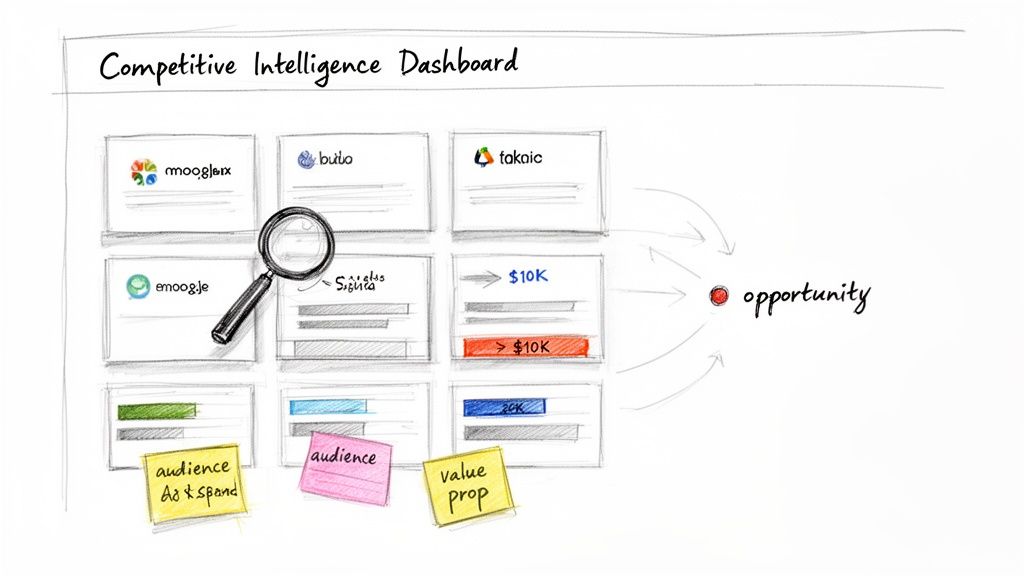
How do you know if a market is worth entering? Find companies already spending serious money to win customers there. If a competitor consistently spends over $10,000 a month on ads, that’s a powerful signal. It means they've found a profitable audience and a message that works. Their investment is your validation.
Ad intelligence tools are invaluable here. For example, a platform like Proven SaaS analyzes Meta's public Ad Library, linking ads to the SaaS companies running them. This lets you track spending patterns and focus only on players who have a working customer acquisition model.
Key Takeaway: Look for validated competitors. A company spending five figures monthly on ads isn't guessing—they've found a repeatable way to turn ad dollars into revenue.
Reverse-Engineer Their Winning Playbooks
Once you’ve identified your key players, it's time to dig in. The goal isn't to copy them but to understand why they succeed. This means analyzing every public piece of their brand.
Here’s what to look for:
- Core Messaging: What's the main headline on their homepage? What pain point do their ads highlight? For example, does their copy promise "effortless collaboration" or "ironclad security"? Those words tell you what their audience values.
- Value Propositions: What specific benefits do they promise? Look for phrases like "save 10 hours a week," "double your conversion rate," or "never lose a file again." These are the concrete outcomes they're selling.
- Target Audience Clues: Who are they talking to? The images they use, their tone of voice, and the customer logos on their site are direct clues. An ad featuring a construction site speaks to a very different audience than one showing a marketing team in a boardroom.
In the competitive SaaS world, a strong brand can cut customer acquisition costs (CAC) by up to 30% in the first few years. Bootstrapped SaaS companies often show higher median revenue growth (31%) than their VC-backed counterparts (27%) because a consistent brand builds trust faster, reducing reliance on massive ad budgets.
A Simple Framework for Your Analysis
Use this table to organize your findings as you analyze each competitor.
| Analysis Area | What to Look For | Example Insight |
|---|---|---|
| Messaging | Homepage headlines, ad copy, slogans. | "Competitor A's ads consistently use the phrase 'AI-powered automation for agencies.'" |
| Value Props | Benefits listed on features, pricing, and testimonial pages. | "Competitor B highlights '24/7 support' and '99.9% uptime' to appeal to enterprise users." |
| Audience | Imagery, case studies, website copy, and language in ads. | "Competitor C uses images of remote teams and focuses on 'collaboration' for distributed work." |
| Pricing | Tiers, free trial offers, annual discounts. | "All major competitors offer a 14-day free trial, but none have a free-forever plan." |
Filling this out for your top 3-5 competitors gives you a clear map of the market, making it much easier to find your unique spot.
Find Your Unique Angle
After mapping out what successful competitors are doing, patterns will emerge. Maybe everyone is chasing enterprise clients, leaving a huge opening for a tool built for small businesses. Or perhaps they all compete on complex features, creating an opportunity for a simpler, more intuitive solution.
Your unique brand position lives in these gaps—the underserved needs and overlooked audiences. This isn't about being different for the sake of it. It’s about being different in a way that delivers real, distinct value.
For a deeper dive, check out this guide on how to conduct a SaaS competitive analysis that actually works. Building your brand on solid market intelligence ensures you’re solving a real problem from day one.
Step 2: Choose a Name That Clicks
With a clear view of the market, it's time to name your brand. A great name is more than just clever—it’s memorable, easy to say, and hints at the value you provide. It’s the first impression and sets the tone for everything that follows.
For example, a descriptive name like SurveyMonkey tells you exactly what it does. A more evocative name like Notion suggests big ideas and organized creativity.
How to Brainstorm Your Perfect Name
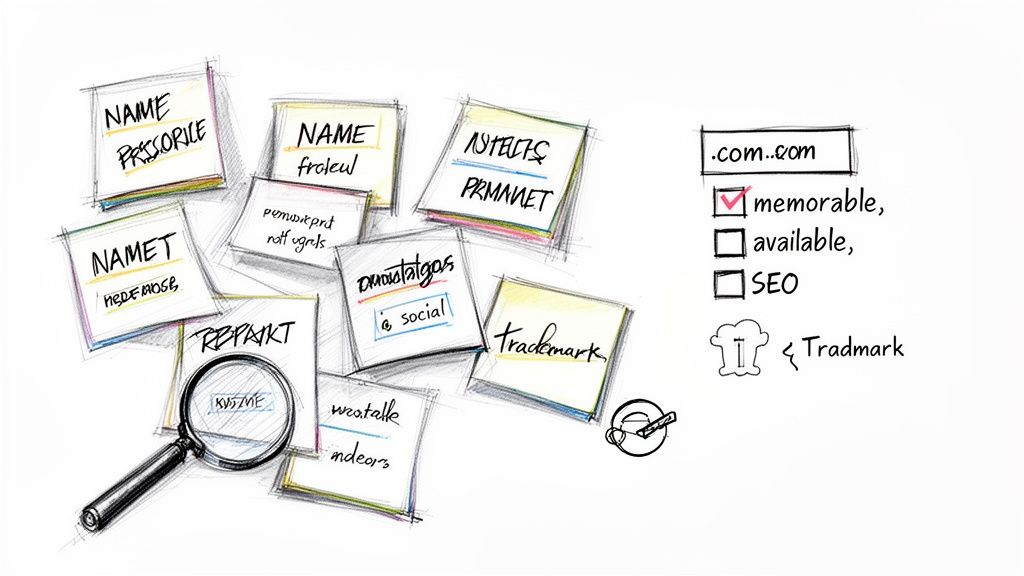
Don't overthink it at first. The goal is to create a massive, unfiltered list of ideas. No judgment.
Here are a few simple frameworks to get you started:
- Combine Keywords: Take words related to your industry and see what sticks. A tool for scheduling social media posts could blend "social" and "pilot," giving you SocialPilot.
- Use a Metaphor: What concept represents your benefit? The founders of Intercom used the idea of an internal communication system to frame their customer messaging tool.
- Invent a New Word: Tweak a real word or combine two. ClickUp is a perfect example—it's short, catchy, and implies action and efficiency.
- Name the Outcome: What’s the end result for your customer? The email client Superhuman promises a faster, better experience, focusing on the feeling you get after using it.
Write down every idea, even the silly ones. A bad idea can often spark a brilliant one.
The Critical Vetting Checklist
Have a shortlist? Great. Now, it's time for a reality check. A name is useless if you can't own the digital real estate that goes with it.
Pro Tip: Don't fall in love with a name before checking its availability. The only perfect name is one you can actually use.
Run your top choices through this essential checklist:
- Domain Availability: Is the
.comfree? While other options exist,.comis still the gold standard. It's what people type by default. - Social Media Handles: Check for the name on X (Twitter), LinkedIn, and other platforms where your customers hang out. Consistency is key for a cohesive brand.
- Search Engine Clarity: Google your top names. Are you competing with a common word or a massive brand in another industry? A generic name like "Apex" is an SEO nightmare, while a unique name gives you a clean slate to rank for.
- Trademark Search: Do a quick search on the USPTO database (or your country's equivalent) to avoid legal trouble down the road.
This process ensures your chosen name gives you a clear and ownable footprint online.
If you're still refining your market position, our Niche Validator tool can help you size up the competition before you fully commit to a name.
Step 3: Craft a Message That Connects
Now it’s time to turn your strategy into words that resonate. This is where your brand becomes a clear, powerful message that connects with your ideal customer. Forget listing features; focus on articulating value. Every word on your website and in your ads should tell the same story about the problem you solve.
A Simple Framework for Powerful Messaging
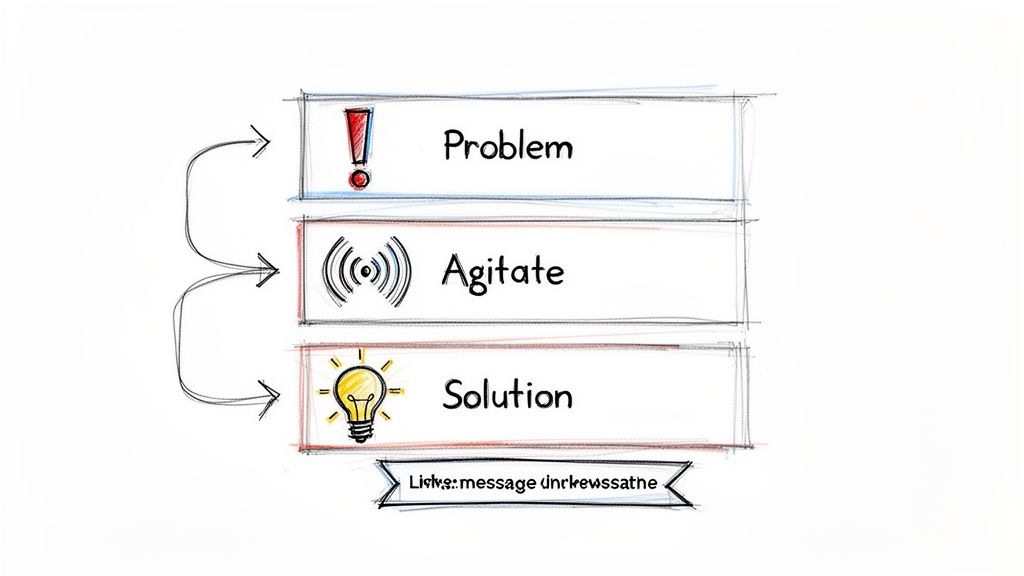
One of the most effective frameworks for copy that converts is Problem, Agitate, Solution (PAS). It’s a simple three-step structure that works.
- Problem: Start by clearly stating your customer's biggest frustration. Show them you understand their pain.
- Agitate: Don't just state the problem—amplify it. Explain why it’s so frustrating and what happens if it's left unsolved.
- Solution: With the pain fresh in their mind, present your product as the clear, obvious relief they've been looking for.
This structure connects on an emotional level first, hooking into a real frustration before presenting a logical solution.
Putting PAS into Practice: An Example
Imagine you're building a SaaS tool for freelance designers to manage projects and invoicing.
- Problem: "Juggling client feedback, project files, and invoices across a dozen different apps is chaotic."
- Agitate: "That chaos leads to missed deadlines, lost files, and awkward 'Have you paid yet?' emails. It damages your reputation and your bank account."
- Solution: "Our platform brings all your projects, feedback, and payments into one calm, organized dashboard, so you can focus on creating, not administrating."
See how that transforms a dry feature list into a compelling story that solves a painful problem? That's the core of a strong message.
Nail Your One-Liner Value Proposition
Your value proposition is the PAS framework distilled into a single, punchy sentence. This is the most important copy you'll write. It grabs attention on your website, in your social media bios, and on your pitch deck.
A great template is: We help [Specific Audience] achieve [Desired Outcome] with [Your Unique Method].
Let’s look at a few examples:
- Slack: "Slack is your digital HQ. It brings your team’s communication together, giving everyone a shared workspace where conversations are organized and accessible."
- Canva: "Design anything. Canva is a free-to-use online graphic design tool. Create social media posts, presentations, posters, videos, logos and more."
Notice they focus on the outcome, not the features. "Your digital HQ" is much more powerful than "a real-time messaging app."
Key Insight: When customers truly get the value you provide, it can push your Net Revenue Retention (NRR) past 120%. A user who understands and achieves value in their first 14 days is 3x less likely to churn in the next 90 days.
Think of your message as your brand's voice. A simple framework like PAS and a clear value proposition give your entire team a consistent story to tell—one that every customer will immediately understand.
Step 4: Design a Lean, Memorable Visual Identity
You don't need a massive budget to look professional. You just need a smart, simple system. A powerful visual identity is built on consistency, not complexity. The goal is to create a cohesive look you can launch with quickly and manage without a full-time design team.
Start with the Essentials: A Logo, Colors, and Fonts
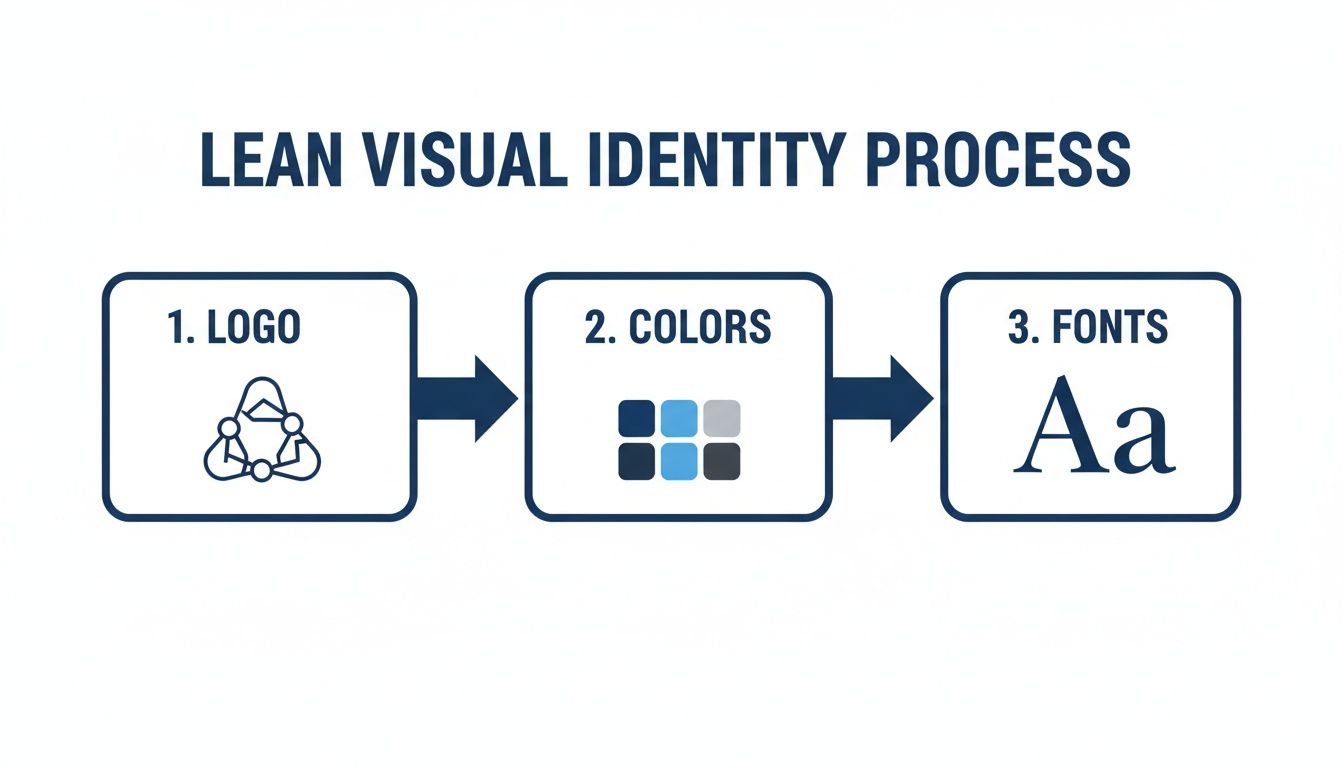
Forget a 50-page brand guide. Your Minimum Viable Brand (MVB) only needs three core components. Get these right, and you're 90% of the way there.
A Simple, Scalable Logo: Your logo has to work everywhere, from a tiny browser favicon to a website header. Overly detailed designs become unreadable when small. A clean wordmark or a simple icon is almost always the best choice for a startup.
A Limited Color Palette: Less is more. Stick to two or three main colors. This constraint forces consistency and makes your brand instantly recognizable. Think of Stripe's iconic blue and purple, or a simple black-and-white palette with one bright accent color for call-to-action buttons.
One or Two Consistent Fonts: Choose one font for headlines (like a bold sans-serif) and another for body text (a clean, readable sans-serif is best). Google Fonts offers a huge library of excellent, free options.
These three elements are your foundation. They ensure everything from your website to your first pitch deck feels like it came from the same credible company.
Where to Invest vs. Where to Save
With a lean budget, every dollar counts. Know where to spend and where to be resourceful.
| Area of Investment | Where to Spend (Invest) | Where to Save (Be Resourceful) |
|---|---|---|
| Logo Design | Hire a good freelancer for a few hundred dollars. A unique, professional logo is a long-term asset. | Avoid design contests or $5 logo generators. They produce generic, forgettable results. |
| Photography | N/A for most early SaaS. You don't need custom photoshoots. | Use high-quality, free stock photo sites like Unsplash or Pexels. Choose images that match your brand’s tone. |
| Graphic Assets | N/A. Your logo and color palette are enough to start. | Use a free tool like Canva to create social media posts or simple ads. Customize templates with your brand colors and fonts. |
| Typography | N/A. Don't buy custom fonts yet. | Stick to the free, high-quality fonts on Google Fonts. |
This approach lets you build a brand that punches above its weight, focusing your cash on the one thing that matters most: a solid, memorable logo.
Remember: A great visual identity without a clear message is like a beautiful car with no engine. Your visuals exist to support and amplify the core message you’ve already crafted.
Build Your MVP Brand Kit
Once you have your logo, colors, and fonts, pull them into a simple "MVP Brand Kit." This is just a shared folder with the core assets your team needs.
Here's what to include:
- Your Logo: SVG (for web), PNG (transparent background), and versions in full color, all black, and all white.
- Color Codes: A simple text file with the HEX codes for your brand colors.
- Font Files: The actual font files (
.ttfor.otf) for your headline and body text, with a quick note on which is which.
That’s it. With this simple kit, anyone on your team can create on-brand materials for your website, social media, or sales deck, ensuring you look polished and professional from day one.
Step 5: Launch Your Brand with a Go-To-Market Checklist
You have a brand strategy, a name, and a visual identity. Now it’s time to launch. A great launch is a coordinated push to ensure your new brand shows up consistently everywhere that matters, right from the start.
Think of this as a focused plan covering what to do before, during, and after you go live. This checklist is your playbook for making an impact from day one.
Pre-Launch: Setting the Stage
The work you do before launch day is what makes it a success. This is all about preparation.
- Claim Your Digital Real Estate: Secure your brand name on every relevant social media platform—even ones you don't plan to use immediately. Grab your handle on X (formerly Twitter), LinkedIn, and YouTube.
- Update Your Profiles: Use your new logo and color palette to create on-brand profile pictures and banner images. Write a compelling bio for each platform using your one-liner value proposition. Your core message must be identical everywhere.
- Prepare Your Launch Content: Get your first few pieces of content ready ahead of time. This could be your first blog post, an "About Us" page, or the copy for your Product Hunt launch.
A launch is won in the prep work. Getting your channels locked down beforehand frees you up to focus on engagement and momentum on launch day.
The Launch Day Push
Launch day is about creating a concentrated burst of energy to get your brand in front of as many of the right people as possible in a short window.
This visual shows how the core components of your brand—logo, colors, and fonts—should be applied to all your launch materials for a cohesive and professional look.
Post-Launch: Keeping the Momentum
Your launch is the starting line, not the finish line. What you do in the following weeks is crucial for turning initial buzz into sustained growth.
- Engage with Everyone: Respond to every comment, question, and mention. Thank people for their feedback. This early engagement builds community and shows you’re listening.
- Publish Helpful Content: Instead of just another blog post, build a free tool, calculator, or valuable template that solves a small problem for your ideal customer.
- Monitor Your Brand: Set up alerts to track mentions of your company name. This feedback is gold and will inform your next steps.
That helpful content piece is especially important. A staggering 86% of SaaS startups fail due to gaps in trust and visibility. However, companies that create organic moats—like free calculators that can boost engagement by 40%—often gain a 31% growth edge. You can explore more SaaS marketing trends from Disruptive Advertising.
This approach transforms your brand from just another product into an indispensable resource, building trust and driving organic traffic from day one.
MVP Brand Launch Checklist
Use this simple checklist to guide you through the process.
| Phase | Key Task | Success Metric |
|---|---|---|
| Pre-Launch | Secure social handles & update profiles with consistent branding. | All key social profiles are claimed and visually aligned. |
| Pre-Launch | Prepare initial content (e.g., first blog post, "About Us" page). | 3-5 pieces of content are drafted, edited, and ready to go. |
| Launch Day | Announce on primary channels (LinkedIn, X, Product Hunt). | Hit target engagement numbers (e.g., 100 upvotes, 50 shares). |
| Launch Day | Actively engage with comments, questions, and feedback in real-time. | 100% of mentions/comments responded to within 2 hours. |
| Post-Launch | Publish first helpful content piece (e.g., free template, calculator). | 500+ visits to the new content piece within the first week. |
| Post-Launch | Set up brand monitoring and start tracking conversations. | Brand mentions are tracked daily, with a weekly feedback summary. |
A structured plan turns your launch from a guess into a strategic move that introduces your brand with clarity, consistency, and impact.
Got Questions? We’ve Got Answers.
Branding can feel overwhelming at first. Most founders get stuck on the same few questions. Let's tackle them head-on with battle-tested answers.
How much should a startup budget for branding?
Forget big dollar amounts. Think in terms of priorities. Your biggest investment costs nothing: the time you spend validating your market and position. That work pays for itself a hundred times over.
Once your strategy is set, you can get a polished brand off the ground for very little cash.
- Logo Design: This is where a small investment goes a long way. Budget a few hundred dollars for a professional freelancer. A clean logo is a core asset you’ll use for years.
- Visuals & Graphics: Get by with free tools. Canva is perfect for social media posts. Customize their templates with your brand colors and fonts.
- Typography: Don't spend a cent. Google Fonts offers a massive library of high-quality, free fonts.
The goal is to launch a consistent, professional MVP brand built on a data-backed strategy.
Can I change my startup's branding later?
Absolutely. In fact, you almost certainly will. Think of your launch brand as version 1.0. It's a tool to get you to market and start learning from customers. As your product and market evolve, your brand should evolve too.
The true foundation you’re laying now isn't the logo—it's your market position and core message. When that is solid, updating your visuals later becomes a smart, strategic process. Don't let the fear of "getting it wrong" stop you. Launch, learn, and iterate.
What's the single most important part of branding for a startup?
If you remember one thing, make it this: consistency. For a new brand, consistency is the ultimate force multiplier.
It’s the glue that holds everything together. When your message, visuals, and tone are the same across your website, app, and ads, you build trust and recognition incredibly fast. An inconsistent brand creates confusion and erodes credibility.
Even if your first logo isn't perfect, using it everywhere is far better than using five slightly different versions in different places. Consistency is your most powerful and cost-effective branding weapon.
How can I measure the ROI of my branding efforts?
You don't need a huge research budget to see if your branding is working. Just track a few key metrics:
- Branded Search Volume: Are people searching for your company by name? You can track this for free in Google Search Console. A steady increase means awareness is growing.
- Customer Acquisition Cost (CAC): As your brand strengthens, your reliance on paid ads should decrease, bringing more customers directly to you and lowering your CAC.
- Net Revenue Retention (NRR): A strong brand creates loyalty. Loyal customers don't churn and are more likely to upgrade, directly boosting your NRR.
Tracking these numbers connects your branding work to real business results. It proves that a strong brand is a critical engine for growth.
Ready to stop guessing and start building on a foundation of proven market demand? Proven SaaS gives you the advertising intelligence to find profitable SaaS ideas where competitors are already spending big. See what's working and launch with confidence.
Build SaaS That's
Already Proven.
14,500+ SaaS with real revenue, ads & tech stacks.
Skip the guesswork. Build what works.
Trusted by 1,800+ founders


