


Competitive intelligence isn't just about knowing your rivals' names; it's about understanding their playbook to find your unfair advantage. For SaaS founders, the challenge is separating actionable signals from overwhelming noise. Generic tools often provide surface-level data, leaving you to connect the dots. They might show you a competitor's website traffic but fail to answer the most critical questions: Which marketing channels are actually profitable for them? What specific features are driving their user engagement?
This guide cuts through that clutter. We’re not just listing platforms; we're ranking the 12 best competitive intelligence tools based on specific, real-world SaaS needs—from validating a product idea by analyzing ad spend to equipping your sales team with battlecards that win deals. Specialized competitor AI analysis tools are key to gaining these strategic advantages.
Each tool is reviewed with a clear focus: how does it help you make better, faster decisions? We provide concrete examples, screenshots, and honest pros and cons. This will help you find the right tool for your stage, whether you're a solo founder validating a niche or a scale-up defending market share. Let's dive in.
1. Proven SaaS
Best For: Validating SaaS Ideas with Ad-Driven Revenue Models
Proven SaaS is an AI-driven advertising intelligence platform built for a specific, high-stakes challenge: de-risking the launch of a new software product. Instead of relying on gut feelings, it uses a competitor's ad spend as a direct signal of market validation. The platform mines the Meta Ad Library, automatically linking ads to over 14,500 SaaS companies to show you who is spending consistently and profitably to acquire customers. This shifts competitive intelligence from reactive analysis to a proactive validation tool.
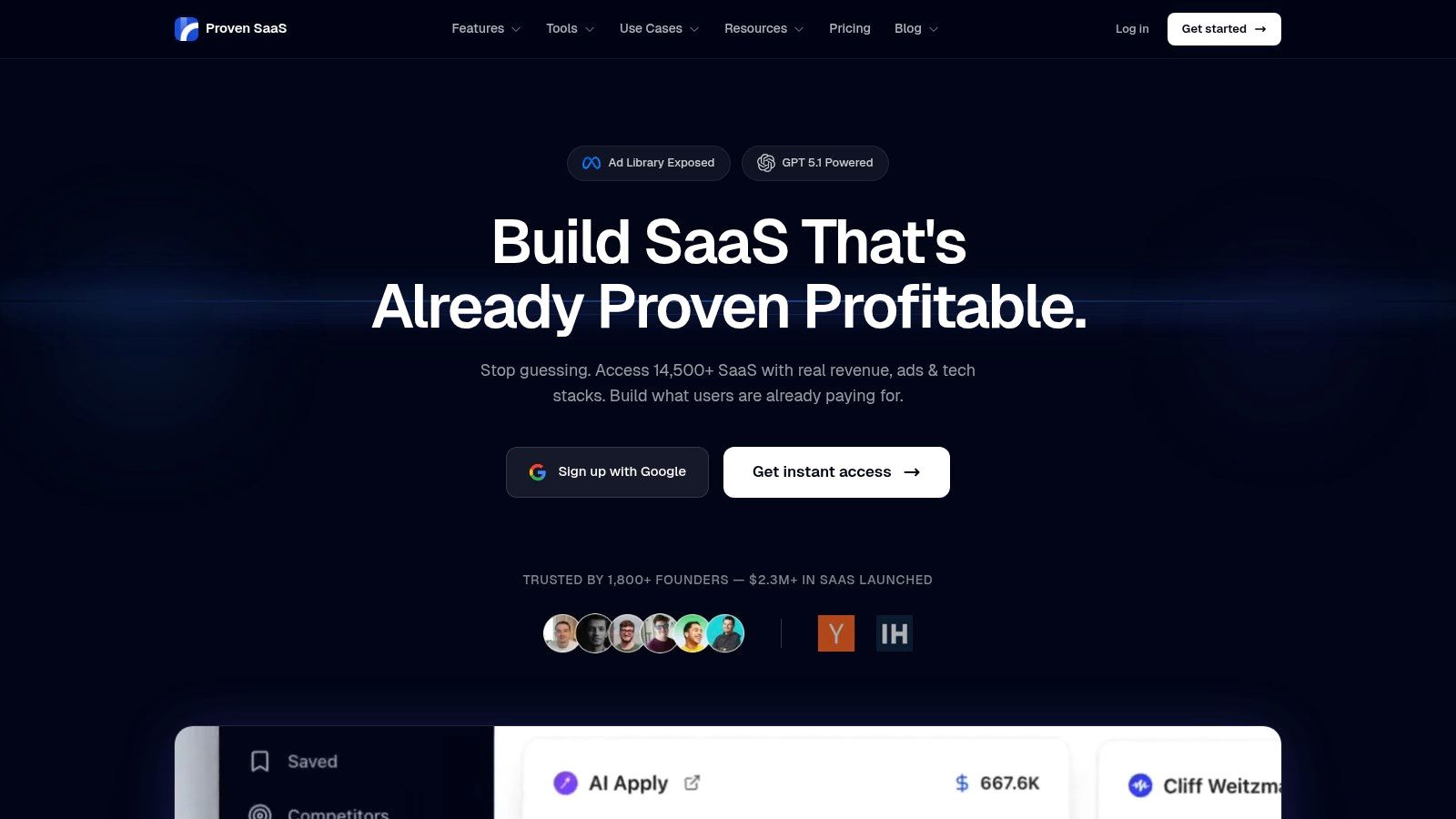
What sets Proven SaaS apart is how it turns raw advertising data into actionable business intelligence. It doesn’t just show you ads; its AI models estimate monthly ad spend and project corresponding revenue (MRR/ARR). This allows founders to quickly identify competitors with proven product-market fit. For example, if you see a competitor consistently spending over $10K per month on ads, that's a strong signal that their business model works. By analyzing their strategy, you can confidently enter a market where a paid acquisition playbook has already been proven. This makes it one of the best competitive intelligence tools for anyone building an ad-driven SaaS.
Key Features & Use Cases
- AI-Driven Revenue Modeling: Instead of just spying on ads, Proven SaaS connects ad spend to estimated revenue, helping you size up a competitor’s business model and market viability. This is invaluable for validating a niche before writing a single line of code.
- Comprehensive SaaS Database: Access a searchable library of 14,500+ SaaS profiles, updated hourly. You can filter by industry, growth signals, and ad spend to uncover hidden opportunities.
- Integrated Toolset: The platform combines an Ad Library, Competitor Finder, and Niche Validator into one simple interface, saving you from juggling multiple tools for market research.
- Focus on High-Signal Competitors: By prioritizing companies with significant ad budgets, the platform helps you focus on what's working at scale. You can analyze their top-performing creatives and landing pages to inform your own go-to-market strategy.
Pricing
Proven SaaS offers a tiered pricing structure, including several free tools to get started. For full access to its database and premium features, you'll need a paid subscription. Visit their official pricing page for the most current plans and to explore trial options.
Our Take
Proven SaaS excels by answering the most critical question for any new venture: "Is there a paying market for this?" While the revenue figures are estimates, they provide a powerful proxy for validation that few other tools can match. Its focus on ad-driven businesses is a limitation, as it may miss organically grown competitors. However, for founders planning to leverage paid acquisition, it's an indispensable platform for finding proven ideas and launching with a data-backed advantage.
Website: proven-saas.com
2. G2 – Competitive Intelligence category
Website: https://www.g2.com/categories/competitive-intelligence
G2 isn’t a competitive intelligence tool itself, but rather a meta-resource: a comprehensive software marketplace driven by verified user reviews. For SaaS founders, its dedicated Competitive Intelligence category is an essential first stop for building a shortlist of potential tools. It allows you to quickly survey the landscape, see who the major players are, and understand what real users think about them.
This platform shines by centralizing peer feedback, helping you cut through polished marketing copy to see how a tool actually performs. You can filter solutions by company size, industry, and specific features, making it one of the best competitive intelligence tools for initial discovery and validation.
Key Features & Use Cases
- Verified User Reviews: Access detailed feedback from actual users on what they love, dislike, and the business problems they solved. This is invaluable for gauging a tool's true strengths and weaknesses.
- Grid® Reports: G2’s quadrant-style reports visually map out market leaders, contenders, and niche players based on user satisfaction and market presence. Use these to quickly identify top-rated solutions.
- Side-by-Side Comparisons: Directly compare features, pricing, and user ratings for up to four different tools at once, streamlining your evaluation process.
Pricing
Access to G2 for research is completely free. The platform makes money from vendors who pay for enhanced profiles and lead generation features.
| Pros | Cons |
|---|---|
| Authentic user feedback provides unbiased, real-world insights. | Sponsored placements can sometimes influence tool visibility. |
| Granular filtering helps you find tools for your specific niche. | Pricing data is often crowd-sourced and may not be 100% accurate. |
| Easy to jump from research to vendor demos with direct links. | The sheer number of reviews can sometimes feel overwhelming. |
Pro Tip: Don't just look at the overall rating. Dive into the most recent reviews and filter them by company size to find feedback from users who most closely match your own profile. This gives you a more relevant picture of how the tool will work for you.
3. Similarweb
Website: https://www.similarweb.com
Similarweb is a go-to platform for understanding a company's digital footprint. It offers a powerful suite of tools that reveal competitor website traffic, engagement metrics, audience demographics, and marketing channel performance. For SaaS teams, it's instrumental for benchmarking your digital presence against rivals and uncovering their most effective customer acquisition channels.
The platform excels at providing a high-level overview of a competitor’s online strategy. For example, you can quickly see if a competitor gets most of its traffic from organic search, paid ads, or social media, helping you decide where to focus your own marketing budget. Its clear interface and accessible plans make it one of the best competitive intelligence tools for startups needing data-driven insights without a hefty enterprise contract.
Key Features & Use Cases
- Traffic & Engagement Analysis: See a competitor's total visits, bounce rate, and average visit duration to gauge their market share and audience engagement.
- Marketing Channel Mix: Break down where a competitor's traffic comes from (e.g., Direct, Search, Social, Referral). This helps you identify and prioritize channels for your own growth.
- Keyword & Ad Intelligence: Analyze competitors' organic and paid keywords, see their ad copy, and understand their search marketing strategy.
Pricing
Similarweb offers several tiers, including a limited free version. Paid plans like "Starter" and "Advanced" have transparent monthly pricing, making it accessible for smaller teams. Enterprise-level features require a custom quote.
| Pros | Cons |
|---|---|
| Clear packaging and starter pricing is accessible to startups. | Lower-tier plans limit historical data to just a few months. |
| Broad coverage across most industries and countries. | Heavy usage or deep analysis often requires more expensive tiers. |
| Intuitive interface makes complex data easy to understand. | Data is based on estimations and may not be 100% precise. |
Pro Tip: Use the "Top Referring Sites" feature to identify high-potential partnership or backlink opportunities. If a site is sending significant traffic to your competitor, it's likely a relevant and valuable place for your brand to be featured as well.
4. Semrush – Competitive Research
Website: https://www.semrush.com
Semrush is a powerhouse for digital marketing intelligence, essential for any team whose growth relies on SEO and PPC. While it's an all-in-one marketing platform, its competitive research capabilities are exceptionally deep, allowing you to deconstruct a competitor’s entire digital strategy from organic search visibility to paid advertising campaigns.
This platform helps you uncover the exact keywords your rivals are ranking for, see their ad copy, and analyze their backlink profile to find new opportunities. For SaaS founders, Semrush is one of the best competitive intelligence tools for understanding and outmaneuvering competitors in search results. For example, its "Keyword Gap" tool lets you enter your domain and up to four competitors' domains to instantly see which valuable keywords they rank for that you don't.
Key Features & Use Cases
- Keyword & Backlink Gap Analysis: Directly compare your domain against competitors to find valuable keywords they rank for that you don't, or identify websites linking to them but not to you.
- Advertising Research: Analyze your competitors' historical Google Ads campaigns. View their ad copy, see the keywords they bid on, and dissect their ad spend estimates.
- Market Explorer: Get a high-level view of any market niche, identifying key players, their market share, and audience demographics. This is great for initial market sizing.
Pricing
Semrush offers tiered subscription plans starting from $129.95/month (Pro plan). More advanced features are available in the Guru ($249.95/month) and Business ($499.95/month) plans.
| Pros | Cons |
|---|---|
| Deep SEO/PPC datasets provide granular, actionable insights. | Full traffic/market intelligence (Trends) is a costly add-on. |
| Widely adopted with abundant tutorials and third-party integrations. | Advanced features can require multiple module subscriptions. |
| Strong workflow tools for tracking, auditing, and reporting. | Can be complex for beginners due to the sheer number of tools. |
Pro Tip: Use the "Topic Research" tool to discover what content resonates in your competitor's niche. Enter a competitor's domain to see their top-performing content, giving you a proven roadmap for your own content strategy.
5. SpyFu
Website: https://www.spyfu.com
SpyFu is a laser-focused competitive intelligence tool dedicated to search marketing. It excels at uncovering the complete Google Ads and SEO blueprint of your competitors, tracking every keyword they've ever bought and every organic rank they've held for over 15 years. This historical depth makes it invaluable for understanding a rival’s long-term strategy.
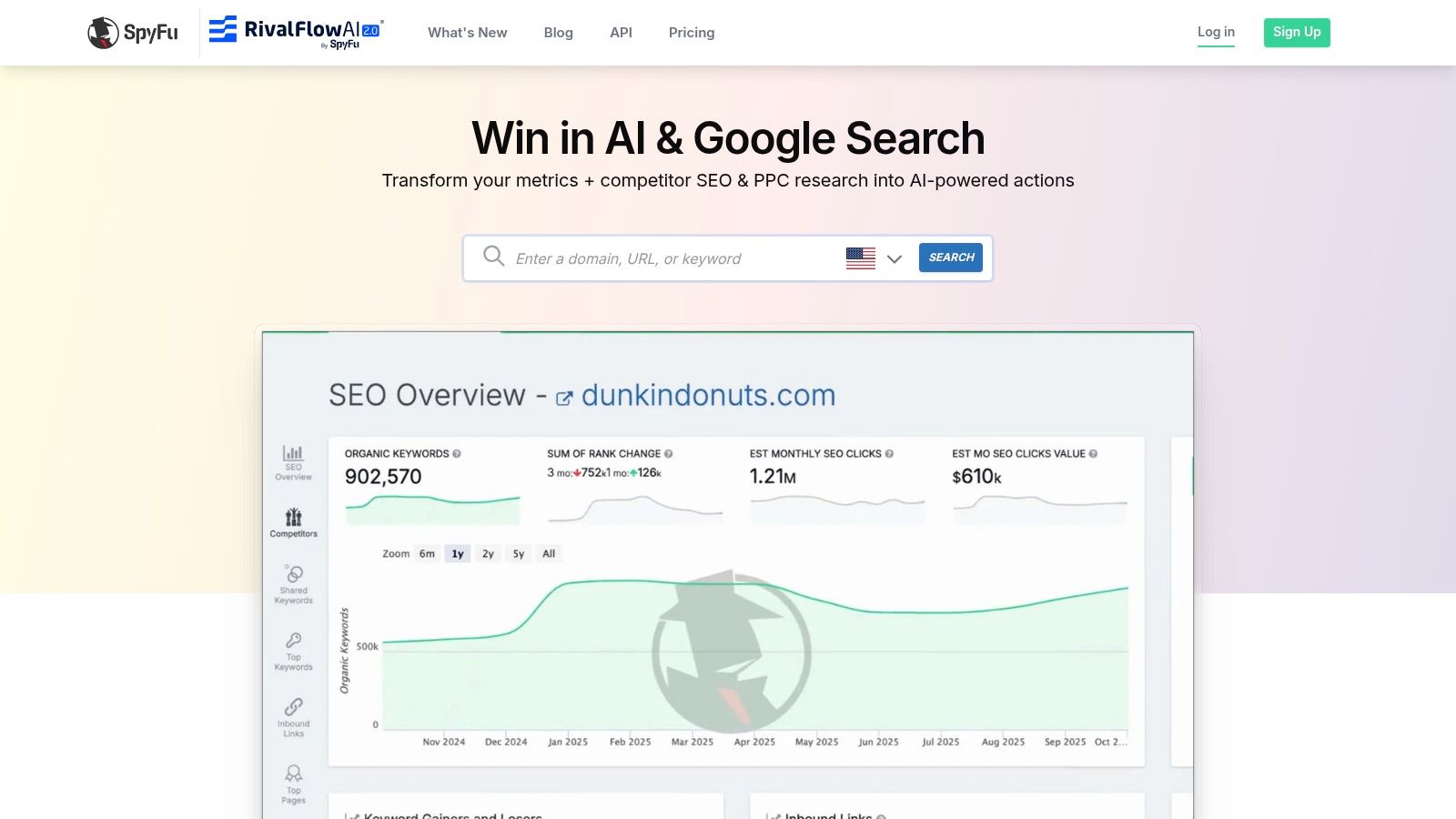
Unlike broader platforms, SpyFu’s strength is its simplicity and generous data access. Even its entry-level plans offer unlimited searches and data exports, making it one of the best competitive intelligence tools for teams that need to perform frequent, in-depth search analysis without worrying about usage caps. For example, you can download a competitor's entire list of profitable Google Ads keywords to find proven terms to add to your own campaigns.
Key Features & Use Cases
- PPC Competitor Research: See your competitors' entire Google Ads history, including their most profitable keywords and ad copy variations. Use this to find proven keywords you might be missing.
- SEO Competitor Analysis: Identify the exact keywords that send organic traffic to your rivals. Analyze their backlink profile to reverse-engineer their SEO success.
- "Kombat" Domain Comparison: A standout feature that visually shows keyword overlap between you and two competitors, instantly revealing "your keywords," "their keywords," and shared opportunities.
- Unlimited Searches & Exports: A significant advantage for power users, allowing for deep, ongoing research without hitting restrictive limits common in other tools.
Pricing
SpyFu offers monthly and annual plans. The Basic plan starts at $39/month ($16/month billed annually) and includes unlimited search results and data exports, making it highly accessible.
| Pros | Cons |
|---|---|
| Generous data access at an affordable entry price. | Primarily focused on search (less breadth than all-in-one tools). |
| Straightforward UI provides quick, actionable insights. | Lacks deep intelligence on social media ads like Facebook or TikTok. |
| Powerful historical data reveals long-term competitor trends. | Data is most comprehensive for Google-centric markets like the US. |
Pro Tip: Use the "Top Keywords" report to find a competitor’s most valuable terms. Filter by "Keyword Buys" to see where they consistently spend their ad budget—a strong signal of high-converting keywords you should target.
6. Crayon – Enterprise Competitive Enablement Platform
Website: https://www.crayon.co
Crayon moves beyond simple monitoring to become a complete competitive enablement platform. It’s designed for mid-market and enterprise teams who need to not only track competitors but also activate those insights with their revenue teams. Crayon automates the collection of signals from across the web and then uses AI to surface the most important updates.
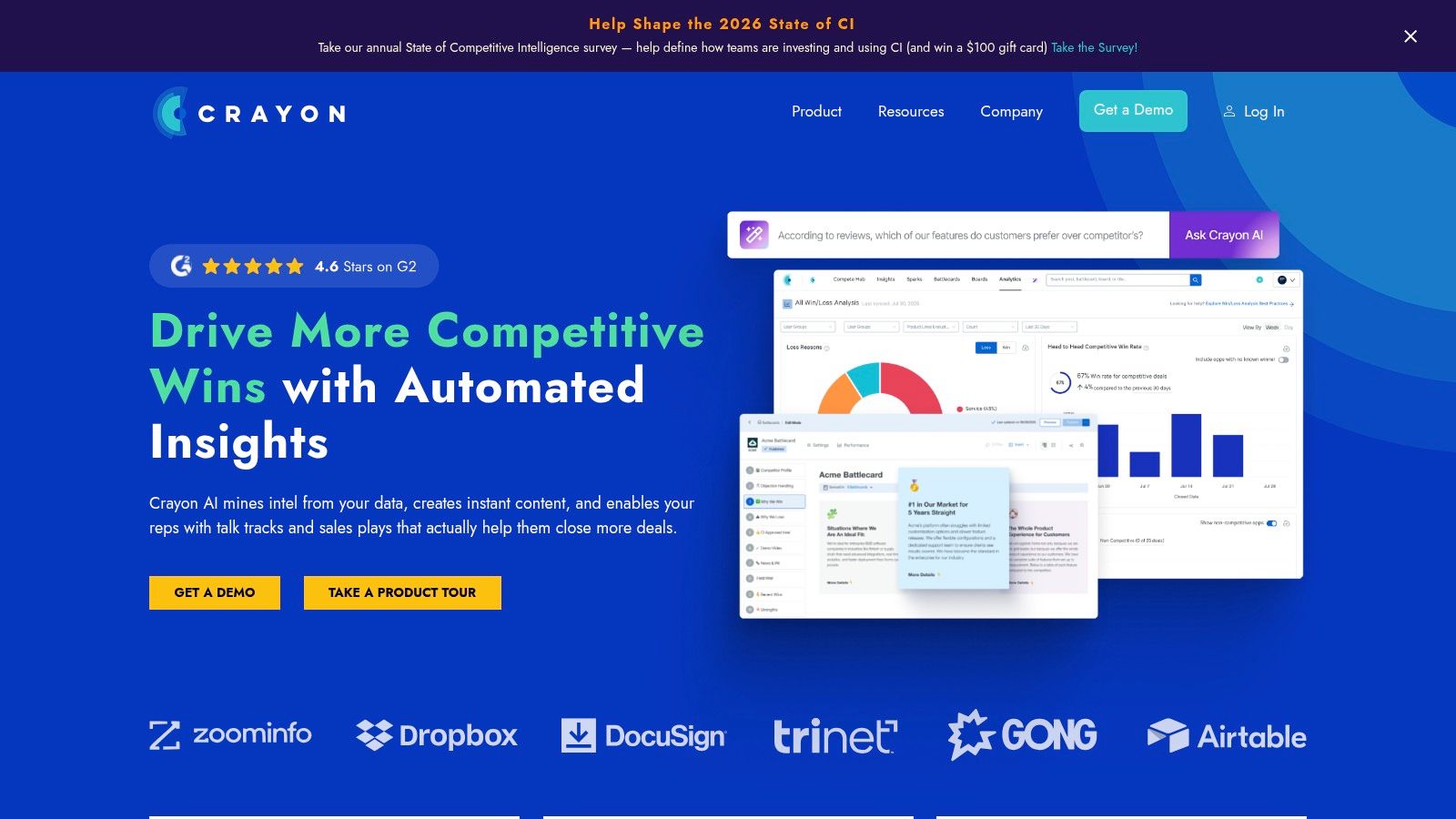
The platform's core strength is its delivery. Instead of just dumping data into a dashboard, Crayon embeds intelligence into the tools your sales and marketing teams already use, like Salesforce and Slack. For example, when a competitor changes their pricing page, an alert can be automatically sent to a sales Slack channel with a summary of the change. This makes it one of the best competitive intelligence tools for organizations looking to build a scalable CI function that directly influences win rates.
Key Features & Use Cases
- Automated Monitoring & AI Summaries: Crayon’s AI engine automatically captures competitor changes across 100+ data types and provides concise summaries, saving hours of manual work.
- Dynamic Battlecards: Create and distribute live battlecards that update automatically as new intelligence is gathered. These can be accessed directly within a CRM.
- Workflow Integration: Push critical alerts and updates directly into Slack, Microsoft Teams, and Salesforce to ensure timely action from sales reps on competitive deals.
Pricing
Crayon’s pricing is quote-based and tailored to enterprise needs. You must contact their sales team for a custom quote.
| Pros | Cons |
|---|---|
| Strong enablement layer tailored for sales and revenue teams. | Pricing is enterprise-level and not suitable for early-stage startups. |
| Extensive resources and support to help mature your CI program. | Can generate significant noise if not properly configured and tuned. |
| Deep integrations with core GTM tools like Salesforce and Slack. | Onboarding requires a dedicated time investment to see full value. |
Pro Tip: When setting up Crayon, start with a narrow focus. Track just your top 2-3 direct competitors and configure alerts for only the most critical signals, like pricing page changes or new product launches. This prevents your team from getting overwhelmed and helps them focus on actionable insights first.
7. Klue – Competitive Enablement
Website: https://klue.com
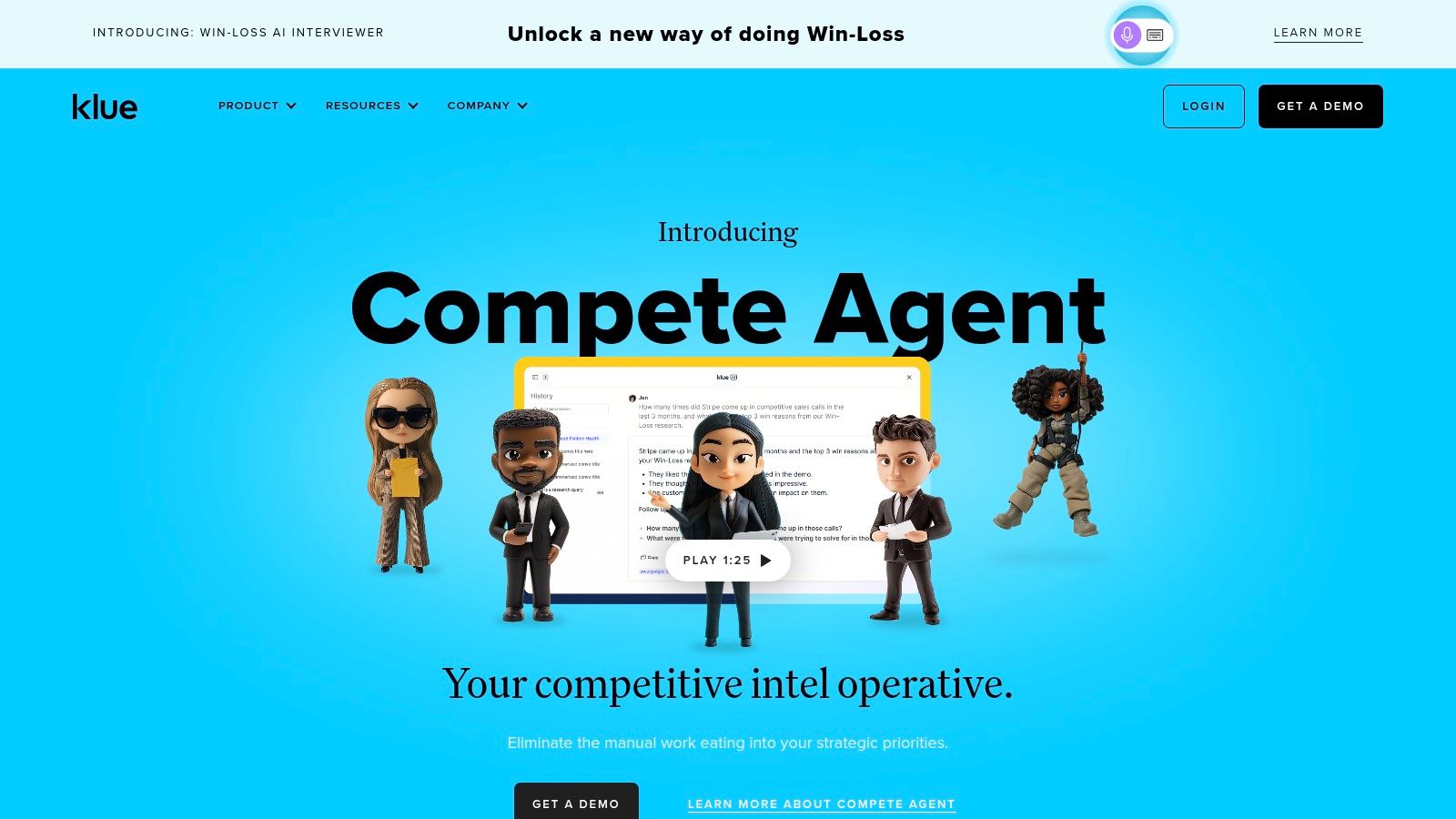
Klue is a competitive enablement platform designed to turn market intelligence into a direct sales advantage. It goes beyond simple data collection by focusing on centralizing competitive insights and distributing actionable guidance—like battlecards—directly to sales teams when they need it most. It's built to arm sellers with the exact information required to win competitive deals.
For SaaS teams with a dedicated sales function, Klue is one of the best competitive intelligence tools for operationalizing CI and proving its impact on revenue. It automates the collection of intel from sources like Slack, news, and CRM data, ensuring your go-to-market teams are always equipped with the latest, most relevant information. For example, a salesperson can use Klue's browser extension while in their email to quickly pull up a competitor's weaknesses without switching tabs.
Key Features & Use Cases
- AI “Compete Agent”: Automatically surfaces real-time competitive intelligence from your company's digital channels (like Slack and CRM) to provide timely deal support.
- Centralized Battlecards: Create, update, and distribute dynamic, easy-to-digest competitive battlecards that sellers can access directly within their workflow, including Salesforce and Slack.
- Win/Loss Analysis: Systematically capture win-loss data from your GTM teams to identify competitive trends, refine your strategy, and share key learnings.
Pricing
Klue’s pricing is not publicly listed and is geared toward mid-market and enterprise companies. You must request a demo to receive a custom quote.
| Pros | Cons |
|---|---|
| Purpose-built to drive sales adoption and competitive wins. | Pricing is undisclosed and aimed at larger, enterprise-level budgets. |
| Strong integrations bring intel directly into a seller's workflow. | Best value is realized with dedicated CI or product marketing owners. |
| Excellent content and education for competitive intelligence leaders. | May be overly complex for very small teams without formal sales processes. |
Pro Tip: Integrate Klue with your CRM and Slack from day one. This creates a powerful feedback loop where sellers can not only consume intel but also contribute new insights from the field, keeping your competitive content fresh and grounded in reality.
8. Kompyte – Automated CI and Sales Battlecards
Website: https://www.kompyte.com
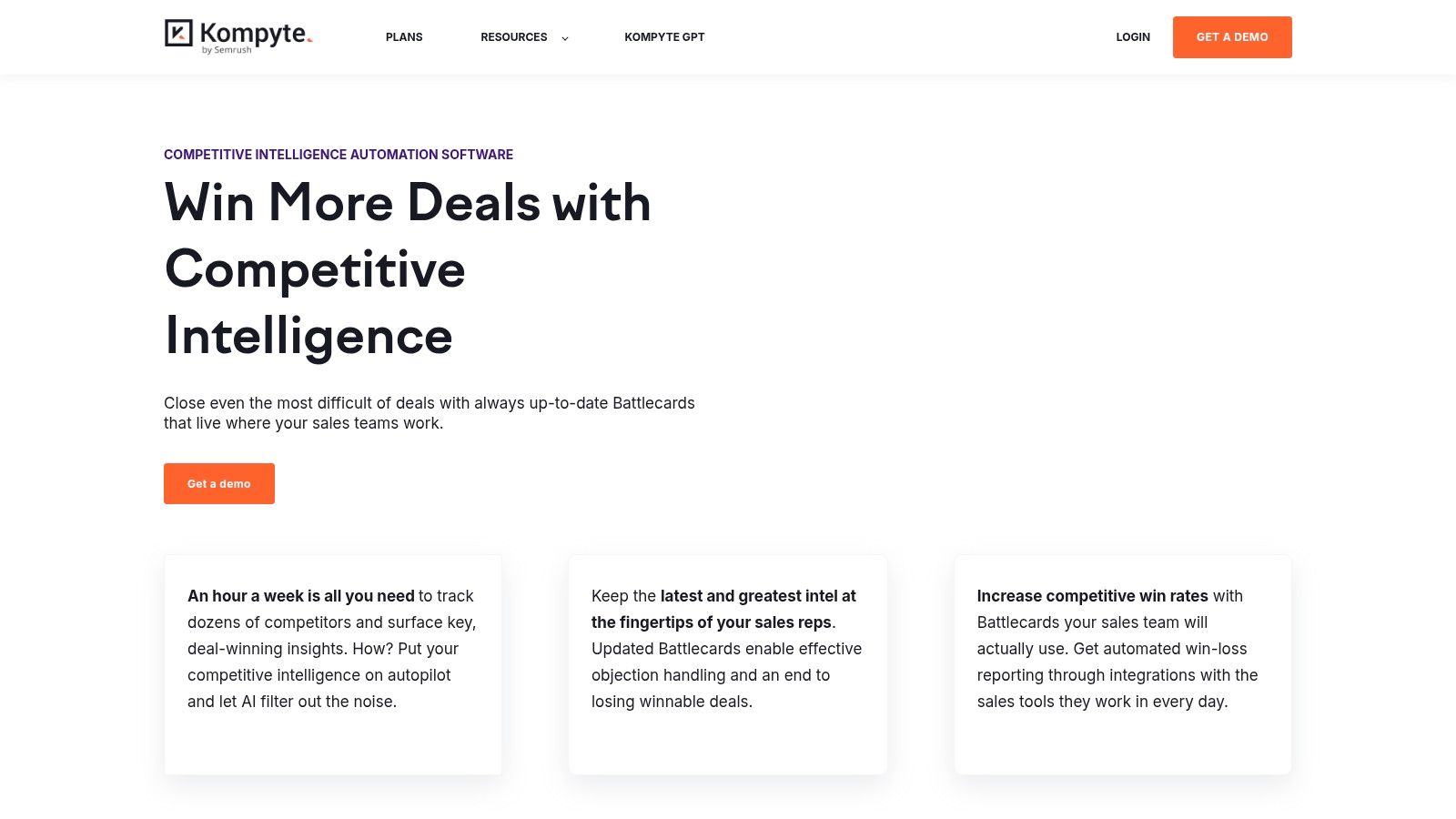
Kompyte specializes in automating the tedious parts of competitive intelligence, making it a powerful ally for product marketing and sales enablement teams. It continuously monitors competitors across their website, social media, ads, and even job postings, using AI to filter out the noise and deliver actionable summaries. The platform excels at translating these insights into practical sales assets.
Its primary focus is on turning raw intelligence into dynamic sales battlecards that live directly within your CRM. This ensures your sales team always has the most current information at their fingertips during prospect conversations. For example, if a rival launches a new feature, Kompyte can automatically detect the change on their website and flag the relevant battlecard for an update. This makes Kompyte one of the best competitive intelligence tools for activating insights and directly impacting revenue.
Key Features & Use Cases
- Automated Tracking: Set up monitoring for key competitors and receive AI-powered summaries of significant changes, such as new messaging, pricing updates, or feature launches.
- Dynamic Sales Battlecards: Create and distribute unlimited battlecards with up-to-date intel. These can be embedded directly in Salesforce, HubSpot, or Slack.
- Win/Loss Analysis: The platform includes tools to track win/loss metrics and analyze battlecard adoption, helping you measure the direct impact of your CI program on sales.
Pricing
Kompyte's pricing is quote-based and depends on factors like the number of competitors you track and the number of users. They typically operate on annual contracts.
| Pros | Cons |
|---|---|
| High degree of automation saves significant manual research time. | Quote-based pricing can make it hard to estimate costs upfront. |
| Excellent CRM integration puts intel directly in the sales workflow. | Less focused on broad market-sizing or deep strategic research. |
| Dedicated customer success helps with setup and ongoing strategy. | Annual contract terms may not suit teams needing short-term intel. |
Pro Tip: Use Kompyte’s adoption analytics to identify your most-used (and least-used) battlecards. Interview the top users on your sales team to understand what makes certain competitive assets effective, and use that feedback to refine your content for the entire team.
9. AlphaSense – Market and Competitive Intelligence Research Platform
Website: https://www.alpha-sense.com
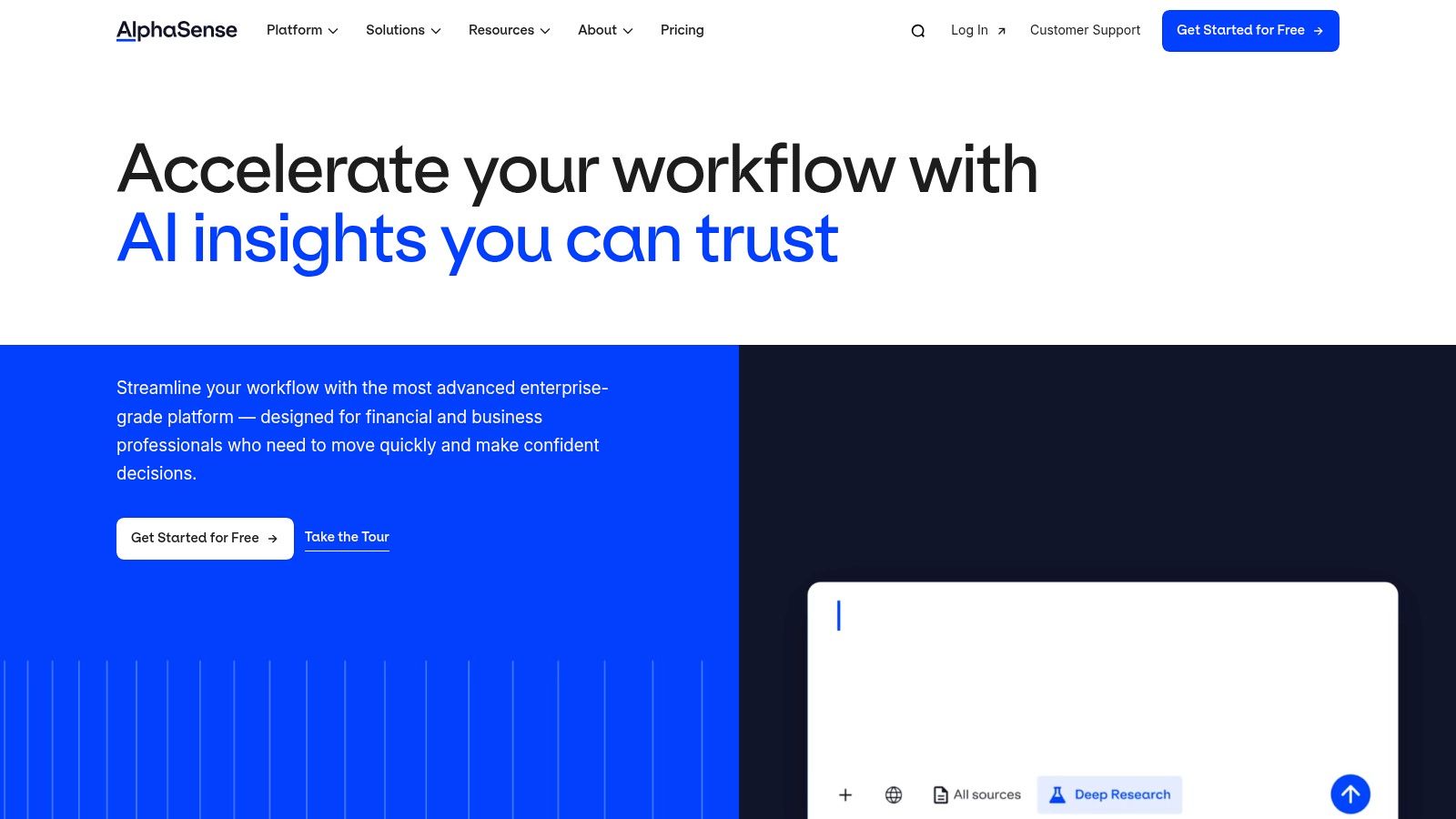
AlphaSense is a market intelligence and search platform designed for high-stakes strategic research. It aggregates over 10,000 premium and public data sources, including company filings, broker research, expert call transcripts, and news, all searchable through a powerful AI engine. For SaaS teams focused on corporate strategy or product management, AlphaSense provides access to information that is typically behind expensive paywalls.
This platform excels at uncovering deep market trends and competitor strategies that aren't visible through public web data alone. It’s one of the best competitive intelligence tools for teams that need to go beyond surface-level analysis and understand the financial health and strategic direction of key players. This is critical when you need to estimate SaaS revenue for private companies or validate market sizing.
Key Features & Use Cases
- AI-Powered Search: Instantly search across millions of documents, including SEC filings, earnings call transcripts, and exclusive equity research reports, to find specific mentions of competitors or market trends.
- Premium Content Aggregation: Gain access to enterprise-grade content from sources like Wall Street investment banks and expert networks, all unified in a single platform.
- Smart Alerts: Set up real-time alerts on competitors, keywords, or industries to stay informed about critical developments like product launches or shifts in strategy.
- Content Segmentation: Easily filter results by content type, industry, or region to conduct highly specific, in-depth research for product roadmapping or investment theses.
Pricing
AlphaSense is an enterprise-grade solution with quote-based pricing. Access is typically sold on a per-seat basis and is geared towards larger teams and corporations.
| Pros | Cons |
|---|---|
| Unparalleled depth of premium, hard-to-find data sources. | Enterprise pricing can be prohibitive for startups and small teams. |
| Powerful AI search saves hundreds of hours on manual research. | Has a learning curve to master advanced filters and content sets. |
| Ideal for strategic, product, and corporate development teams. | Might be overkill for teams needing only basic web or ad intel. |
Pro Tip: Use the "Company Tearsheet" feature to get a quick, comprehensive overview of a public competitor, including financials, key events, and recent mentions in analyst research. It's a great starting point before diving deeper into specific documents.
10. Owler – Company Profiles, News, and Competitor Tracking
Website: https://www.owler.com
Owler is a community-powered business intelligence platform that excels at delivering curated news alerts and high-level company data. It's a fantastic starting point for sales and marketing teams who need to keep a daily pulse on their competitors, prospects, or partners without getting bogged down in complex analytics.
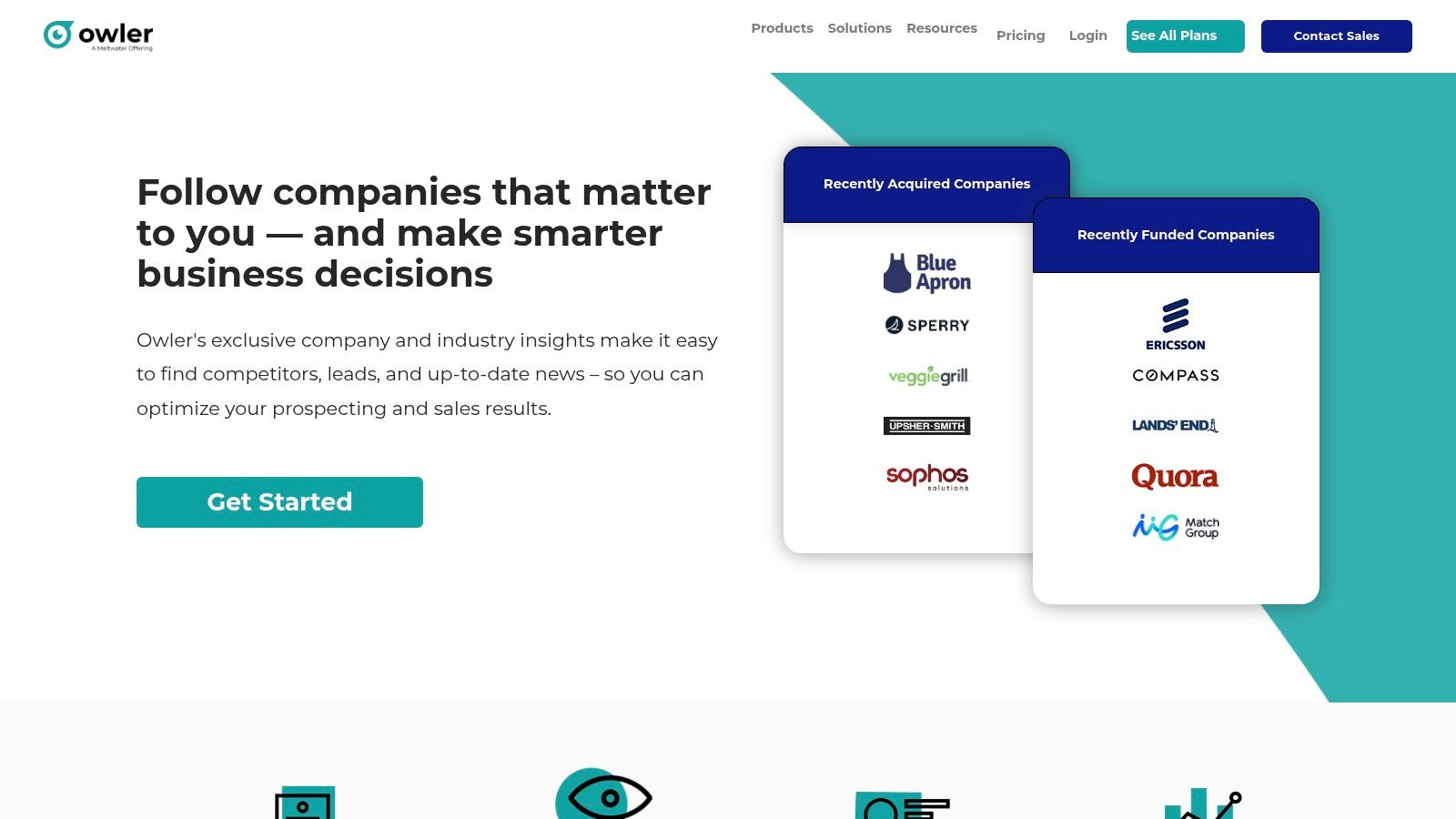
The platform’s strength lies in its simplicity. By allowing you to "follow" specific companies, Owler automates the process of tracking key events like funding rounds, leadership changes, and major news mentions. For example, a funding announcement for a competitor is a perfect trigger for your sales team to reach out to their existing customers. This makes Owler one of the best competitive intelligence tools for lightweight, ongoing monitoring.
Key Features & Use Cases
- Real-Time News Alerts: Set up daily digests or real-time notifications for your key competitors to stay instantly informed about press releases, acquisitions, and other market-moving events.
- Company Profiles: Quickly access essential data points like estimated revenue, employee count, funding history, and key executives for millions of public and private companies.
- CRM & Slack Integrations: Pipe competitor news directly into your Salesforce, HubSpot, or Slack channels, embedding competitive intelligence into your team's daily workflow.
Pricing
Owler offers a free plan with limited follows and features. Paid plans (Pro and Max) unlock more follows, advanced search, and integrations, with pricing available upon request.
| Pros | Cons |
|---|---|
| Low cost of entry and very easy to set up for daily scanning. | Estimates (e.g., revenue) should be used directionally. |
| Good coverage of private companies for sales and growth teams. | Deeper strategic analysis requires pairing it with other tools. |
| Delivers actionable alerts directly into your existing workflows. | The free tier is quite limited for serious competitive tracking. |
Pro Tip: Use Owler's "Top Competitors" feature on a company profile to quickly discover secondary and tertiary competitors you may have overlooked. This is a great way to broaden your market map with minimal effort.
11. BuiltWith – Technology Stack Intelligence
Website: https://www.builtwith.com
BuiltWith is a highly specialized tool that answers one crucial question: what technologies are your competitors (and potential customers) using? By scanning millions of websites, it provides a detailed breakdown of the software stack behind any domain, from analytics and advertising platforms to payment gateways and CRM systems.
This makes it an indispensable resource for technology-based market segmentation. For example, if you're selling a Shopify app, you can instantly generate a list of all websites using Shopify. If your software integrates with HubSpot, BuiltWith can provide your entire target addressable market. It transforms technology usage from a guess into a quantifiable dataset, making it one of the best competitive intelligence tools for prospecting and market sizing.
Key Features & Use Cases
- Technology Lookups: Enter any domain to see a comprehensive list of all detected technologies, including CMS, analytics, widgets, and advertising networks.
- Historical Trends: Track technology adoption over time. See when a competitor added or removed a specific tool, signaling a potential shift in their strategy.
- Lead Generation & List Building: Create targeted prospect lists based on specific technology usage. For example, find all e-commerce sites in the UK that use Stripe but not Klaviyo.
Pricing
BuiltWith offers a limited free lookup for individual sites. Paid plans for advanced features like list building and trend reports start at $295/month (Basic Plan).
| Pros | Cons |
|---|---|
| Massive dataset with deep coverage of web technologies. | Pricing is high, making it more suitable for B2B sales teams. |
| Excellent for TAM analysis and technology-based prospecting. | Solely focused on technology; lacks traffic, ad, or keyword data. |
| Historical data offers insights into competitor tech changes. | The user interface can feel dated and less intuitive than modern tools. |
Pro Tip: Use the free browser extension for quick, on-the-fly analysis. When you land on a prospect’s or competitor's website, you can see their tech stack with a single click without having to navigate back to the BuiltWith site.
12. Wappalyzer – Technology Lookups and Leads
Website: https://www.wappalyzer.com
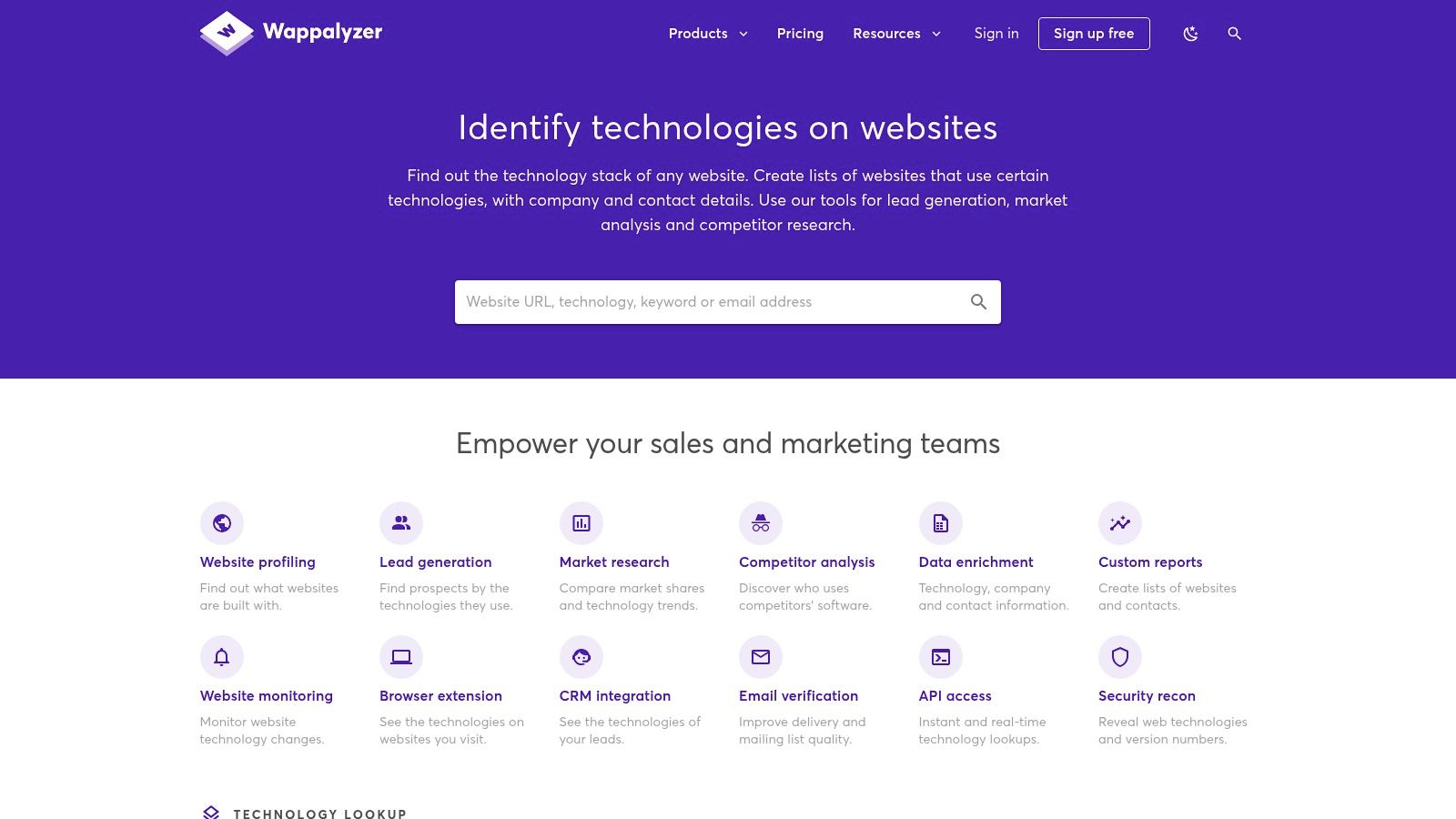
Wappalyzer is another highly specialized tool that uncovers the technology stack of any website. For SaaS teams, it answers a critical question: "What software are my competitors (and potential customers) using?" By identifying everything from their CRM to their analytics platforms, you can spot tech trends, identify integration opportunities, and build hyper-targeted sales lists.
It excels at turning a competitor's technology choice into a strategic signal. For example, if a key rival adopts a new marketing automation tool like Marketo, Wappalyzer can alert you. This might signal they are moving upmarket, giving you a chance to adjust your own strategy. This makes it one of the best competitive intelligence tools for tech-focused market research and sales prospecting.
Key Features & Use Cases
- Technology Stack Detection: Use the browser extension for instant analysis of any site you visit, or use the API and bulk lookup features for large-scale research projects.
- Lead List Generation: Create targeted prospect lists based on technology usage. For instance, build a list of all websites using HubSpot but not a specific video hosting platform—perfect for a SaaS offering that integration.
- Competitor Tech Monitoring: Set up alerts to get notified when a competitor adds or removes a specific technology, giving you an early warning of strategic shifts.
Pricing
Wappalyzer offers free lookups and a free browser extension. Paid plans start with a "Starter" tier and scale up with more credits for lookups, lead generation, and API access. Monthly and annual options are available.
| Pros | Cons |
|---|---|
| Lower entry price compared to enterprise data platforms. | Less depth on traffic and performance metrics than other tools. |
| Actionable tech signals for building targeted outbound lists. | API credit limits and quotas can be restrictive on lower tiers. |
| Simple browser extension makes ad-hoc research effortless. | Data is focused purely on technology, lacking broader business context. |
Pro Tip: Use Wappalyzer to enrich your existing lead lists. Upload a list of company domains and run a bulk lookup to append their full technology stack. This allows you to tailor your outreach based on their current software, making your sales pitches significantly more relevant.
Top 12 Competitive Intelligence Tools — Side-by-Side Comparison
| Product | Key Benefit | Use Case Example | Price Point |
|---|---|---|---|
| Proven SaaS 🏆 | Validate SaaS ideas with real ad data | Find a niche where competitors profitably spend $20k+/mo on ads | From Free |
| G2 | Find & compare tools with user reviews | Read reviews from similar-sized companies before buying | Free |
| Similarweb | Analyze website traffic & marketing channels | See if a competitor's growth is from SEO, social, or paid ads | Freemium |
| Semrush | Deconstruct SEO & PPC strategies | Find keywords a competitor ranks for that you're missing | $$ |
| SpyFu | Uncover 15+ years of ad history | Download a rival's most profitable Google Ads keywords | $ |
| Crayon | Automate intel delivery to sales teams | Get a Slack alert when a competitor changes their pricing | $$$ |
| Klue | Arm sellers with real-time battlecards | Sales rep pulls up competitor weaknesses from their CRM | $$$ |
| Kompyte | Keep sales battlecards automatically updated | Auto-detect a competitor's new feature launch & flag for review | $$$ |
| AlphaSense | Access premium market research & filings | Search expert call transcripts for mentions of a competitor | $$$$ |
| Owler | Track company news & funding alerts | Get an email when a competitor raises a new funding round | Freemium |
| BuiltWith | Identify a website's entire tech stack | Build a sales list of all websites using Shopify & Stripe | $$ |
| Wappalyzer | Monitor competitor technology changes | Get an alert when a rival switches from HubSpot to Marketo | $ |
How to Pick the Right CI Tool for Your Stage
Navigating the landscape of competitive intelligence tools can feel overwhelming. The most critical takeaway isn't that one tool is definitively "the best," but that the right tool is the one that directly answers your most urgent strategic questions.
The central theme is to match the tool to the task. Don't pay for an all-in-one enterprise suite if your immediate goal is to understand a competitor's technology stack. Similarly, don't rely on basic SEO tools when you need to model the ad-to-revenue potential of a new SaaS niche. Clarity on your objective is the first and most important step.
A Practical Framework for Your Decision
To simplify your choice, think about your primary goal. We can group the tools we've discussed into a few core job functions.
For Idea Validation & Market Sizing: If you're an early-stage founder hunting for validated SaaS ideas, your focus is on identifying profitable niches. Proven SaaS is purpose-built for this, linking ad spend to estimated revenue, while Similarweb provides the high-level traffic data needed to assess opportunity size.
For SEO & Content Strategy: Growth marketers aiming to dominate search results need granular data on keywords and backlinks. Semrush and SpyFu are the industry standards here, offering deep dives into organic and paid search strategies.
For Sales Enablement & Deal-Winning: When your sales team is on the front lines, they need real-time, digestible intelligence to win deals. This is where dedicated platforms shine. Klue, Crayon, and Kompyte excel at turning raw data into actionable battlecards.
For Technology & Prospecting: Understanding what powers your competitors' products and marketing is a massive advantage. For this, look no further than BuiltWith and Wappalyzer. They provide a clear snapshot of the tech stacks your rivals and prospects are using.
Final Considerations Before You Commit
Before you subscribe, remember that the best competitive intelligence tools are only as effective as the strategy behind them. Start small by defining one critical question you need to answer. Is it "Which of my competitor's ad campaigns are driving the most revenue?" or "What messaging are they using to win deals against us?"
Pick the tool that answers that one question most effectively. Once you've extracted that initial value, you can expand your usage. This focused approach ensures you see a return on your investment quickly. For a more extensive analysis, consult our review of the 12 Best Competitive Intelligence Tools for a complete picture.
Ultimately, competitive intelligence is about turning information into a decisive advantage. By choosing the right tool for your stage and your specific goals, you arm yourself with the insights needed to not just compete, but to lead.
Ready to find your next profitable SaaS idea? Proven SaaS cuts through the noise by connecting competitor ad spend directly to estimated revenue, giving you the market proof you need to build with confidence. Stop guessing and start validating with a free trial of Proven SaaS today.
Build SaaS That's
Already Proven.
14,500+ SaaS with real revenue, ads & tech stacks.
Skip the guesswork. Build what works.
Trusted by 1,800+ founders


