

Building a successful SaaS isn't about having a totally unique idea; it's about finding a proven market and out-executing the competition. But how do you find those proven markets without spending months on dead-end research? The answer lies in competitive intelligence. The right software doesn't just show you what your competitors are doing, it reveals which markets have validated demand, where customers are spending money, and what strategies are already working.
This guide cuts through the noise. We'll break down the 12 best competitive intelligence software platforms, focusing on actionable insights for SaaS founders and growth teams. You'll discover the specific tools that help you:
- Find validated niches by analyzing competitor ad campaigns and revenue. For example, seeing multiple competitors spend heavily on ads targeting dentists signals a profitable market.
- Arm your sales team with real-time battlecards and market updates. Imagine your salesperson getting an alert that a competitor just dropped their price, right before a demo.
- Track crucial signals like new feature launches, pricing changes, and technology adoption. This helps you react quickly and stay ahead.
Instead of generic descriptions, this resource provides a clear, side-by-side analysis of each platform. We compare features, pricing, and ideal use cases to help you find the perfect fit, whether you're a bootstrapped founder looking for an MVP idea or an enterprise team needing to dominate a category.
Each review is structured for clarity, using simple visuals, screenshots, and direct links to help you make a fast, informed decision. We’ll cover everything from Crayon and Klue for sales enablement to Proven SaaS and Similarweb for market opportunity analysis. Let's find the tool that gives you an unfair advantage.
1. Proven SaaS
Best For: Validating SaaS Ideas with Ad-Driven Demand
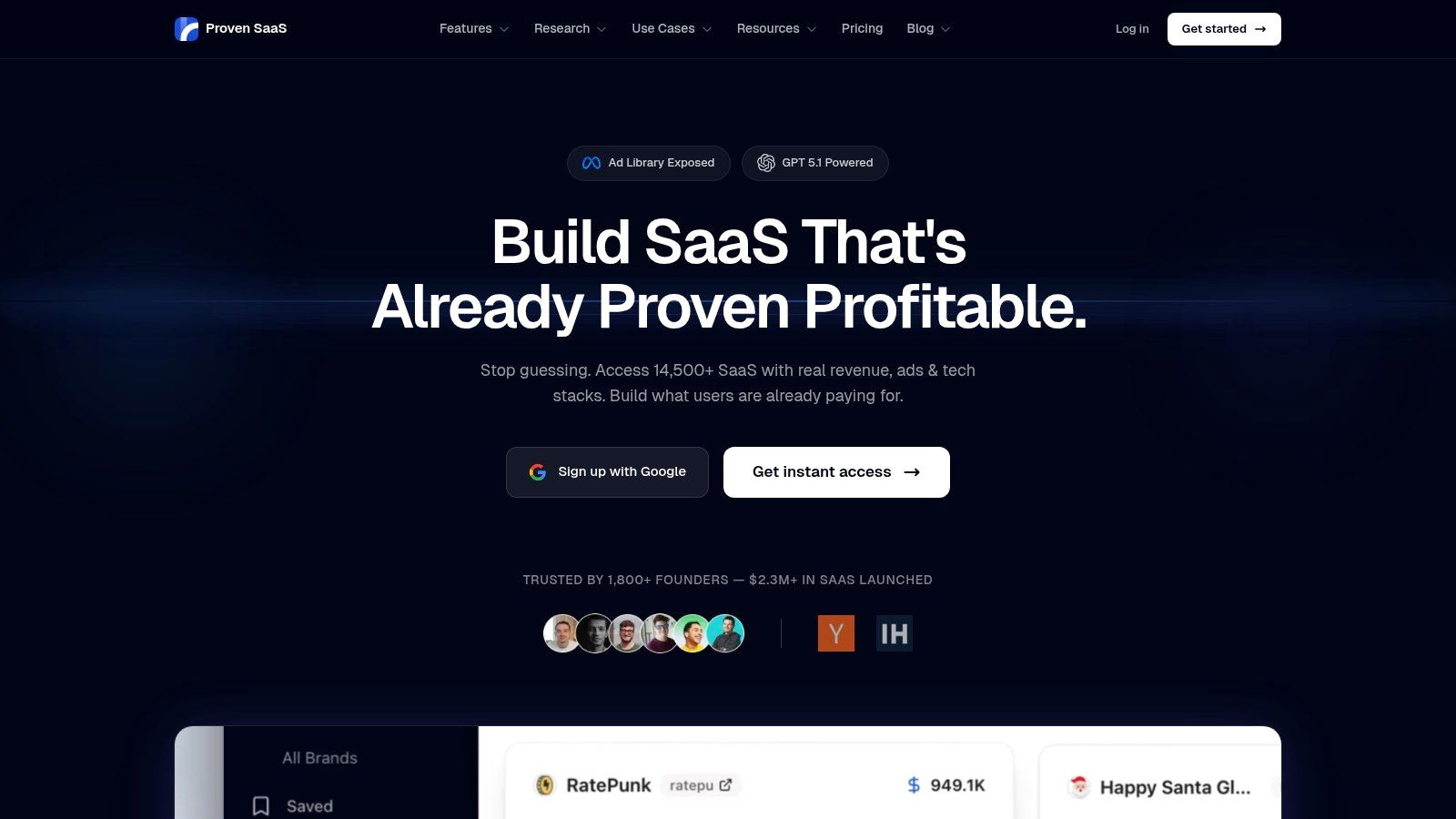
Proven SaaS is a powerful advertising intelligence platform designed for a specific, high-stakes purpose: helping founders and growth teams discover and validate revenue-generating SaaS ideas. It operates on a simple yet profound premise: sustained, significant ad spend is one of the strongest public signals of product-market fit. By analyzing the Meta Ad Library, the platform identifies SaaS companies actively investing in customer acquisition, providing a direct window into what's already working.
This makes Proven SaaS a standout choice in the world of competitive intelligence software, shifting the focus from broad market analysis to actionable, ad-driven opportunity discovery. Instead of just tracking competitor features, it helps you find entire niches where real companies are successfully acquiring customers through paid channels.
Why It Stands Out
What differentiates Proven SaaS is its workflow, which is engineered for speed and validation. The platform indexes over 14,500 SaaS products, focusing on those spending more than $10,000 per month on ads. This acts as a high-quality filter, surfacing competitors with meaningful traction. For each company, it models estimated MRR, growth rates, and even profit scores, allowing you to quickly prioritize opportunities.
Key Takeaway: Proven SaaS shortens the validation cycle dramatically. By analyzing competitors' winning ad creatives, audience targeting, and funnels, you can de-risk your own go-to-market strategy before writing a single line of code.
Practical Use Cases
- SaaS Founders: Discover validated niches with proven customer demand. Example: A founder identifies a trend of B2B SaaS tools for landscapers consistently spending on Facebook ads, signaling a ripe, underserved market.
- Agencies & Dev Studios: Quickly conduct market research for clients, presenting data-backed opportunities instead of speculative ideas.
- Acquisition Entrepreneurs: Identify profitable, growing SaaS businesses with a predictable customer acquisition model for potential acquisition.
Core Features at a Glance
| Feature | Description |
|---|---|
| SaaS Idea Database | Search and filter 14,500+ SaaS products by niche, revenue band, growth rate, and more. |
| Revenue Intelligence | Get estimated monthly revenue and growth trends to gauge market size and opportunity. |
| Ad Creative Library | See the exact ads, copy, and funnels that are converting for your competitors. |
| Audience Insights | Understand the demographics (age, gender, location) that successful competitors are targeting. |
| Profit & CAC Scores | Proprietary scores help you instantly assess the potential profitability and payback period of a business model. |
Access: Pricing details are not public; you must create an account to view subscription plans.
Website: proven-saas.com
2. Crayon
Best For: Automating Intelligence for Sales and Marketing Teams
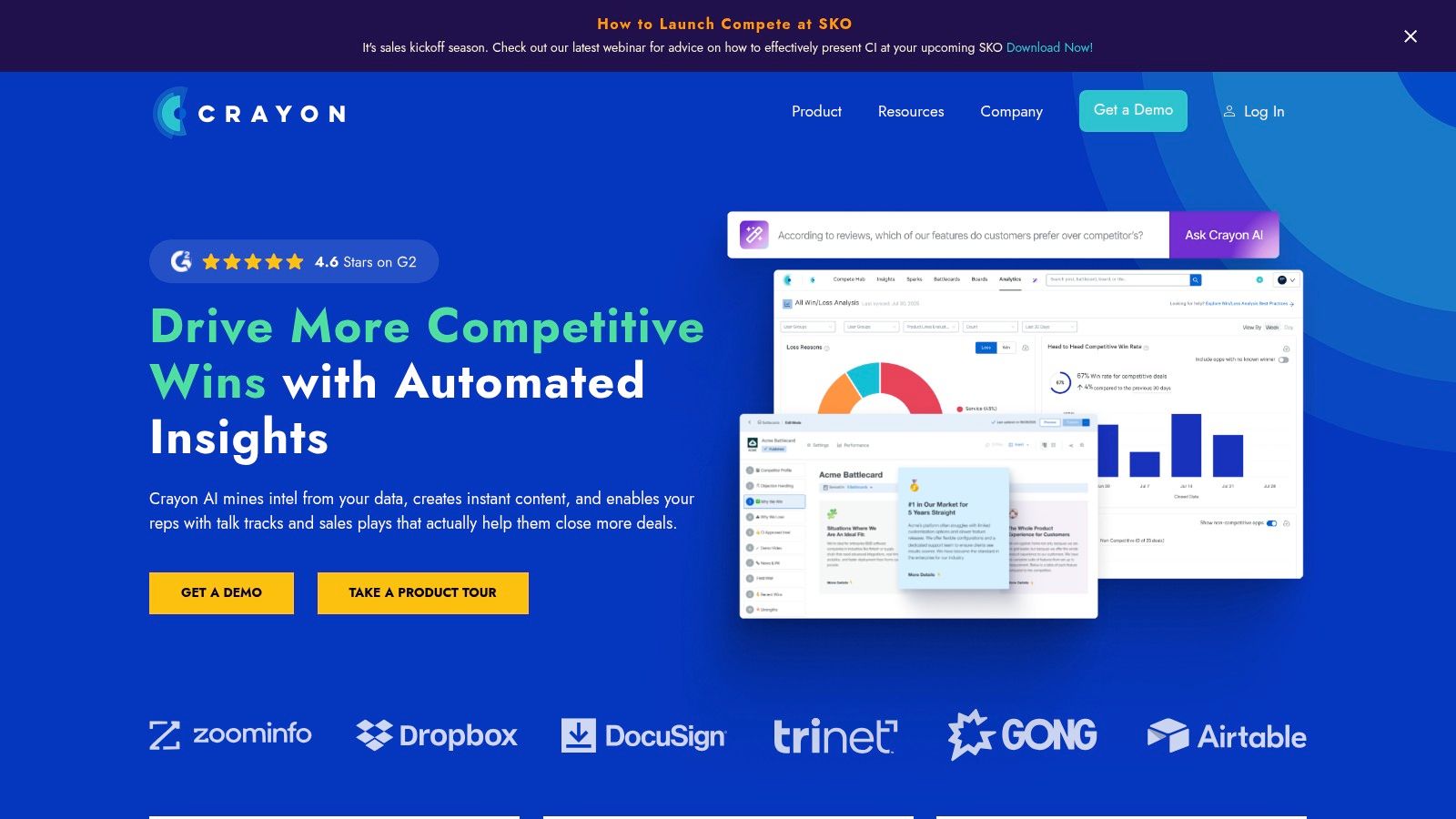
Crayon is an enterprise-grade competitive intelligence platform designed to not just gather data, but to activate it across sales, marketing, and executive teams. While some tools focus purely on data aggregation, Crayon excels at operationalizing intelligence. It automatically monitors over 100 data types across the web, including subtle website copy changes, pricing page updates, and new customer reviews, reducing countless hours of manual research.
The platform then converts these raw signals into actionable assets. Its AI engine, Sparks, helps summarize key competitor moves and prioritize critical updates. For teams serious about building a competitive intelligence program, Crayon bridges the gap between raw data and revenue-driving action.
Key Features & Use Cases
- Automated Monitoring & Digests: Crayon tracks everything from press releases and social media to API documentation and job postings. It delivers daily email digests, ensuring teams never miss a critical update.
- Sales Enablement Integrations: It pushes intel directly into workflows via Salesforce and Slack, equipping sales reps with timely information where they already work. Example: An alert pops up in a sales rep's Slack channel: "Competitor XYZ just launched a new integration with HubSpot," giving them a heads-up before their next call.
- AI-Powered Battlecards: The platform uses AI to generate and maintain dynamic battlecards, which are centralized in a "Compete Hub." This makes it a strong contender for the best competitive intelligence software for sales-driven organizations.
- Call Recording Analysis: Integrations with Gong and Chorus allow it to mine sales calls for competitor mentions, providing real-world feedback on how your team stacks up. This process is a core part of a strong SaaS competitive analysis framework.
| Feature | Best For |
|---|---|
| Intel Sources | Comprehensive web tracking (100+ types) |
| Primary Use Case | Operationalizing CI for sales enablement |
| Unique Offering | AI-generated insights (Sparks) and deep sales workflow integrations |
| Pricing Model | Quote-based; requires a sales call. No public pricing is available. |
Pros:
- Reduces manual data collection significantly with its broad, automated tracking.
- Strong focus on activating intelligence for sales and marketing teams.
- Unlimited competitor and user tracking (per their positioning).
Cons:
- Lack of transparent pricing can be a hurdle for smaller teams.
- Best suited for larger organizations with the resources to implement and manage a formal CI program.
3. Klue
Best For: Helping Sales Teams Win More Deals
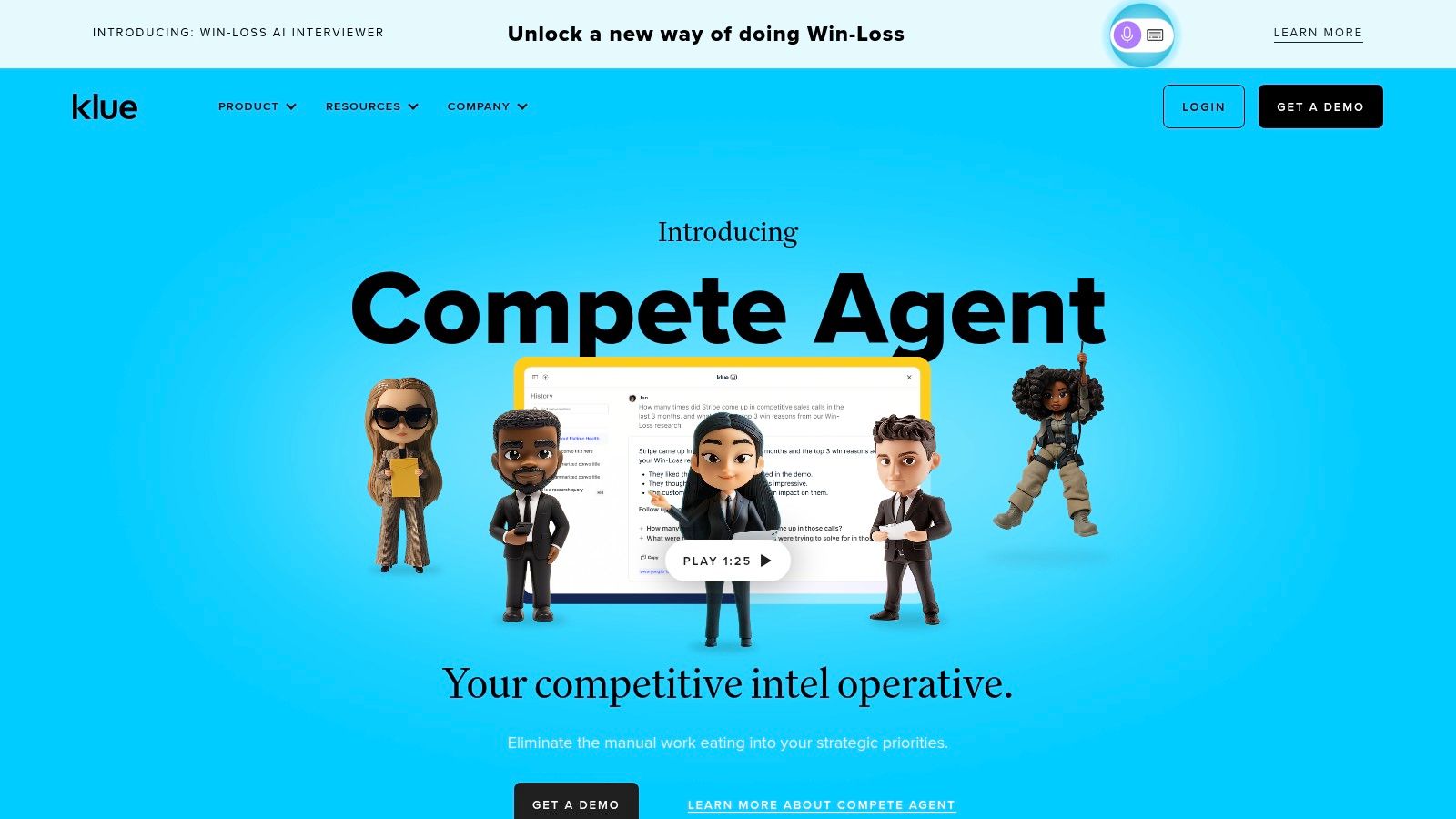
Klue is a competitive enablement platform specifically engineered to help sales teams win more deals. Where some tools focus on broad market monitoring, Klue zeroes in on delivering real-time, deal-specific intelligence directly into the sales workflow. It gathers intel from a wide range of sources, including public web data, your own CRM, and sales call recordings, to create a dynamic picture of the competitive landscape.
The platform excels at turning this data into tangible sales assets. Klue's "Compete Agent" automatically surfaces insights and feeds them into battlecards and deal briefs, ensuring your reps have the exact information they need, when they need it. This focus on closing the loop between intelligence gathering and revenue impact makes it a top choice for organizations prioritizing sales effectiveness.
Key Features & Use Cases
- Deal-Specific Intelligence: Klue automatically generates insights tailored to specific opportunities in your pipeline, providing reps with targeted talking points and strategies.
- Centralized & Dynamic Battlecards: It houses all your competitive battlecards in one place, tracking their consumption and even correlating their usage with win rates, offering clear ROI metrics.
- Integrated Win/Loss Analysis: The platform includes services and analytics to systematically capture and analyze why you win and lose deals, feeding those learnings back into your competitive strategy. Example: After analyzing 50 lost deals, Klue reveals that "Competitor X's faster onboarding" is mentioned 80% of the time, highlighting a critical product gap to address.
- Deep Workflow Distribution: Klue pushes intelligence directly into tools sellers use every day like Slack and Salesforce, maximizing adoption and impact. This makes it a powerful contender for the best competitive intelligence software for sales-centric organizations.
| Feature | Best For |
|---|---|
| Intel Sources | Public web data, CRM, win/loss interviews, sales calls |
| Primary Use Case | Arming sales teams with deal-specific intel to improve win rates |
| Unique Offering | Battlecard consumption metrics tied to revenue and win/loss analytics |
| Pricing Model | Quote-based; requires a demo and sales consultation. |
Pros:
- Excellent focus on sales enablement and distributing intel within existing workflows.
- Provides continuous, deal-specific insights rather than static competitor profiles.
- Strong analytics that measure the impact of CI on sales performance.
Cons:
- No public pricing requires engaging in a sales process for evaluation.
- Implementation can be resource-intensive, similar to other enterprise enablement platforms.
4. Similarweb
Best For: Analyzing Website Traffic and Digital Strategy
Similarweb is a digital intelligence powerhouse known for its comprehensive web traffic and engagement data. While many tools focus on internal analytics, Similarweb provides a market-level view, allowing businesses to benchmark their digital performance against any competitor. It answers critical questions like "Where does our competitor's traffic come from?" and "What is their audience's demographic profile?" This makes it a go-to platform for market research, digital strategy, and high-level competitive analysis.
The platform excels at deconstructing a company's entire digital footprint, from its most effective marketing channels to its global audience distribution. For SaaS founders and marketers needing to understand market share, identify top referral sources, or analyze a competitor's online acquisition strategy, Similarweb offers a clear, data-driven starting point.
Key Features & Use Cases
- Traffic & Engagement Benchmarking: Analyze any website’s traffic volume, bounce rate, pages per visit, and average visit duration to understand a competitor's digital health.
- Audience Demographics: Gain insights into a competitor's audience, including age, gender, location, and interests, to refine your own targeting strategies.
- Channel Mix Analysis: Break down traffic sources across direct, organic search, paid search, social, referral, and email channels. Example: You discover your main competitor gets 40% of their traffic from a single niche blog, revealing a valuable partnership opportunity for your own business.
- Alerts & Monitoring: Set up alerts to get notified when a competitor’s traffic spikes or when they start getting significant traffic from a new source. This makes it one of the best competitive intelligence software options for digital marketers.
| Feature | Best For |
|---|---|
| Intel Sources | Web traffic data, audience panels, and digital channel analysis |
| Primary Use Case | Benchmarking digital performance and analyzing traffic acquisition |
| Unique Offering | Broad market-level traffic intelligence with accessible self-serve tiers |
| Pricing Model | Free limited version; paid self-serve plans; custom enterprise packages. |
Pros:
- Clear self-serve pricing makes it accessible for individuals and small teams.
- Recognized as a category leader with broad market coverage and a trusted dataset.
- The user interface is intuitive and presents complex data in an easy-to-digest format.
Cons:
- Historical data depth and data export features are limited on lower-tier plans.
- Advanced capabilities often require an enterprise-level plan and a sales call.
5. Semrush
Best For: Uncovering Competitor SEO and Ad Strategies
Semrush is a powerhouse in the digital marketing world, but its .Trends toolkit transforms it into a formidable competitive intelligence platform. While best known for its SEO and advertising features, Semrush provides deep insights into a competitor’s digital strategy, from organic traffic sources and backlink profiles to their complete advertising playbook. This makes it ideal for teams who want to connect high-level market analysis with granular channel-level tactics.
The platform excels at deconstructing a competitor's online footprint. You can see their top-performing keywords, analyze their ad copy, and even estimate their digital marketing spend. For SaaS founders and marketers, this means you can uncover the exact strategies rivals use to attract customers, allowing you to replicate their successes or exploit their weaknesses.
Key Features & Use Cases
- Market & Traffic Analytics: The .Trends toolkit offers market share analysis, audience overlap views, and traffic journey mapping to understand where visitors come from and where they go next.
- EyeOn Automated Tracking: This feature automatically monitors competitors’ new blog posts, ad campaigns, and website updates, sending weekly email alerts to keep you informed.
- Integrated SEO & Ad Toolkits: Semrush connects its CI data directly to a massive suite of tools for keyword research, backlink analysis, and advertising intelligence. Example: You find your competitor is ranking #1 for "best project management software for small teams." With one click, you can analyze the exact page, its backlinks, and keyword density to build a better piece of content. This makes it a top choice for the best competitive intelligence software for marketing-focused teams.
- Content and PR Monitoring: You can track competitor brand mentions across the web, helping you understand their PR strategy and find new link-building opportunities.
| Feature | Best For |
|---|---|
| Intel Sources | Digital marketing channels (SEO, PPC, Content, Social) |
| Primary Use Case | Uncovering competitor digital marketing and content strategies |
| Unique Offering | Deep integration of competitive data with actionable SEO/PPC workflows |
| Pricing Model | Starts at $129.95/mo; .Trends toolkit is an additional $200/mo per user. |
Pros:
- Mature ecosystem that seamlessly integrates CI with daily marketing tasks.
- Provides granular data on specific keywords, ads, and content pieces.
- Transparent add-on pricing makes it easy to calculate costs.
Cons:
- Can become expensive as toolkits and user seats are added.
- The vast number of tools can be overwhelming for users new to digital marketing.
6. Kompyte (by Semrush)
Best For: Quickly Building and Distributing Sales Battlecards
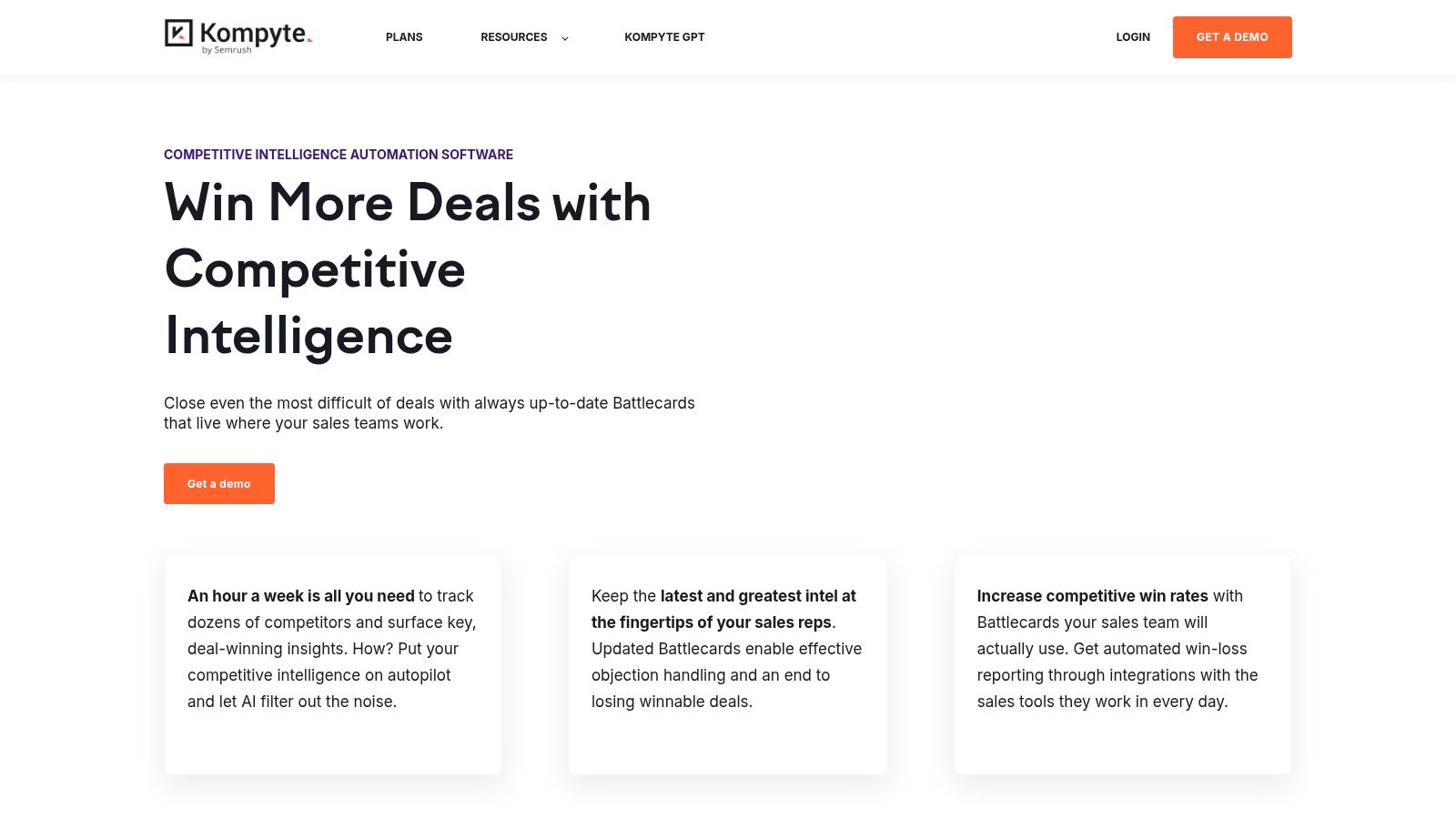
Kompyte, now part of the Semrush suite, is an automated competitive intelligence platform designed specifically for go-to-market (GTM) teams. Its core strength lies in its speed and focus on turning competitive data into tangible sales and marketing assets, particularly battlecards. It streamlines the entire process from tracking competitor activities to equipping sales reps with the exact information they need to win deals.
Unlike more sprawling platforms, Kompyte is purpose-built for producing actionable competitive workflows with a fast time-to-value. Many users report seeing initial insights within 24-48 hours and achieving full setup in under two weeks, making it ideal for teams who need to build a CI function quickly and effectively.
Key Features & Use Cases
- Automated Battlecard Creation: Kompyte is a leader in creating and distributing dynamic, up-to-date sales battlecards. It automatically detects competitor changes and pushes updates to the relevant cards.
- GTM Workflow Integrations: It integrates deeply into existing GTM tech stacks, including Salesforce, HubSpot, and Slack, ensuring intel is accessible where teams work.
- Targeted Alerts & Reports: The platform delivers real-time alerts on competitor moves. Example: Kompyte sends an alert that a top competitor just removed mentions of their "money-back guarantee" from their pricing page, giving your sales team a powerful talking point about risk.
- Rapid Implementation: Kompyte is known for its quick setup and dedicated onboarding support. This makes it one of the best competitive intelligence software options for organizations that need to launch a formal program without a lengthy implementation cycle.
| Feature | Best For |
|---|---|
| Intel Sources | Broad web monitoring focused on GTM signals (websites, ads, reviews, etc.) |
| Primary Use Case | Building and distributing sales battlecards and GTM intelligence |
| Unique Offering | Extremely fast time-to-value and a specialized focus on battlecard workflows |
| Pricing Model | Quote-based; requires a demo and annual contract. No public pricing. |
Pros:
- Purpose-built for sales enablement and battlecard creation.
- Fast implementation and strong onboarding support.
- Unlimited battlecards and reports are included across all pricing tiers.
Cons:
- Pricing is not transparent and requires an enterprise-style sales process.
- Primarily focused on GTM use cases, which may be limiting for broader strategic intelligence needs.
7. Owler
Best For: Simple, Automated Competitor News Tracking
Owler is a community-powered business information platform that provides a straightforward way to track competitors and receive timely news alerts. It excels at delivering high-level company data, funding announcements, and leadership changes for millions of businesses. While not as deep as enterprise-focused CI tools, Owler is an excellent starting point for teams wanting to establish a basic competitor monitoring routine without a significant upfront investment.
The platform's strength lies in its simplicity and scale. Users can quickly build watchlists of competitors, partners, and prospects, and receive daily email digests summarizing key events like acquisitions, funding rounds, and major news mentions. This makes it a great, low-effort tool for staying informed on the competitive landscape.

Key Features & Use Cases
- Vast Company Database: Owler contains profiles on over 20 million companies, mapping out competitive relationships and providing key firmographic data.
- Daily News Digests: Its core feature is the "Daily Snapshot," an email that summarizes the latest news, press releases, and blog posts from the companies you follow. Example: You receive an email digest in the morning that shows a key competitor just acquired a smaller startup, signaling their move into a new market segment.
- CRM & Slack Integrations: Paid tiers (Owler Max) offer integrations with Salesforce and Slack, allowing teams to push competitive alerts directly into their existing workflows.
- Funding & Acquisition Alerts: The platform is particularly useful for tracking investment and M&A activity within a specific market. It's a solid choice for the best competitive intelligence software for high-level market signal tracking.
| Feature | Best For |
|---|---|
| Intel Sources | Community-sourced data, news articles, press releases, and company blogs |
| Primary Use Case | Simple, automated tracking of high-level competitor news and events |
| Unique Offering | A free community tier for basic tracking and a simple daily digest format |
| Pricing Model | Free community plan available. Pro and Max plans are quote-based. |
Pros:
- Extremely easy to set up and start tracking competitors with minimal effort.
- The free community tier provides significant value for small teams or individuals.
- Broad coverage of millions of public and private companies.
Cons:
- Lacks the deep, granular tracking of website changes or product-level updates.
- Enterprise pricing is not transparent and requires a sales process.
8. AlphaSense
Best For: Deep Market Research with Expert Content
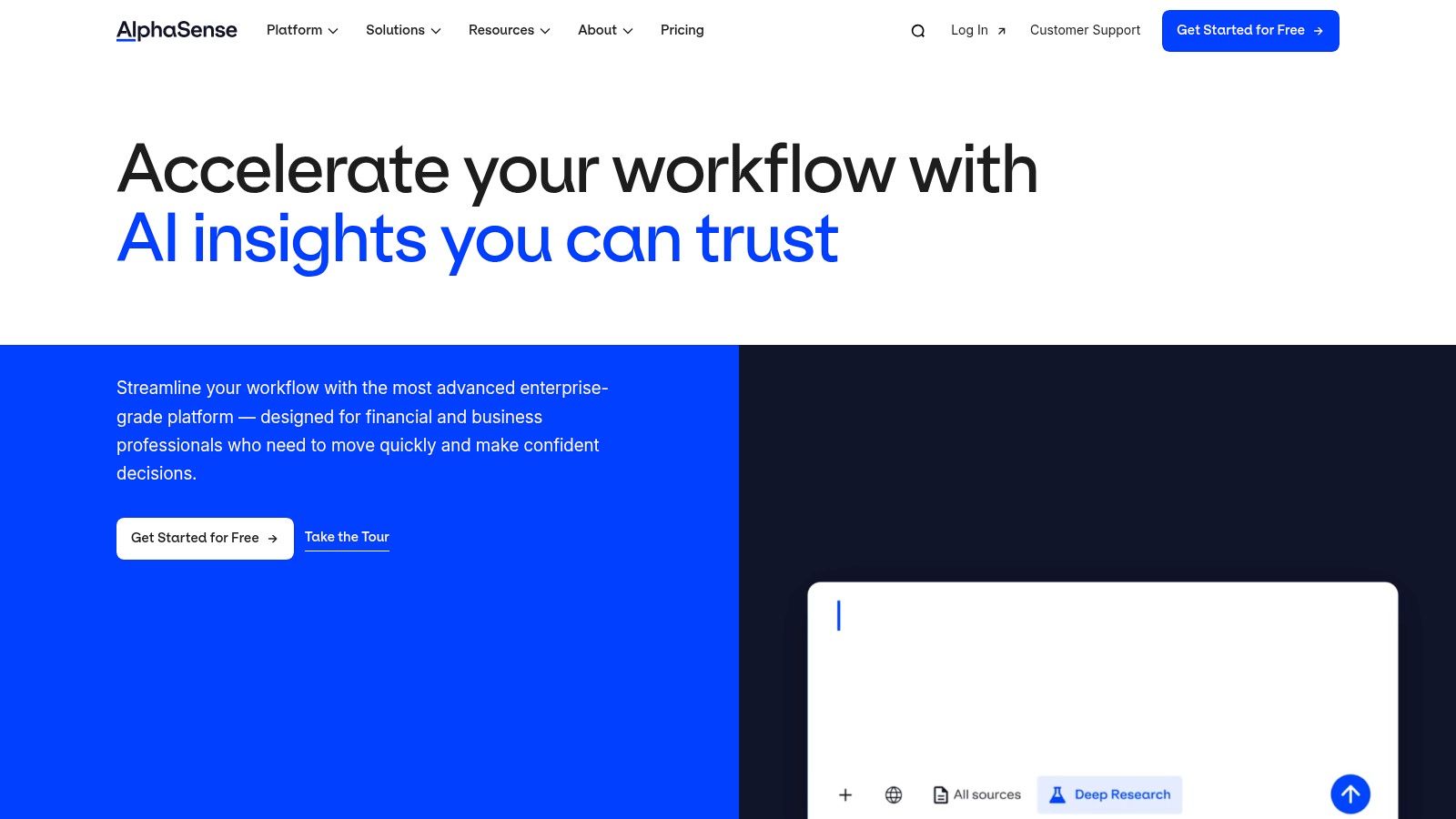
AlphaSense is a premium market intelligence platform that goes beyond standard web monitoring, focusing instead on deep, authoritative content. It aggregates a massive library of sources including SEC filings, broker research, expert call transcripts, and news, making it a go-to tool for corporate strategy, product management, and investor relations teams. While other tools track what competitors do publicly, AlphaSense reveals the why behind their moves through expert analysis and primary research documents.
Its powerful AI search and summarization engine allows users to instantly find insights across millions of documents. This makes it an incredibly efficient tool for due diligence, understanding market sentiment, and uncovering strategic shifts that aren't announced in a press release.
Key Features & Use Cases
- Premium Content Aggregation: Provides access to an extensive library of expert call transcripts, broker research, and regulatory filings that are not available through standard web scraping.
- AI-Powered Search & Summarization: Its AI engine can search across all content sources and provide smart summaries, saving hundreds of hours of manual research. Example: Instead of reading a 100-page analyst report on your market, AlphaSense AI summarizes the key competitor threats and opportunities in a few paragraphs. This makes it a powerful tool for a comprehensive SaaS market research process.
- Trend & Sentiment Analysis: Users can track key themes, competitor mentions, and market sentiment across thousands of sources to identify emerging opportunities and risks.
- Expert Support & Onboarding: AlphaSense offers tailored per-seat and enterprise plans that come with 24/7 help and dedicated training, ensuring teams can extract maximum value.
| Feature | Best For |
|---|---|
| Intel Sources | Broker research, expert transcripts, filings, news, and internal docs |
| Primary Use Case | Deep market research and strategic intelligence for corporate teams |
| Unique Offering | Access to exclusive expert content and AI-driven document analysis |
| Pricing Model | Quote-based; requires annual commitment and sales engagement for access. |
Pros:
- Access to deep, authoritative sources not found in other CI tools.
- Excellent for executive, product, and investor relations use cases.
- Robust AI summarization significantly speeds up the research process.
Cons:
- High price point makes it inaccessible for most startups and small businesses.
- The sales process is required to get pricing or access the platform.
9. BuiltWith
Best For: Analyzing a Competitor's Technology Stack
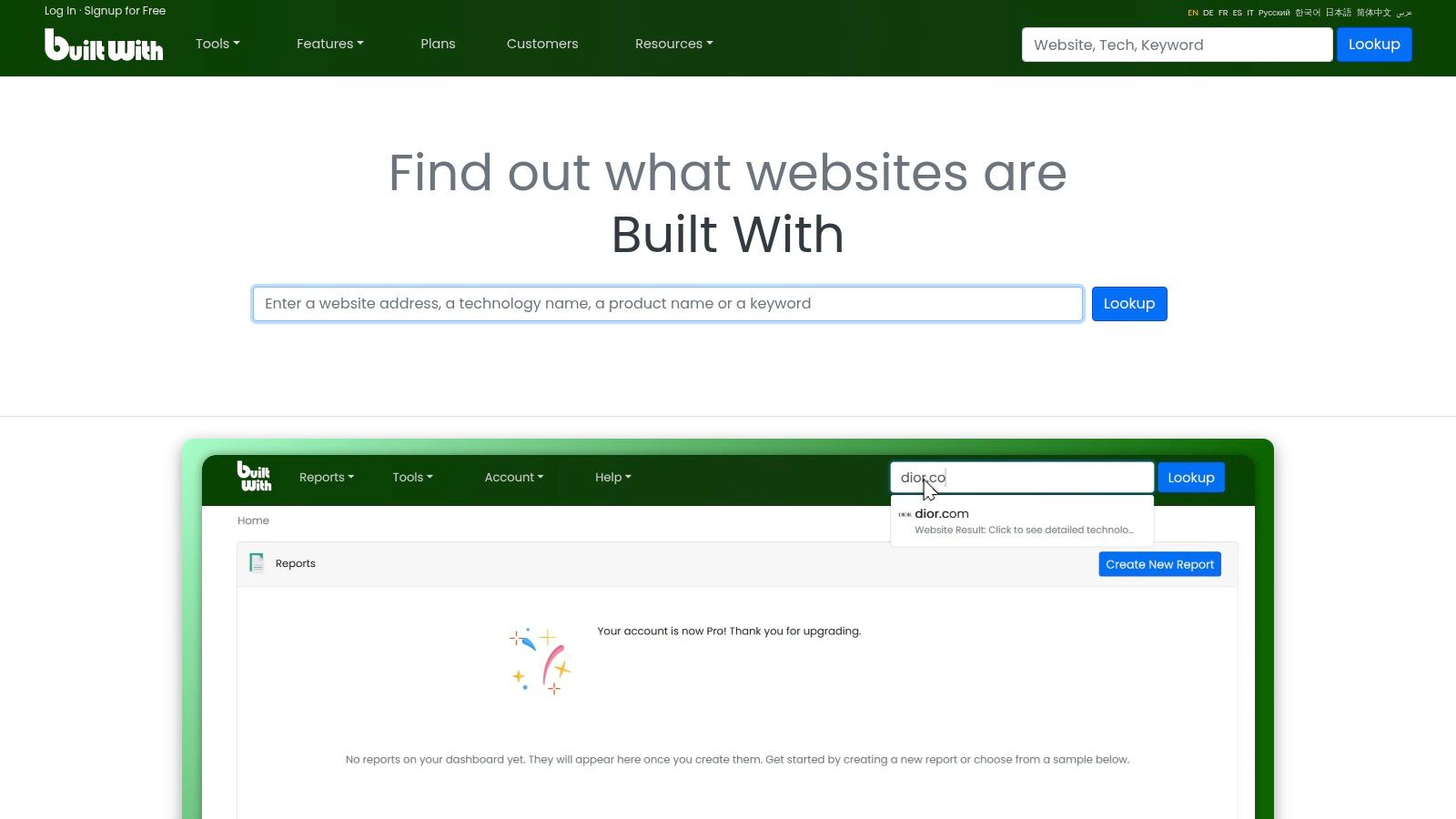
BuiltWith isn't a traditional competitive intelligence platform; instead, it's a powerful technology lookup tool that provides deep insights into a competitor's tech stack. It reveals which technologies a website is built with, from analytics and tracking pixels to hosting providers and CRM systems. This information allows product and sales teams to infer a competitor's operational maturity, marketing sophistication, and potential integration opportunities.
By analyzing a competitor's technology adoption history, you can spot strategic shifts, such as a move to a more expensive marketing automation platform, signaling a bigger budget. For go-to-market teams, it’s an invaluable resource for building highly targeted prospect lists based on the specific software a company uses.
Key Features & Use Cases
- Technology Profiling: Provides a detailed breakdown of all detectable technologies on over 414 million domains, including historical usage data to track trends.
- Lead Generation & List Building: Users can create targeted lists of websites based on the technologies they use or don't use. Example: You can find all websites using HubSpot but not using a specific live chat tool, creating a perfect prospect list for your new chat software.
- Market Share Analysis: Offers reports on technology adoption trends and market share, helping you understand the competitive landscape for specific software categories.
- API Access: Allows for programmatic access to its massive dataset, enabling teams to enrich their own CRM data or build custom intelligence solutions. BuiltWith is one of the best competitive intelligence software options for technical analysis.
| Feature | Best For |
|---|---|
| Intel Sources | Website technology detection (analytics, widgets, frameworks, etc.) |
| Primary Use Case | Building tech-based prospect lists and analyzing a competitor's tech stack |
| Unique Offering | Historical technology usage data and extensive lead filtering options |
| Pricing Model | Free for individual lookups; Paid plans start at $295/month (Basic). |
Pros:
- Excellent for inferring competitor maturity, budget, and tooling priorities.
- Flexible pay-as-you-go options for one-off reports and lists.
- Provides actionable data for outbound sales and partnership teams.
Cons:
- Purely focused on technology; lacks context on messaging, ad spend, or organic traffic.
- Monthly plans for full access can be expensive for early-stage startups.
10. Wappalyzer
Best For: Quick, Tactical Lookups of Competitor Technology
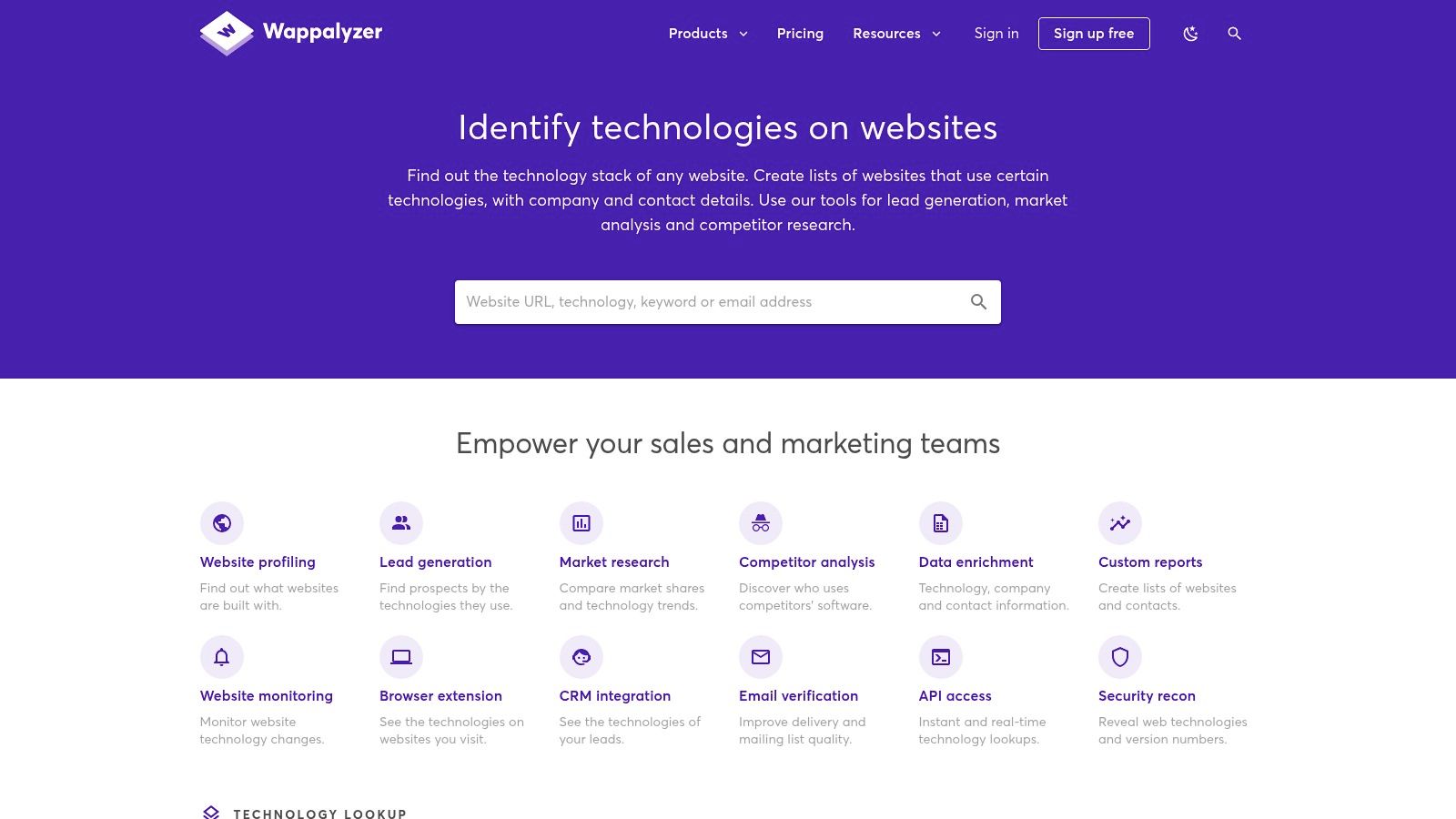
Wappalyzer is a technology profiler that offers a direct, tactical view into a competitor's tech stack. While not a comprehensive competitive intelligence platform, it provides a crucial and often overlooked data point: what tools your rivals are using to build, market, and run their business. By simply visiting a website with its browser extension, you can instantly see the CMS, analytics tools, CRMs, and ad tech being used.
This insight is powerful for several reasons. It can reveal a competitor's new strategic investment (e.g., adopting HubSpot signals a marketing push), identify potential sales leads for your own tech product, or help you understand the technical sophistication of a market. Wappalyzer specializes in this specific niche, making it an essential, lightweight addition to any CI toolkit.
Key Features & Use Cases
- Technology Profiling: Instantly identify over a thousand web technologies via a browser extension or API.
- Website Alerts: Monitor specific competitors and receive alerts when they add or remove a technology from their stack, providing a real-time signal of a strategic shift.
- Lead List Generation: Build targeted lists of prospects based on the technologies they use. Example: Find all e-commerce websites built on Shopify that don't use a loyalty program app, creating a prime audience for your new Shopify app.
- Bulk Lookups & API Access: Users can analyze thousands of websites at once via bulk uploads or integrate Wappalyzer's data into their own applications using its robust API. This makes it a versatile tool for both manual checks and automated workflows.
| Feature | Best For |
|---|---|
| Intel Sources | Website technology stack detection |
| Primary Use Case | Tactical CI on competitor tooling and tech-based lead generation |
| Unique Offering | Simplicity and laser-focus on technology profiling with real-time alerts |
| Pricing Model | Free browser extension; paid plans start at $250/month for more features. |
Pros:
- Extremely easy to use, providing instant insights with its browser extension.
- Offers a unique and valuable CI signal (technology changes) that many broader platforms miss.
- Straightforward pricing with a free tier for basic, individual use.
Cons:
- Narrow focus; it only answers the "what technology" question and requires other tools for strategic context.
- Its value is primarily tactical and may not support broad, program-level competitive intelligence efforts alone.
11. SpyFu
Best For: Reverse-Engineering Competitor Search Marketing
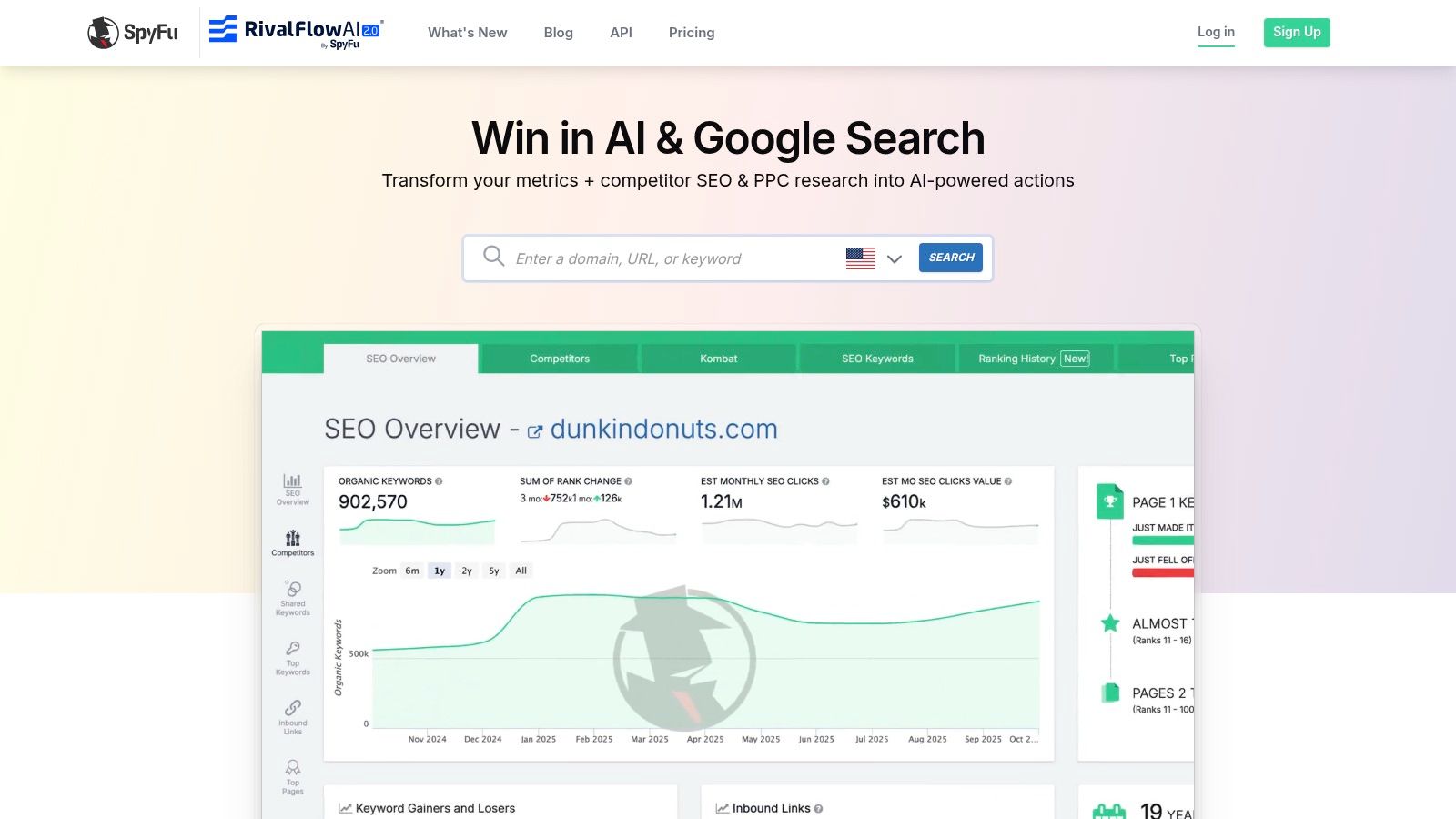
SpyFu is a specialized competitive intelligence tool laser-focused on the search channel. While broader platforms track everything from press releases to feature updates, SpyFu dives deep into competitor SEO and PPC strategies. It reveals years of historical data on keywords competitors have bought on Google Ads, the ad copy they've tested, and every organic rank they've held.
This makes it an invaluable resource for marketing teams aiming to dominate search results. Instead of guessing which keywords to target or what ad copy will resonate, you can analyze a competitor's entire search marketing playbook. It uncovers both their successes and failures, allowing you to learn from their budget and build a more effective strategy from day one.
Key Features & Use Cases
- PPC Competitor Research: See every keyword your competitors have bid on, the ad variations they’ve run, and their estimated monthly ad spend. Example: Discover that your competitor has been bidding on the keyword "Zendesk alternative" for three years straight, proving it's a profitable term worth targeting yourself.
- SEO Keyword & Content Gap Analysis: The Kombat feature allows you to compare your domain against two competitors to find valuable keywords they rank for that you don't, identifying clear content opportunities.
- Historical Data: SpyFu offers over 15 years of historical data, allowing you to track a competitor's search strategy evolution over time.
- Rank Tracking: Monitor your keyword rankings across Google and Bing and get actionable reports to guide your SEO efforts. While it focuses on search, it shares similarities with some of the best social ads spy tools in its ability to uncover ad-related intelligence.
| Feature | Best For |
|---|---|
| Intel Sources | Google & Bing SERPs (PPC and Organic) |
| Primary Use Case | SEO and PPC campaign optimization and competitor analysis |
| Unique Offering | Extensive historical ad copy and keyword data at an accessible price |
| Pricing Model | Tiered plans starting at $39/month (billed annually) with public pricing. |
Pros:
- Excellent value for deep insights into search marketing channels.
- Transparent and affordable pricing tiers make it accessible for smaller teams.
- Generous historical data provides a long-term view of competitor strategies.
Cons:
- Its focus is almost exclusively on search; not a full-stack CI platform.
- Lacks the sales enablement and battlecard features of enterprise tools.
12. G2
Best For: Researching and Comparing Software with Real User Reviews
While not a competitive intelligence tool itself, G2 is an essential first stop for evaluating and shortlisting them. It's a B2B software marketplace that aggregates authentic user reviews, allowing you to see how real-world users feel about different platforms. Instead of relying solely on vendor marketing, you can use G2's grids and comparisons to benchmark features, ease of use, and quality of support across dozens of CI solutions.
For SaaS founders and growth teams, G2 is the ultimate due diligence resource. You can filter by company size to see what tools are popular with SMBs versus enterprises, read detailed pros and cons, and discover new or niche players you might have otherwise missed. It saves countless hours by helping you build a data-backed shortlist of vendors to demo.
Key Features & Use Cases
- Verified User Reviews: Access thousands of in-depth reviews from verified users, providing unbiased insights into a tool's strengths and weaknesses.
- Grid Reports: G2’s proprietary Grid visually plots software based on user satisfaction and market presence, helping you quickly identify category leaders and high-momentum products.
- Detailed Comparisons: Compare up to four products side-by-side on features, pricing details, and review ratings to make informed decisions. Example: You're deciding between Klue and Crayon. On G2, you can create a side-by-side comparison and see that users rate Klue's ease of setup higher, which might be the deciding factor for your small team.
- Category Discovery: Using G2 to browse the CI category is an effective way to find the best competitive intelligence software for specific needs, from market intelligence to sales enablement.
| Feature | Best For |
|---|---|
| Intel Sources | Aggregated user reviews, product data, and market presence signals |
| Primary Use Case | Researching and shortlisting CI software vendors before a demo |
| Unique Offering | Vendor-neutral platform with crowdsourced, real-world user feedback |
| Pricing Model | Free to browse and compare. Paid features are available for vendors. |
Pros:
- Saves significant time in the initial vendor evaluation and discovery phase.
- Provides authentic, unbiased user sentiment to counterbalance vendor marketing.
- Excellent filtering allows you to find tools that fit your specific company size and needs.
Cons:
- It's a directory, not a CI platform, so it’s a starting point for research, not an analytics tool.
- Sponsored placements can influence visibility, so it's wise to look beyond the top results.
Top 12 Competitive Intelligence Tools Comparison
| Product | Core features & unique selling points (✨) | Quality / Trust (★) | Target audience (👥) | Price / Value (💰) |
|---|---|---|---|---|
| Proven SaaS 🏆 | ✨ Meta Ad Library scraping + AI company-mapping; est. MRR, profit scores; 14.5k+ SaaS | ★★★★☆ — live updates, strong social proof | 👥 Founders, indie hackers, growth teams, dev studios | 💰 Sign-up required; high ROI for builders & rapid validation |
| Crayon | ✨ 100+ intel types, AI Sparks, automated battlecards & sales integrations | ★★★★ — enterprise CI breadth | 👥 CI teams, sales enablement, large orgs | 💰 Quote-based; enterprise value (implementation required) |
| Klue | ✨ Deal-specific CI: Compete Agent, battlecards, win/loss analytics | ★★★★ — sales-oriented impact tracking | 👥 Revenue teams, sales enablement | 💰 Enterprise pricing; demo-led |
| Similarweb | ✨ Traffic, audience, channel & ad intelligence; benchmarking + alerts | ★★★★ — broad market coverage | 👥 Marketing teams, market analysts, growth leads | 💰 Self-serve tiers; free trial on select plans |
| Semrush | ✨ SEO + Ads toolkits, market trends, competitor tracking | ★★★★ — mature ecosystem for SEO/ads | 👥 SEO/marketing teams, agencies | 💰 Tiered plans, 7-day trials; add-ons possible |
| Kompyte (by Semrush) | ✨ GTM-focused CI: fast battlecards, alerts, Salesforce/HubSpot integrations | ★★★★ — quick time-to-value for GTM | 👥 Product marketing, GTM & sales teams | 💰 Quote-based; annual terms typical |
| Owler | ✨ Massive company profiles, follow lists, news digests & CRM integrations | ★★★ — easy lightweight CI | 👥 SMBs, ops, basic CI users | 💰 Free community tier; paid "Max" for integrations |
| AlphaSense | ✨ Filings, broker research, transcripts + AI summarization (authoritative) | ★★★★☆ — premium sources & support | 👥 Strategy, IR, investor teams | 💰 Premium enterprise pricing; sales engagement |
| BuiltWith | ✨ Technology usage histories, prospect lists, exports & API access | ★★★★ — deep tech-detection data | 👥 Product, outbound, sales ops | 💰 Pay-as-you-go & subscription plans |
| Wappalyzer | ✨ Browser extension + tech detection, alerts, lead lists | ★★★ — quick stack signals | 👥 Devs, SDRs, small GTM teams | 💰 Free tier; simple paid plans & API |
| SpyFu | ✨ Historic PPC/SEO buys, ad copy tests, rank tracking, SEO gap analysis | ★★★★ — search-channel specialist | 👥 PPC/SEO teams, agencies | 💰 Clear tiered pricing; good historical value |
| G2 | ✨ Vendor-neutral marketplace: reviews, product grids & market dashboards | ★★★★ — current user sentiment & discovery | 👥 Buyers, procurement, vendor researchers | 💰 Free browsing; paid vendor features available |
From Intelligence to Action: Making Your Final Choice
We've explored a dozen of the best competitive intelligence software platforms, each offering a unique lens through which to view your market. From the broad digital landscape scans of Similarweb and Semrush to the sales-focused battlecard builders like Klue and Crayon, the right tool is out there. The key isn't finding a mythical, one-size-fits-all solution; it's about aligning a tool's core strengths with your most critical business objective.
The ultimate goal of competitive intelligence is not to collect data for its own sake. The goal is to make better, faster decisions that give you a strategic edge. A massive spreadsheet of competitor features is useless without the context of which ones customers actually value and pay for.
Your Final Decision Framework
As you move toward a decision, resist the temptation to choose the tool with the most features. Instead, refocus on your primary "job-to-be-done." This single question will guide you to the right shortlist and prevent you from overspending on a platform you'll only use 10% of.
Here’s a simple framework to help you select the best competitive intelligence software for your specific situation:
- For Idea Validation & Niche Discovery: If your primary goal is to find validated market demand before you build a product, you need signals that prove people are actively spending money. Tools like Proven SaaS and SpyFu, which focus on ad spend and keyword profitability, are your most direct path to validation. They show you where the money is already flowing.
- For Sales Enablement & Deal Wins: If you need to equip a sales team to consistently win against established competitors, you need real-time alerts, dynamic battlecards, and CRM integration. Platforms like Klue, Crayon, and Kompyte are built specifically for this workflow, turning market intel into actionable talking points for your sales reps.
- For Comprehensive Market & Trend Analysis: If you need a 30,000-foot view of the market, you need broad data sets. Similarweb provides unparalleled web traffic and audience insights, while AlphaSense offers deep market research and expert commentary. For understanding the technology stacks that power your competitors, BuiltWith and Wappalyzer are indispensable.
Implementing Your CI Strategy
Once you’ve made your choice, remember that the tool is just the vehicle. Your strategy is the roadmap. Start small. Don’t try to track every competitor and every data point from day one.
- Define 3-5 Key Competitors: Focus on the players who matter most.
- Identify 2-3 Critical Signals: What data actually influences your decisions? This could be pricing changes, new ad campaigns, or significant hiring trends.
- Establish a Rhythm: Create a simple, repeatable process for reviewing insights and sharing them with the relevant team members. Whether it’s a weekly email digest or a bi-weekly meeting, consistency is key.
The journey from raw data to a winning strategy is what separates market leaders from the rest of the pack. The right competitive intelligence software acts as a powerful catalyst, compressing that journey and bringing clarity to your most important decisions. Your competitors are already using these tools; the real question is, how will you use them to get ahead?
Tired of chasing unproven ideas? Proven SaaS was built for founders who want to build businesses based on real, ad-driven market demand. Stop guessing and start validating with our database of SaaS companies, their ad spend, and revenue estimates to find your next profitable niche. Discover validated SaaS ideas today at Proven SaaS.
Build SaaS That's
Already Proven.
14,500+ SaaS with real revenue, ads & tech stacks.
Skip the guesswork. Build what works.
Trusted by 1,800+ founders


