

A Startup Founder's Guide to MVP Development
Launching a startup isn't about building a perfect, feature-packed product from day one. It's about launching a product with just enough features to attract early users. This allows you to test your core idea in the real world without spending a fortune.
This strategy, known as building a Minimum Viable Product (MVP), is designed to help you learn directly from your market instead of guessing what people want. It’s a direct response to one of the biggest startup killers: building something nobody is willing to pay for.
Why an MVP Is Your Startup's Smartest First Move
It’s tempting to pour all your time and money into building a "perfect" product. But launching that masterpiece only to find out no one will use it is a fast track to failure. The MVP approach flips that script.
An MVP isn’t a buggy, unfinished app. It’s a strategic tool designed to reduce risk and build your business on a foundation of real-world evidence, not just hopeful assumptions.
Think of your MVP as a learning machine. Its primary goal is to get clear answers to your most important questions. For example:
- Does your core idea solve a real problem for a specific group of people?
- Are they willing to pay for a solution?
- Which features are essential, and which are just "nice-to-haves"?
The Core Benefits of Starting Small
Building an MVP forces you to distill your grand vision down to its absolute essence. This intense focus is what gives early-stage companies a fighting chance and delivers a few huge advantages.
Real-World Validation: An MVP is the ultimate reality check for your business idea. It confirms if there’s a genuine need for what you're building before* you've spent your entire budget. You can dig deeper into this crucial first step in our guide on what is market validation.
- Speed to Market: Focusing only on essential features gets your product out the door much faster. This speed lets you start collecting user feedback, building a community, and gaining a foothold in the market while your competitors are still stuck in planning meetings.
Lower Upfront Costs: A smaller feature set means a smaller bill from your developers. For a startup on a tight budget, this is everything. It allows you to spend your precious capital on features you know* users want, not the ones you’re just guessing they might.
> "An MVP is your first, most honest conversation with the market. It’s not about perfection; it’s about getting a clear 'yes' or 'no' on your core value proposition as quickly and cheaply as possible."
From Theory to Reality
The numbers don't lie. Startups that launch with an MVP have a better shot at long-term success because they get to validate their ideas when it matters most—at the very beginning.
In fact, a shocking 42% of startups fail because they build something with no market need. That’s the exact, fatal flaw an MVP is designed to prevent. By starting lean, you can gather feedback, pivot when needed, and make sure you’re building a solution that truly solves a problem for your customers.
Building Your MVP Blueprint
A successful MVP starts long before anyone writes a single line of code. It begins with a solid, strategic blueprint that anchors your project in reality. This planning phase is your best defense against the classic startup trap: building a beautiful product that nobody actually needs or wants to pay for. Getting this right from the start saves a ton of time and money down the road.
Your first job isn't to brainstorm features—it's to find a genuine, painful problem that a specific group of people is wrestling with. This means getting out of your own head and into the market. Talk to potential customers. Run simple surveys. Lurk in the online communities where your target audience complains. You're hunting for recurring frustrations and unmet needs.
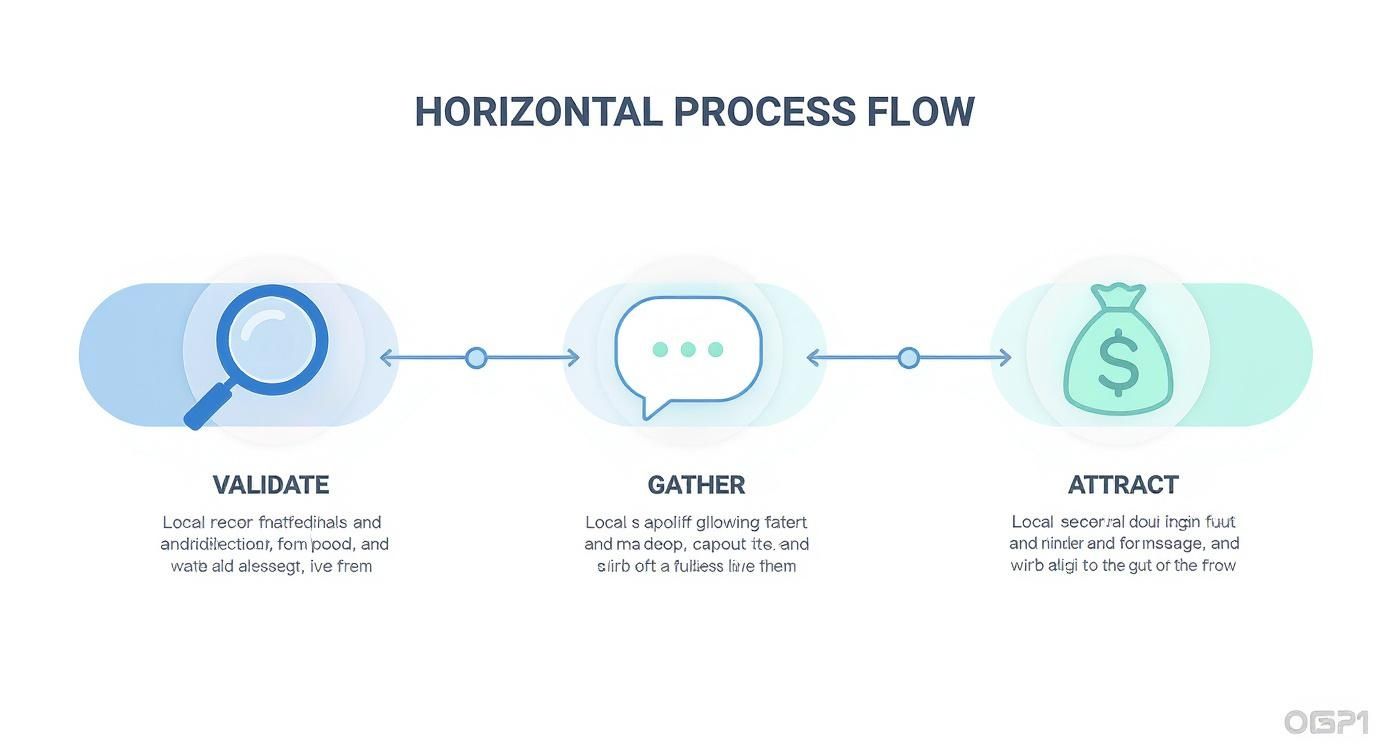
This simple infographic captures the essence of how an MVP can fuel a startup's growth.
The flow is straightforward: Validate your idea, gather real-world feedback, and start attracting those crucial first users. At its core, an MVP's job is to prove you're on the right track and build early momentum.
Define Your Core Features
Once you've zeroed in on a real problem, it's time to define the absolute minimum set of features needed to solve it. This is where many founders go wrong. The temptation to add "nice-to-have" features is huge, but you have to be ruthless. If a feature doesn't directly solve that one core problem for your first users, it gets cut. Period.
Example: A Project Management Tool
Let's say you're building a tool for small creative agencies. After research, you discover their biggest headache is tracking billable hours accurately.
- Core Feature: A dead-simple, one-click timer that a user can assign to a specific project.
- Non-Essential Feature: A complex reporting dashboard with custom charts and team performance analytics.
That dashboard is a great idea for version 2.0, but it doesn't solve the immediate, primary problem. Focusing only on the timer gets your product into users' hands faster and lets you validate your main assumption: "Will agencies use a simple tool to track time?" A thorough competitive landscape analysis can also shed light on what features are considered standard in your space.
> Don't confuse a "minimum" product with a "bad" one. Your MVP should be simple, not sloppy. It must solve the core problem reliably and offer a clean, usable experience.
Map the User Journey
With your core feature list locked in, sketch out a simple user journey map. This is a flowchart showing the exact steps a user takes to solve their problem with your product. It forces you to see the world through their eyes and keeps the development team focused on what actually matters.
For our project management tool example, the user journey might look like this:
- Sign Up: User creates an account.
- Create Project: User adds a new project.
- Track Time: User starts the timer and assigns it to the project.
- Stop Time: User stops the timer.
- Review: User sees a basic list of their timed entries for the day.
- Speed: Frameworks like Ruby on Rails, Django, or Node.js are popular for a reason. They let you get features up and running quickly.
- Scalability: You don't need to build for a million users on day one, but you also don't want the app to crash if you get a burst of early traffic. Choose a stack that can grow with you.
- Talent Pool: When you use a well-known technology, finding developers to help you is easier and more affordable.
- Build an In-House Team: This gives you maximum control, as your team lives and breathes your product. However, it’s the most expensive and slowest option upfront due to recruiting costs, salaries, and benefits.
- Hire Freelancers: A flexible and cost-effective option for specific tasks or smaller projects. The downside is that you become the project manager, juggling different freelancers, ensuring quality, and protecting your IP.
- Partner with a Development Agency: Often the fastest way to get a full, experienced team. Agencies bring their own project managers and proven processes, which takes a huge load off your shoulders. It's a bigger investment than freelancers but can be cheaper and faster than building your own team.
- Invite-Only Beta: Give exclusive access to people from your waitlist or trusted professional network.
- Community Release: Launch to a specific online community where your ideal users gather, like a niche Subreddit or a specialized Facebook group.
- Geographic Rollout: Limit the release to a single city or country first. This keeps the initial user base manageable and makes support requests less overwhelming.
- User Engagement: Are people actually using the core feature? Keep a close eye on your daily and weekly active users (DAU/WAU) to see if they're coming back consistently.
- User Retention: This is the big one. What percentage of users are still around after one week or one month? High retention is a strong signal that you're building something people genuinely need.
- Customer Acquisition Cost (CAC): How much does it cost in marketing and sales to get one new customer? Keeping this number low is critical for survival.
- Customer Lifetime Value (LTV): How much revenue can you realistically expect from a single customer? For a sustainable business, your LTV must be significantly higher than your CAC.
- Bugs: Things that are broken. These are almost always your top priority.
- Quick Wins: Small tweaks that deliver a ton of value with minimal effort.
- Feature Requests: New ideas from users that could expand the product's value.
- Future Ideas: Cool concepts to keep on the back burner for the long-term.
- Casting Too Wide a Net: When you try to build a product for "everyone," you usually end up building one for no one. A great MVP solves a specific problem for a specific group of people.
- Ignoring Tough Feedback: It stings to hear criticism, but that negative feedback is pure gold. Dismissing it with "they just don't get it" is a massive blind spot.
- Skipping the Blueprint: Diving straight into code without a prototype is like trying to build a house without architectural drawings. Prototyping is a cheap, fast way to catch major design flaws before a single line of code is written.
This lean blueprint becomes your North Star during the mvp development for startup process. It ensures every decision serves one clear purpose: solving one problem, for one audience, exceptionally well.
Time to Roll Up Your Sleeves and Build
Alright, the planning's done. You have your blueprint. Now comes the exciting part: turning those ideas into something real. This is where you shift from thinking to doing, building a functional product that users can actually interact with. The goal here isn't a flawless, polished masterpiece—it's about getting something tangible out the door, fast.
The entire process is powered by the classic build-measure-learn loop. You build a core feature, get it in front of users to see what they do, and use that feedback to figure out what to build next. It's a simple, agile cycle that stops you from burning months (and cash) building something nobody wants.
Picking the Right Tools for the Job
Your technology stack is a critical decision in mvp development for startup success. It's a balancing act: you need to move quickly now without painting yourself into a corner later.
It's tempting to jump on the latest, shiniest framework, but it's often better to stick with proven technologies that have extensive documentation, a strong community, and are built for rapid development.
Here’s what to look for in your tech stack:
From Napkin Sketch to a Clickable Product
Before writing a single line of code, create a prototype. Seriously, don't skip this step. Wireframing and prototyping let you test the entire user flow and catch design flaws before you've spent a dime on development.
You don’t need anything fancy. Tools like Figma or Balsamiq are great, but even pen and paper work for early stages. The goal is to map out the core journey, from signing up to solving the user's main problem. You'll be amazed at how many flawed assumptions you uncover this way.
> A usable product is more important than a beautiful one. Your MVP doesn't need to win design awards, but it absolutely must be intuitive. If users get frustrated, you've already lost.
This approach is built for speed. Agile methods can slash time-to-market by an average of 45%, which is a massive advantage when you need to adapt quickly. A focused team can typically build a solid MVP in 8 to 16 weeks.
And the data backs this up: a whopping 67% of successful SaaS startups point to this constant cycle of refinement as the key to their growth. For more on this, see how expert teams approach MVP timelines on kodekx.com.
Ultimately, the build phase is about creating the simplest version of your idea that can kickstart that all-important feedback loop. Build it, ship it, and get ready to learn.
Budgeting and Resourcing Your MVP
Let's talk about the two things that turn a great idea into a real product: money and people. This is a critical stage where many founders trip up. You either underestimate how much cash you'll need or you pick the wrong hands to build the thing. Getting your budget and resources dialed in is just as important as deciding on your feature set.
So, what’s the magic number? The honest answer to how much an MVP costs is, "it depends." For a relatively straightforward app, you might be looking at a range of $10,000 to $50,000. If you're building something more complex, especially with AI, that number can easily climb past $150,000.
Don't forget the prep work. The initial discovery phase—where you define requirements, conduct market research, and create wireframes—can cost anywhere from $3,000 to $27,500. It's tempting to rush this, but don't. Teams that invest at least 20% of their budget in this upfront planning are three times more likely to launch a successful product. If you want to dive deeper into the numbers, you can explore more MVP cost data on americanchase.com.
Choosing Your Development Team
With a budget in mind, the next massive decision is who will build your MVP. You have three main options, and the right choice depends on your startup's cash flow, timeline, and how hands-on you want to be.
To make this decision easier, here's a quick comparison:
MVP Resourcing Options At a Glance
| Option | Average Cost | Level of Control | Best For |
|---|---|---|---|
| In-House Team | High | Maximum | Well-funded startups with a long-term vision and a need for deep domain expertise. |
| Freelancers | Low to Medium | Medium | Founders on a tight budget with strong project management skills and well-defined tasks. |
| Development Agency | Medium to High | High (Collaborative) | Startups that need to move fast, require a full team of specialists, and want to reduce management overhead. |
Choosing your path is a strategic decision that shapes not just your budget but your entire launch timeline and your role as a founder.
Uncovering the Hidden Costs
Here’s a pro tip: your mvp development for startup budget isn't just for developers. It's easy to forget the other costs that can derail your finances if you're not prepared.
> Be prepared for more than just the build. A solid MVP budget should include funds for design tools, third-party APIs, server hosting, basic marketing, and post-launch maintenance. These are not 'extras'—they are essential operating costs.
Think about it. You’ll have monthly subscriptions for design tools like Figma. You'll need to pay for any third-party APIs you integrate, like a payment processor or a mapping service. And of course, you'll have ongoing server hosting costs with providers like AWS or Google Cloud.
Finally, set aside a small chunk of cash for initial marketing to get your first users and for post-launch bug fixes. Because trust me, there will be bugs. A well-planned budget ensures you not only get to launch day but have the fuel to keep going afterward.
Launching and Learning from Your MVP
Getting your MVP out the door feels like crossing the finish line, but it’s really just the starting gun. This is the moment your carefully crafted assumptions collide with reality. The goal isn’t a splashy, headline-grabbing launch. It’s a quiet, controlled release to a small group of early adopters.
These first users are your most precious resource. They are the ones who feel the pain you're solving most acutely and are usually more forgiving of a product that's still a little rough. Your only job is to listen—truly listen—to every single thing they have to say.
The Power of a Soft Launch
Instead of a big public reveal, opt for a "soft launch." This lets you test everything in a real-world environment without the pressure of mass-market expectations. It’s your golden opportunity to fix critical bugs and get brutally honest feedback before you open the floodgates.
A soft launch can take a few different forms:
This controlled environment is perfect for gathering both qualitative feedback (user interviews) and hard data (analytics) to make smart decisions.
Tracking What Actually Matters
Once people are using your product, you need to measure what they do, not just what they say. It's easy to get distracted by "vanity metrics" like total sign-ups, which can paint a misleadingly rosy picture.
Instead, focus on the handful of metrics that truly reveal your product's health.
These numbers tell the unfiltered story of your journey toward product-market fit. For a much deeper look, our guide on how to find product-market-fit lays out a complete framework.
> The point of an MVP isn’t to validate your ego—it’s to invalidate your riskiest assumptions. Be ready to hear that your favorite feature is useless or your pricing is way off. That feedback is pure gold.
Turning Feedback into a Clear Roadmap
Collecting feedback is just step one. The real work is creating a system to act on it. You need a simple loop where users can easily report bugs and suggest ideas.
From there, prioritize what comes next. A simple but effective method is to sort all feedback into four buckets:
This simple process helps you turn a chaotic stream of user feedback into an organized, actionable roadmap. Every update should be a deliberate step toward solving your customer's problem better, moving you from a minimum viable product to a product they can't live without.
Common MVP Mistakes to Avoid
Building an MVP is an exciting time, but it's also a minefield of potential missteps. Steering clear of common traps can be the one thing that separates a successful launch from a project that fizzles out.
The most common pitfall? "Gold-plating" the MVP. It's the nagging temptation to add just one more feature, believing it will hook every user. In reality, this "feature creep" just delays the feedback you desperately need. Remember, the goal is to test a single, critical assumption—not to build a Swiss Army knife.
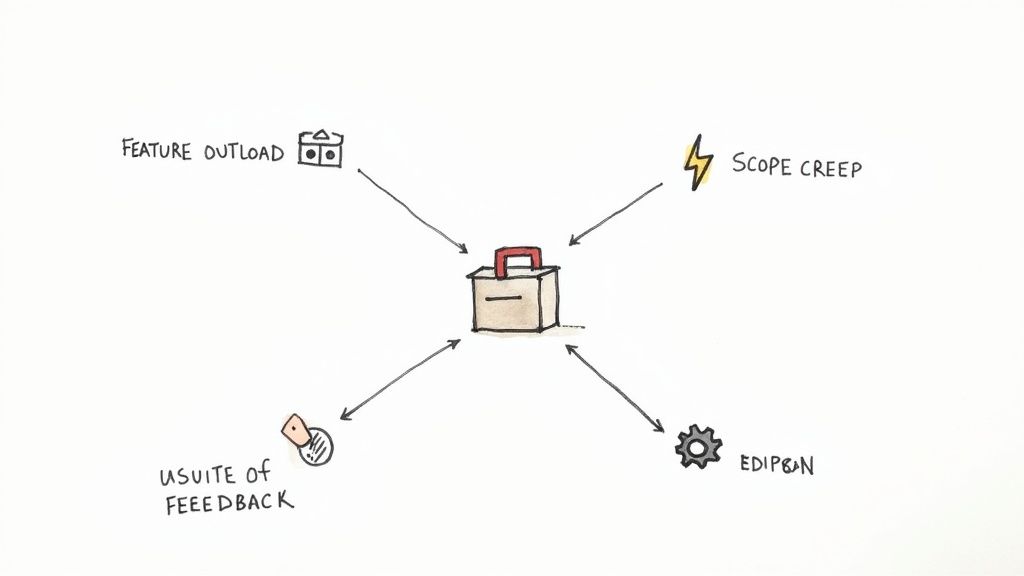
This is the fundamental choice every founder faces. Should you build more, or should you listen more? Every decision should pull you toward listening.
Forgetting the "Viable" in MVP
On the flip side, some founders confuse "minimum" with "mediocre." Your MVP must be simple, but it absolutely must be viable. That means it needs to work smoothly, feel intuitive, and actually solve the user's core problem. A buggy or confusing product doesn't test your idea; it just tests a user's patience.
Here are a few other classic blunders to avoid:
> "Your first MVP is not about building a smaller version of your final product. It's about running the smallest possible experiment to test your biggest assumption."
Solving a Problem Nobody Cares About
But the single biggest, most fatal mistake is building a beautiful solution for a problem that doesn't exist. This happens when a founder falls in love with their idea before confirming anyone has the problem. It’s not a surprise that more than 35% of startups fail for this very reason.
To sidestep this, become obsessed with the problem, not your solution. Get out there and talk to potential customers relentlessly. Listen to what frustrates them. Make sure your MVP is a laser-focused painkiller for a real-world headache. By avoiding these common errors, you keep your project lean, your vision clear, and your startup on the fast track to finding product-market fit.
---
Ready to skip the guesswork and find a SaaS idea that's already proven to be profitable? Proven SaaS uses AI to analyze millions of ads, uncovering what competitors are successfully spending money on right now. Find your validated SaaS idea today and build with confidence.
Build SaaS That's
Already Proven.
14,500+ SaaS with real revenue, ads & tech stacks.
Skip the guesswork. Build what works.
Trusted by 1,800+ founders


