8 Powerful Sales Follow Up Email Examples That Close in 2025
In sales, the real work begins after the first contact. Without a strong follow-up plan, promising deals often go silent. What separates a persistent professional from a spammer? A clear and valuable approach. The key is having proven, effective sales follow up email examples ready to adapt and use.
This guide provides a clear playbook, not just generic templates. We'll break down eight field-tested follow-up emails for different scenarios, from adding value to creating urgency.
For each example, you will learn:
- Why it works: The simple psychology behind its effectiveness.
- When to use it: The best scenarios for each email.
- How to personalize it: Actionable tips to make it your own.
Our goal is simple: to help you get replies, build trust, and close more deals. Let’s turn silence into signed contracts.
1. The Value-Add Follow-Up
This approach shifts the focus from "checking in" to providing genuine value. Instead of asking for a decision, you offer a resource or insight that helps your prospect. This positions you as a helpful expert, not just another salesperson.
By leading with value, you stay top-of-mind without applying pressure. It’s one of the most effective sales follow up email examples because it respects the buyer's time and builds trust.
Why It Works
This method works because it centers on the prospect’s needs. It shows you listened during your first conversation and are invested in their success, not just in making a sale. Providing relevant content demonstrates your expertise and keeps the conversation going.
> Strategic Insight: A value-add email changes the dynamic from a sales pitch to a professional consultation. It gives you a legitimate reason to reach out to a quiet prospect.
Example Template
Subject: A resource for [Prospect's Goal/Challenge]
Hi [Prospect Name],
Following our chat about improving [Specific Area], I found this article on [Relevant Topic] and thought you'd find it useful.
The section on [Specific Detail] made me think of our discussion about [Challenge They Mentioned].
Here's the link: [Insert Link to Resource]
No need to reply, just wanted to share.
Best,
[Your Name]
Actionable Takeaways
- Be Specific: Reference an exact point from your previous conversation to show you paid attention.
- Stay Relevant: The resource must directly address their pain points. A clear audience analysis is key here.
- Use a Soft CTA: A low-pressure call-to-action like "happy to discuss" or "let me know what you think" invites a response without demanding one.
2. The Check-In Follow-Up
This is a classic, low-pressure email designed to gently resurface in your prospect's inbox. Its main goal is simple: bring your previous conversation back to the top of their mind. It’s a polite nudge that acknowledges people get busy.
It's one of the most common sales follow up email examples because it's easy to write and respects the prospect's timeline, making it ideal for warm leads who have already shown interest.
Why It Works
This email works because of its simplicity. It’s a low-friction way to maintain contact and gauge interest without being pushy. By keeping it brief and casual, you make it easy for a prospect to reply.
> Strategic Insight: A well-timed check-in can restart a stalled conversation. Its effectiveness lies in its unassuming nature; it's a "no big deal if you're not ready" message that relieves pressure.
Example Template
Subject: Following up on our conversation
Hi [Prospect Name],
Just wanted to quickly check in on the proposal I sent over last week.
I know things can get hectic, so no worries if you haven't had a chance to look.
Let me know if you have any questions.
Best,
[Your Name]
Actionable Takeaways
- Keep it Casual: Use a friendly tone. Phrases like "just wanted to check in" make the email feel less like a demand.
- Be Clear: Mention the exact item you're following up on (e.g., "the proposal," "our call") to provide context.
- Acknowledge Their Time: Show empathy by recognizing they are busy. This small gesture builds rapport.
3. The Problem-Agitation-Solution (PAS) Follow-Up
The PAS follow-up is a classic persuasion framework. It works in three steps:
- Problem: Restate a known problem.
- Agitate: Explore the negative impact of that problem.
- Solution: Present your product as the clear answer.
- Quantify the Pain: Use data in the agitation section. Phrases like "costing you $X" or "wasting X hours" make the problem real.
- Be Authentic: Base the agitation on real consequences discussed previously. Avoid dramatic language.
- Focus on One Problem: Don't try to address multiple issues. Focusing on one core pain point makes the PAS structure more impactful and is a key step in finding the right approach to product-market fit.
- Make it Relevant: Always use a case study from a company in the same industry, of a similar size, or with a similar problem.
- Use Specific Metrics: Vague claims are weak. Use hard numbers like "reduced their sales cycle by 40%" for maximum impact.
- Keep it Focused: Highlight one strong success story rather than overwhelming the prospect with too much information.
- Get Permission First: Always ask your mutual connection before using their name. An even better approach is to ask them for a direct email introduction.
- Be Specific: Clearly state why the referrer recommended the introduction and connect it to a goal of the prospect.
- State a Clear Ask: Clearly ask for the next step, whether it's a brief call or a connection. This makes it easy for the prospect to say yes.
- Acknowledge, Don't Dismiss: Start by validating their concern. Phrases like "That's a valid question" show you're listening.
- Use Proof, Not Platitudes: Counter objections with specific data, a case study, or a customer testimonial.
- Create an "Objection Library": Document the top objections you hear and create pre-written, resource-backed email templates for each one.
- Be Authentic: Only use real deadlines. If you claim an offer expires, you must honor that.
- Explain the "Why": Clearly state the reason for the urgency, such as "end-of-quarter pricing" or "limited spots." This adds legitimacy.
- Provide a Clear Path: Make it easy for the prospect to take action. Include a clear call-to-action, like "Let me know if you'd like me to send over the agreement."
- Map the Sequence: Plan your touchpoints in advance (e.g., Day 1: Email, Day 3: LinkedIn, Day 5: Call).
- Vary the Message: Tailor your message for each platform. Keep LinkedIn messages shorter and more conversational.
- Reference Other Channels: Mention your previous touchpoints in your messages (e.g., "Just sent you an email with...").
- Honor Preferences: If a prospect responds on one channel, focus your communication there. This is a key part of an integrated digital marketing strategy for a startup.
- 1st Follow-Up: Start with a Value-Add or a simple Check-In.
- 2nd Follow-Up: Use a Social Proof or Educational email to address objections.
- 3rd Follow-Up: Try a Problem-Agitation-Solution approach to re-engage them.
- 4th Follow-Up: Use a Multi-Channel touchpoint for one last opportunity.
- Be Helpfully Persistent: Your goal is to provide value with every touchpoint. Each email should offer a new insight or make their decision-making process easier.
- Personalize Beyond the Name: True personalization means referencing their specific challenges, mentioning a competitor, or connecting your solution to a goal they shared.
- Test and Refine: Track your open rates and reply rates. Which subject lines work best? Which CTAs get the most clicks? Use data to continuously improve your system.
This structure creates urgency and reminds the prospect why they need your help.
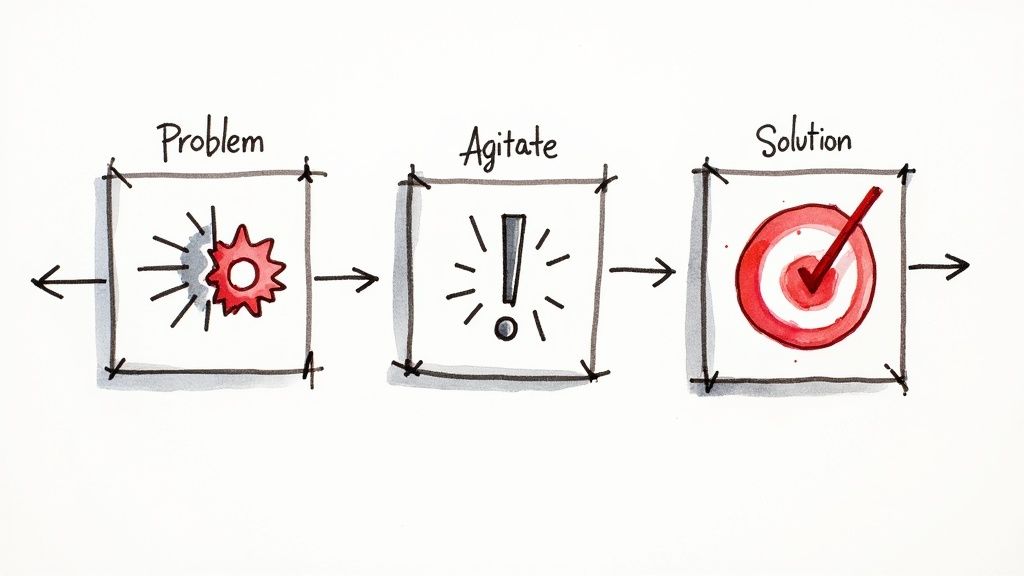
The PAS framework is one of the most powerful sales follow up email examples because it connects directly to the prospect's pain points and frames your solution as essential.
Why It Works
This email taps into the desire to avoid loss. By agitating a problem, you show you understand their challenges on a deeper level and can provide a direct path away from their pain. It reminds them of the cost of doing nothing.
> Strategic Insight: The "agitation" step is the most critical. Instead of just stating the problem, you amplify its negative effects, making the need for a solution feel immediate.
Example Template
Subject: A thought on fixing [Problem]
Hi [Prospect Name],
When we spoke, you mentioned your team's inefficient onboarding process (Problem).
This often means new hires feel disengaged, and a large part of their first-year salary is spent just getting them up to speed (Agitation).
Our platform cuts that onboarding time in half, so new team members can start contributing within weeks, not months (Solution).
Would 15 minutes next Tuesday be a good time to show you how?
Best,
[Your Name]
Actionable Takeaways
4. The Social Proof Follow-Up
This email uses the psychological principle that people follow the actions of others. Instead of talking about your product's features, you show how similar companies have successfully used your solution. This builds credibility and reduces risk for the buyer.

This tactic is extremely effective because it moves from claims to concrete results. It's one of the best sales follow up email examples for overcoming skepticism and showing proven value.
Why It Works
This email answers the prospect's unspoken question: "Has a company like mine solved a problem like mine with your product?" It validates your claims with third-party evidence, making your pitch more believable and creating a powerful sense of FOMO (fear of missing out).
> Strategic Insight: Social proof reduces the risk of a purchase decision. Seeing a peer succeed with your tool makes a prospect feel more confident in their choice.
Example Template
Subject: How [Similar Company] achieved [Specific Result]
Hi [Prospect Name],
During our chat, you mentioned the challenge of [Mention Prospect's Pain Point].
A company in your industry, [Similar Company/Customer Name], faced the same problem. They used our solution to [Achieve Specific, Quantifiable Result - e.g., increase lead conversion by 35%].
I thought you might find their story insightful. You can read the case study here: [Link to Case Study/Testimonial]
Are you free for a brief call next week to discuss how we could do the same for [Prospect's Company]?
Best,
[Your Name]
Actionable Takeaways
5. The Referral or Introduction Follow-Up
This follow-up uses a mutual connection to establish immediate credibility and trust. A recommendation from a trusted source carries far more weight than a standard cold outreach, making it one of the most effective sales follow up email examples for cutting through the noise.
This approach is a cornerstone of networking-focused sales and is highly effective because it transforms a cold interaction into a warm one.
Why It Works
This method works because we trust people we know. When a prospect sees you have a mutual connection, it lowers their guard and makes them more likely to listen. It instantly gives your message credibility.
> Strategic Insight: A referral isn't just a name-drop; it's a transfer of trust. When a mutual contact suggests you connect, their reputation is implicitly on the line.
Example Template
Subject: Introduction from [Referrer's Name]
Hi [Prospect Name],
[Referrer's Name] suggested I reach out to you. They mentioned your great work in [Specific Area] at [Prospect's Company].
Based on your team's focus on [Mention Prospect's Goal], I thought you might be interested in how we helped [Similar Company] achieve [Specific Result].
Would you be open to a 15-minute call next week to explore if this could be valuable for you?
Best,
[Your Name]
Actionable Takeaways
6. The Educational/Objection Handling Follow-Up
This is a proactive email that addresses a prospect's known or anticipated concerns. Instead of waiting for them to voice an objection about price, integration, or competitors, you tackle it head-on with helpful resources. This reframes potential deal-breakers into opportunities to build trust.
It's one of the most useful sales follow up email examples for moving deals past a sticking point by showing empathy and expertise.
Why It Works
This method is effective because it removes friction from the buying process. Prospects often go quiet due to unanswered questions or doubts. By addressing these objections directly, you provide clarity and confidence, making it easier for them to make a decision.
> Strategic Insight: Directly addressing an objection shows you understand the prospect's world. It proves you've heard their concerns and have a thoughtful, data-backed answer.
Example Template
Subject: More info on [Objection, e.g., integrating with your tools]
Hi [Prospect Name],
During our last chat, you mentioned a concern about [Specific Objection]. It's a great question we hear often.
To make it clearer, I've attached a brief guide that shows how we seamlessly connect with tools like [Tool 1] and [Tool 2].
In short, most clients are up and running in a single afternoon.
Happy to walk you through a live example if you're interested.
Best,
[Your Name]
Actionable Takeaways
7. The Urgency/Scarcity Follow-Up
This email uses FOMO (fear of missing out) to encourage a timely decision. It introduces a time-sensitive element, such as an expiring offer or an upcoming price change, to motivate the prospect to act now. When used ethically, it provides a compelling reason for the prospect to prioritize your proposal.
It’s one of the classic sales follow up email examples because it directly addresses indecision by creating a clear reason to make a choice.
Why It Works
This method works because it creates a clear consequence for delaying a decision. It answers the prospect's internal question of "Why should I deal with this now?" by introducing a genuine deadline, forcing a re-evaluation of your offer's priority.
> Strategic Insight: True urgency is not manufactured; it is communicated. Use this email when a real business event provides a natural deadline. Fabricating urgency will erode trust.
Example Template
Subject: Quick heads-up: Q2 pricing starts April 1st
Hi [Prospect Name],
I'm reaching out to let you know that our current pricing, including the 15% discount we discussed, is set to expire on March 31st.
If you'd like to lock in the current rate, we'll just need to finalize the paperwork by then.
Let me know if you have any questions.
Best,
[Your Name]
Actionable Takeaways
8. The Multi-Channel Follow-Up
This strategy moves beyond the inbox to engage prospects on different platforms like LinkedIn, phone, or even SMS. It acknowledges that busy decision-makers may prefer different communication methods and increases your chances of being seen.
This is one of the most modern sales follow up email examples for cutting through the noise. It meets buyers where they are.
Why It Works
This strategy works because it increases your visibility without being annoying. A prospect might ignore an email but notice a LinkedIn message. It shows persistence and adaptability, signaling that you are a serious partner.
> Strategic Insight: A multi-channel sequence prevents you from being perceived as a pest in any single channel. Spreading your touchpoints makes your follow-up feel more professional.
Example Template
Subject: Following up from our call
Hi [Prospect Name],
Just following up on our conversation about your goals for [Specific Area].
I also sent you a connection request on LinkedIn and would be happy to continue the conversation there if it's more convenient.
Would you be open to a brief 10-minute call next Tuesday to discuss this further?
Best,
[Your Name]
Actionable Takeaways
8-Example Sales Follow-Up Email Comparison
| Template | Complexity 🔄 | Resources Needed ⚡ | Expected Outcomes ⭐ | Best For 💡 | Key Advantage 📊 |
|---|---|---|---|---|---|
| Value-Add | Moderate | Moderate | Builds credibility | Warm leads, ABM | Builds trust |
| Check-In | Low | Low | Maintains rapport | Gentle nudges | Least intrusive |
| PAS | High | High | Creates urgency | Stalled deals | Strong persuasion |
| Social Proof | Moderate | Moderate | Boosts confidence | Decision-stage buyers | Reduces risk |
| Referral | Low | Low | High response rates | Cold prospects | High-trust intro |
| Objection Handling | Moderate | Moderate | Removes barriers | Stuck deals | Shows expertise |
| Urgency | Low | Low | Drives fast action | Closing stalled deals | Creates clear deadline |
| Multi-Channel | High | High | Highest visibility | Enterprise accounts | Meets buyers where they are |
Build Your Unstoppable Follow-Up System
The real power lies in moving beyond individual templates. These sales follow up email examples are building blocks for a complete outreach system. Each one serves a different purpose in the sales conversation.
Successful sales professionals don't just send emails; they orchestrate conversations. They know a follow-up isn't an interruption but a continuation of the value they provide.
From Examples to a System
The goal is to create a repeatable sequence or "cadence." Think of the examples in this article as your toolkit.
Mapping these emails into a logical sequence creates a thoughtful journey for your prospect. This approach shows professionalism and respect for their time.
Key Principles for Success
As you adapt these templates, remember three core principles:
Ultimately, these sales follow up email examples are your foundation. The artistry comes from how you combine, personalize, and deploy them. By building a thoughtful, value-driven follow-up system, you'll not only close more deals but also build a reputation as a trusted advisor.
---
Finding the right prospects to use these follow-up emails on is half the battle. Proven SaaS gives you a curated database of fast-growing SaaS companies and the key decision-makers behind them, so you can spend less time prospecting and more time closing. Discover your next high-value customer with a validated list from Proven SaaS.
Build SaaS That's
Already Proven.
14,500+ SaaS with real revenue, ads & tech stacks.
Skip the guesswork. Build what works.
Trusted by 1,800+ founders